
When you’re setting up a business in the UAE, one of the first big decisions you’ll make is choosing the right legal structure. For many entrepreneurs, the Limited Liability Company (LLC) is the answer. Think of it as a financial shield; it draws a clear legal line between you (the owner) and the business itself.
This separation is crucial. It means your personal assets—your home, your savings, your car—are protected from any business debts or legal troubles. It’s this fundamental protection that makes the LLC the most popular and practical choice for countless businesses across the Emirates.
What Exactly Is a UAE Limited Liability Company?
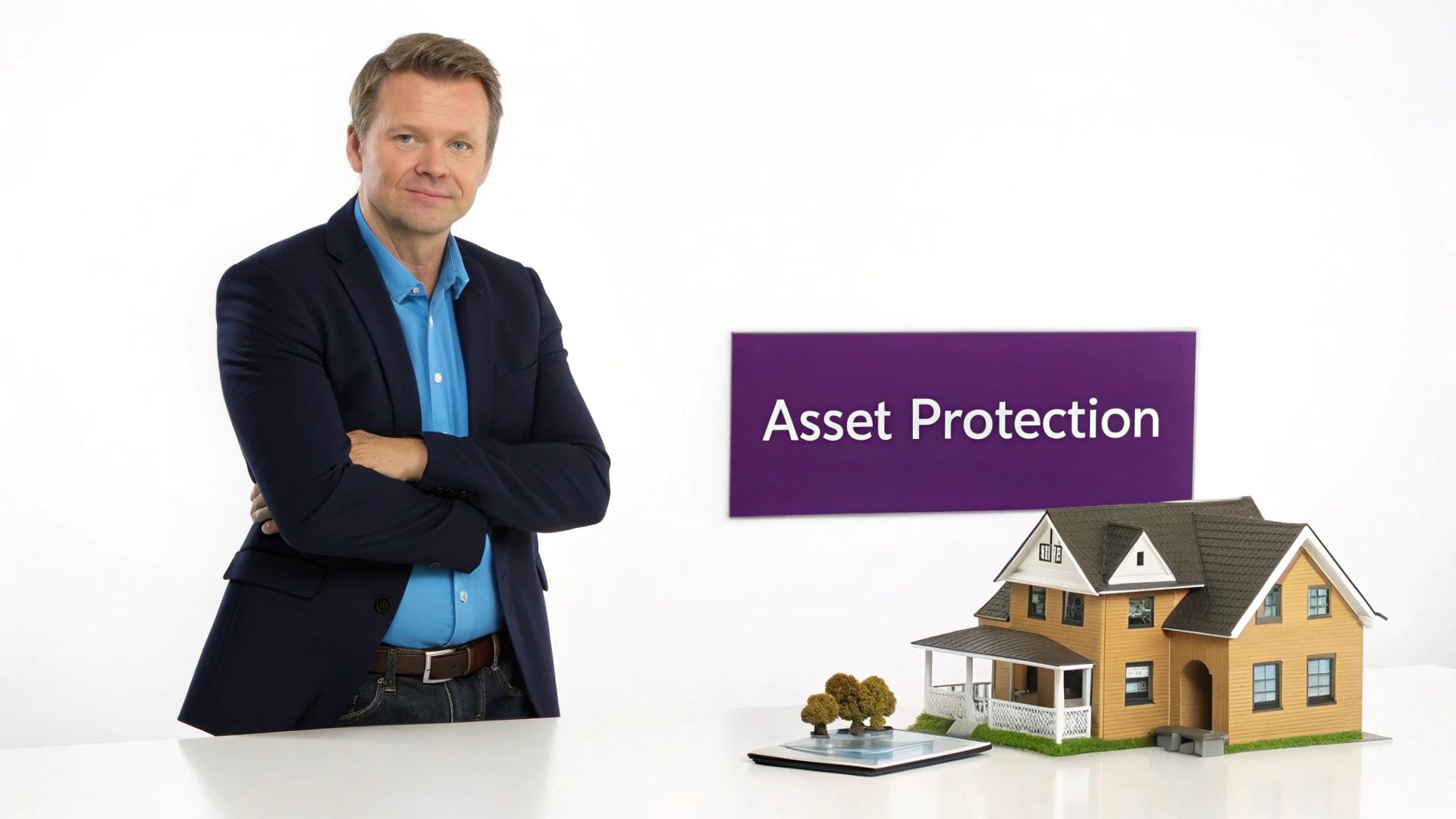
Starting any business comes with a mix of excitement and risk. The Limited Liability Company (LLC) structure is specifically designed to manage that risk by limiting your personal financial exposure. It effectively creates a new “legal person” in the eyes of the law, totally separate from its owners, who are known as shareholders.
This is the LLC’s superpower. Let’s say your business needs to take out a loan or, in a worst-case scenario, faces a lawsuit. With an LLC, only the company’s assets are on the line. Creditors can’t come after your personal belongings. This gives you a secure foundation to grow, allowing you to take calculated risks without putting your family’s financial future in jeopardy.
Core Features of a UAE LLC
The appeal of a UAE LLC isn’t just about asset protection. It also offers a powerful combination of operational freedom and market credibility that other setups just can’t match.
Here’s a breakdown of what makes it stand out:
- Separate Legal Identity: Your company can own property, sign contracts, and even sue or be sued, all under its own name.
- Limited Liability for Shareholders: As a shareholder, the most you can ever lose is the amount you’ve invested in the company’s shares. Nothing more.
- Enhanced Credibility: An LLC signals stability. Banks, suppliers, and government agencies tend to see LLCs as more professional and reliable than sole proprietorships, which makes everything from opening a corporate bank account to securing credit much smoother.
- Operational Flexibility: The LLC structure unlocks a massive range of business activities, especially on the UAE mainland, giving you direct access to the entire local market.
An LLC is far more than a piece of paper. It’s a strategic move that tells the market you’re serious and here for the long haul. It offers the peace of mind entrepreneurs need to stop worrying about personal risk and start focusing on innovation and growth.
Why Is the LLC the Go-To Choice?
There’s a very good reason the LLC is the default choice for so many. In fact, around 70% of all businesses in the UAE are registered as LLCs. That figure alone speaks volumes about its suitability for both Emirati nationals and international investors.
Recent legal changes have made it even more compelling. Not long ago, foreign investors setting up on the mainland were restricted to owning just 49% of their company. Thanks to amendments in the UAE Commercial Companies Law, that cap has been lifted. Now, 100% foreign ownership is possible for the vast majority of business activities, opening the floodgates for global entrepreneurs.
It’s vital to grasp not just the benefits but also the finer points. When setting up your company, you should be clear on everything from the nuances of establishing a business in the UAE by reading this guide to understanding the limits of liability, such as when the corporate veil might be pierced.
Choosing Your Jurisdiction: Mainland vs. Free Zone
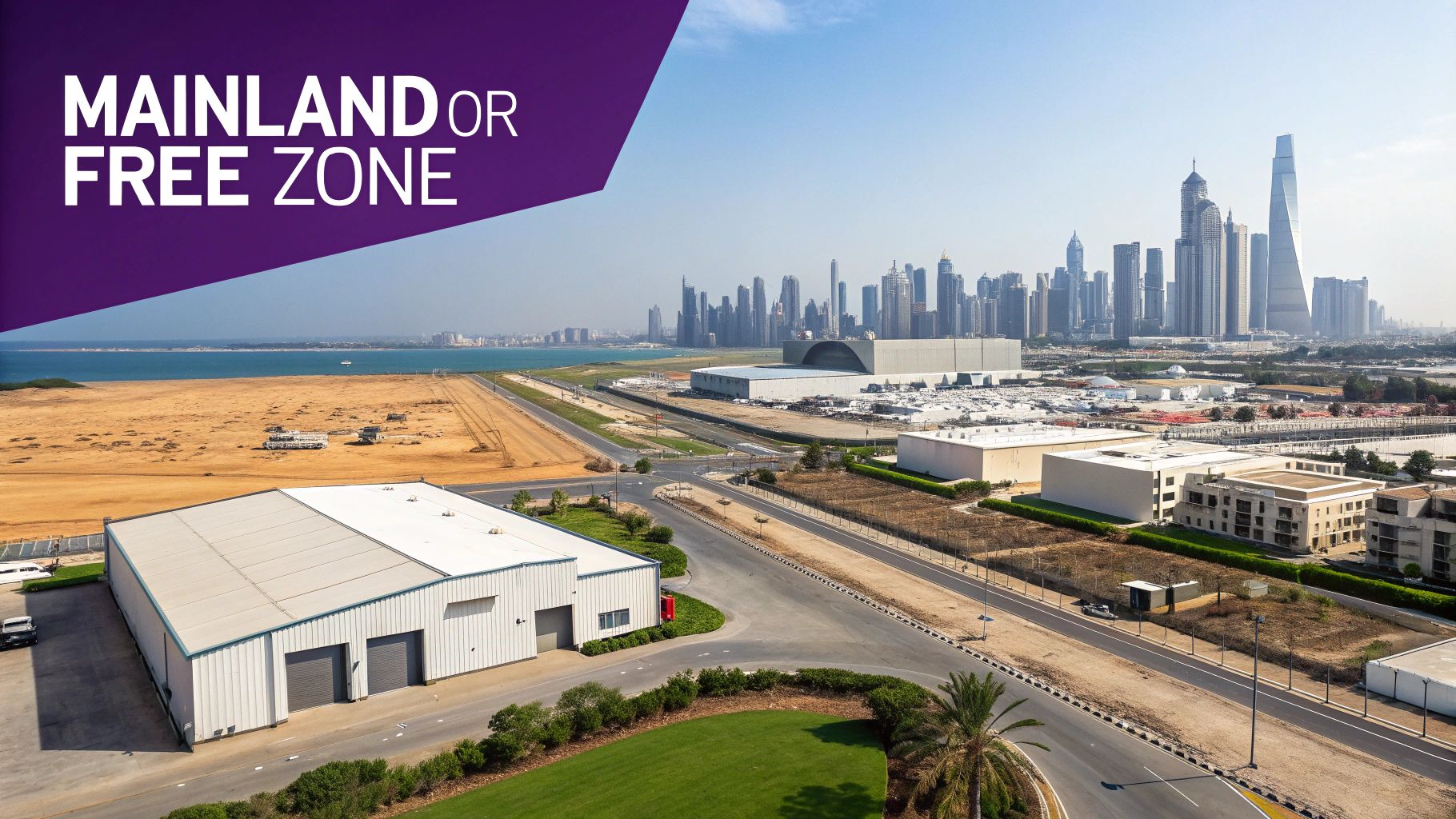
So, you’ve decided an LLC is the right move for your business in the UAE. Fantastic. Now comes the next big question, and it’s a crucial one: where will your company be based? This isn’t just about picking an office location; it fundamentally defines who you can do business with, where you can operate, and the rules of the game you’ll be playing by.
In the UAE, your choice really comes down to two paths: setting up on the Mainland or in a Free Zone.
Think of a Mainland LLC as having an all-access pass to the entire UAE economy. It’s the classic, go-anywhere business structure. You can set up shop in any emirate, trade directly with any customer or company in the country, and even bid for those lucrative government contracts. If your business model involves a café, a local retail brand, or any service targeting the domestic market, the Mainland is almost certainly where you need to be.
On the other hand, a Free Zone LLC operates within a specific, designated economic area. Picture it as a specialised business park with its own regulator and rules, often built to foster a particular industry like tech, media, or logistics. These zones are designed to attract foreign investment with some serious perks, but the trade-off is that their business activities are generally restricted to within the zone or for international trade.
A Deeper Look at Ownership and Operations
Getting into the nuts and bolts of ownership and daily operations is where you’ll really see the differences between these two options. While recent legal changes now allow for 100% foreign ownership for most Mainland businesses, the unique advantages of Free Zones still make them a powerful magnet for international entrepreneurs.
The headline benefit of a Free Zone has always been its straightforward guarantee of 100% foreign ownership, no questions asked. They also typically offer faster, more streamlined setup procedures and exemptions from customs duties, which is a massive plus for businesses involved in import and export. The catch? If you want to sell your products directly to customers on the UAE mainland, you can’t just open a storefront; you’ll need to work with a local distributor, which adds another layer of cost and complexity.
Mainland companies are registered with the Department of Economic Development (DED) in their respective emirate. They give you the ultimate freedom to operate anywhere within the UAE’s domestic market. This structure requires a physical office space and full adherence to UAE federal laws. While the initial setup might feel a bit more hands-on compared to a Free Zone, the direct market access it provides is non-negotiable for many business models.
Choosing your jurisdiction isn’t just a logistical step; it’s a strategic one. Your decision will directly impact your customer reach, growth potential, and long-term operational costs. It’s about aligning your business model with the right legal and economic environment from day one.
UAE LLC Comparison: Mainland vs. Free Zone
To really crystallise this decision, let’s put the core features side-by-side. This table breaks down the fundamental differences between setting up on the Mainland versus in a Free Zone, helping you see which route truly aligns with your business goals.
| Feature | Mainland LLC | Free Zone LLC |
|---|---|---|
| Scope of Business | Unrestricted trade across the entire UAE | Limited to the Free Zone and international markets |
| Ownership | 100% foreign ownership for most activities | Guaranteed 100% foreign ownership |
| Office Space | Mandatory physical office requirement | Often offers flexible desk or virtual office options |
| Government Tenders | Eligible to bid on government contracts | Not eligible to bid on government contracts |
| Regulatory Body | Department of Economic Development (DED) | Specific Free Zone Authority (e.g., DMCC, JAFZA) |
| Visa Eligibility | Based on office size and business activity | Often tied to the business package chosen |
| Tax Benefits | Subject to standard UAE corporate tax and VAT | Often offers corporate tax exemptions on certain income |
Ultimately, the right choice boils down to your vision. If you’re planning to serve the local UAE population directly, a Mainland LLC is the clear winner. But if your focus is on international trade, regional distribution, or a niche industry that a specific zone caters to, a Free Zone company offers distinct advantages that are tough to overlook.
Your Step-By-Step LLC Formation Roadmap
Setting up a Limited Liability Company in the UAE isn’t a single event; it’s a journey with a clear, structured path. While it demands a sharp eye for detail, understanding the sequence of events makes the whole thing far less intimidating. Think of it like building a house – you need a solid foundation before the walls go up. This roadmap will walk you through each critical phase, ensuring you tick every legal box along the way.
But here’s a pro tip: the real first step doesn’t involve any paperwork at all. It starts with your vision. Before you even think about legal forms, you need a solid session of strategic planning for your small business to nail down its mission and goals. This clarity will guide every decision you make later, from picking a trade name to defining your services.
Once your strategy is set, you can get down to the official process. This guide is specifically for a Mainland LLC, which means your main point of contact will be the Department of Economic Development (DED) in your emirate of choice.
Step 1: Pinpoint Your Business Activities and Legal Form
First things first, you need to decide exactly what your business will do. The DED has a list of over 2,000 approved business activities, and your choice here is huge. It determines whether you get a commercial, professional, or industrial licence and flags if you need special approvals from other government bodies (like the Health Authority or a media council).
After you’ve locked in your activities, you officially confirm your legal structure as a Limited Liability Company (LLC). This is the cornerstone of your entire setup.
Step 2: Reserve Your Trade Name
Your company’s name is its identity, and the UAE has strict rules about it. Get this wrong, and your application will bounce. Your name can’t violate public morals, include religious language, or be a carbon copy of an existing company’s name.
You’ll submit your proposed name to the DED for approval. Once they give it the green light, the name is reserved for you, so no one else can grab it while you’re getting the rest of your documents in order.
Step 3: Get the Initial Approval
The next big milestone is getting an Initial Approval Certificate. This is basically the UAE authorities giving you a preliminary nod, confirming they have no objection to your business being established. It’s the key that unlocks the next steps, like drafting legal documents and signing an office lease.
To get it, you’ll submit an application with the shareholders’ passport and visa copies. This approval is your formal ticket to the next stage of setting up your limited liability company uae.
Think of the Initial Approval as an ‘approval in principle.’ It doesn’t mean you can start trading, but it confirms your business idea and shareholders are acceptable. It’s the official go-ahead to start spending real money on the next steps.
Step 4: Draft and Notarise Your Memorandum of Association
The Memorandum of Association (MOA) is your LLC’s constitution. It’s the rulebook, laying out everything from the company’s objectives and share capital to how profits and losses are split and who is responsible for what. For an LLC, this document has to be drafted in both Arabic and English.
Once it’s drafted, all shareholders must sign the MOA in front of a Notary Public here in the UAE. This is a non-negotiable step that legally cements the agreement between all partners.
Step 5: Secure a Physical Office and Your Tenancy Contract
Every Mainland LLC in the UAE needs a physical address. A virtual office just won’t cut it. You must lease a commercial space and get an official tenancy contract, which is then registered with Ejari (the government’s online rental registration system).
This registered tenancy contract is your proof of address and is an absolute must-have for your final licence application. This is a key difference from many Free Zone setups, which often allow for more flexible desk arrangements.
Step 6: Get Your Hands on the Trade Licence
This is the final hurdle. With everything else in place, you’ll submit your complete file to the DED. This package will include:
- The Initial Approval Certificate
- A copy of the notarised MOA
- Passport copies for all shareholders
- The registered tenancy contract (Ejari)
- Any extra approvals needed for your specific business activities
The DED will review everything. If it all checks out, they’ll issue a payment voucher for the licence fees. Once you’ve paid, they’ll hand over your official Trade Licence. At that moment, your limited liability company uae is officially and legally open for business.
Getting to Grips with the Paperwork and Costs
Let’s be honest: no one enjoys surprise costs, especially when you’re pouring your energy into a new business venture. Getting a crystal-clear picture of the documents and fees for your limited liability company in the UAE isn’t just helpful—it’s essential for smart budgeting and a smooth launch. When you know exactly what to expect financially, you can plan with confidence.
Before the Department of Economic Development (DED) hands over your trade licence, you’ll need to pull together a file of essential documents. Think of it as preparing your business’s official introduction; each paper validates who you are, what you do, and where you’ll be doing it. One missing document can put the brakes on the whole process.
The Must-Have Document Checklist
While there can be minor differences from one emirate to another, the core documents you’ll need for a Mainland LLC are fairly standard. Having these ready to go from the start will save you a world of time and hassle.
- Passport Copies for Shareholders: You’ll need a clear, valid copy of the passport for every shareholder and the company’s designated manager.
- Initial Approval Certificate: This is the green light from the DED, confirming they’ve accepted your proposed trade name and business activity.
- Notarised Memorandum of Association (MOA): This is the legal foundation of your company. It needs to be signed by all shareholders and officially stamped by a public notary.
- Registered Tenancy Contract (Ejari): For a Mainland company, a physical office is a must. The Ejari serves as official proof of your registered business address.
This infographic lays out the key milestones, giving you a bird’s-eye view of where the paperwork fits into the bigger picture.
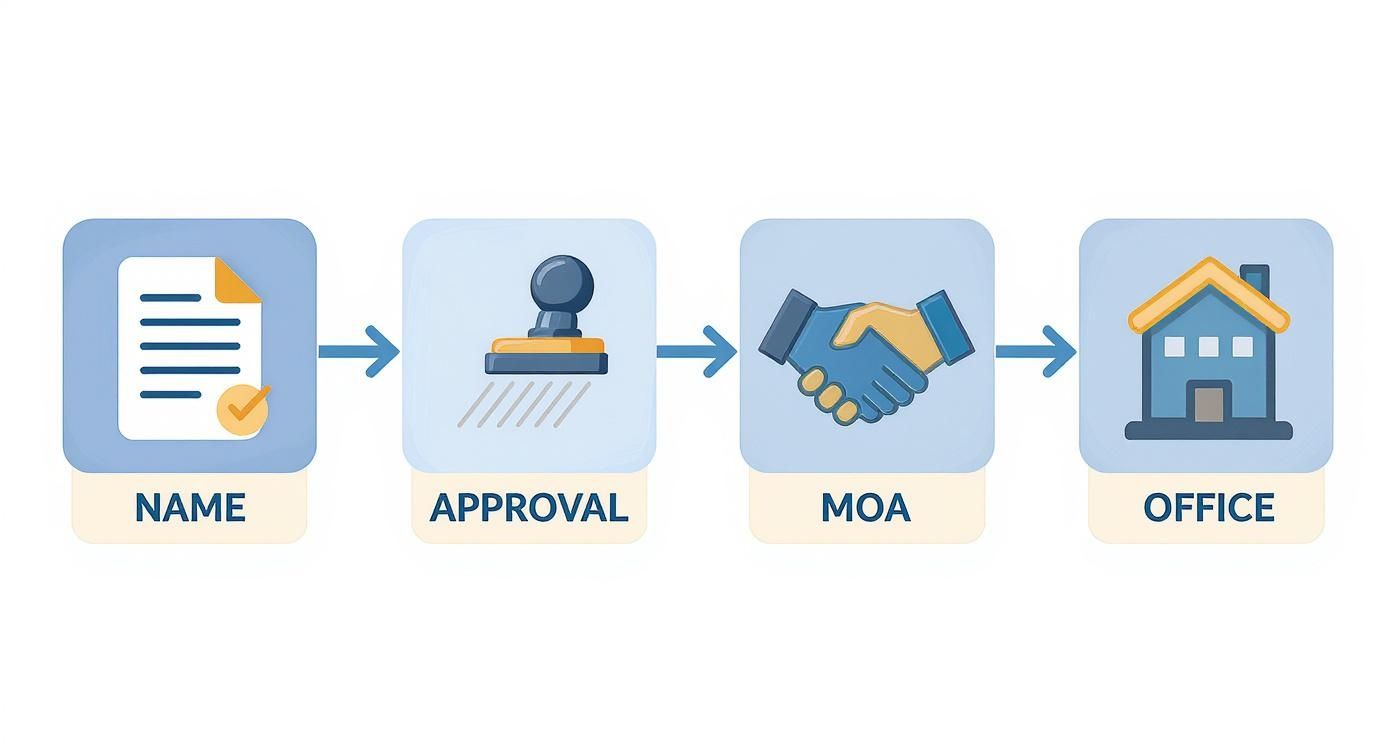
As you can see, getting your initial approvals and legal agreements sorted is the first order of business, even before you finalise your office space and get the licence itself.
A Realistic Look at the Setup Costs
The total investment to get your LLC up and running isn’t just one single payment. It’s a collection of various government and service fees. A good rule of thumb is to budget between AED 20,000 and AED 30,000, but keep in mind this figure can shift depending on your specific business activity, office size, and other choices.
Here’s what those costs typically cover:
- Trade Licence Fees: The primary government charge for your licence. The amount depends heavily on the type of commercial activity you’ll be conducting.
- Trade Name Reservation: A fee paid to the DED to secure your chosen company name.
- Initial Approval Fee: This covers the DED’s review and issuance of your initial approval to proceed.
- MOA Notarisation Fees: The cost to have a public notary officially witness and attest your Memorandum of Association.
- Office Rental and Ejari: This includes your annual office rent plus the government fee for registering the tenancy contract.
- Market Fees: In some emirates, you’ll find a small “market fee,” which is usually calculated as a percentage of your office rent.
Knowing the full cost landscape is non-negotiable. The smartest move you can make is to create a detailed budget that accounts for every one-off government fee and recurring expense like rent. This foresight helps you avoid cash flow problems during those crucial first months.
While the process is well-defined, going it alone can feel overwhelming. This is where partnering with a corporate services provider really pays off. As specialists in Mainland Company Formation in Dubai & Abu Dhabi and Freezone Company Formation across the UAE, we take the guesswork out of the equation. We provide cost-effective business setup solutions tailored to your needs, ensuring everything is done right the first time. With our 24/7 support service, we’re always here when you need us.
Navigating Tax and Compliance Obligations
Getting your trade licence is a huge milestone, but it’s really just the starting line. Once your limited liability company uae is officially born, your focus has to shift from setting it up to keeping it running smoothly. This is where the world of ongoing compliance, tax duties, and other regulatory tasks comes into play, and it’s absolutely critical for the long-term health of your business.
Think of your trade licence as a passport. It gives you the right to operate, but you still have to follow the local laws. For an LLC in the UAE, this means a steady rhythm of renewals, reporting, and staying on the right side of various legal frameworks. Letting these things slide can lead to hefty fines, disruptions to your operations, and a black mark on your company’s name. Staying on top of these responsibilities isn’t just “good practice”—it’s the foundation of a successful business in the Emirates.
Core Compliance Your LLC Must Manage
Beyond the initial flurry of paperwork, there are several key responsibilities that will need your attention every single year. These are the non-negotiables that keep your company in good standing with the authorities.
- Annual Trade Licence Renewal: Your licence isn’t a one-and-done deal; it has to be renewed annually. This involves submitting updated documents, like your office tenancy contract (Ejari), and paying the renewal fees to the Department of Economic Development (DED).
- Adherence to Labour Laws: If you have staff, you are bound by the UAE Labour Law. This covers everything from issuing proper contracts and complying with the wage protection system (WPS) to managing visa sponsorships and calculating end-of-service benefits.
- Ultimate Beneficial Owner (UBO) Registration: Every company is required to keep a register of its ultimate beneficial owners and report this information to the authorities. It’s a key transparency measure in the UAE’s fight against money laundering.
Missing your licence renewal deadline can trigger fines and could even get your company’s bank account frozen. It’s easily one of the most critical annual tasks on your checklist.
Understanding the UAE Corporate Tax Landscape
The business environment in the UAE has gone through a massive change. The introduction of corporate tax on 1 June 2023, has completely redrawn the map for financial compliance. A federal corporate tax of 9% now applies to the taxable profits of UAE businesses that exceed AED 375,000 a year. This isn’t a minor tweak; recent research shows 94% of businesses in the UAE have seen their compliance challenges grow since it came in. You can explore the full impact of UAE corporate tax regulations to get a deeper sense of these changes.
On top of that, the 5% Value Added Tax (VAT) is still very much in play. Your business must register for VAT with the Federal Tax Authority (FTA) if your taxable supplies and imports cross the mandatory threshold of AED 375,000 annually. You also have the option to register voluntarily if your turnover is over AED 187,500.
The days of treating bookkeeping as an afterthought are long gone. With corporate tax and VAT now firmly in place, keeping meticulous, accurate, and up-to-date financial records is no longer a choice—it’s a legal requirement. These records are the foundation for your tax filings and can be audited by the FTA at any time.
The Critical Role of Proper Bookkeeping
In this new tax-focused environment, solid accounting practices are your best defence. Good bookkeeping isn’t just about filing accurate tax returns; it’s about having the financial clarity to make smart business decisions.
Your books should paint a clear picture of:
- All your income and revenue sources.
- Every single business expense, backed up by an invoice or receipt.
- All company assets and liabilities.
Keeping these records in order helps you calculate your taxable income correctly, claim all the deductions you’re entitled to, and ensure you’re paying exactly the right amount of tax. Investing in professional accounting help or software from the very beginning can save you from major headaches and potential fines down the road. As the best corporate service provider in Dubai, Abu Dhabi & Sharjah, we provide cost-effective solutions to help you enjoy UAE tax benefits for international entrepreneurs. With our 24/7 support, you’re never on your own.
So, Should You Go It Alone or Partner With an Expert?
You can navigate the process of setting up a limited liability company in the UAE by yourself, but the real question is—should you? The path from picking a jurisdiction to staying on top of tax compliance is riddled with potential traps. A single misstep can easily lead to frustrating delays and unexpected costs. This is where partnering with a corporate service provider can make all the difference, turning a daunting task into a manageable one.
Think of an expert partner as your local guide. They know the terrain, speak the language of bureaucracy, and make sure every form is filed correctly and every deadline is hit. Their deep-seated knowledge of both Mainland and Free Zone setups is crucial in helping you choose the right foundation for your business—avoiding common mistakes that could trip you up before you even get started.
Get to Market Faster and Stay Compliant
Working with a specialist is more than a convenience; it’s a strategic move. Instead of getting bogged down for weeks trying to interpret complex regulations, you can pour that energy into what you do best: building your business. A dedicated team will handle the administrative hurdles for you, from securing initial approvals to sorting out visas.
Handing over the setup to a professional isn’t just buying a service. It’s an investment in your own peace of mind and a faster launch. Your partner ensures you’re perfectly positioned to take full advantage of UAE tax benefits while staying 100% compliant from day one.
As specialists in company formation across Dubai, Abu Dhabi, and Sharjah, we offer:
✅ The best corporate service in Dubai, Abu Dhabi & Sharjah
✅ Expertise in Mainland & Freezone Company Formation
✅ Cost-effective business setup solutions tailored to your needs
✅ 24/7 support service – we’re always here when you need us
✅ Guidance to help you enjoy UAE tax benefits for entrepreneurs
Ready to get started the smart way?
📞 Call Us Now: +971-52 923 1246
💬 WhatsApp Us Today for a Free Consultation
Common Questions About Setting Up an LLC in the UAE
When you’re looking to set up a limited liability company in the UAE, a lot of questions pop up. It’s completely normal, especially if this is your first venture in the region. Getting straight answers is the first step to making your business a reality.
We’ve helped countless entrepreneurs get started, and we find the same key questions come up time and again. Here are the clear, simple answers you need to get moving.
Can a Foreigner Really Own 100% of a UAE LLC?
Yes, absolutely. For most business activities on the mainland, a foreign investor can now own 100% of their LLC. This is a game-changer. Gone are the old days of needing a local Emirati partner to hold a 51% stake. The law changed, opening the doors wide for international entrepreneurs to have full control.
Of course, there are a few exceptions. Certain strategic sectors, like oil and gas, still have specific ownership rules. But for the vast majority of businesses—from tech startups to consulting firms—full foreign ownership is now the standard.
Do I Have to Live in the UAE to Own an LLC?
Not at all. You can own a limited liability company in the UAE from anywhere in the world. It’s one of the big draws for international investors who want a foothold in the market without needing to relocate immediately.
That said, while you don’t need to live here, your business does. Every LLC needs a registered physical office address in the UAE. Many business owners also find that getting a UAE residence visa through their company makes things like opening a bank account and travelling much easier.
What’s the Real Cost to Set Up an LLC in the UAE?
You should budget somewhere between AED 20,000 and AED 30,000 for the total setup cost. It’s important to understand this isn’t just one single fee; it’s a collection of different payments made at various stages of the process.
Here’s a rough breakdown of what that figure covers:
- Trade Licence Fees: This is the main government fee for your specific business activity.
- Initial Approval & Name Reservation: These are administrative fees paid to the relevant economic department.
- MOA Notarisation: The cost of having your company’s Memorandum of Association officially attested.
- Office Lease & Ejari: The rent for your physical office space and the cost of registering the tenancy contract.
As business setup specialists, we can give you a crystal-clear quote with no hidden surprises, tailored exactly to what your business needs.
Partnering with the best corporate service provider in Dubai, Abu Dhabi & Sharjah turns a potentially confusing process into a straightforward one. We are specialists in Mainland Company Formation in Dubai & Abu Dhabi and Freezone Company Formation across the UAE. With our 24/7 support service, we build your business on a solid foundation, so you can focus on what you do best: growing it. Let us handle the complexities for you.