

When you start a job in the UAE, the employment contract you sign is more than just a piece of paper. It’s the single most important document that will shape your entire professional life here. Think of it as the legal blueprint for your role—it lays out your rights, your duties, and what you’ll be paid. A solid contract is the bedrock of a secure and successful career in the Emirates.
The Foundation of Your Career in the UAE
Your journey in the UAE’s professional world truly begins the moment you sign your UAE employment contract. This isn't just a formality; it's a legally binding agreement governed by UAE Labour Law, and it acts as the cornerstone of the relationship between you and your employer. Everything from your salary and working hours to your end-of-service benefits is detailed within its clauses, which is why it's crucial to understand exactly what you're agreeing to.
This guide will break it all down for you, turning dense legal jargon into clear, practical information. Whether you're an employee about to accept a new position or an employer drawing up a new agreement, getting this right from the start protects your rights and clarifies your obligations.
Why Your Contract Matters More Than Ever
The UAE Labour Law has seen some significant updates recently, with a much stronger emphasis on employee rights and the responsibilities of employers. These changes directly affect how employment contracts are written and enforced, making precise drafting and full compliance more critical than ever. For example, the window for filing employment-related claims has been extended to two years, giving employees a longer period to address any issues.
This evolving legal landscape highlights just how important a well-prepared contract is. For businesses, this often means working with specialists in Mainland Company Formation in Dubai & Abu Dhabi or Freezone setups to ensure every single agreement is up to code.
A well-structured contract does more than just tick the legal boxes. It fosters a relationship built on trust and transparency, paving the way for a successful and long-term partnership for both sides.
Building Your Career on a Solid Legal Footing
Your employment contract is a major milestone. It not only marks the official beginning of your new role but also governs your entire journey with the company. Understanding the complete Employee Life Cycle, from the initial recruitment phase all the way to your exit, helps you navigate your career with confidence and stay compliant.
For employers, especially international entrepreneurs eager to enjoy UAE tax benefits, getting this right is non-negotiable. Partnering with the Best Corporate Service Provider in Dubai, Abu Dhabi & Sharjah is a smart, cost-effective way to guarantee compliance from day one. With 24/7 support service, you'll have peace of mind knowing you’re always here when you need us.
Ready to build your business or career on a compliant foundation? 💬 WhatsApp Us Today for a Free Consultation or 📞 Call Us Now: +971-52 923 1246.
The Legal Framework That Governs Your Contract
To really get to grips with your UAE employment contract, you first need to understand the laws that give it its teeth. Every single contract, whether you're working on the mainland or in most free zones, is built on a very specific legal foundation. Think of it as the blueprint that ensures fairness, clarity, and protection for everyone involved—both the company and you.

The cornerstone of employment law in the UAE is Federal Decree-Law No. 33 of 2021. This law is a big deal. It updated the old rules to bring in more flexible ways of working and stronger protections, reflecting just how fast the country's economy is moving. When it comes to your rights at work, this law is the ultimate source of truth.
The Legal Pyramid of Employment
A good way to picture the UAE's employment laws is to think of a pyramid. Right at the very top, you have the main Federal Law.
- The Federal Law: This is the big one—Federal Decree-Law No. 33. It sets out all the core rights and duties, from working hours and leave entitlements to how and when a contract can be ended.
- Ministerial Resolutions: Just below the Federal Law, you’ll find resolutions from the Ministry of Human Resources and Emiratisation (MOHRE). These fill in the practical details. For example, while the law might say you need a work permit, a resolution will explain the exact step-by-step process for getting one.
- Your Contract: At the base of the pyramid is your personal employment contract. This is where the pyramid structure is so important: your contract must always follow the rules set by the Federal Law and its resolutions. It can offer you more than the law requires, but it can never offer you less.
This hierarchy makes sure every UAE employment contract meets a single national standard, so protections are consistent across the board. While the UAE has its own specific regulations, it's also helpful to have a handle on the general principles of employment law and compliance that shape good working relationships everywhere.
MOHRE Contract vs. Company Offer Letter: The Dual Contract System
When you land a job in the UAE, you'll almost certainly see two documents: a company offer letter and the official MOHRE contract. It's absolutely crucial to know the difference.
The offer letter from the company is usually more detailed. It might talk about things like company-specific policies, performance bonuses, or who you report to. However, the MOHRE contract is the one that truly matters in the eyes of the law. It’s the official, legally binding document registered with the government.
In any dispute, the terms in the official, MOHRE-registered UAE employment contract will almost always win out over an internal company offer letter. If there’s a contradiction, the UAE Labour Courts will enforce the MOHRE contract, period.
The government is serious about compliance, and employers who get it wrong face hefty penalties. This includes making sure every employee has a valid work permit and that all their financial dues are settled, especially when a business is sold or restructured.
This strict legal framework is there to protect your rights. For businesses, getting this right from day one is non-negotiable. It’s why many entrepreneurs, especially those leveraging specialists in Mainland Company Formation in Dubai & Abu Dhabi or specialists in Freezone Company Formation across the UAE, find that expert guidance is the smartest way to ensure full compliance from the start.
Decoding the Types of UAE Employment Contracts
When you're working in the UAE, the type of employment contract you sign isn't just a piece of paper—it's the blueprint for your entire professional relationship. Not all contracts are the same, and the law provides a few different models to fit various work situations. Knowing which UAE employment contract you have is crucial, as it dictates the flexibility, security, and obligations for both you and your employer.
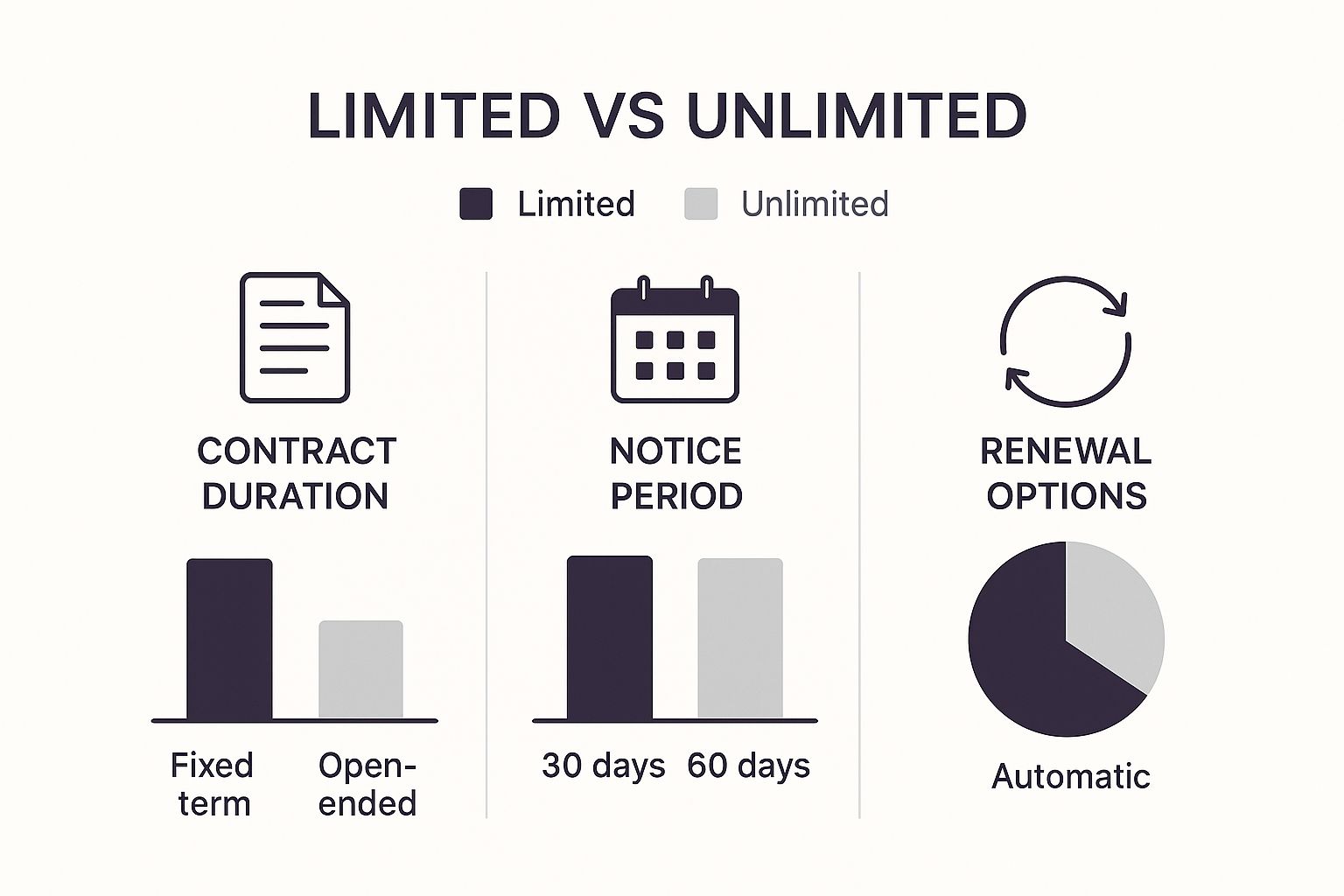
The go-to model, and now the standard for nearly everyone, is the limited-term contract. Think of it like a lease on an apartment; it has a clear start and a definite end date. This structure provides a sense of predictability right from the get-go, so everyone knows where they stand.
This built-in expiry date is what defines the relationship. When the term is up, you and your employer can shake hands and renew it, or simply let it conclude. The employment ends naturally without needing a specific reason, other than the contract reaching its finish line. You'll find this model used everywhere, from the financial hubs of DIFC to the retail shops in the malls.
The Standard: The Limited-Term Contract Explained
Under the current UAE Labour Law, the limited-term contract is the default choice. It’s designed to provide a solid framework for a specific job, project, or period of work. The defining feature is that the duration is spelled out right there in the agreement, leaving very little room for ambiguity.
So, what does this look like in the real world?
- A Defined End Date: Your contract has a specific start and end date. This brings a level of certainty for both the business's planning and your own career path.
- Renewal Is a Choice: The contract doesn't just roll over automatically. To keep the working relationship going, both you and your employer must actively agree to and sign a new contract or a renewal addendum.
- A Clean Finish: When the contract term ends, it simply expires. This is very different from ending a contract early, which involves specific notice periods and potential financial penalties.
The move to a single, unified limited-term contract model was a significant shift in the UAE Labour Law. The goal was to build a more stable and transparent job market by standardising how contracts are managed, renewed, and concluded.
A New Era of Flexibility: Exploring Modern Work Models
The world of work has changed, and the law has changed with it. Recognising that not every job fits the traditional 9-to-5 mould, the UAE introduced several flexible work models. These are designed to accommodate non-traditional arrangements, giving both businesses and talented professionals more freedom to connect.
These models are a real asset for companies that need specific expertise for a short time—like those navigating a Mainland Company Formation in Dubai & Abu Dhabi—and for individuals looking for a healthier work-life balance.
Let's break down the most common flexible options:
- Part-Time Work: This is pretty straightforward—it’s for anyone working fewer hours than a standard full-time employee. For instance, a small business might hire a marketing expert for 15-20 hours a week on a part-time contract. In this case, their salary and leave are calculated pro-rata, meaning they’re proportional to the hours they put in compared to a full-timer.
- Temporary Work: Perfect for projects with a short, defined lifespan, usually under a year. Imagine a company bringing on an IT specialist for a six-month system upgrade. A temporary contract is the perfect fit for that kind of specific, time-bound task.
- Flexible Work: This is one of the more modern options. It gives an employee variable working hours or days that shift based on the company's workload. It’s all about adaptability, making it a great choice for industries like events or hospitality where demand can spike and dip unpredictably.
Essential Clauses You Absolutely Must Understand
Once you have your specific type of UAE employment contract in hand, it’s time to zoom in on the fine print. This is where the core agreements that define your day-to-day work life and long-term financial security are spelled out. Getting a firm grip on these clauses isn't just a good idea; it's absolutely essential.
Think of your contract as a blueprint for your professional relationship. To avoid any unwelcome surprises down the line, you need to understand every detail of that blueprint. Let's break down these crucial components, one by one, into plain English.
The Probation Period
The probation period is your initial trial run. It’s a legally defined timeframe at the start of your job where both you and your employer get to see if it’s a good fit. UAE Labour Law is very clear on how this works.
By law, your probation can't go on for more than six months. During this window, the rules for ending the contract are a bit different. If your employer wants to let you go, they must give you 14 days' written notice. If you decide to leave to take another job in the UAE, you need to provide 30 days' notice. Planning on leaving the country altogether? A 14-day notice is required from your side.
What to Watch For: Make sure you know the exact start and end dates of your probation. This trial period is a one-time deal with an employer. It can’t be extended or reset, even if you get a promotion or move to a new role within the same company.
Salary and Allowances
Your salary is more than just a single number; it's typically broken down into a basic salary and various allowances. This distinction is one of the most important things to get right in your contract.
The basic salary is the core component of your pay. Allowances are the extras, like payments for housing, transport, or children's education. A generous allowance package can look great and will certainly boost your monthly take-home pay, but there's a critical catch: your end-of-service gratuity is calculated based only on your basic salary.
The average monthly salary in the UAE is a competitive AED 13,450 (about US$3,663), putting it at the top in the Gulf region. While health insurance and gratuity are legally required, many companies also offer housing, transport, and education allowances to attract talent. You can find more salary data for the UAE on Expatica.com.
The Notice Period
The notice period is the amount of time either you or your employer must give before ending the employment relationship after the probation period is over. This clause ensures a smooth and professional transition, preventing sudden departures that could disrupt the business or leave an employee high and dry.
The rules are straightforward:
- The legal minimum notice period is 30 days.
- The legal maximum is 90 days.
Your specific notice period will be stated clearly in your contract. It's vital to honour this commitment to avoid legal trouble or financial penalties. If you try to leave without serving the full notice, your employer could file a claim against you for compensation.
To clarify the difference between the rules during probation and a standard notice period, let's look at them side-by-side.
Probation Period vs. Notice Period: A Clear Comparison
This table breaks down the distinct rules, rights, and obligations for both you and your employer during these two very different phases of employment.
| Aspect | Probation Period | Notice Period |
|---|---|---|
| Purpose | An initial trial to assess the suitability of the employee and the role. | A formal transition period for ending the employment contract after probation. |
| Duration | A maximum of 6 months. Cannot be extended. | Between 30 and 90 days, as specified in the contract. |
| Employer Termination Notice | Minimum 14 days' written notice. | The full period stated in the contract (e.g., 30, 60, or 90 days). |
| Employee Resignation Notice (to join a new UAE employer) | Minimum 30 days' written notice. | The full period stated in the contract. |
| Employee Resignation Notice (to leave the UAE) | Minimum 14 days' written notice. | The full period stated in the contract. |
| Gratuity Entitlement | No gratuity is paid if termination occurs during probation. | Full gratuity is calculated and paid upon successful completion of service. |
As you can see, the probation period has its own unique set of rules designed for flexibility at the start of a job, while the standard notice period provides more stability for a planned exit.
End-of-Service Gratuity
Your end-of-service gratuity is a lump-sum payment you receive when you leave your job. Think of it as a mandatory 'thank you' bonus for your service and loyalty. It's a cornerstone of the UAE Labour Law and a right for almost every expatriate employee.
The amount you receive is calculated based on your last-drawn basic salary and your total length of service. The formula is:
- 21 days of basic salary for each of your first five years of service.
- 30 days of basic salary for each year of service after the fifth year.
What to Watch For: The total gratuity payment cannot be more than two years' full salary. It’s absolutely critical to remember this is tied to your basic salary. A contract with a low basic salary and high allowances will mean a much smaller gratuity payment. Paying close attention to these details helps you understand the true long-term financial value of your UAE employment contract.
Navigating Resignation and Termination Correctly
Ending a professional relationship is a significant step, and in the UAE, it's a process governed by very clear rules. Whether you're the one deciding to move on or it's your employer's decision, handling the end of your UAE employment contract properly is crucial. This isn't just about being professional; it’s about protecting your legal rights and ensuring you receive every dirham you're owed.

This process is something many people in the Emirates will go through. While the job market is buzzing with new opportunities, it also sees a lot of movement. In fact, nearly two-thirds of employees anticipate changing jobs within a year, often chasing better salaries to keep up with economic pressures. If you want to dive deeper into these trends, you can discover more insights about the UAE job market on DITRC.com. This high turnover rate makes it more important than ever for everyone to understand the right way to say goodbye.
The Employee Resignation Process
So, you've decided to leave your job. You can't just tell your manager you're not coming in tomorrow. There's a formal procedure you have to follow.
- Put it in Writing: First things first, you need to submit a formal resignation letter or email. This isn't just a courtesy; it's a legal necessity that creates a clear record of when you gave notice.
- Serve Your Notice Period: Check your employment contract. It will specify a notice period, which is usually between 30 and 90 days. You're legally required to work through this entire period unless you and your employer both agree in writing to shorten or waive it.
Skipping these steps can land you in hot water. If your sudden exit causes business losses, your employer could potentially file a claim against you for compensation. It’s always best to follow the rules.
Employer-Initiated Termination
Employers also have a strict set of rules to follow when they want to end an employment contract. The reasons for letting someone go generally fall into two categories, and each has its own legal path.
The most common way is termination with notice for a legitimate reason, like ongoing poor performance or business redundancy. In these cases, the employer must be able to prove the reason is valid and must still honour the full contractual notice period.
The other, much more serious category, is immediate dismissal without any notice.
Article 44 of the UAE Labour Law lays out a very specific list of "gross misconduct" offences. If an employee commits one of these, an employer can terminate them on the spot, without notice and without paying any end-of-service gratuity. These are serious violations that completely shatter the employment relationship.
Let's break down what counts as such a severe offence.
What Counts as Gross Misconduct?
Summary dismissal under Article 44 isn't for small mistakes or for simply not hitting your targets. It’s reserved for major breaches of conduct.
Some examples include:
- Using a false identity or providing forged documents to get the job.
- Causing a significant financial loss to the company (and the employer must report it to the authorities within seven working days).
- Ignoring critical safety instructions in a way that puts others at risk.
- Failing to perform your fundamental duties even after receiving two written warnings and undergoing a formal investigation.
- Leaking confidential company secrets or intellectual property.
On the flip side, if an employer fires you without a valid reason from Article 44, or terminates you for performance without giving proper notice, the UAE Labour Courts could rule it an arbitrary dismissal. Should the court agree, it can order the employer to pay you extra compensation.
Your Final Settlement Rights
Once your employment officially ends, you are entitled to a final settlement. This calculation is the last, critical step in closing this chapter of your career, and it needs to be completely accurate.
Your final settlement must include:
- End-of-Service Gratuity: The full gratuity payment you've earned, based on your years of service and basic salary.
- Unused Annual Leave: A cash payment for any vacation days you've accrued but haven't used.
- Repatriation Ticket: Unless you're moving directly to another job within the UAE, you're entitled to a one-way flight ticket back to your home country.
- Any Unpaid Salary: All wages owed to you right up to your last day of employment.
For businesses, particularly those navigating a Freezone Company Formation across the UAE for the first time, getting these calculations right is absolutely vital. This is where many businesses find that cost-effective business setup solutions tailored to your needs are invaluable, ensuring every step—from hiring to termination—is done by the book.
Ensuring Compliance and Getting Expert Help
Staying on the right side of UAE Labour Law isn’t something you can just set and forget. It's a continuous process that requires attention from both sides of the employment relationship. Think of it as relationship maintenance; being proactive is the secret to avoiding misunderstandings and building a foundation of trust. For employers, this means keeping meticulous records and, crucially, staying current with any changes in the law that could affect your UAE employment contract duties.
If you're an employee and something about your contract feels off, your first port of call should be a calm, professional conversation with your employer. Often, a simple chat can clear things up. If that doesn't resolve the issue, your next step is to raise the matter with the Ministry of Human Resources and Emiratisation (MOHRE).
The Value of Expert Partnership
Let's be honest, trying to master the nuances of UAE business setup and contract law on your own can be a real headache, especially if you're new to the region. This is where partnering with a specialist isn't just a convenience—it's a smart, cost-effective business setup solution tailored to your needs that ensures you're compliant from the get-go.
When you're operating across borders, you might come across the term Employer of Record (EOR). Getting to grips with what an EOR does is essential for both companies and their staff to maintain full legal compliance and keep operations running smoothly. This guide on What Is an Employer of Record breaks it down perfectly.
Whether you’re setting up shop in Mainland Dubai, expanding into a Freezone, or simply want the peace of mind that your contracts are solid, bringing in an expert is your best move for a smooth and legally sound journey.
As the Best Corporate Service Provider in Dubai, Abu Dhabi & Sharjah, we create solutions built around your unique business needs. We are specialists in Mainland Company Formation in Dubai & Abu Dhabi and specialists in Freezone Company Formation across the UAE. Our 24/7 support service means we are always here when you need us.
Secure your business and your career in the UAE. 📞 Call Us Now: +971-52 923 1246 or 💬 WhatsApp Us Today for a Free Consultation.
Frequently Asked Questions
It's natural to have questions when you're looking at a UAE employment contract. Let's walk through some of the most common ones we hear from both employees and business owners, so you can feel confident about where you stand.
Can My Employer Change My Contract Without My Consent?
In short, no. Your employer can't just decide to change the core parts of your employment contract—things like your salary, job title, or main workplace—without your clear, written agreement.
For any major change, both you and your employer need to sign an official addendum. This isn't just a handshake deal; that addendum must be formally registered with the Ministry of Human Resources and Emiratisation (MOHRE) to be legally valid. If they try to push through changes without your consent, they could be breaching the contract.
What Is the Difference Between a Mainland and Free Zone Contract?
Think of it this way: a Mainland contract is directly under the umbrella of the UAE Federal Labour Law and MOHRE. It’s the standard across the country.
A Free Zone contract, on the other hand, is issued by that specific Free Zone’s authority, like DMCC or JAFZA. While it’s still built on the foundation of the UAE Labour Law, each Free Zone might have its own unique way of handling things like sponsorship, sorting out disagreements, and general paperwork. This is precisely why it’s smart to work with specialists in Mainland Company Formation in Dubai & Abu Dhabi and specialists in Freezone Company Formation across the UAE.
At the end of the day, the fundamental protections of the Labour Law—like your gratuity and termination rights—apply everywhere. The real differences are in who manages the paperwork and some of the specific procedures you'll follow.
Is a Non-Compete Clause Enforceable in the UAE?
Yes, a non-compete clause can hold up in the UAE, but the rules are very strict. It’s not a blanket ban. For a court to consider it valid, the clause has to be reasonable and very specific about its limits.
- Duration: The restriction can't last for more than two years after your contract ends.
- Geography: It must be confined to a clear geographical area.
- Nature of Work: It has to specify the exact type of work you're not allowed to do, so it only prevents direct competition.
Crucially, your employer has to prove that the clause is truly necessary to protect their business interests. The courts look at these very closely and won't hesitate to throw one out if it seems unfair or overly restrictive.
What Happens If My Employer Fails to Pay My Salary on Time?
Not paying salaries on time is a major red flag and a serious violation of UAE Labour Law. The government's Wage Protection System (WPS) is designed specifically to track salary payments, and companies face steep penalties for being late.
If your salary isn't paid on time, you have every right to file a formal complaint with MOHRE. Just make sure you keep a record of everything—emails, messages, and any other proof of non-payment—to build a strong case.
Getting the details right on a UAE employment contract is key, and it helps to have an expert in your corner. As the Best Corporate Service Provider in Dubai, Abu Dhabi & Sharjah, we provide straightforward, cost-effective business setup solutions tailored to your needs with 24/7 support service.
Whether you're setting up on the Mainland or in a Freezone, our specialists in Mainland Company Formation in Dubai & Abu Dhabi and specialists in Freezone Company Formation across the UAE are ready to guide you and make sure everything is compliant from day one. Enjoy UAE tax benefits for international entrepreneurs.
📞 Call Us Now: +971-52 923 1246 or 💬 WhatsApp Us Today for a Free Consultation.