Before you can even think about opening a business bank account in the UAE, you'll need your essentials in order: a valid trade licence, all shareholder documents, and a business plan that actually makes sense. This isn't just another box to tick; it's the move that proves your company is a legitimate player in one of the world's most competitive markets.
As the best corporate service provider in Dubai, Abu Dhabi & Sharjah, we understand that this step is the foundation of your success.
Why a Business Account Is Your First Big Move in the UAE
Let's cut to the chase. Setting up a company in Dubai or any other emirate has its milestones, but getting that corporate bank account open is the one that truly brings your business to life. It’s what turns your trade licence from a framed document on the wall into a tool that can actually make and receive money.
Frankly, you can't operate professionally without one.
This account is the bedrock of your company's financial credibility. When you send an invoice or get paid through a corporate account, you're sending a clear message to clients, partners, and regulators: you're a serious, properly structured business. It also draws a clean line between your personal and company funds—a non-negotiable step for clean accounting, especially now that UAE corporate tax is a reality. For international entrepreneurs, this is a key step to enjoy UAE tax benefits.
Building Operational Trust and Efficiency
For your day-to-day operations to run smoothly, a dedicated business account is essential. It's how you'll manage your cash flow, pay your staff through the Wage Protection System (WPS), and settle up with suppliers. Trying to juggle all of this through a personal account is a recipe for disaster. It's not just unprofessional; it’s a massive red flag for banks that could get your funds frozen or your account shut down.
A corporate account unlocks core business functions:
- Professional Transactions: You can receive client payments and pay suppliers with a clear, official paper trail.
- Access to Credit: It helps you build a financial track record, which is exactly what you'll need when you want to apply for business loans or other financing down the road.
- Simplified Accounting: Your financial records stay organised, making bookkeeping and annual audits far less painful.
The reality is that banks in the UAE want to see a clear, logical story. A corporate account provides that narrative, showing them you have a viable business model and are committed to operating transparently within the local economy.
The banking world here is changing, too. Digital-first banks and neobanks are popping up, offering more flexible and often faster solutions for startups and SMEs. In fact, the demand for these modern business accounts is surging, with a projected 21.33% compound annual growth rate. This boom is largely driven by SMEs looking for better ways to handle everything from cash flow to payroll.
You can get a deeper understanding of this shift by reading the full report on the Middle East and Africa neobanking market. As specialists in company formation, we’ve seen it all, and we can help you navigate these options to find the right banking partner that fits your business perfectly.
Getting Your Documents Right The First Time
One of the most common pitfalls I see trip up entrepreneurs trying to open a business bank account is a flawed document submission. Seriously, a single missing paper or a document in the wrong format can send your application right back to square one.
To sidestep this frustration, try thinking about your document prep differently. It's not just a chore; it's your first real conversation with the bank. You’re telling them the story of a credible, well-organised business that’s ready to go. UAE banks operate under incredibly strict compliance rules, so every single document they ask for has a purpose—to verify your company’s identity, ownership, and legitimacy. Nailing this stage is the best thing you can do for a fast, smooth approval.
This process is what establishes your credibility, lets you take payments, and ultimately fuels your growth. It all starts with getting that application right.
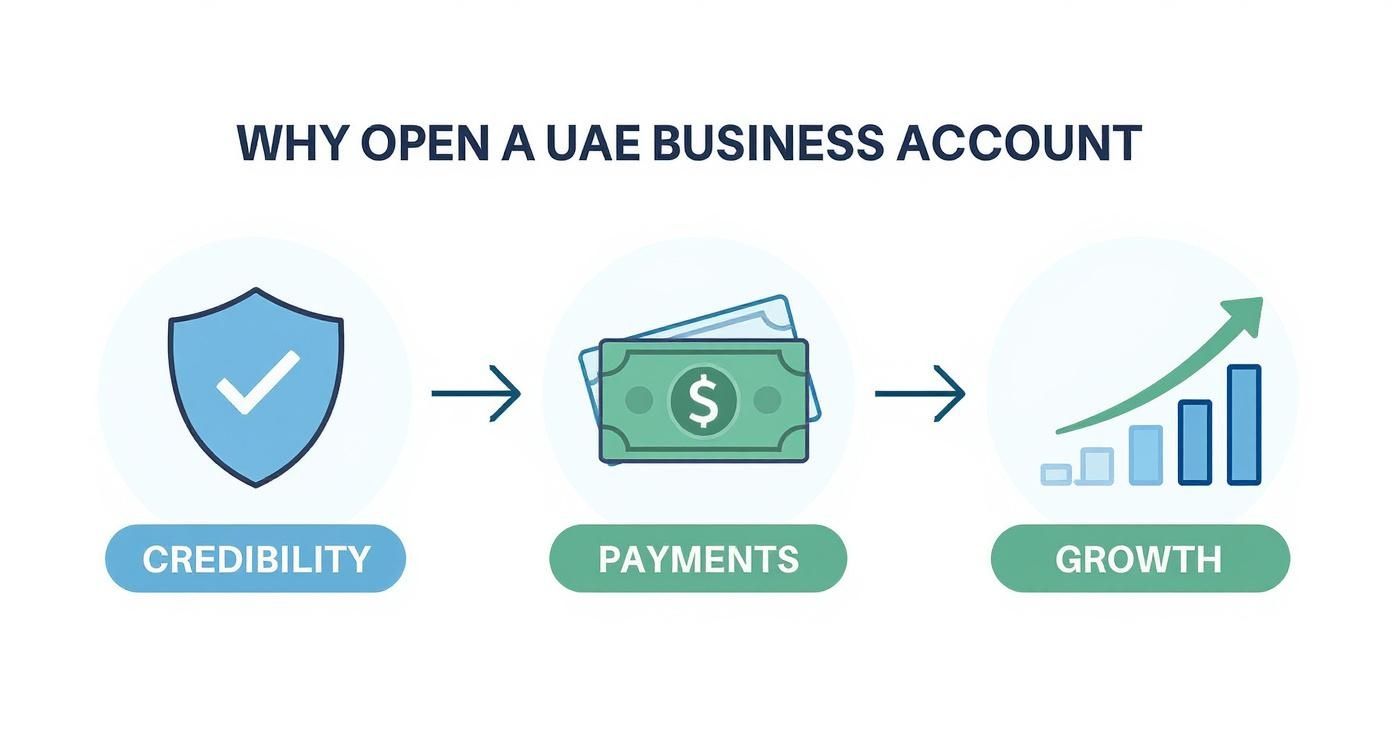
As you can see, each step builds on the last, making that initial setup absolutely critical for your long-term success.
Getting your paperwork in perfect order before you even approach the bank is non-negotiable. Below is a detailed checklist of what you'll need. Think of this as your minimum viable package—the absolute essentials to even get in the door.
Essential Document Checklist for UAE Business Bank Accounts
| Document Category | Specific Document | Key Purpose & Pro Tip |
|---|---|---|
| Company Legal Status | Valid Trade Licence | This is the core proof of your company's existence. Pro Tip: Don't submit a licence that's about to expire. Make sure it has at least six months of validity left, or you risk an immediate rejection. |
| Company Constitution | Memorandum of Association (MOA) / Articles of Association (AOA) | Outlines ownership and company rules. Pro Tip: The bank will cross-reference shareholder names and percentages here with their passport copies. Ensure they match perfectly—no exceptions. |
| Shareholder & Signatory ID | Passport Copy, UAE Residence Visa, Emirates ID | Required for every single shareholder and authorised signatory. Pro Tip: Provide crisp, high-resolution colour scans. Black and white or blurry copies are almost always rejected. |
| Operational Premise | Tenancy Contract / Ejari | Verifies your physical business address in the UAE. Pro Tip: Ensure the contract is in the company's name and is currently valid. |
| Address Verification | Recent Utility Bill | For each shareholder, to confirm their personal residential address. Pro Tip: This bill must be recent—less than three months old is the standard. |
| Business Justification | Detailed Business Profile / Plan | Explains your business model, target market, and projected turnover. Pro Tip: A clear, concise one-page summary is often more effective than a 50-page business plan. Get straight to the point. |
This table covers the fundamentals, but to really set yourself up for success, you need to think one step ahead of the bank's compliance team.
Going Beyond the Basics: Proactive Preparation
Thinking ahead can prevent weeks of back-and-forth. The bank’s compliance officers will dig deeper than just your corporate filings, so having answers ready for their next questions gives you a massive advantage.
Here's what they'll likely ask for next:
- A Solid Business Profile: Write a concise, one-page summary of your business activities, who your target customers are, and your expected annual turnover. This gives the relationship manager a clear picture of your company.
- Source of Funds Declaration: Be prepared to explain exactly where your initial investment capital came from. Have supporting evidence ready, like personal bank statements or loan agreements.
- Customer & Supplier Details: Have a list of your top three potential clients and suppliers. This shows the bank you have a viable business model ready to launch.
My Personal Tip: The signature on the bank's application form must be a near-perfect match to the one in the signatory's passport. I can't stress this enough. Banks are forensic about this, and a noticeable difference is one of the most common (and easily avoidable) reasons for rejection.
The UAE’s financial services sector is booming. The local open banking market alone is projected to rocket from USD 5.6 billion in 2025 to USD 19.2 billion by 2031. This incredible growth shows huge confidence in the region’s financial infrastructure, but it also means banks are more diligent than ever. You can read more about the UAE's thriving financial sector on gfmag.com.
One final point: if any of your original documents are not in English or Arabic, you will need legally attested translations. Don't leave this until the last minute, as the attestation process itself can take time. By preparing all of this with meticulous care, you're not just ticking boxes—you're building a compelling case for why the bank should want to partner with your business.
How to Choose the Right Bank for Your Business
Picking where to bank is one of the first, and most important, decisions you'll make for your new company. It’s tempting to just go with the big international name you recognise, but that can be a mistake. The right bank can genuinely help you grow, while the wrong one can turn into a constant source of frustration and hidden fees.
This isn't just about finding a place to park your cash. You need to match the bank's services, fee structure, and even its personality with your actual business model. What’s perfect for a high-turnover e-commerce business is often a terrible fit for a consulting firm that just needs straightforward, reliable service.
Traditional Banks Versus Digital Challengers
In the UAE, you've got two main camps: the big, established traditional banks and the newer, more nimble digital banks (sometimes called neobanks). They both have their pros and cons, and the best choice really depends on what you need day-to-day.
-
Traditional Banks: These are the household names with physical branches you can walk into. Their big selling point is often a dedicated relationship manager and access to more complex services like trade finance or substantial business loans. The catch? They usually demand high minimum balances and their application process can feel a bit slow and old-fashioned.
-
Digital Banks: These are the modern, online-first players. They focus on a smooth user experience through slick mobile apps and web portals. You'll often find lower (or even zero) minimum balance requirements and much clearer pricing, which is a huge plus for startups and small businesses. The trade-off is usually less face-to-face support.
Choosing a bank is a lot like hiring a key business partner. You have to ignore the shiny marketing and focus on what really matters: How much will it cost me every month? How easy is their online system to use? And can I get a real person on the phone when something goes wrong?
Think of it this way: a company importing and exporting goods will probably lean towards a traditional bank with strong trade finance and multi-currency options. But a freelance graphic designer in a free zone? They’d be much better off with a digital bank that has low fees and a simple, efficient online platform.
Key Factors That Truly Matter
When you start looking at different banks, it's easy to get bogged down in marketing fluff. To cut through the noise, just focus on the three things that will directly affect your money and your time.
First up, the minimum balance requirements. This is a big one in the UAE. Many banks insist you keep an average monthly balance anywhere from AED 25,000 to over AED 250,000. If you dip below that, you can get hit with some pretty nasty monthly penalties, sometimes more than AED 500. Be honest about your cash flow and pick an account you know you can maintain without stress.
Next, get forensic with the fee schedule. Don't just look at the monthly account fee. You need to dig into the cost of everything else: sending and receiving international payments, getting a chequebook, and even using their online banking platform. These little charges can pile up fast, especially if you deal with international clients or suppliers.
Finally, take a hard look at their online banking portal. Let's be realistic, you'll be running most of your company's finances online. Is the platform actually easy to use? Can you make batch payments without pulling your hair out? A clunky, outdated system is a massive time-waster. When you're weighing your options, it's worth reviewing these essential factors to consider when comparing banks.
Getting this choice right from day one saves you the enormous hassle of switching banks down the road. Our team offers cost-effective business setup solutions tailored to your needs and can point you toward a bank that truly fits your company's DNA, whether you're setting up on the mainland or in a free zone.
What Banks Really Want to See in Your KYC Application
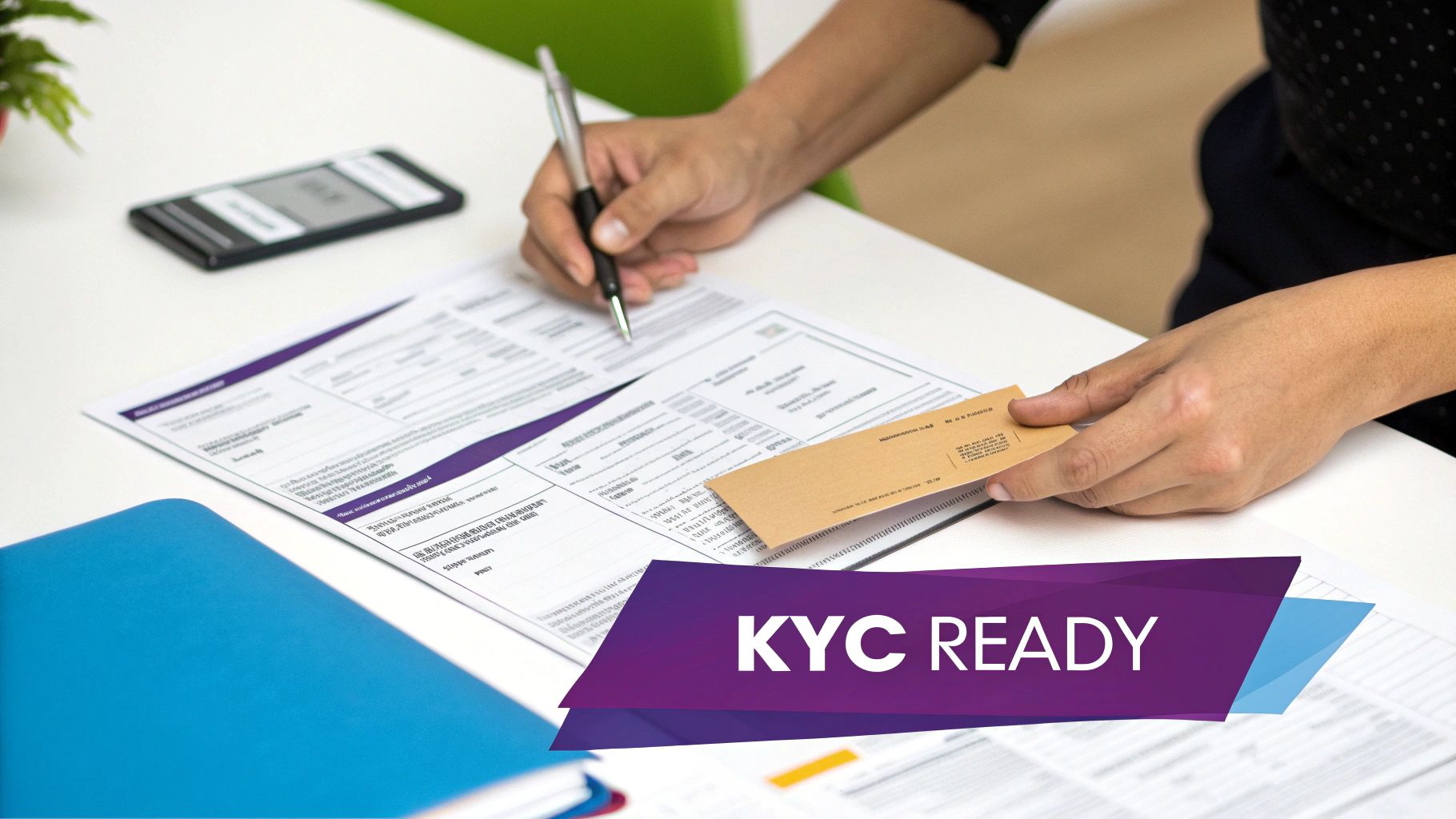
Getting through the Know Your Customer (KYC) process is often the last, and frankly, the toughest part of opening your business bank account. It’s more than just a box-ticking exercise. You’re telling the bank a story about your business, and their compliance team is trained to poke holes in it. Your application needs to be solid.
At the end of the day, banks are looking for one thing: proof. They need proof that your business is legitimate, that it operates in a way that makes sense, and that it has a real presence—what’s known as economic substance—here in the UAE. They want to know how you make money, who you’re selling to, and where that money is coming from. If your application is vague, you're raising a massive red flag that will, at best, cause major delays or, at worst, get you rejected outright.
Your Secret Weapon: The One-Page Business Profile
One of the best things you can do for your application is to create a concise, one-page business profile. Don’t ever assume the bank will figure out your entire business model just by looking at your trade licence. Your profile needs to spell it out for them, proactively answering the very questions their compliance officers have on their checklist.
Make sure this document clearly covers:
- What you actually do: Explain your business model in simple, direct language. Ditch the industry jargon.
- Who you sell to: Define your target customers. Are they local businesses, regional distributors, or international clients?
- How you make money: Break down your primary revenue streams.
- Who you work with: List any key suppliers or partners critical to your operations.
- Your financial forecast: Give them a realistic projection for your first year's turnover.
Think of it like this: your profile is the cheat sheet for your business. It gives your relationship manager everything they need to go to bat for you internally. When you make their job easier, your application moves a whole lot faster.
Proving You’re a Real Business on the Ground
In the current regulatory climate, proving you have a genuine physical presence in the UAE isn't just a good idea—it's non-negotiable. A simple PO Box address just doesn’t cut it anymore. Banks need to see that your business has a real footprint in the country. This is the core of economic substance.
This is probably the single most important compliance check you’ll face. Having a legitimate office address, even if it's a flexi-desk in a shared business centre, shows the bank you're not just a "paper company." It signals a serious commitment to operating in the UAE.
This is exactly why your tenancy contract (Ejari) is so crucial. It’s the official proof of your physical address and acts as the foundation of your KYC file. Without it, your chances of getting an account approved are practically zero. As specialists in Mainland Company Formation in Dubai & Abu Dhabi and Freezone Company Formation across the UAE, we make sure this foundational piece is locked in from the very beginning.
This sharp focus on transparent business operations is happening for a reason. The UAE has positioned itself as a leader in open banking, driving the financial technology revolution in the Middle East. With the region's fintech revenue expected to reach between $3.5 to $4.5 billion by 2025, the UAE is a major hub for financial innovation. You can read more about the rise of open banking in the MEA region on grandviewresearch.com. This tech-driven environment means banks have better tools for analysis, but it also makes them far more careful about who they bring on as a client. A clear, well-documented application is your ticket in.
Common Mistakes That Get Your Application Rejected
Navigating the process to open a business bank account can feel like walking through a minefield. From our experience handling countless applications for clients in Dubai, Abu Dhabi, and Sharjah, we've seen the same avoidable errors sink otherwise solid applications. Understanding these common pitfalls is the first step to avoiding them entirely.
Often, rejection comes down to simple inconsistencies. You have to remember, the bank's compliance team will meticulously cross-reference every single document you submit. If the shareholder names on your trade licence don't perfectly match the names in their passports or your Memorandum of Association, it’s an immediate red flag.
Even a tiny spelling variation can cause significant delays or outright rejection. It seems small, but to a compliance officer, it's a gap that needs explaining.
The Vague Business Description Pitfall
One of the most frequent mistakes we see is submitting a generic or unclear description of business activities. Banks need to understand exactly how you make money to comply with strict anti-money laundering (AML) regulations. A vague summary just creates suspicion and forces the compliance team to assume the worst.
So, instead of saying something like, "We are a consulting company," you need to provide a sharp, clear summary that leaves no room for doubt.
Here’s an example of a strong business description: "Our company provides specialised digital marketing consulting for e-commerce businesses in the GCC. Our primary revenue streams are monthly retainers for SEO services (60%), project-based fees for website development (30%), and commissions on paid advertising campaigns (10%)."
This level of detail gives the bank confidence. It tells them you have a legitimate, well-defined business model and that you actually understand your own operations. Honestly, this single paragraph can be the difference between a quick approval and a frustrating rejection.
Following Up The Right Way
If your application is delayed, how you follow up is critical. I've seen clients make things worse with constant, impatient emails or calls. This can work against you, making you seem desperate or problematic to the bank staff. A professional, patient approach is always your best bet.
Here’s a simple strategy that works far better:
- Wait for the initial timeframe to pass. Give the bank the full period they quoted before you even think about checking in.
- Send a polite follow-up. A single, courteous email to your relationship manager simply asking for a status update is more than enough.
- Provide requested information immediately. If they come back asking for an additional document, send it on the same day if possible. Speed and efficiency on your end demonstrate professionalism.
Knowing when to bring in an expert can save you from all these frustrations. As specialists in both Mainland and Freezone company formation across the UAE, we manage the entire process, making sure every detail is perfect before submission. With our 24/7 Support Service, we are always here when you need us. We handle the follow-up professionally, using our established bank relationships to ensure your application gets the attention it deserves.
Your Questions About UAE Business Banking Answered
Even with the best-laid plans, opening a business bank account in the UAE throws up some very specific questions. I've heard them all from entrepreneurs setting up shop in Dubai, Abu Dhabi, and beyond. Getting these practical, real-world queries sorted out early on can save you a world of headaches and missteps down the line.
Let's start with a big one: can you open a business bank account without ever setting foot in the UAE? The short answer is, almost certainly not. While a good setup partner can get all the paperwork and pre-approvals done remotely, the banks here still insist on an in-person meeting for the final signing and verification. This is a non-negotiable compliance step. The whole point of getting help is to make sure this isn't a long, drawn-out affair but a single, efficient appointment.
Timelines and Minimum Balances
So, how long does this whole process actually take? If your company has a simple ownership structure and your application is perfect, you could be looking at a turnaround of just two to four weeks. It's fast when things go smoothly.
However, if you've got a more complex shareholder setup or the bank's compliance team flags something for a closer look, it can easily stretch to six or even eight weeks. Your best bet for a speedy approval is a flawless application from the get-go.
And what about that minimum balance? This is something UAE banks take very seriously. If your balance dips below the required threshold for the month, you'll be hit with a penalty fee, which usually runs anywhere from AED 150 to over AED 500. It's crucial to pick an account where you know you can comfortably maintain that balance. For keeping your finances in order, getting comfortable with documents like your monthly statements is key. You can get a good primer on understanding your statement of account to make sure you're always on top of things.
Here's a critical piece of advice I always give my clients: you absolutely must have a physical office address for a business bank account. A PO Box won't cut it. This is about proving to the bank that your business has real economic substance and a legitimate base of operations in the UAE.
Navigating these requirements is where an expert partner makes all the difference. At 365 DAY PRO Corporate Service Provider LLC, we offer cost-effective business setup solutions tailored to your needs and handle the entire bank opening process, ensuring you meet every compliance check without the hassle.
📞 Call Us Now: +971-52 923 1246
💬 WhatsApp Us Today for a Free Consultation at https://365dayproservices.com