
If you're looking to tap directly into the bustling UAE economy, a mainland company in Dubai is your ticket in. It’s the setup that lets you trade freely across the Emirates, work directly with government bodies, and put down physical roots wherever you see fit. Simply put, it offers a level of operational freedom that other setups just can't match.
✅ Best Corporate Service Provider in Dubai, Abu Dhabi & Sharjah
✅ Specialists in Mainland Company Formation in Dubai & Abu Dhabi
✅ Specialists in Freezone Company Formation across the UAE
✅ 24/7 Support Service – Always here when you need us
✅ Cost-Effective Business Setup Solutions tailored to your needs
✅ Enjoy UAE Tax Benefits for International Entrepreneurs
📞 Call Us Now: +971-52 923 1246
💬 WhatsApp Us Today for a Free Consultation
Why a Dubai Mainland Company Is Your Best Move

Deciding where to base your business in the UAE is a huge first step. While free zones have their perks, a mainland license brings a powerful and unique set of advantages to the table, especially if you have your sights set on long-term growth and deep market penetration. For any entrepreneur aiming for unfettered access to the local economy, this is the premier choice.
The whole game changed for mainland Dubai company formation after a landmark government decision. Before June 2021, you needed a local Emirati partner holding a mandatory 51% stake in your business. Now, thanks to a major regulatory overhaul, 100% foreign ownership is possible for most business activities. This shift has completely transformed the appeal of a mainland setup, giving founders what they want most: complete control. You can dig into the full details of this business-friendly amendment to see its impact.
Gaining Unrestricted Market Access
A free zone company, by its nature, is usually confined to its specific zone or international dealings. A mainland company, on the other hand, tears down all those internal walls.
What does that mean for you in practice?
- Trade Directly: You can sell your products and services to anyone, anywhere in Dubai and across the other six Emirates. No need for a local agent or distributor to act as a middleman.
- Establish Multiple Branches: Want to open a second office or a new retail store? Go for it. You can expand your physical footprint across Dubai and the other Emirates as your business scales.
- Bid on Government Contracts: This is a big one. You’ll be eligible to compete for lucrative government tenders and massive projects—a market that is exclusively reserved for mainland-registered companies.
This kind of freedom is a game-changer. If you’re in retail, it means opening a flagship store in a prime mall. For a consultancy, it's about setting up shop in a key business district to be right where your clients are.
A mainland license is not just a legal document; it's a strategic key that unlocks the entire domestic UAE economy, from individual consumers to the highest levels of government procurement.
Building a Substantial Local Presence
Setting up on the mainland sends a clear signal: you're serious about the local market. It immediately boosts your credibility and gives you a solid foundation for building a lasting business. With a mainland license, you get the flexibility to pick your perfect office spot, whether that’s a slick office in a Downtown Dubai tower or a practical warehouse in Al Quoz.
This physical presence is more than just a business address. It's a core piece of your operational backbone. It lets you sponsor more employee visas than many free zone alternatives, which is crucial when you're ready to grow your team. By operating from the mainland, your business becomes woven into the local economic fabric, helping you build trust with customers, partners, and banks.
Nailing Down Your Business Activity and Legal Form
Before you start scouting for office space or looking into visas, there are two decisions you have to get right. They're the absolute bedrock of your mainland company setup: what your business will actually do (your activity) and how it will be legally structured.
These two things are completely linked, and one will dictate the options for the other. Getting this part right from the get-go is a non-negotiable first step. It saves a world of headache, not to mention money, down the road.
First, you need to find your specific business activity from the massive list curated by Dubai's Department of Economy and Tourism (DED). This isn't just a box-ticking exercise; it legally defines what your company can and cannot do. A business selling fashion online has a totally different activity code than a digital marketing agency, and this single choice determines which license you’ll apply for. A solid grasp of the general business incorporation process is essential for a smooth start.
Pinpointing the Right Business License
Once you know your activity, it will naturally slot into one of three main license categories. Each one is designed for a specific type of operation, and your choice here sets the stage for everything that follows, from ownership rules to which government approvals you'll need.
- Commercial License: This is your ticket if you're involved in trading—buying and selling goods of any kind. Think retail shops, import-export firms, e-commerce stores, and general trading companies.
- Professional License: This is tailored for service-based businesses run by skilled professionals. We're talking about consultancies, law firms, accounting services, educational trainers, and IT specialists.
- Industrial License: If you're making, manufacturing, processing, or assembling physical goods, this is the license for you. This covers everything from food processing plants to textile manufacturing and metal fabrication.
So, if you're launching an online store for electronics, you’re heading for a Commercial License. On the other hand, if you're a team of developers offering custom software solutions, you'll be applying for a Professional License. Simple as that.
Choosing Your Company's Legal Structure
With your license type sorted, the next crucial piece of the puzzle is the legal structure of your company. This defines things like liability, ownership, and management. For most people setting up on the Dubai mainland, it usually boils down to two very popular and practical choices.
The Limited Liability Company (LLC) is, by a huge margin, the most common route for entrepreneurs, particularly those with a Commercial or Industrial license. Its biggest selling point? It separates your personal assets from the business. This means if the company runs into debt or legal trouble, your personal bank account and property are safe.
The other main option is a Civil Company. This structure is a perfect fit for professionals—think doctors, lawyers, engineers, and consultants who need a Professional License. It's essentially a formal partnership for qualified experts in their field and allows for 100% foreign ownership, but there’s one very important catch.
Even when you own 100% of your professional firm, you are legally required to appoint a UAE national as a Local Service Agent (LSA). This person holds no shares and has zero say in your business operations. They simply act as your official government liaison for a fixed annual fee.
This is a critical detail. The headlines about 100% foreign ownership are true, but the LSA requirement for professional licenses is a nuance that can trip people up. It's a mandatory part of the process that, if missed, can bring your entire setup to a grinding halt.
Dubai Mainland License Types at a Glance
To make it easier to see how these pieces fit together, here's a quick comparison of the three primary license types and their typical structures.
| License Type | Best Suited For | Ownership Structure Example | Typical Activities |
|---|---|---|---|
| Commercial | Trading, import/export, retail, e-commerce | Limited Liability Company (LLC) with 100% foreign ownership | General Trading, Electronics, Apparel, Foodstuff Distribution |
| Professional | Service-based businesses, consultancies, skilled trades | Civil Company with 100% foreign ownership + a Local Service Agent (LSA) | IT Consultancy, Marketing Agency, Legal Firm, Salons |
| Industrial | Manufacturing, production, assembly | Limited Liability Company (LLC) with 100% foreign ownership | Food Processing, Furniture Manufacturing, Metal Fabrication |
Getting the right mix of activity, license, and legal form is the foundation of a solid mainland company. Our job is to give you the practical advice needed to build that foundation correctly, ensuring it’s perfectly aligned with what you want to achieve here in Dubai.
Navigating Approvals and Documentation
Once you’ve locked in your business activity and legal structure, it's time to shift from planning to action. This is where the real paperwork begins. It can look like a mountain of forms and requirements, but when you break it down, it's just a series of logical steps. Getting this administrative part right from the start is the secret to a fast, smooth setup.
Your first port of call is the Department of Economy and Tourism (DED). You'll need two key approvals to get the ball rolling: your trade name reservation and the Initial Approval. Think of these as the official green lights that give you permission to move forward with finding an office and finalising your legal documents. They aren't just formalities; they're foundational.
Securing Your Trade Name and Initial Approval
Your company name is your first impression, and in Dubai, it has to play by the rules. The DED has some very clear guidelines to make sure all business names are unique, professional, and respectful. For instance, your name can't be already registered, use offensive language, or make any religious or political references.
From our experience, here are a few tips to get your name approved on the first attempt:
- Spell out initials: If you want to use an acronym like 'JLT Trading', you have to write it out fully as 'J L T Trading'. It's a small detail that often trips people up.
- Be distinctive: The more unique your name, the better your chances. Common or generic names are almost always rejected.
- Check it first: Before you get too attached to a name, a quick search on the DED portal can save you a world of headache and time.
Once your trade name is reserved, the next step is applying for Initial Approval. This is basically the DED giving you a preliminary nod, confirming they have no objections to your proposed business. It's a crucial document that authorises you to continue the setup process, like drafting your company's Memorandum of Association (MOA) and securing a lease.
The Essential Document Checklist
With your Initial Approval in hand, the next phase is all about document collection. Staying organised here is non-negotiable if you want to avoid delays. While the exact list can shift slightly depending on your business activity and ownership structure, there are a few core documents you'll always need.
Core Documents for All Shareholders and Managers:
- Passport Copies: Every single shareholder and the appointed manager must provide a clear, colour copy of their passport.
- Visa and Emirates ID Copies: If anyone involved is already a UAE resident, you'll need copies of their residence visa and Emirates ID as well.
- Application Form: This is the main DED form detailing your chosen trade name, activities, and partner information.
This infographic breaks down the typical flow, showing how each decision builds on the last, leading right up to the documentation stage.
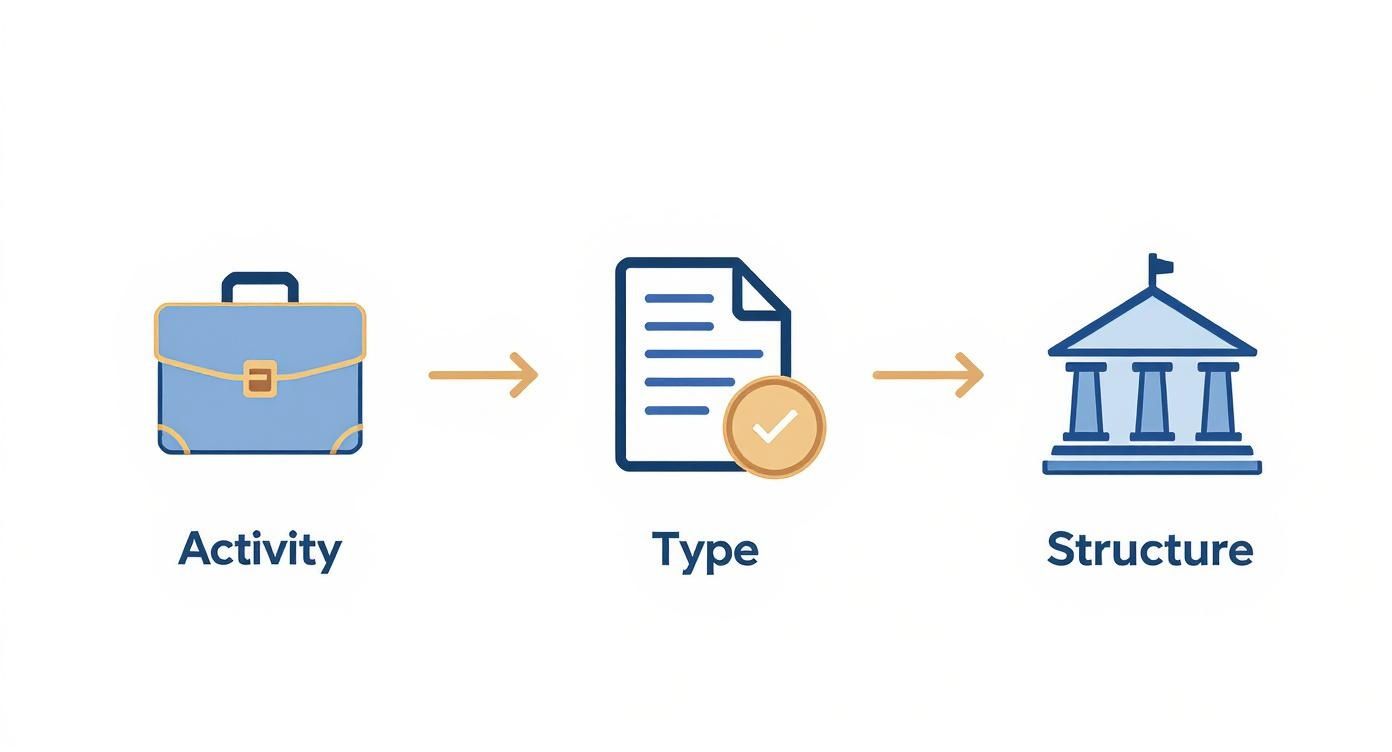
As you can see, the process is designed to be sequential. Each decision—from activity and license type to legal structure—is a building block for the next phase of documentation and approvals.
Keep in mind, some professional licences might require extra paperwork, like attested educational certificates or proof of relevant experience. We've handled countless applications, so we can tell you precisely what's needed for your specific situation, ensuring nothing gets missed.
The Mandatory Physical Office and Ejari
A key difference with a mainland company in Dubai is the absolute requirement for a physical office space. You can't just use a home address; you must have a proper commercial tenancy contract. The DED is very strict on this point.
This is where the Ejari system comes into play. In Arabic, 'Ejari' means 'my rent', and it's the official government portal for registering all tenancy contracts in Dubai.
An approved Ejari is the one document that proves your physical business address. Without it, the DED simply will not issue your final trade licence. It’s the final piece of the puzzle that makes your company’s presence on the mainland legitimate.
The process itself is quite simple. After finding an office and signing the lease, you or your agent must register the contract on the Ejari portal. This generates a unique Ejari certificate, which is then submitted to the DED with the rest of your documents.
This step directly ties your business licence to a physical location, reinforcing your commitment to operating within the UAE market. It doesn't matter if you opt for a large office, a small serviced desk, or a spot in a co-working space—as long as it comes with a valid Ejari, you're good to go. At 365 DAY PRO, we often help clients find cost-effective office solutions that tick all the legal boxes without breaking the bank.
Getting Real About Costs and Timelines
Alright, let's talk about the two questions every entrepreneur asks first: "How much is this going to set me back?" and "How long will it take?" Vague answers won't help you write a business plan. You need real numbers and practical timelines to get started on the right foot with your mainland Dubai company formation.
The final bill can swing wildly depending on what you’re doing. A small consultancy practice has a completely different price tag than a large-scale general trading company that needs a warehouse and multiple external approvals. Your business activity, how many visas you need, and the size of your office are the three big dials that control the cost.
Your Initial Setup Investment
Think of the initial setup as a bundle of one-off government fees and service charges. These are the mandatory costs to get your trade licence in hand and make your business official in the eyes of the Dubai authorities.
Here’s a snapshot of where that initial money goes:
- Trade Name Reservation: A fee to the Department of Economy and Development (DED) to lock in your company name.
- Initial Approval: The DED's preliminary green light for your business idea.
- Memorandum of Association (MOA): Fees for drafting and notarising this core legal document.
- Licence Issuance: This is the big one—the main fee paid to the DED for your final trade licence.
- Government Service Fees: Various smaller payments for things like Tasheel, the centre that processes your labour and immigration paperwork.
These fees are non-negotiable. For example, the licence issuance fee for a general trading company will naturally be higher than for a simple professional licence because you’re permitted to do much more with it. At 365 DAY PRO, we pride ourselves on giving you a fully itemised quote from day one, so you see exactly where every single dirham is allocated. No surprises.
Budgeting for Your Annual Running Costs
Getting your licence is a huge first step, but the financial commitments don't stop there. To stay compliant and keep your doors open, you need to budget for several recurring annual expenses.
Your trade licence renewal is the most significant annual government fee. It’s what keeps your business legally active. Right alongside it is your office rent. Whether you've got a full-blown office, a flexi-desk, or a spot in a co-working space, that Ejari-registered tenancy contract comes up for renewal every year.
I see it all the time: new entrepreneurs focus so heavily on the setup fees that they forget about what comes next. Smart budgeting means planning for these recurring costs from the very beginning. It's the key to your company's long-term financial stability.
To give you a clearer picture, we've put together a sample budget. Remember, these are estimates—your final costs will depend on your specific setup.
Estimated Cost Breakdown for a Dubai Mainland LLC
| Cost Component | Estimated Cost Range (AED) | Frequency (One-Time/Annual) | Notes |
|---|---|---|---|
| Initial Setup Fees | |||
| Trade Name & Initial Approval | 1,000 – 2,000 | One-Time | Standard DED fees. |
| MOA Notarisation | 1,500 – 3,000 | One-Time | Varies based on share capital. |
| Trade Licence Issuance | 15,000 – 30,000+ | One-Time | Highly dependent on business activity. |
| Establishment Card | 2,000 – 2,500 | One-Time | Required for visa processing. |
| Visa & Immigration | |||
| Investor/Partner Visa | 4,000 – 5,500 | One-Time (per 2 years) | Includes medicals and Emirates ID. |
| Employee Visa | 5,500 – 7,500 | One-Time (per 2 years) | Quotas and profession can affect cost. |
| Annual Recurring Costs | |||
| Trade Licence Renewal | 12,000 – 25,000+ | Annual | Your largest recurring government fee. |
| Office Rent (Ejari) | 15,000 – 50,000+ | Annual | Depends on size and location. |
| Local Service Agent (if applicable) | 5,000 – 15,000 | Annual | For professional licences needing a UAE national. |
| Corporate Tax Registration | 0 (but compliance has costs) | Annual | Mandatory registration, potential accounting fees. |
This table should help you build a foundational budget. For a precise quote tailored to your business, it's always best to have a direct conversation.
Why Timelines Aren't One-Size-Fits-All
Just like costs, timelines vary. The myth that every mainland company gets set up in a week is just that—a myth. The complexity of your business activity is the number one thing that dictates the pace.
A straightforward professional services firm or a standard trading company? We can often get those processed quite quickly, sometimes in as little as one to two weeks, because they don't need a lot of external sign-offs.
It’s a different story for regulated industries. If you’re opening a medical clinic, an educational institution, or a financial advisory, you're looking at a longer road. You'll need special approvals from bodies like the Dubai Health Authority (DHA) or the Knowledge and Human Development Authority (KHDA). Each has its own rigorous review process, which can easily extend your setup timeline to between four and eight weeks. As you can probably guess, this added layer of complexity also tends to increase the overall cost. For a deeper dive, check out this guide on the financial breakdown of setting up a Dubai company to see how it all connects.
So, You've Got Your License. What's Next?

Getting that official trade license in your hands feels like crossing the finish line, doesn't it? It's a huge step in your mainland Dubai company formation, and definitely worth celebrating. But before you pop the champagne, there are a few more crucial pieces of the puzzle to put in place to get your business truly up and running.
These next moves—setting up a corporate bank account and handling your tax registrations—are absolutely essential. They lay the groundwork for your company's financial integrity and ensure you're compliant with UAE law from the very start.
Opening Your Corporate Bank Account
This is where many new entrepreneurs hit their first real snag. Opening a corporate bank account in Dubai isn't just a quick trip to the nearest branch. UAE banks have incredibly strict compliance and "Know Your Customer" (KYC) protocols, so showing up unprepared is a recipe for frustration and delays.
They need to see more than just your license. Banks want to get a clear picture of your business, where your funds are coming from, and the kind of transactions you'll be making.
To make this go as smoothly as possible, get your paperwork in order first. You’ll need:
- Your complete company file: This means the trade license, Memorandum of Association (MOA), share certificates, and your Ejari.
- Personal documents for all shareholders and managers: Copies of passports, residence visas, and Emirates IDs are a must.
- A solid business profile: A simple, clear summary of what your business does, who you sell to, and your expected annual turnover.
I've seen countless business owners get caught out by the level of detail banks require. Don't be surprised if they ask for things like supplier agreements, initial client invoices, or even a CV to understand your professional background. This is where having a business setup consultant in your corner can be a game-changer; they can help package your application and introduce you to bankers who understand your industry.
Getting Your Head Around Tax Obligations
The moment your company is formed, you’re on the hook for complying with the UAE's tax regulations. For a new mainland business, this primarily involves two things: Value Added Tax (VAT) and the relatively new Corporate Tax.
Value Added Tax (VAT) Registration
VAT is a standard tax on most goods and services in the UAE. You don't necessarily have to register for it on day one, but you absolutely must keep an eye on your revenue.
Registration with the Federal Tax Authority (FTA) becomes mandatory once your taxable supplies and imports cross AED 375,000 in a 12-month period. You can also choose to register voluntarily if your turnover is over AED 187,500. Missing the mandatory deadline brings heavy penalties, so it pays to be proactive.
Navigating the New Corporate Tax
Introduced in June 2023, the UAE's Corporate Tax is something every business owner needs to understand. The headline rate is 9%, which is still one of the most competitive in the world.
But here's the key takeaway for startups and small businesses: there's a 0% tax rate on annual profits up to AED 375,000. This is a massive advantage. However, even if you expect to be in this zero-rated bracket, you are still legally required to register your business with the FTA. It's best to get this done early to avoid any compliance issues down the road.
With the legal and financial foundations in place, it's time to think about growth. A great place to start is by exploring some proven digital marketing tips for small businesses.
We're Here to Help You Launch Your Dubai Business
Setting up a mainland company in Dubai isn't just a matter of filling out forms. It’s a maze of legal structures, licensing rules, banking requirements, and tax laws. Honestly, trying to navigate it all on your own can be a real headache, leading to expensive mistakes and delays that burn through your budget and your patience.
This is exactly why having a seasoned expert in your corner makes all the difference. We specialise in both mainland and free zone setups across the UAE, creating clear, affordable paths for entrepreneurs from around the world. We'll handle the entire process from start to finish.
Your Guide on the Ground in Dubai
We know this market inside and out. Our team understands every step of the process, ensuring you can take full advantage of the UAE's tax benefits without getting tangled up in red tape.
Here's how we help:
- Expert advice on whether a Mainland or Free Zone setup is right for you.
- Affordable packages tailored to your actual business activities.
- 24/7 support, because business questions don't just pop up between 9 and 5.
This hands-on approach frees you up to concentrate on what really matters: building your business. And there's never been a better time. A recent Mastercard SME Confidence Index revealed that a staggering 91% of small and medium-sized businesses in the UAE are optimistic about the future. On top of that, 90% expect their revenue to either hold steady or grow, which speaks volumes about the opportunities here. You can read more about the growth outlook for UAE SMEs.
Don't go it alone. Partnering with a dedicated corporate service provider from the very beginning means you have support every step of the way, setting you up for success from day one.
Ready to get started with a team that's always in your corner?
📞 Call Us Now: +971-52 923 1246
💬 WhatsApp Us Today for a Free Consultation
Common Questions About Mainland Dubai Company Setup
Setting up a business in mainland Dubai can bring up a lot of questions. I’ve worked with hundreds of entrepreneurs navigating this process, and a few key queries always come up. Here are some straight answers based on real-world experience.
Do I Still Need a Local Sponsor for a Dubai Mainland Company?
This is probably the most common question I get, and for good reason. The rules have changed significantly.
For most commercial and industrial activities—over a thousand of them, in fact—the old 51% local sponsorship rule is a thing of the past. You can now own 100% of your company. It’s a massive shift that has opened up the market.
However, if you're setting up a professional services business, like a consultancy, clinic, or design studio, the rules are different. You'll need to appoint a Local Service Agent (LSA), who must be a UAE national. Don't let the term worry you; an LSA has zero shares in your business and no say in how you run it. Think of them as your official government liaison, paid a fixed annual fee for their role.
Can I Run My Mainland Business From Home?
The short answer is no. A registered physical office space is non-negotiable for a Dubai mainland trade licence. When you apply, the Department of Economy and Tourism (DED) will ask for a valid tenancy contract, registered with Ejari, as proof that your business has a legitimate physical address. This is a major distinction from many free zone setups.
But that doesn't mean you need a huge, expensive office from day one. There are plenty of smart, cost-effective ways to meet this requirement. Getting a dedicated desk in a business centre or using a flexible co-working space are both popular and perfectly acceptable options.
A key point people often mix up is the difference between an Initial Approval and the final Trade Licence. The Initial Approval is just the DED's first nod, saying they have no objection to your business idea. It's the green light to move forward with things like drafting your MOA. The Trade Licence is the final, official permit you get after you've submitted everything, including your signed lease (Ejari). You absolutely cannot start operating until that final licence is in your hands.
Ready to start your business journey with confidence? The specialists at 365 DAY PRO Corporate Service Provider LLC are here to provide cost-effective, tailored solutions for your mainland company formation, backed by 24/7 support. Let us handle the complexities so you can focus on growth.
For a seamless and expert-guided setup, explore our services today.