

Figuring out overtime pay in the UAE all boils down to one core principle: if you work beyond your standard hours, you must be paid extra for it. The law is quite clear on this. The entire calculation is based on your basic salary, with an added premium of at least 25% for regular overtime and 50% if you’re working at night or on your designated rest day.
Understanding UAE Overtime: The Legal Essentials

Before we jump into the numbers and formulas, it’s really important to get a handle on the legal side of things. The UAE has a solid framework to make sure overtime is handled fairly, protecting both employees from overwork and employers from legal missteps. It all starts with defining what a normal workday looks like.
The Legal Framework for Working Hours
The key piece of legislation here is the Federal Decree-Law No. 33 of 2021, which brought some major updates to the country’s labour laws. Since it came into effect on 2 February 2022, the rules for private sector employees are crystal clear: the maximum standard working hours are 8 hours per day or 48 hours per week.
Anything you’re asked to work beyond these limits is officially considered overtime. It’s that simple. Getting this right is the first step to an accurate and compliant payroll. You can dig deeper into the updated UAE overtime legislation on firstbit.ae for more details.
Key Takeaway: Let’s say your contract is for an 8-hour day. If your boss asks you to stay and work for 10 hours on a Tuesday, those extra 2 hours are overtime. Paying you for them isn’t a favour; it’s a legal requirement.
Basic Salary vs. Total Compensation
This is probably the most common mistake I see people make. When it comes to calculating overtime, the UAE Labour Law is very specific: you must use the employee’s basic salary only.
This means you have to strip out all the other parts of their compensation package. Things like allowances and benefits don’t count towards this calculation.
Here’s a quick list of what to exclude:
- Housing or accommodation allowance
- Transportation allowance
- Utility or phone benefits
- Any special bonuses or commissions
So, if an employee’s total monthly package is AED 10,000, but their employment contract breaks it down and shows a basic salary of AED 6,000, your overtime calculations must be based on that AED 6,000 figure. Getting this distinction right is absolutely crucial for staying on the right side of the law.
The Standard Overtime Calculation Formula Explained
When you’re figuring out how overtime is calculated in the UAE, the most common situation you’ll encounter is for extra hours worked on a normal weekday. The law is quite specific on this to make sure you’re paid fairly for that extra time. It all boils down to a clear formula, which starts with converting your monthly basic salary into an hourly wage.
The first thing you need to do is pinpoint your daily wage. You find this by taking your monthly basic salary and dividing it by 30 (the standard number of days used for payroll calculations). With that daily figure in hand, you then divide it by the standard 8 working hours to get your hourly rate. This rate is the bedrock of all your overtime calculations.
For any extra hours you put in on a regular working day, UAE labour law mandates that you’re paid a premium. The pay for these standard overtime hours is calculated at 125% of your normal hourly wage. Think of it as your regular hourly pay plus a 25% bonus for the extra work.
Putting The Formula Into Practice
Let’s run through a quick, practical example to see exactly how this works on the ground.
Say your employment contract shows a basic monthly salary of AED 5,000.
- First, get your daily wage: AED 5,000 ÷ 30 days = AED 166.67 per day.
- Next, find your hourly rate: AED 166.67 ÷ 8 hours = AED 20.83 per hour.
- Finally, apply the overtime premium: AED 20.83 × 1.25 = AED 26.04 per overtime hour.
Simple as that. For every hour of standard overtime you work, you’ve earned AED 26.04. If you stayed late for three hours one evening, you’d be looking at an extra AED 78.12 (AED 26.04 x 3) for that day’s work.
A Quick Tip: Always remember that these calculations must be based only on your basic salary, not your total compensation package that might include allowances for housing or transport. Getting this first step right is crucial for an accurate calculation.
To make it even clearer, let’s break down the process into simple, repeatable steps.
Standard Overtime Calculation Steps
| Step | Calculation | Example (AED 5,000 Basic Salary) |
|---|---|---|
| 1. Find the Daily Wage | Monthly Basic Salary ÷ 30 Days | AED 5,000 ÷ 30 = AED 166.67 |
| 2. Find the Hourly Wage | Daily Wage ÷ 8 Hours | AED 166.67 ÷ 8 = AED 20.83 |
| 3. Calculate Overtime Rate | Hourly Wage × 1.25 (125%) | AED 20.83 × 1.25 = AED 26.04 |
Following these three steps ensures you can quickly and accurately figure out what you’re owed, taking any guesswork out of the equation.
This visual guide neatly summarises the key stages, from finding your base hourly rate to applying the correct multiplier for your extra hours.
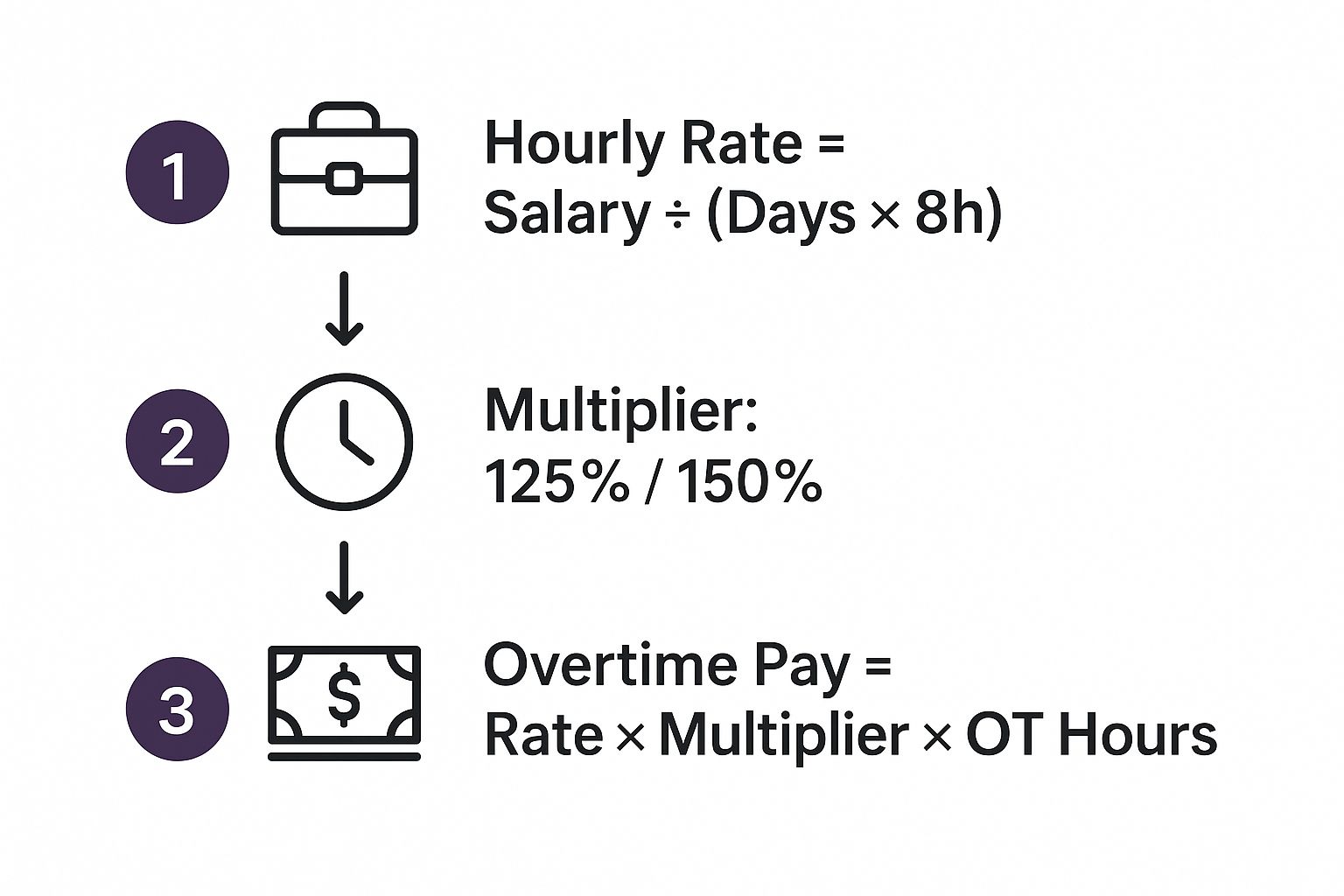
As you can see, it’s a logical, step-by-step process. This systematic approach is designed to be straightforward, so you can easily double-check your payslip and confirm your overtime earnings are correct.
Calculating Pay for Holidays, Weekends, and Night Shifts

Working extra hours on a normal weekday is one thing, but what about when you’re called in on your day off or a public holiday? The UAE Labour Law acknowledges that this time is far more valuable, and as a result, the compensation required is significantly higher. It’s absolutely crucial to get these calculations right to stay compliant.
It’s a common misconception that all overtime is paid the same. The reality is, the premium you earn is directly tied to when you worked those extra hours. Knowing the difference is key to ensuring you’re paid fairly for giving up your personal time.
Rest Day and Weekend Work
If your employer needs you on your official rest day—a Friday for most people—the rules for calculating your pay change. Forget the standard 25% premium; for work on a designated rest day, your overtime is calculated with a 50% premium.
This bumps your hourly pay up to 1.5 times your normal rate.
Let’s go back to our employee earning an hourly wage of AED 20.83. Here’s how it breaks down:
- Rest Day Overtime Rate: AED 20.83 × 1.5 = AED 31.25 per hour.
If that employee works a full 8-hour shift on their day off, they’ve earned an extra AED 250 (AED 31.25 x 8) for that day alone. It’s a serious increase, and it’s designed to reflect the value of protected personal time.
A key point here is that an employer might offer a day off in lieu of the premium pay. If they don’t give you another day off, though, that 50% premium isn’t optional—it’s mandatory.
Night Shifts and Public Holidays
The law reserves the highest premiums for work done during late-night hours or on official public holidays. These are seen as the most disruptive situations for an employee, and the pay reflects that.
Under the law, any work performed between 10 p.m. and 4 a.m. is officially considered “night work.” Overtime during this window also gets a 50% premium, the same as working on a rest day.
Public holidays are in a category of their own. If you’re required to work on a day like Eid or National Day, you’re entitled to one of two things:
- A different day off in lieu of the holiday you worked.
- Your normal day’s wage, plus an additional premium of at least 50%.
So, for working on a public holiday, you’re effectively paid 150% of your usual daily salary.
Take our example employee who earns AED 166.67 per day. If they work on a public holiday, they are owed their regular AED 166.67 plus an overtime payment of at least AED 83.34, for a total of AED 250.01 for the day.
Decoding the UAE’s Overtime Rules and Limits
Figuring out the overtime calculation is only half the battle. To stay compliant, you also need a firm grasp of the legal framework surrounding overtime in the UAE. The Labour Law isn’t just about pay formulas; it sets crucial boundaries to protect employees from being overworked and clarifies who qualifies for overtime in the first place.
At the heart of these rules is the daily overtime cap. In most cases, an employer can’t ask you to work more than two overtime hours per day. This is a vital safeguard that prevents the standard 8-hour workday from becoming a routine 10-hour one, protecting employee well-being.
Of course, the law is practical and accounts for genuine emergencies.
When the Two-Hour Rule Can Be Bent
There are a few rare and serious situations where the two-hour daily limit can be stretched. It’s important to understand these are not for catching up on deadlines or managing a busy spell. They are strictly for critical events that could cause major harm to the business.
The exceptions cover work that is essential to:
- Prevent a massive financial loss.
- Deal with a serious accident or a major technical breakdown.
- Manage the fallout from an unexpected emergency.
These provisions give businesses the flexibility to handle a crisis without routinely overworking their staff.
A Word of Caution: The law is very clear here. An employer can’t just label a heavy workload an “emergency” to get around the two-hour rule. The circumstances must be genuinely severe and pose an immediate threat to the company’s stability or safety.
Who Isn’t Covered by Overtime Pay?
Not everyone on the payroll is eligible for overtime. The UAE Labour Law carves out exemptions for certain roles where the nature of the work doesn’t fit the standard hourly model. The most common group excluded from overtime pay are those in senior managerial or supervisory positions.
The logic is that these employees typically have significant control over their own schedules and are accountable for the overall direction and success of their departments or the company. The law limits standard overtime to a maximum of two hours a day, but understanding the nuances, including these key exemptions, is crucial for full compliance. To dig deeper into these specific regulations, you can find out more about UAE overtime regulations on cercli.com.
Navigating Compliance with Expert Business Support

Trying to master the finer points of UAE Labour Law, especially when it comes to calculating overtime, can feel like a full-time job in itself. Getting these calculations right isn’t just good practice; it’s a legal requirement. Even small payroll mistakes can quickly spiral into significant compliance headaches and unhappy staff.
That’s where having an expert in your corner makes all the difference. As the best corporate service provider in Dubai, Abu Dhabi, and Sharjah, we specialise in making your business journey seamless.
✅ Specialists in Mainland Company Formation in Dubai & Abu Dhabi
✅ Specialists in Freezone Company Formation across the UAE
✅ 24/7 Support Service – Always here when you need us
✅ Cost-Effective Business Setup Solutions tailored to your needs
✅ Enjoy UAE Tax Benefits for International Entrepreneurs
Our role is to manage the complex regulatory details, freeing you up to concentrate on what truly matters—growing your business. Don’t let payroll complexities become a roadblock.
Ready to get it right from day one?
📞 Call Us Now: +971-52 923 1246
💬 WhatsApp Us Today for a Free Consultation
Frequently Asked Questions About UAE Overtime Pay
When it comes to calculating overtime in the UAE, the same questions tend to pop up time and again from both employers and employees. Getting the details right is crucial for fair pay and legal compliance, so let’s clear up a few of the most common sticking points.
Is Overtime Calculated on Basic or Total Salary?
This is easily the most frequent point of confusion, and it’s a critical one. Under UAE Labour Law, overtime pay is always calculated based on your basic salary.
All other parts of your compensation package, like your housing or transport allowance, are not factored in. The figure listed as your “basic salary” in your official employment contract is the only number used to work out your overtime rate.
What Happens if My Employer Won’t Pay Overtime?
An employer’s refusal to pay for legitimate overtime worked is a serious breach of the law. Fortunately, if you find yourself in this difficult situation, you have a formal process to follow.
You can file a complaint directly with the Ministry of Human Resources and Emiratisation (MOHRE). The Ministry will investigate your claim and, if they find your employer is at fault, they will take action to enforce the correct payment.
For employers, it’s vital to remember that failing to pay overtime isn’t just a payroll mistake—it’s a direct violation of federal law that can result in significant penalties.
Does Every Employee Qualify for Overtime Pay?
Not quite. The law does make exceptions for certain senior roles.
Typically, individuals in high-level managerial or supervisory positions are not eligible for overtime compensation. The logic here is that their roles come with a greater degree of autonomy over their working hours and responsibilities. To be sure, you should always check the specific duties and job title against the legal definitions.
Navigating company setup and legal compliance in the UAE can be a complex process. At 365 DAY PRO Corporate Service Provider LLC, we simplify it for you. From mainland and free zone formation to ongoing PRO support, we ensure your business operates smoothly and legally.
Get your free consultation with 365 DAY PRO Corporate Service Provider LLC today!