
The journey to a successful business setup in Dubai hinges on a single, crucial decision that will shape your company’s future: where to plant your flag. You have two primary paths—setting up on the Dubai Mainland or within one of its specialised Free Zones. Each route comes with its own unique landscape of benefits, regulations, and opportunities, so understanding the difference is the first real step you’ll take as an entrepreneur in the UAE.
Your Blueprint for Starting a Business in Dubai

Dubai is far more than just a city of breathtaking skyscrapers; it’s a global launchpad for ambitious entrepreneurs. But before you can tap into its incredible potential, you need to grasp the fundamental differences between a Mainland and a Free Zone company. This isn’t just a box-ticking exercise; it affects everything from who you can do business with to your ownership structure and tax liabilities.
The city’s reputation as a magnet for new ventures is backed by hard numbers. In a recent year, Dubai saw the creation of more than 20,000 new companies, a staggering figure driven largely by foreign investors. This activity speaks volumes about its business-friendly climate and strategic global position.
Key Considerations for Your Setup
Making the right choice isn’t about which option is “better” but which is better for you. It’s a strategic move that needs to align perfectly with your business model and growth plans.
To get started, ask yourself these core questions:
- Who are my customers? If you plan to trade directly with clients and consumers across the UAE, a Mainland setup is your ticket. If your focus is primarily on international markets, a Free Zone might be a more streamlined fit.
- What ownership do I need? While 100% foreign ownership is now the norm for most activities in both jurisdictions, the fine print can differ. Getting this right from day one is essential for maintaining control.
- What’s my budget? The initial setup fees, office space requirements, and annual renewal costs can vary dramatically between Mainland and Free Zones. It’s important to find a solution that works for your bottom line.
Choosing the right jurisdiction is the single most important decision you will make. It dictates the rules you play by, the opportunities you can seize, and the overall trajectory of your business in the UAE.
Mainland vs Free Zone At a Glance
To simplify this critical decision, let’s break down the core differences. Think of this as your quick-reference guide.
| Feature | Dubai Mainland | Dubai Free Zone |
|---|---|---|
| Market Access | Unrestricted access to the entire UAE market | Primarily trade within the zone and internationally |
| Ownership | 100% foreign ownership for most business activities | 100% foreign ownership is standard |
| Office Space | Must have a physical office space registered with Ejari | Flexible options, including virtual offices |
| Government Approvals | Requires approvals from DED and other authorities | Approvals managed by the specific Free Zone authority |
| Business Scope | Wide range of activities available across all sectors | Activities often restricted to specific industries |
Ultimately, a Mainland company offers unparalleled freedom to operate anywhere in the UAE, while a Free Zone provides a more contained, often industry-specific environment with its own set of unique benefits.
Once your business is legally registered and ready to go, your next big move is building an online presence. A professional website is non-negotiable for reaching your target audience, so it’s worth learning how to create your own business website to start on the right foot.
Choosing Your Jurisdiction: Mainland or Free Zone

Right, this is the big one. The moment your idea for a business setup in Dubai starts to become real. Deciding between a Mainland company and a Free Zone isn’t just a box to tick; it’s the most critical strategic decision you’ll make at this stage. It literally defines your entire operational reality—who you can sell to, the rules you live by, and how you can grow.
Think of it like building a house. You wouldn’t use the same foundation for a sprawling villa as you would for a high-rise apartment block. Your business is no different. Your choice of jurisdiction has to be a perfect match for your company’s scale, your industry, and where you see yourself in five years.
Understanding the Dubai Mainland Advantage
Setting up on the Dubai Mainland means you’re registering directly with the Department of Economic Development (DED). The major upside? You have the freedom to trade and do business anywhere in the UAE, with absolutely no restrictions. If your plan is to serve the local market directly, this is the way to go.
Let’s say you’re launching a boutique chain of speciality coffee shops. A Mainland licence is essential. It lets you open branches wherever you see an opportunity, from the bustling streets of Downtown Dubai to the quiet suburbs of Jumeirah. You can also bid on those lucrative government contracts, a massive market that’s completely off-limits to most Free Zone businesses. That unrestricted access is the core appeal of a Mainland setup.
Things got even better in 2021 when the UAE passed a landmark law allowing 100% foreign ownership for most mainland companies. This was a game-changer, removing the old requirement for a local partner and sparking a huge wave of foreign-owned tech and e-commerce businesses. You can discover more insights about these business setup trends and how they’ve reshaped the landscape.
The bottom line for a Mainland company is geographic and commercial freedom. If your business model relies on direct trade within the UAE, physical retail locations, or government work, the Mainland is your only real strategic choice.
Of course, this freedom comes with its own set of responsibilities. Mainland companies need a physical office space and will have to get approvals from various government bodies, not just the DED, depending on their specific business activity.
The Strategic Appeal of UAE Free Zones
Dubai has more than 40 specialised Free Zones, and each one is its own little economic ecosystem with its own rules and regulator. They are specifically designed to pull in foreign investment by offering some very attractive incentives, which is why they’re so popular with international entrepreneurs.
The main benefits of a Free Zone are pretty compelling:
- Complete Foreign Ownership: This has always been the standard here, giving you total control.
- Tax Exemptions: Most Free Zones offer long-term guarantees of zero corporate and personal income taxes.
- Customs Duty Waivers: If you’re importing or exporting, operating from a Free Zone means you don’t pay customs duties.
Picture a tech startup building a new SaaS platform for a global customer base. Setting up in a place like Dubai Internet City (DIC) just makes sense. They’re immediately part of a tech-focused ecosystem, they get a tax-efficient structure, and they don’t need a physical presence all over the UAE because their clients are worldwide.
Making the Right Choice for Your Business
Forget generic pros and cons lists. This decision has to come from a hard look at your actual business needs. Your operational model, your target customers, and your growth plans will point you in the right direction.
Let’s walk through a couple of real-world scenarios:
- A Logistics and Trading Company: Imagine a business importing goods from Asia and re-exporting them to Europe and Africa. This company would be a perfect fit for Jebel Ali Free Zone (JAFZA). Being right next to a major seaport and airport, combined with the customs tax exemptions, gives them a massive competitive edge for international trade.
- A Marketing Consultancy Firm: Now consider a consultant whose clients are all UAE-based businesses. A Mainland licence is the clear winner. It allows them to operate freely, visit client offices in Dubai or Abu Dhabi, and engage directly with the local economy without any middlemen.
A Comparative Look at Key Factors
To make things even clearer, here’s a simple breakdown of how Mainland and Free Zone setups stack up on the issues that matter most.
| Factor | Dubai Mainland | Dubai Free Zone |
|---|---|---|
| Primary Market | The entire UAE, including local consumers and government | International markets and other Free Zone companies |
| Business Scope | Broad scope covering thousands of activities | Often specialised by industry (e.g., media, tech, health) |
| Visa Eligibility | Generally tied to the size of your physical office space | Flexible visa packages, often not requiring a physical office |
| Regulatory Body | Department of Economic Development (DED) and other ministries | The specific Free Zone Authority (e.g., DMCC, DAFZA) |
Ultimately, picking between Mainland and a Free Zone is the foundational step in your business setup in Dubai. Working with a corporate service provider can bring a lot of clarity here, making sure the path you choose actually lines up with your financial and operational goals. With some expert guidance, you can navigate the red tape and build a company that’s structured for real success.
Getting to Grips with Business Licences and Legal Structures
So, you’ve pinpointed the perfect jurisdiction—be it Mainland or a Free Zone. Now comes the next crucial piece of the puzzle in your business setup in Dubai: defining your company’s legal identity.
This isn’t just about paperwork; it’s about building the very DNA of your company. Your licence and legal structure dictate everything from what activities you can legally perform to how your business is owned and, critically, the level of personal liability you carry.
Getting this right from the very beginning is non-negotiable. If you align your business activities with the correct licence, you’ll sidestep a world of expensive compliance issues and operational headaches later on. This is where a solid understanding of your options becomes your most powerful tool.
The Main Types of Business Licences Explained
The licence you need is tied directly to what your business actually does. Dubai’s framework is designed to categorise businesses logically, and while there are countless specialised permits, nearly every company falls under one of three main licence categories.
Think of these licences as different passports, each giving you access to a specific commercial territory. Get the wrong one, and you could find your operations stalled before they even start.
Let’s break them down.
Commercial Licence
This is the one you’ll see most often. It’s for any business involved in the buying and selling of goods, whether that’s trading, retail, or e-commerce. If your model involves moving physical or digital products, a Commercial Licence is almost certainly what you’ll need.
- Who needs it? General traders, e-commerce stores, import/export firms, and your typical retail shop.
- Real-world example: An entrepreneur wants to launch an online store selling handcrafted leather goods to customers across the UAE. She’ll need a Commercial Licence to legally buy raw materials, hold stock, and sell her finished products online.
Professional Licence
The Professional Licence is for service-based businesses and individuals recognised for their expertise. We’re talking about consultants, artisans, accountants, and other professionals who trade on their intellectual skills rather than physical products.
A huge advantage here, especially on the Mainland, is that this licence often allows for 100% foreign ownership.
- Who needs it? Marketing agencies, IT consultants, business advisors, and design studios.
- Real-world example: A seasoned digital marketing strategist decides to set up her own consultancy in Dubai Media City. She needs a Professional Licence to legally offer services like SEO and brand strategy to her corporate clients.
Industrial Licence
If your business involves manufacturing, producing, or assembling goods, the Industrial Licence is mandatory. This is for any company transforming raw materials into finished products. These setups typically require extra approvals from other government bodies to ensure they meet strict safety and environmental standards.
- Who needs it? Food processing plants, textile manufacturers, and metal fabrication workshops.
- Real-world example: A company plans to establish a facility to assemble and package consumer electronics. They’ll require an Industrial Licence, plus specific approvals for their factory space and production line.
Choosing the right licence is all about matching your core business activity to the correct legal classification. I’ve seen so many new entrepreneurs make costly mistakes by mismatching them. A good consultant will help you classify your activities correctly from day one.
Choosing the Right Legal Structure
Once the licence is sorted, you need to pick a legal structure. This decision defines your company’s ownership and, crucially, its liability. It determines whether your personal assets are on the line if the business runs into debt.
The two most common structures you’ll encounter for a business setup in Dubai are the Limited Liability Company (LLC) and the Sole Establishment.
Limited Liability Company (LLC)
For foreign investors, the LLC is by far the most popular choice in the UAE. Its biggest benefit is creating a legal firewall between the owner’s personal assets and the company’s liabilities.
What does that mean in practice? If the business faces financial trouble, your personal wealth—your home, car, and savings—is protected. An LLC can be formed with a minimum of two and a maximum of 50 shareholders, and each person’s liability is limited to their share of the investment.
Sole Establishment
A Sole Establishment is owned by a single individual who has complete control and keeps all the profits. It’s a simpler structure to set up, but it comes with a major caveat: unlimited liability.
There is no legal separation between you and the business. This means you are personally responsible for all business debts. This structure is often used for professional licences where the business is tied to one person’s specific skills. While it seems straightforward, the personal financial risk is significantly higher.
Navigating the Paperwork to Secure Your Trade Licence
Once you’ve locked in your jurisdiction and company structure, it’s time to dive into the administrative side of your business setup in Dubai. This is the paperwork phase, and while it might look like a mountain of forms, it’s really just a sequence of steps that bring your business to life. Getting this part right is the final sprint before you have your trade licence in hand.
Think of it as assembling your company’s official identity. Each document, from reserving your name to getting the final licence, is a piece of proof that your business is legitimate, compliant, and ready to operate in the UAE. Trust me, a little extra care here will save you a world of headaches and delays later on.
This is also the point where many entrepreneurs see the incredible value in getting expert help. As specialists in both Mainland Company Formation in Dubai & Abu Dhabi and Freezone Company Formation across the UAE, we act as your navigator, making sure every form is filled out perfectly and submitted on time. It frees you up to actually focus on launching your business, not waiting in government queues.
Securing Your Business Identity: The Trade Name
First things first, your business needs a name. Officially reserving your trade name is your first real step, and it’s a process governed by some very specific rules from the Dubai Department of Economy and Tourism (DET).
Your name can’t violate public morals, include religious references, or use the names of any government bodies. It also has to be one-of-a-kind. A quick search on the DET portal will tell you if your dream name is already taken. Oh, and if you’re setting up a Limited Liability Company (LLC), remember to add the “LLC” suffix to the end.
Getting this wrong means an instant rejection. My advice? Come prepared with a few compliant options. It’s a small bit of prep that can save you weeks of frustrating back-and-forth.
The Foundation: Your MOA and Office Lease
With your name secured, the next move is to draft two cornerstone documents: the Memorandum of Association (MOA) and your office tenancy contract.
- Memorandum of Association (MOA): This is essentially your company’s constitution. It lays out your business activities, lists all the shareholders and their ownership stakes, and defines how the company will be managed. For most company structures, this document needs to be professionally drafted and attested by a notary public.
- Office Lease (Ejari): For a mainland company, a physical office is non-negotiable. You’ll need to provide a valid tenancy contract that’s been registered with Ejari, Dubai’s official online lease registration system. This is your proof of a legitimate business address, which is a critical requirement for getting your licence approved.
These two documents are the legal and physical bedrock of your company. It’s crucial that the details in both perfectly match what you submitted in your initial application. Any discrepancies will bring the process to a screeching halt.
To make things clearer, here’s a quick checklist of the core documents you’ll be dealing with.
Core Documentation Checklist for Dubai Business Setup
This table summarises the essential paperwork you’ll need to gather for both Mainland and Free Zone setups. Having these in order is the key to a smooth process.
| Document/Step | Purpose | Key Tip |
|---|---|---|
| Trade Name Reservation | To secure a unique, compliant name for your business. | Have 3-5 name options ready that adhere to UAE naming conventions to avoid rejection and delays. |
| Initial Approval Certificate | A no-objection certificate from the authorities to proceed with the business setup. | This confirms the government has no issue with your proposed business activity and shareholders. |
| Memorandum of Association (MOA) | A notarised legal document outlining the company’s structure, ownership, and operational rules. | Use a legal professional to draft this. Errors in the MOA are a common and costly source of setbacks. |
| Tenancy Contract & Ejari | Proof of a physical business address, mandatory for mainland companies. | Ensure your office space is approved for your specific business activity before signing the lease. |
| Passport & Visa Copies | Personal identification for all shareholders and managers involved in the company. | Make sure all passports have at least six months of validity remaining. |
| External Approvals (If any) | Specialised permits required for certain business activities (e.g., healthcare, education, engineering). | Research if your activity needs external approval before you start the licensing process. This can take time. |
Putting this package together correctly is more than half the battle won. It’s the foundation upon which your trade licence is built.
The Role of a Public Relations Officer (PRO)
Here’s where a lot of founders choose to bring in a specialist. A Public Relations Officer (PRO) is an expert in navigating the UAE’s government departments, whether it’s the DET, the Ministry of Labour (Tasheel), or Dubai Immigration (Amer).
Hiring a PRO isn’t a luxury; it’s a strategic investment in efficiency. They handle the legwork of submitting documents, securing approvals, and managing visa applications, transforming a complex bureaucratic process into a streamlined workflow. Their relationships and expertise are invaluable.
A professional PRO service ensures your paperwork is submitted correctly the first time around, handles all the government liaison for you, and keeps you in the loop at every stage. For anyone new to the UAE system, this kind of support is often the difference between a smooth launch and a very stressful one.
The infographic below gives you a clear picture of how the costs typically break down during the setup process.
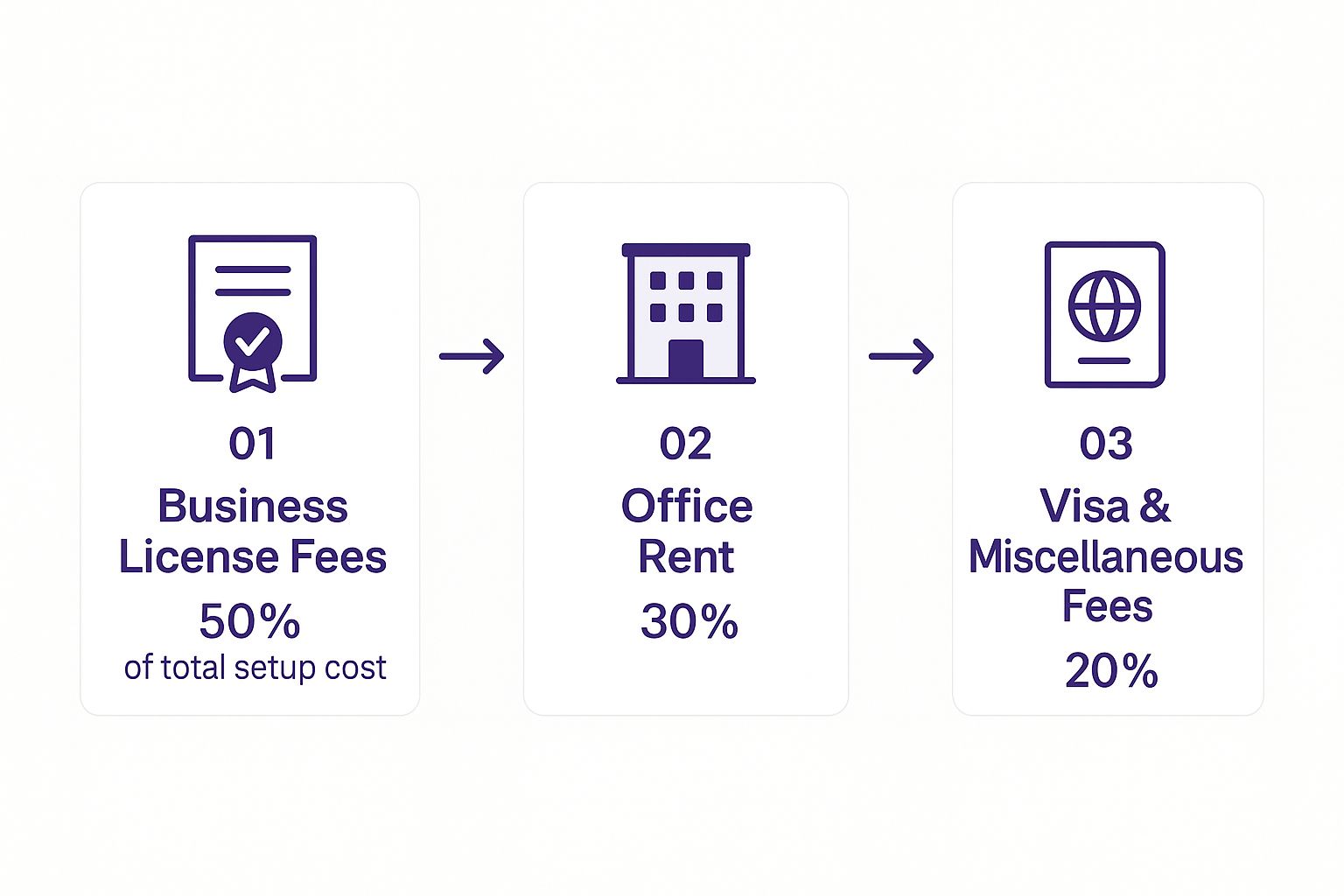
As you can see, the business licence fees are the biggest piece of the pie. This just highlights how important it is to get your application right the first time to avoid the cost of reapplying.
Final Approvals and Getting Your Licence
After you’ve submitted everything—the MOA, Ejari, and any external approvals your industry might need—you’ll get a payment voucher for your trade licence fee. This is the final hurdle.
Once that payment is processed, it’s time to celebrate. You’ll be issued your official trade licence! This document formally makes your company a legal entity, giving you the green light to start operating, open a corporate bank account, and apply for residence visas for yourself and your employees.
With our cost-effective business setup solutions and 24/7 support, our team can handle this entire process for you. From securing your trade name to managing all PRO services, we turn your business setup in Dubai into a completely hassle-free experience.
Ready to get your trade license without the headache? 💬 WhatsApp Us Today for a Free Consultation.
Managing Your Money: Corporate Banking and Taxes
Your business isn’t truly in business until the money is moving. Once you have that trade licence in hand, the very next thing on your list should be setting up your company’s financial backbone. This means opening a corporate bank account and getting to grips with Dubai’s tax system.
Opening Your Corporate Bank Account
Let’s be frank: opening a corporate bank account in Dubai can be a real headache for new founders. UAE banks are incredibly thorough with their compliance and due diligence—they have to be. This means you need to show up looking like a serious, credible business.
Just waving your new trade licence around won’t cut it. They’ll want to see a well-thought-out business plan, solid proof of a physical address (your Ejari), and clear details on who the company shareholders are. Showing up with a messy, incomplete application is the fastest way to get your application rejected or stuck in a month-long limbo.
To get a green light without the painful back-and-forth, make sure you have your ducks in a row:
- A Rock-Solid Business Plan: Clearly spell out what your company does, how it makes money, and who your customers are.
- Complete Company Documents: Have everything ready—your trade licence, Memorandum of Association (MOA), and copies of all shareholder passports and visas.
- Proof of Your Business Address: This is non-negotiable. Your Ejari-registered tenancy contract is the proof they need of your physical presence in Dubai.
Expert Tip: Don’t just hand over a pile of papers. Present it as a professional package. Walk the banker through your business model and projections. It shows you’re organised and serious about your venture.
Also, think about your day-to-day cash flow. Beyond a standard bank account, it’s worth understanding local invoice factoring options which can be a lifesaver for managing liquidity while you wait for clients to pay.
Navigating the UAE Corporate Tax Framework
For a long time, the UAE’s biggest selling point was its “tax-free” status. That’s changed. With the introduction of a federal corporate tax, you need to be much more strategic about your finances from the get-go.
The government has introduced a 9% corporate tax, but it only applies to profits that exceed AED 375,000 (roughly USD $102,000). While it’s a big shift, let’s keep it in perspective. A 9% rate is still one of the lowest you’ll find anywhere in the world, which is why Dubai remains such a magnet for international business.
This new tax landscape simply means that proper accounting and financial planning are no longer optional—they’re essential for success.
Enjoy UAE Tax Benefits for International Entrepreneurs
This is where your choice of jurisdiction really matters. While the federal tax is the new standard, Free Zones still hold a major trump card: powerful tax incentives.
Businesses operating within many of Dubai’s Free Zones can still qualify for a 0% corporate tax rate. The catch? You have to meet specific conditions, which usually involve performing “qualifying activities” and, critically, not dealing directly with the UAE mainland market.
This makes that initial decision—Mainland or Free Zone—more important than ever. Getting expert advice here is crucial. An expert can analyse your business model and tell you if it aligns with the Free Zone requirements for tax exemptions, ensuring your business setup in Dubai is structured for maximum tax efficiency.
We are specialists in Mainland and Free Zone company formations across the UAE. We can help you navigate these critical financial steps to make sure you’re set up for success and can take full advantage of the UAE’s favourable tax environment.
📞 Call us now at +971-52 923 1246 to sort out your banking and tax strategy.
Your Dubai Business Setup Questions, Answered
Starting a business in a new country always comes with a lot of questions. It’s completely normal. As the best corporate service provider in Dubai, Abu Dhabi & Sharjah, we’ve helped hundreds of entrepreneurs get started, and here are the answers to the questions that come up most often.
What’s the Real Minimum Cost to Set Up a Business in Dubai?
This is the big one, and the honest answer is: it depends. There’s no single price tag. You could get a simple freelance permit in a Free Zone for as little as AED 15,000, but that’s a very specific scenario. A Mainland company, on the other hand, will always have a higher starting cost.
The final bill really comes down to four things:
- Business Activity: A general trading licence costs more than a simple consultancy licence. Some activities also need extra approvals from government bodies, which adds to the cost.
- Legal Structure: Setting up an LLC is a different process and cost compared to a sole establishment.
- Visas Needed: Each residence visa for you, your family, or your staff is an additional expense.
- Office Space: This is a major factor. A physical office on the Mainland is a significant cost, whereas many Free Zone setups let you start with a more affordable flexi-desk or virtual office.
The key is to map out exactly what you need with cost-effective business setup solutions tailored to your needs. That’s where good advice pays for itself—getting a clear, itemised breakdown upfront saves you from surprises later.
Can I Get a UAE Residence Visa if I Open a Company?
Yes, absolutely. In fact, setting up your own company is one of the most popular and direct ways to get a UAE residence visa. This investor visa is linked to your company, essentially making you a resident because you’re a business owner here.
It’s not a free-for-all, though. The number of visas your company is eligible for depends on a few things. For a Mainland company, the size of your office is often a key factor. In Free Zones, the rules vary, but it’s usually tied to your company package. We can help structure your application from the start to make sure you get the number of visas you need for yourself and your team.
For most international entrepreneurs, the visa is just as important as the business licence itself. We manage the entire journey—from the initial company registration all the way to getting that visa stamped in your passport. It makes the move to living and working in the UAE much smoother.
Do I Still Need a Local Emirati Partner for a Mainland Company?
This used to be a huge deal, but things have changed dramatically for the better. For the vast majority of businesses, the answer is now no. Thanks to major legal updates, 100% foreign ownership is now permitted for over a thousand different business activities on the Dubai Mainland.
This has been a game-changer, opening up the Mainland market to global entrepreneurs without the need to give up equity.
Of course, there are exceptions. A handful of strategic sectors, usually linked to areas of national importance, still require a local Emirati partner. That’s why it’s critical to get the right advice for your specific activity before you start. We can tell you instantly if your business falls under the 100% ownership rule, ensuring you can operate on the Mainland with full control of your company.
As a leading corporate service provider, we live and breathe this stuff. Whether you’re looking at Mainland or a Free Zone in Dubai, Abu Dhabi, or Sharjah, our job is to make the complex simple. With our 24/7 Support Service, we’re always here when you need us. We handle the paperwork and processes so you can focus on building your business.
📞 Call Us Now: +971-52 923 1246
💬 WhatsApp Us Today for a Free Consultation at https://365dayproservices.com