So, you’re considering the freelance life in the UAE? Excellent choice. But let’s clear up one of the biggest points of confusion right away: the “freelance visa” isn’t just one document. It’s better to think of it as your complete package for legally working for yourself and living in the Emirates.
This modern setup is a combination of two critical parts: your freelance permit (which lets you work) and your residence visa (which lets you live here). Together, they give you a level of freedom and independence that a standard employment visa simply can’t match.
Unpacking Your UAE Freelance Visa Toolkit
When people hear “freelance visa,” they often imagine a single stamp in their passport that covers everything. The reality is a bit more layered. It’s a two-part system designed to give you both professional legitimacy and personal stability as a self-employed expert in the UAE.
Here’s a simple analogy. Think of a professional driver. To work legally, they need two things: a driver’s license to prove they have the skills and permission to drive, and a vehicle registration to show their car is road-legal. The UAE’s freelance setup works exactly the same way.
The Two Core Components
First up is the freelance permit, which you might also hear called a freelance licence. This is your professional permission slip. It officially registers you as a sole practitioner in your specific field—be it marketing, IT, design, or consulting—and gives you the legal authority to offer your services. This permit is issued by a specific free zone or mainland authority and essentially acts as your business registration.
The second piece of the puzzle is your residence visa. This is the document that allows you to actually live in the UAE. Once your freelance permit is approved, you can then apply for your residence visa, which is usually valid for one to two years and can be renewed. This is what gets stamped in your passport and lets you do essential things like open a bank account, rent an apartment, and truly build a life here.
Key takeaway: A common mistake is thinking the freelance permit automatically makes you a resident. It doesn’t. The permit is the first, necessary step—it’s the key that unlocks your ability to apply for the residence visa.
This two-part structure is the UAE’s savvy response to the global shift towards independent work. The country has worked hard to become a top destination for freelance talent, moving past the old-school model where every visa had to be tied to a single employer.
This isn’t just talk, either. The government is actively backing this shift. As part of its ‘Projects of the 50’ initiative, the UAE set a goal to issue 100,000 freelance licences by 2025. They’ve already granted over 25,000 Green Visas—a special five-year residency for freelancers and self-employed individuals, showing a serious commitment to attracting global talent. If you want to dig into the numbers, you can find more insights about the UAE’s freelance initiatives online.
Do You Qualify for a UAE Freelance Visa?
Alright, you’ve grasped the two-part structure: the freelance permit (your license to work) and the residence visa (your license to live here). The big question now is, “Do I actually qualify?”
The UAE is actively looking for skilled professionals to fuel its economy, so the doors are open. But it’s not a free-for-all. They need to see that you’re a legitimate expert in your field. This isn’t about ticking boxes on a generic form; it’s about presenting a convincing professional profile that proves your value.
What Are They Looking For?
While the specifics can shift slightly from one free zone to another, every application is generally judged on a few core pillars. Think of these as the foundation you need to have in place before you even start.
- Your Field of Work: You need to operate in a recognised professional sector. We’re talking about fields like tech, media, education, marketing, design, and various consulting services.
- Proof of Your Expertise: This is non-negotiable. You’ll need a solid CV or a professional portfolio that showcases your skills, past projects, and maybe even some client testimonials. This is your chance to prove you’re an established pro, not a beginner.
- Your Educational Background: In most cases, a university degree (like a Bachelor’s) is a must-have, especially for specialised roles in fields like engineering or education. Be prepared to get your degree certificates officially attested.
These pillars help the authorities feel confident that you’re a serious professional who can stand on their own two feet in the UAE’s competitive market. They want to see that you’re ready to hit the ground running.
The Green Visa: A Pathway for High Earners
For seasoned freelancers who are already earning a significant income, the UAE has rolled out a more prestigious option: the Green Visa for Freelancers and Self-Employed Individuals.
This is a five-year, self-sponsored residency visa designed for top-tier global talent. As you’d expect, the bar is set quite a bit higher, with a clear focus on financial stability and proven success.
To be eligible for the Green Visa, you have to meet these criteria:
- Hold a specialised diploma or, more commonly, a bachelor’s degree.
- Show proof of annual income from your freelance work of at least AED 360,000 (that’s about $98,000 USD) for the last two years.
That income threshold is the real game-changer here. It shows how the UAE is strategically targeting highly skilled, financially independent professionals. This visa is becoming incredibly popular—over 25,000 were issued to freelancers by 2025, proving its appeal. If you want to dig deeper into its impact, you can explore detailed reports on the UAE Green Visa.
By setting a clear income benchmark, the Green Visa creates a distinct pathway for high-achieving freelancers, offering them longer-term stability without the need for a local sponsor.
Time for a Quick Self-Assessment
So, let’s get practical. Look at your own profile. Do you have a degree relevant to your work? Is your portfolio polished and packed with your best projects? Can you easily pull up bank statements or client invoices to show a steady income?
Answering these questions honestly is the first step in figuring out which freelance route is right for you. For example, a software developer with a computer science degree and a strong GitHub profile is a shoo-in. A marketing consultant with industry certifications and a track record of high-value contracts is also in a great position.
To see how the UAE’s approach fits into the global picture, it can be helpful to look at general digital nomad visa requirements elsewhere. But if you’re still unsure, talking to a specialist can clear things up and help you choose the path that makes the most sense for your professional journey.
Choosing Between a Mainland and Free Zone Setup
One of the biggest decisions you’ll make when setting up as a freelancer in the UAE is where to anchor your business. It really comes down to two paths: setting up on the Mainland or within a Free Zone. Each has its own distinct flavour, with unique pros and cons. The right choice for you depends entirely on what you do, who your clients are, and where you see your business going.
Think of it this way: a Mainland licence is like opening a shop right on the high street. You have complete, unrestricted access to the entire local market. A Free Zone, on the other hand, is like setting up in a specialised, high-tech business park. It has its own rules, community, and perks, but your access to the wider local market is a bit more structured.
The Freedom of a Mainland Licence
A Mainland freelance licence, which you’d get from the Department of Economy and Tourism (DET) in Dubai or a similar authority in another emirate, offers the most flexibility. Plain and simple. It gives you the freedom to do business anywhere in the UAE, with anyone.
This means you can work directly with government departments, pitch to private companies located on the mainland, and take on clients in any emirate without a second thought. If your client base is mostly here in the UAE, this is often the best route. For instance, a consultant bidding on government tenders or an event planner organising local corporate functions would find a Mainland licence essential. It just removes all the red tape for local trade.
The trade-off? The setup can be a bit more involved and sometimes more expensive upfront. You’re operating within the main legal framework of the UAE, which can mean a few more administrative hoops to jump through compared to a Free Zone’s self-contained environment.
The Focused Environment of a Free Zone
Free Zones are special economic areas created to encourage foreign investment, each with its own independent set of rules. For freelancers, they offer a clear, often more affordable, and community-focused way to get a UAE freelance visa.
When you’re based in a Free Zone, you’re technically licensed to operate within that zone. To work with Mainland companies, you might need to use an intermediary or follow specific invoicing rules. While that might sound like a limitation, for many freelancers today—especially those with digital services—it’s barely a hurdle.
A Free Zone setup is perfect for freelancers whose clients are primarily based outside the UAE or those who offer digital services that don’t require a physical presence in the Mainland market.
The advantages of going the Free Zone route are pretty compelling:
- Cost-Effective: Packages are often more affordable and bundle everything you need.
- Simplified Setup: The application process is generally quicker and demands less paperwork.
- Networking: Many zones focus on specific industries, creating buzzing communities of professionals in the same field.
Comparing Top Free Zones for Freelancers
The UAE has over 40 free zones, but a handful have become go-to hubs for freelancers. Each one has carved out its own niche, offering different perks for different professions.
- Dubai Media City (DMC) & Dubai Internet City (DIC): These are the premier spots for creatives, media pros, and tech wizards. They boast an incredible ecosystem with major global companies right on your doorstep, making them fantastic for networking.
- Ras Al Khaimah Economic Zone (RAKEZ): Known for its great value and a huge list of approved activities, RAKEZ is a fantastic all-rounder. It offers a very cost-effective way for freelancers in all sorts of sectors to get started.
- Umm Al Quwain Free Trade Zone (UAQ FTZ): This zone’s claim to fame is its incredibly straightforward and fast setup process. It’s a top pick if you want to get your UAE freelance visa and licence sorted with minimal fuss.
Your final choice should really be about what fits your work. A graphic designer might feel right at home in the creative buzz of Dubai Media City, while a general business consultant might prefer the wide scope and lower costs of RAKEZ. Chatting with a specialist can help you weigh these options properly, ensuring you make a smart decision that will support your business from day one.
Understanding the Costs of a Freelance Visa
Let’s talk numbers. This is often the first—and most important—question people ask: “How much is this actually going to cost me?” Getting your head around the budget for a UAE freelance visa is a critical first step, and it pays to have a clear financial roadmap.
Instead of looking for one single, all-in price tag (which can be misleading), it’s much smarter to break down the individual costs. This way, you know exactly where your money is going and can avoid any nasty surprises down the line. The final figure depends on a few things: the free zone you pick, how many business activities you need on your licence, and the visa’s validity—usually one, two, or even five years.
Breaking Down the Core Expenses
When you see a price for a freelance visa “package,” it’s not just for a single stamp in your passport. That cost is a bundle of different government and administrative fees required to get you set up legally. Knowing what these are helps take the mystery out of the process.
Here’s a look at the main things you’ll be paying for:
- Freelance Permit/Licence Fee: Think of this as your professional permission slip to operate. It’s an annual fee and is usually the biggest chunk of your initial setup cost.
- Establishment Card Fee: This is a crucial little card that links your freelance business to the immigration and labour departments. You can’t even start your own visa application without it.
- Residence Visa Application Fee: This is what you pay the government to process your visa. It covers things like the entry permit and changing your visa status once you’re in the country.
- Medical Fitness Test: Everyone applying for a residence visa has to pass a mandatory health check at a government-approved centre. They’re mainly screening for communicable diseases.
- Emirates ID Application: You’ll need this for pretty much everything in the UAE—opening a bank account, renting an apartment, you name it. This fee covers the application for your national ID card.
- Visa Stamping Fee: The final step. This is the fee for getting the actual residence visa sticker placed in your passport, making you an official UAE resident.
What Is a Realistic Budget for a UAE Freelance Visa?
Alright, let’s get to the bottom line. How much should you set aside? The good news is that getting a freelance visa in the UAE has become more and more affordable.
As of 2025, you can find entry-level packages starting from around AED 7,500. This typically gets you the essentials: your annual freelance permit, the establishment card, and a one-year residency visa. It’s a fantastic starting point for anyone testing the waters.
If you’re looking for a bit more stability, a two-year freelance visa package is a very popular option. These tend to range from AED 10,000 to AED 25,000. The higher price usually includes all the necessary permits and residency, and sometimes other perks like help getting your health insurance sorted. For a closer look at what goes into these prices, you can review detailed breakdowns of freelance visa costs in Dubai.
To give you a clearer picture, here’s a typical itemised breakdown of what to expect.
Estimated Cost Breakdown for a UAE Freelance Visa
| Expense Item | Estimated Cost (AED) | Notes |
|---|---|---|
| Freelance Permit/Licence | 3,000 – 7,500 | Annual fee, varies significantly by free zone and activities. |
| Establishment Card | 1,500 – 2,500 | A one-time fee for new setups, renewable every three years. |
| Residence Visa (1-Year) | 3,000 – 5,000 | Includes entry permit, status change, medical, and Emirates ID. |
| Total Estimated Initial Cost | 7,500 – 15,000+ | This is an estimate for a one-year visa package. |
| Mandatory Health Insurance | 800 – 4,000+ | Annual cost paid separately. Price depends on coverage and age. |
| Additional Services (Optional) | 1,000 – 3,000 | Fees for PRO services, bank account assistance, etc. |
Keep in mind these are estimates, and the final cost will depend on the specifics of your application and the provider you choose.
It’s crucial to remember that mandatory health insurance is a separate cost. UAE law requires all residents to have valid health coverage, and this is an out-of-pocket expense you must factor into your annual budget.
Working with a specialist can often save you money and a lot of headaches. At 365 DAY PRO, we’ve built our reputation on transparent and straightforward business setup solutions. We help entrepreneurs from all over the world tap into the UAE’s tax benefits by making sure their setup is compliant and cost-effective from day one. And with our 24/7 support, we’re always here to talk you through the numbers and answer any questions you have.
Your Step-by-Step Application Guide
Getting a UAE freelance visa can feel a bit daunting at first, but it’s really just a series of logical steps. Think of it less like a complex puzzle and more like a checklist. When you break it down, the whole process becomes much clearer.
I’ve designed this guide to be your roadmap, walking you through every stage from gathering your first documents to getting that all-important Emirates ID in your hand.
The journey is split into two main phases. The first part you can do entirely from home, before you even book a flight. The second part happens once you’re here in the UAE. Let’s start at the beginning.
Stage 1: The Document Preparation Phase
This first stage is all about laying a strong foundation. Honestly, getting your paperwork right from the start is the most critical part of the entire application. Any small mistake or missing document here can cause major headaches and delays down the line.
Your goal is simple: build a professional profile that ticks all the boxes for your chosen free zone or mainland authority.
Here’s exactly what you’ll need to pull together:
- Passport: A clean, high-quality colour copy. Make sure it’s valid for at least six to eight months and has a minimum of two blank pages.
- Passport-Sized Photograph: Get a recent one done with a plain white background. It needs to meet the standard UAE visa photo requirements.
- Updated CV or Portfolio: This is where you get to shine. Your CV needs to clearly outline your professional background, skills, and key achievements. If you’re in a creative field, a polished portfolio is essential.
- Educational Certificates: You’ll need a copy of your university degree or your highest relevant qualification. Be aware that some authorities will require this to be attested, which is a formal verification process.
- Bank Reference Letter or Financial Statements: The authorities need to see that you can support yourself. A simple reference letter from your bank or your last few bank statements usually does the trick.
Pro Tip: If your degree needs attestation, start that process immediately. It’s a multi-step journey involving authorities in both your home country and the UAE, and it’s often the single biggest time sink. A delay here will bring your entire application to a halt.
Nailing this preparation phase sets you up for a smooth application. Once you have these documents sorted, you’re ready to kick off the formal process. At 365 DAY PRO, this is where we come in—we guide our clients through this crucial first step, making sure every document is perfectly prepared for submission to either a Mainland or Free Zone authority.
The flowchart below gives you a bird’s-eye view of the key stages, showing how you move from getting your permit to having your final residency in hand.
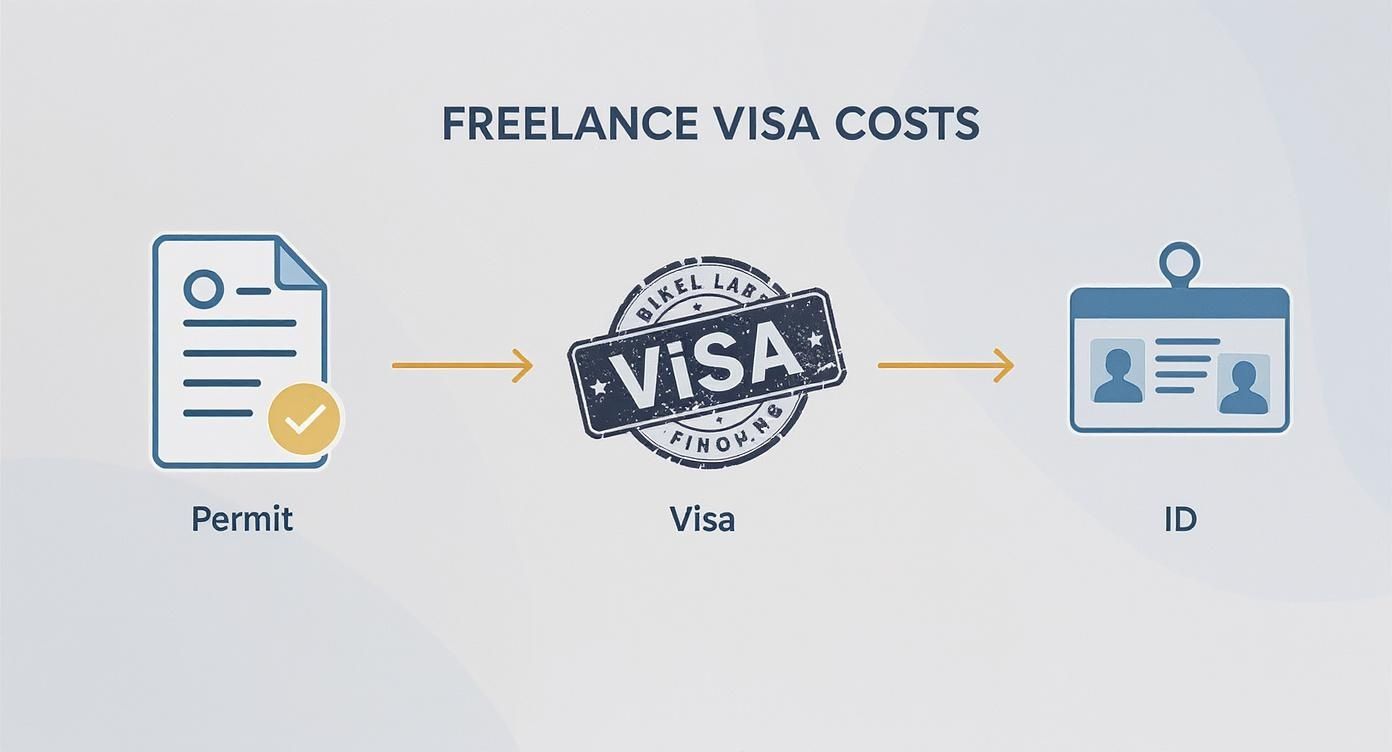
As you can see, it’s a sequence of approvals. Each step—the permit, the visa, and the ID—unlocks the next one, bringing you closer to your official status as a freelance resident.
Stage 2: The In-Country Process
Once your freelance permit application is approved and you receive your entry permit, it’s time to head to the UAE. This next phase is very hands-on and requires you to be physically present to get everything finalised.
- Medical Fitness Test: After you land, one of your first tasks is a mandatory medical screening at a government-approved health centre. It’s a very straightforward procedure, usually just a quick blood test and a chest X-ray to check for any communicable diseases.
- Biometrics and Emirates ID Application: With a clean bill of health, your next stop is a Federal Authority for Identity and Citizenship (ICA) centre. Here, you’ll provide your fingerprints and have your photo taken for your Emirates ID card. This card will become your primary form of identification across the UAE.
- Visa Stamping: This is the final step! Once the medical results are through and the Emirates ID application is in the system, your passport is submitted to have the residence visa stamped inside. This is the official sticker that confirms you’re a resident for the next one or two years.
While you’re settling in, don’t forget to sort out practicalities like your phone. You’ll want to get connected as soon as you arrive, so it’s worth looking into options for reliable mobile data in the United Arab Emirates. With our 24/7 support, we can also give you a steer on these kinds of next steps to help make your transition as smooth as possible.
Let the Experts Handle the Paperwork, So You Can Focus on Your Business
Getting a freelance permit in the UAE involves dealing with several different government bodies, each with its own set of rules, documents, and deadlines. While you can certainly tackle it yourself, you might find it quickly turns into a full-time job. That’s valuable time and energy you could be spending on what really matters: getting your freelance business ready for launch.
This is where bringing in a specialist can be a game-changer. Why take on the extra stress when an expert can handle the entire process for you? As the best corporate service provider in Dubai, Abu Dhabi & Sharjah, we know the system inside and out, so you don’t have to.
Think of Us as Your Business Setup Co-Pilot
Our job is to be your guide through the whole process, making sure every form is filled out correctly and every deadline is met. We’ve designed our cost-effective business setup solutions to be tailored to your needs, whether you’re a graphic designer, an IT consultant, or an international entrepreneur looking to enjoy UAE tax benefits. We’re focused on one thing: getting you set up for success, without the headaches.
Here’s what our experience brings to the table:
- Specialists in Mainland & Free Zone Setups: As specialists in Mainland Company Formation in Dubai & Abu Dhabi and Freezone Company Formation across the UAE, we’ll help you understand the real-world differences and choose the best path for your business goals.
- Affordable, No-Nonsense Solutions: Our packages are transparent and built to offer great value. No hidden fees, no unnecessary complications.
- Smart Advice on UAE Tax Benefits: We help international freelancers and entrepreneurs structure their business to make the most of the UAE’s tax-friendly environment.
- 24/7 Support Service: Questions and concerns don’t stick to a 9-to-5 schedule, and neither do we. We’re always here when you need us, ready to provide the support you need, whenever you need it.
Handing over the administrative work to a professional partner means you can sidestep the common mistakes and delays. It turns a potentially confusing bureaucratic maze into a clear, simple path to starting your freelance career in the UAE.
Ready to begin your journey with confidence?
📞 Call Us Now: +971-52 923 1246
💬 WhatsApp Us Today for a Free Consultation
Frequently Asked Questions
Sorting out the final details before a big move can feel a bit overwhelming. Let’s clear up some of the most common questions freelancers ask about the UAE visa, so you know exactly what to expect.
Can I Sponsor My Family on a Freelance Visa?
Yes, you absolutely can. This is one of the best parts about getting a proper freelance residence visa in the UAE. As soon as your own visa is stamped, you can start the process to sponsor your spouse and children.
You’ll just need to show that you meet the minimum income requirements to support them and have the right paperwork, like your attested marriage and birth certificates. It makes this a genuinely viable, family-friendly option for professionals wanting to bring their loved ones along.
Do I Need to Rent a Physical Office?
For almost every freelancer, the answer is a firm no. Most freelance permits, particularly the popular ones from free zones like RAKEZ or UAQ FTZ, are set up for people who work from home or use co-working spaces. This “flexi-desk” approach is a huge money-saver.
It’s a major reason the freelance route is so appealing—you get all the benefits of a legitimate business licence without being tied down by the cost of a commercial lease.
What Are My Tax Obligations as a Freelancer?
The UAE’s tax-friendly environment is a massive draw. As a freelancer with your own permit, you won’t pay any personal income tax on what you earn.
The main thing to keep an eye on is Value Added Tax (VAT). If your turnover from clients inside the UAE crosses the mandatory threshold of AED 375,000 in a year, you must register for VAT with the Federal Tax Authority and start filing regular returns. It’s a key compliance step to be mindful of as your freelance business scales up.
How Long Does the Entire Visa Process Take?
The total time can shift a bit depending on which free zone you choose and how quickly you get your documents in order. On average, you should plan for the whole thing to take about three to four weeks from the day your complete application is submitted.
This covers everything from getting your initial permit approved and receiving the entry permit, right through to the in-country steps like your medical test, biometrics appointment, and the final visa stamp in your passport. The most common hold-up? Delays with document attestation.
Having an expert partner can make answering these questions—and navigating the process—much easier. At 365 DAY PRO, we specialise in affordable business setup for entrepreneurs in Dubai, Abu Dhabi, and Sharjah. From picking the right licence to managing the paperwork, we’re here to make your start in the UAE a success. Start your seamless business setup with 365 DAY PRO today.