
Protecting your brand in the UAE’s bustling marketplace isn’t just a good idea—it’s essential. Think of your trademark registration in Dubai as the cornerstone of your brand’s identity, giving you the legal muscle to build value, fend off copycats, and operate with real confidence.
Why You Can’t Afford to Skip Trademark Registration in Dubai

In a place as dynamic as Dubai, your brand is everything. It’s your reputation, your connection with customers, and, frankly, one of your most valuable assets. Leaving it legally unprotected is like building a beautiful house on land you don’t own. Sooner or later, you’re going to have a problem.
The official registration process, handled by the UAE Ministry of Economy, gives you the exclusive right to use your mark. Once it’s yours, no one else can legally use a similar name, logo, or slogan within your business categories. This protection is a game-changer for everyone, from a fresh startup in a free zone to a long-standing mainland company.
The High Stakes of an Unregistered Brand
Running a business without a registered trademark is a massive gamble. Picture this: you pour years of effort and money into building a loyal customer base, only to find a competitor has opened up shop with a confusingly similar name. If you haven’t registered your trademark, your hands are largely tied. You risk watching your hard-earned market share and credibility evaporate overnight.
Without that official certificate, you lack the legal standing to shut down infringers quickly and effectively. You could get dragged into expensive, time-consuming disputes that drain resources away from what you do best—running your business.
From a Name to a Valuable Asset
A registered trademark does more than just protect you; it sends a powerful message. It tells customers, investors, and partners that you are serious about your brand’s integrity and future. This legal status is critical for a few key reasons:
- Creates Tangible Value: A registered trademark becomes an intangible asset that boosts your company’s overall worth.
- Enables Growth: It’s a must-have if you ever plan to franchise your business or license your brand to others.
- Secures Your Future: It locks down your brand identity as you expand, stopping others from grabbing your name in new territories.
Businesses are catching on. The UAE witnessed an incredible 64 percent year-on-year increase in trademark registrations in the first quarter, highlighting just how seriously brand protection is now being taken.
Securing your trademark isn’t just a bureaucratic step. It’s the move that transforms your brand from a simple concept into a powerful, defensible, and valuable corporate asset.
Ultimately, getting your trademark registered is a core part of any comprehensive online brand protection strategies designed to protect your identity everywhere. Working with a specialist like 365 DAY PRO can ensure you get it right from the start, providing a cost-effective way to secure your brand’s future.
Nailing the Prep Work for Your Trademark Application
Getting a trademark registered in Dubai is all about laying the right groundwork. I’ve seen too many people rush the application, only to face a rejection that costs them time, money, and a lot of frustration. If you get these initial steps right, the whole process with the UAE Ministry of Economy becomes much smoother.
First things first: you absolutely have to conduct a proper trademark search. This isn’t just a quick look on Google. It’s a deep dive into the official databases to see if your name, logo, or slogan is truly unique and available within your industry.
Honestly, skipping this step is just asking for trouble. Imagine spending a fortune on branding, packaging, and marketing, only to find out months down the line that someone else already owns a similar mark. Your application could be dead on arrival, or even worse, you could be facing a legal battle. A thorough search is your best insurance against that headache.
Finding Your Niche: The Nice Classification
Once you’re reasonably sure your mark is unique, it’s time to figure out where your brand fits. The UAE, along with most of the world, uses the Nice Classification system. This is basically an international catalogue that sorts all goods and services into 45 distinct classes. Picking the right class is critical because it defines exactly what your trademark protects.
You need to file your application under the specific class (or classes) that covers what your business actually does.
Let’s look at a few real-world examples:
- A software company in Dubai would typically file under Class 9 (for the software itself) and maybe Class 42 (for services like IT consulting or SaaS).
- A new coffee shop or restaurant would squarely fall into Class 43 (services for providing food and drink).
- A fashion label selling clothes and shoes needs protection under Class 25 (clothing, footwear, headgear).
Choosing the right Nice classes isn’t just a box-ticking exercise; it sets the legal boundaries for your brand’s protection. Go too broad, and the Ministry might push back. Go too narrow, and you could leave your brand exposed as you grow.
Think about where you are now and where you’re heading. If you plan on expanding your product line or services later, it might be smart to register in those future classes from the start. This stops someone else from swooping in and registering a similar mark in a category you plan to enter. And of course, before you file, you need a solid mark to protect. For some great tips, check out this guide to creating impactful logos.
Getting Your Paperwork in Order
With your search done and classes picked, the last piece of the puzzle is gathering your documents. The UAE Ministry of Economy is very particular about what they need. Having everything organised and ready to go will prevent the kind of administrative delays that can hold up your application for weeks.
Here’s a quick checklist of what you’ll almost always need:
- Trademark Image: A clear, high-resolution digital file of your mark.
- Applicant Details: Your full name, address, and nationality.
- Copy of Trade Licence: If you’re applying as a company, a valid UAE trade licence is non-negotiable.
- Power of Attorney (POA): If you’re using a professional service like ours, you’ll need a properly notarised and legalised POA. This gives us the authority to handle everything for you.
- Passport Copy: A clear copy of the passport for the individual applicant or the company’s manager.
Making sure every document is perfectly filled out, signed, and notarised (where required) is crucial. Tiny mistakes, like a name not matching the trade licence or an incorrect POA, are some of the most common reasons for an application to get bounced back. A little bit of diligence here saves a lot of hassle later and sets you up for a successful registration.
Navigating the Official Registration Process
Once you’ve done your homework—completing your pre-filing search and preparing your documents—it’s time to formally start the registration process with the UAE Ministry of Economy. This is where things get official. Your application will be scrutinised, evaluated, and hopefully, approved, giving your brand the legal protection it deserves.
The journey from submission to certification has a few key milestones. Knowing what to expect at each stage can make the entire procedure much less intimidating.
The infographic below gives a great bird’s-eye view of the foundational steps that pave the way for a smooth official filing.
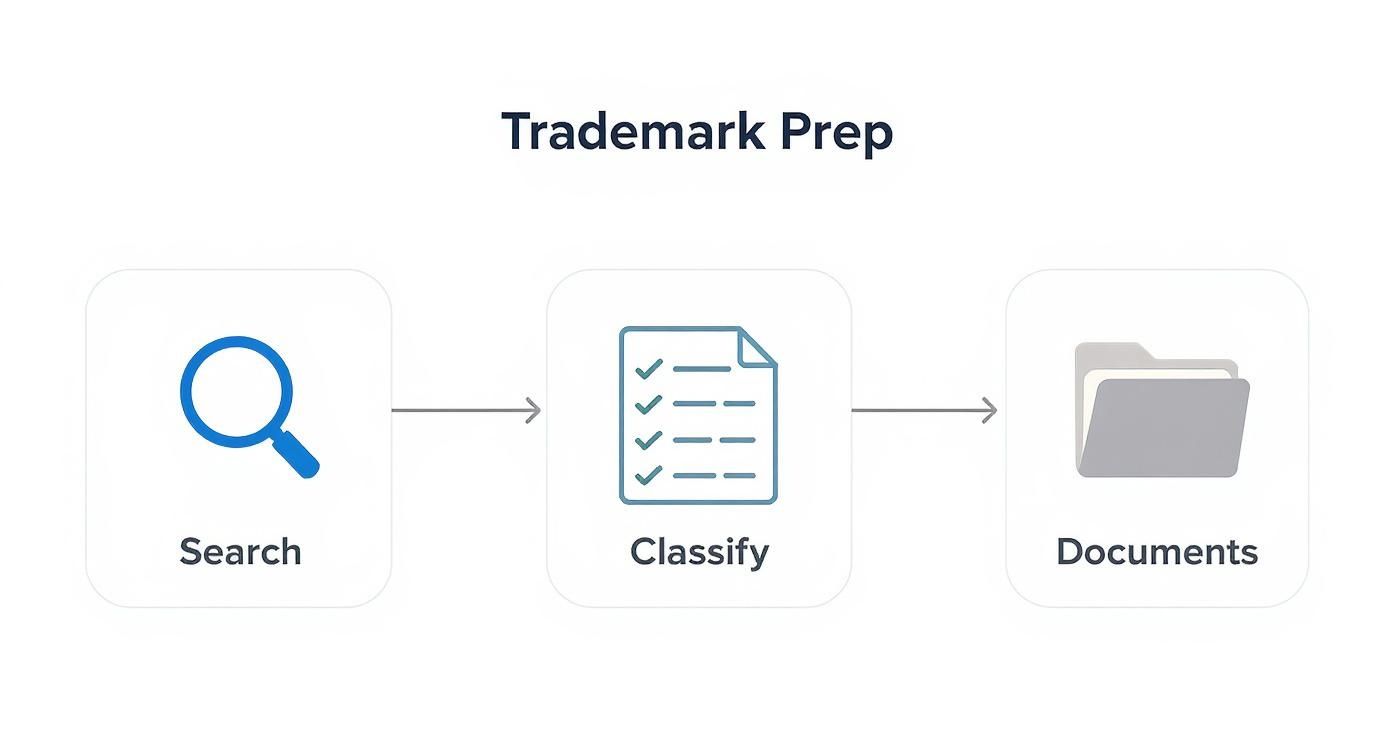
As you can see, the work you put in before you file is just as critical as the filing itself.
Submitting Your Application
Your first move is to file the application through the Ministry of Economy’s online portal. The UAE has embraced a digital-first approach, which makes the initial submission fairly straightforward. You’ll upload all your prepared documents—your trade licence, a high-quality image of your trademark, and a notarised Power of Attorney if you’re working with a firm like ours.
Along with the documents, you’ll need to pay the initial filing fees. A crucial piece of advice here: double-check everything. Make sure every single detail on the online form perfectly matches your supporting paperwork. Even a small discrepancy can trigger a query from the Ministry, immediately pausing your application and adding weeks, or even months, to the timeline.
Inside the Examination Phase
After submission, your application enters the examination phase. This isn’t just a rubber-stamp exercise; it’s the most critical stage of the entire process. An official examiner at the Ministry will perform a deep dive into your application to ensure it complies with UAE Federal Law.
Here’s what they’re looking for:
- Distinctiveness: Is your mark genuinely unique? Or is it too generic or descriptive for the goods or services you offer? The goal is to ensure consumers can clearly identify your brand.
- Compliance: The examiner will check that your mark doesn’t conflict with public morals or religious principles, a significant consideration within the UAE’s cultural and legal framework.
- Conflict Check: They conduct their own comprehensive search for any existing trademarks—both registered and pending—that might be confusingly similar to yours.
This review can take a few months. If the examiner flags an issue, you’ll receive what’s called an “office action.” You’ll have a limited time to respond with a solid legal argument or make necessary amendments. This is where having an expert in your corner can make all the difference in crafting a response that satisfies the examiner’s concerns.
The Publication and Opposition Period
If your application clears the examination, it’s not quite the finish line. The next step is publication. Your trademark’s details will be published in the Official Gazette and two local Arabic newspapers. Think of it as a public announcement of your intent to register the mark.
This publication kicks off a 30-day opposition period. During this month, any third party who feels your trademark infringes upon their rights has the chance to formally object.
An opposition is a serious legal challenge. If someone files one against your application, it triggers a formal proceeding where both sides must present evidence and arguments. This is a situation where you absolutely need professional legal support to defend your brand.
If the 30 days pass without any opposition, or if you successfully defend against one, your application is finally approved for registration.
Securing Your Certificate and Planning for Renewal
With the final hurdles cleared, you’ll pay the last set of registration fees. The Ministry of Economy will then issue your official trademark registration certificate. This document is your proof of ownership, granting you exclusive rights to use that mark across the UAE. It’s a massive milestone.
Your trademark registration in Dubai is valid for 10 years from the date you first filed the application. It’s an asset you need to maintain. To keep your protection in place, you must renew it within the final year of its validity period. Missing this deadline can result in your mark being dropped from the register, leaving your brand exposed. We always tell our clients to set calendar reminders a full year in advance—it’s the easiest way to ensure your brand stays protected for decades.
UAE Trademark Registration Timeline and Cost Breakdown
To give you a clearer picture of the investment in time and money, here’s a breakdown of the typical process. Keep in mind that these are estimates, and complex cases or oppositions can extend the timeline and add costs.
| Stage | Estimated Timeline | Typical Government Fees (AED) | Notes |
|---|---|---|---|
| Filing & Initial Review | 1-2 weeks | 1,000 | Fee to submit the application and get it into the system. |
| Examination | 2-4 months | – | No direct fee, but this is the Ministry’s internal review period. |
| Publication | 1 month | 1,000 | Fees for publishing in the Official Gazette and local newspapers. |
| Opposition Period | 30 days | – | A waiting period. Costs only incur if an opposition is filed. |
| Registration | 1-2 weeks | 10,000 | Final fee to issue the certificate after the opposition period closes. |
| Total Estimated Time | 4-6 months | 12,000 | This is for a straightforward application with no objections. |
This table outlines the government fees you can expect. Professional service fees for handling the entire process, from search to renewal reminders, are separate and provide significant value by ensuring a smooth and successful registration.
Thinking Beyond Borders: Taking Your Trademark Global
Getting your trademark registered in Dubai is a massive win, but for most forward-thinking businesses, the UAE is just the starting point. As your company scales, your ambitions will inevitably cross borders, and your brand protection strategy needs to be ready to move with you.
The good news is that expanding your trademark’s reach doesn’t mean you have to start the entire lengthy process from scratch in every new country.
Your Gateway to the World: The Madrid Protocol
Thankfully, the UAE is a member of the Madrid Protocol, an international treaty that dramatically simplifies protecting a trademark in multiple countries. For businesses with global aspirations, this system is a real game-changer.
Instead of wrestling with separate, expensive, and complicated applications in each jurisdiction, the Madrid Protocol allows you to file a single international application. You kick this off through the UAE Ministry of Economy, using your local UAE registration as the foundational or “base” mark. From there, you can designate any of the 130 member countries where you want to secure protection.
Think about it: your brand is taking off, and you’re eyeing expansion into Europe, Asia, and North America. The old way involved hiring lawyers in each region, navigating different legal systems, and paying multiple sets of fees. The Madrid Protocol streamlines all of this into one application, in one language, with one set of fees. It’s a far more efficient and cost-effective path to securing your brand internationally.
The Madrid Protocol is the most strategic tool for global brand protection. It centralises a complex international process, saving you an incredible amount of time, money, and administrative headaches while locking down your brand in key markets.
Protecting Your Turf: Enforcement Within the UAE
While global expansion is exciting, you can’t lose sight of protecting your brand right here at home. Discovering that someone is piggybacking on your registered trademark without permission is infuriating, but you have powerful legal tools at your disposal in the UAE. The key is knowing how to act decisively to shut down infringement fast.
Intellectual property filings are booming in the United Arab Emirates. A recent period saw 18,175 new trademarks registered—a staggering 39 percent jump from the previous year. In such a crowded marketplace, robust enforcement has never been more critical. You can discover more insights about the growth of IP registrations in the UAE.
Practical Steps to Stop Trademark Infringement
So, what do you do when you find an infringer? The first move, almost always, is to have a legal professional send a formal cease-and-desist letter. This isn’t just a simple request; it’s an official notice informing the other party they are violating your legal rights and demanding an immediate stop. Often, this is enough to resolve the problem without things getting messy.
If they ignore the letter or refuse to comply, it’s time to escalate. Your next step is filing a formal complaint with the relevant authorities.
Here’s who you turn to:
- Department of Economic Development (DED): For infringements on the Dubai mainland, the DED is your first port of call. They have the power to investigate, conduct raids, and confiscate counterfeit goods.
- Customs Department: If you’re worried about fake versions of your products being imported, you can register your trademark with customs. This gives them the authority to identify and seize infringing goods right at the border before they ever hit the market.
- Filing a Court Case: For more serious or persistent violations, bringing a case to the UAE courts is the ultimate step. This can result in major financial penalties for the infringer and a legally binding court order to stop all their infringing activities.
Navigating these channels requires a certain finesse and expertise. This is where partnering with a corporate service provider like 365 DAY PRO gives you the backing you need to act swiftly and effectively, ensuring your hard-earned brand identity is defended—both here in the UAE and wherever your business takes you next.
Common Mistakes to Avoid When Filing
Getting your trademark registration in Dubai across the finish line can feel like navigating a minefield. The path seems simple enough, but it’s littered with small, easy-to-miss traps that can cause serious delays or even get your application thrown out by the UAE Ministry of Economy. I’ve seen it happen time and again. Knowing what these pitfalls are from the start is the best defence for your brand.
Perhaps the single biggest mistake is cutting corners on the pre-filing search. A quick Google search just won’t cut it. You need to be absolutely sure your mark isn’t too similar to an existing one, or so generic that it can’t be protected in the first place. Imagine spending a fortune on branding and marketing, only to find out six months later that your application has been rejected and you have to start all over. It’s a costly, frustrating, and entirely avoidable scenario.
Another classic error is getting the Nice Classification wrong. This system is incredibly specific, and a misstep here can leave huge gaps in your legal armour. For example, say you’re launching a food delivery app. You might register it under a restaurant services class, but if you forget the software class, what’s stopping a competitor from launching a nearly identical app with a similar name? Legally, you’ve left the door wide open.
Incomplete or Incorrect Documentation
There’s no faster way to stall your application than by submitting sloppy paperwork. The Ministry’s requirements are rigid, and they will send your file back for even the slightest error.
Here are a few of the most common documentation blunders we see:
- Poor Quality Logo Files: A blurry, low-resolution logo is an instant red flag. Your mark’s image needs to be crisp, clear, and in the correct format.
- Mismatched Information: The applicant’s name on the registration form has to be exactly as it appears on the trade licence. No variations, no abbreviations.
- Invalid Power of Attorney (POA): If an agent is filing for you, the POA must be perfectly notarised and legalised. Any mistake here brings the entire process to a dead stop.
These might sound like minor details, but each correction adds weeks, sometimes months, to the timeline.
Ignoring International Context
In a global hub like Dubai, thinking only locally is a major strategic blind spot. If you have any ambition to expand, you need to consider international protection from day one, and that means looking at the Madrid Protocol.
The WIPO’s Madrid System is a game-changer, offering a central gateway to file for protection in multiple countries at once.
This system simplifies what would otherwise be a chaotic and expensive process of filing country by country. Ignoring it means you could pour resources into growing your brand, only to discover your name is already taken in your next target market. That’s a roadblock that can halt expansion in its tracks.
A successful trademark registration isn’t just about filing forms. It’s about building a strategic defensive wall around your brand. Overlooking any of these common mistakes can leave a critical gap in that wall.
Recent government initiatives have made the UAE’s IP system more friendly for SMEs by reducing some official fees. But don’t mistake lower costs for less complexity. The legal hurdles are still very much in place. You can read more about these UAE trademark system reforms to get a better sense of the current landscape.
This is precisely where professional guidance pays for itself. As specialists in this field, we handle the nitty-gritty of trademark registration in Dubai day in and day out. We know the system, we know the common traps, and we make sure every detail is perfect—from conducting the deep-dive search to preparing flawless documents. It’s the most cost-effective way to save yourself time, money, and a whole lot of headaches.
Common Questions About Dubai Trademarks Answered
When you’re looking to protect your brand in the UAE, a lot of questions pop up. It’s completely normal. Before you invest your time and money, you need clear answers. Here, I’ll walk you through some of the most common queries we get from business owners just like you, breaking down the essentials so you can move forward confidently.
What Can I Actually Register as a Trademark?
The simple answer is you can register almost any unique signifier of your brand. But of course, there are rules. The whole point of a trademark is to be distinctive—it has to clearly separate your products or services from everyone else’s.
You can generally register things like:
- Brand and Product Names: Think “Apple” for computers or “Nespresso” for coffee.
- Logos and Symbols: The Nike swoosh or the McDonald’s golden arches are perfect examples.
- Slogans and Taglines: “Just Do It” is a classic. It’s short, memorable, and tied directly to a brand.
- Sounds or Scents: This is less common, but if you have a unique jingle or a specific scent for your retail stores, it is possible to register it.
What you can’t do is register something generic. Trying to trademark “Fresh Juice” for a juice company won’t fly because it just describes the product. The Ministry of Economy will also reject anything that goes against public morals, uses official state emblems, or is just too similar to a mark that’s already registered.
The real test is distinctiveness. Does your mark point directly to your brand, or is it just a general description? If you’re unsure, our team at 365 DAY PRO can give you a quick, honest assessment of whether your mark is likely to get approved.
How Long Does Trademark Registration Take in Dubai?
This is one of the first things everyone asks, and the answer is: you’ll need a bit of patience. If everything goes smoothly and there are no objections, you’re looking at a timeline of six to twelve months from the day you file to the day you have the registration certificate in hand.
That window covers all the necessary stages: the initial filing and review, the detailed examination by the Ministry, the mandatory 30-day publication period (where it’s announced publicly), and the final certificate issuance.
Keep in mind, that’s the best-case scenario. If the examiner raises questions or, more seriously, another company formally opposes your application, the process can get significantly longer. This is where working with a professional really helps—we know how to anticipate common roadblocks and handle them efficiently to keep things on track.
What’s the Difference Between a Trademark and a Trade Name?
This is a huge point of confusion for new entrepreneurs, but the difference is critical.
- A trade name is your company’s legal name. It’s what you register with the Department of Economic Development (DED) or a free zone authority to get your business licence. It lets you operate legally, but it doesn’t offer much in the way of brand protection.
- A trademark, on the other hand, protects your brand identity—the logo, name, or slogan that customers actually see and associate with your products or services.
Think of it this way: your registered trade name might be “Desert Bloom General Trading LLC,” but you sell your products under the brand name “Oasis,” complete with a unique logo. The trade name lets you exist as a legal entity; the trademark stops competitors from using the “Oasis” name and logo.
What Happens If Someone Opposes My Trademark?
Getting an opposition notice can feel intimidating, but it’s a standard part of the process. After your mark is approved by the examiner, it’s published for 30 days. During this window, anyone who thinks your trademark infringes on their rights can file a formal objection.
If this happens, the Ministry of Economy will notify you, and you’ll have 30 days to submit a counter-statement. This isn’t just a simple reply; it’s a legal defence of your application. The Ministry then reviews arguments from both sides before making a ruling.
This stage is serious business and requires a solid understanding of UAE trademark law. Frankly, it’s not something you want to handle alone. Having experienced professionals like us in your corner is absolutely essential to build a strong case and protect your brand.
Ready to secure your brand’s future in the UAE? Navigating the complexities of trademark registration in Dubai is what we do best. The team at 365 DAY PRO Corporate Service Provider LLC are specialists in mainland and free zone business setup, offering cost-effective solutions and 24/7 support to ensure your intellectual property is protected correctly from day one.
✅ Best Corporate Service Provider in Dubai, Abu Dhabi & Sharjah
✅ Specialists in Mainland Company Formation in Dubai & Abu Dhabi
✅ Specialists in Freezone Company Formation across the UAE
✅ 24/7 Support Service – Always here when you need us
✅ Cost-Effective Business Setup Solutions tailored to your needs
✅ Enjoy UAE Tax Benefits for International Entrepreneurs
📞 Call Us Now: +971-52 923 1246
💬 WhatsApp Us Today for a Free Consultation