
Keeping your Dubai trade license up to date isn't just another box to tick on your annual to-do list. It's a fundamental part of keeping your business legally sound and running smoothly. Think of it less as paperwork and more as a crucial health check for your company. A timely trade license renewal in Dubai is what separates you from hefty fines, serious operational roadblocks, and a damaged reputation with key bodies like the Dubai Department of Economy and Tourism (DET).
The High Stakes of Your Annual Renewal

Running a business in Dubai’s fast-paced market means playing by the rules, and your trade license is the rulebook's first chapter. Letting that license expire is simply not an option—it’s a fast track to some major business headaches. The consequences aren't just a possibility; they're a certainty, put in place to ensure every company maintains its legal standing.
The fallout from a late renewal goes way beyond a simple penalty. It kicks off a domino effect that can bring your operations to a grinding halt. When you understand what’s really at stake, this yearly task shifts from a routine chore to a strategic move that protects the business you've poured everything into.
Financial and Operational Penalties
The first and most obvious hit is to your wallet. The DET hands out monthly fines that add up quickly, turning what should be a standard cost into a significant financial drain. But those penalties are just the tip of the iceberg. An expired license can trigger much more severe actions that directly threaten your ability to operate:
- Frozen Corporate Bank Accounts: Once your license is invalid, banks are obligated to freeze your company accounts. Suddenly, you have no cash flow to pay salaries, cover supplier invoices, or manage daily expenses.
- Visa Processing Blocks: Your company's immigration file can be suspended. This means you can't apply for new employee visas or even renew existing ones, crippling your ability to hire and retain the talent you need.
- Company Blacklisting: If you ignore the renewal for too long, your company can be blacklisted. This does serious damage to your professional reputation and makes it incredibly difficult to conduct business in the future.
A timely renewal isn’t just about dodging fines; it’s about protecting the very heart of your business operations and its credibility in a fiercely competitive market. It sends a clear signal to everyone—clients, partners, and the authorities—that your company is stable, professional, and reliable.
The sheer volume of businesses here highlights just how vital this process is. As of mid-2023, Dubai was home to a record 460,000 active business licenses, which is almost half of all licenses across the UAE. Since these licenses are valid for just one year, it creates a constant flow of renewal applications. You can dig into more data on the UAE's business landscape to see the full picture.
Getting Your Paperwork in Order: A No-Nonsense Checklist
A smooth trade license renewal in Dubai isn't about luck; it's about preparation. The secret to avoiding frustrating delays or, worse, a rejection, is to get all your documents lined up well before you even think about submitting them. It’s the difference between a quick, seamless process and one that gets bogged down in back-and-forth corrections.
This isn't just about collecting a stack of papers. Each document tells a part of your business's story, and the authorities need to see that every detail is correct and up-to-date. A single missing signature or an expired certificate can bring everything to a grinding halt.
The Foundational Four: Core Documents for Every Renewal
No matter your business activity, a few key documents form the bedrock of every renewal application on the mainland. Think of this as your starting lineup – get these right, and you're already halfway there.
- The Typed BR/1 Form: This is your official renewal application. It needs to be filled out perfectly with your company's current details. Don't forget, it must be signed by an authorised partner and carry the official company stamp.
- A Copy of Your Current Trade License: Simple enough, but make sure it’s a clear, legible copy of the license you’re renewing.
- Valid Passport Copies: You'll need up-to-date passport copies for every partner and investor named on the license. A good rule of thumb is to check that no one's passport is close to expiring.
- A Valid Tenancy Contract and Ejari Certificate: For mainland businesses, this is non-negotiable. Your tenancy contract must be valid for at least one month from the date you submit your renewal application. Critically, it must be registered on the Ejari system.
An invalid or unregistered tenancy contract is the number one reason for an instant rejection. Before you do anything else, double-check your Ejari status. This is the official proof of your physical business address, and the authorities will not proceed without it.
The sheer volume of renewals processed highlights how critical accuracy is. Just to give you an idea, Sharjah—right next door to Dubai—handled a staggering 30,910 trade license renewals in the first half of 2024 alone. In every single case, the BR/1 form and a valid tenancy contract were essential.
To make this easier to digest, here’s a quick summary of what you absolutely must have ready.
Essential Document Checklist for Trade License Renewal
| Document | Key Requirement | Pro Tip |
|---|---|---|
| Typed BR/1 Form | Must be filled out accurately, signed, and stamped. | Download the latest version from the official portal to avoid using an outdated form. |
| Current Trade License | A clear, readable copy is required. | Keep a digital copy on file for easy access every year. |
| Passport Copies | Valid copies for all partners/investors. | Check expiry dates at least three months before renewal to avoid last-minute surprises. |
| Tenancy Contract & Ejari | Must be valid for at least one month and registered. | Verify your Ejari registration online before you start the renewal process. It saves a lot of headaches. |
Getting these four documents in perfect order sets you up for a hassle-free renewal.
Don't Forget External Approvals and Specialised Paperwork
Now for the part that trips up many business owners. Depending on what your company does, you might need a green light from other government departments before you can renew. Think of it this way: the Department of Economy and Tourism (DET) gives the final sign-off, but only after other relevant bodies have given their nod.
For instance, a medical clinic will need approval from the Dubai Health Authority (DHA). A restaurant needs clearance from the Food Safety Department of Dubai Municipality. A construction firm? You'll likely need approvals from several municipal departments.
If you’re planning a move, a comprehensive business relocation checklist can be a lifesaver, ensuring you don’t miss crucial steps like updating your license details with the right authorities.
Forgetting these external approvals is a classic mistake that can stop your renewal dead in its tracks. The best approach is to identify all the regulatory bodies tied to your business activity and get their approval before you even start the main renewal application with the DET. A little proactive legwork here can save you a world of trouble later.
Navigating the Dubai Licence Renewal Process
Now that you have all your paperwork in order, you’re ready to tackle the actual renewal. The whole thing is handled online, which might sound a bit daunting, but it's actually a pretty logical and efficient system once you get the hang of it. Knowing the flow beforehand takes away all the guesswork.
Your main port of call will be the Dubai Department of Economy and Tourism (DET) e-Services platform. This is where the magic happens – from uploading your documents to receiving your new licence. It’s a far cry from the old days of paper-shuffling and long queues, making life much easier for business owners.
Kicking Off Your Digital Renewal
First things first, you'll need to submit your application on the official portal. This is where your preparation pays off. You'll be prompted to upload the documents you've gathered, primarily your valid, attested tenancy contract and the completed BR/1 form. The system is quite intuitive and guides you through what it needs.
Once everything is uploaded and the system verifies your documents, it will generate a payment voucher. This is a key step. The voucher lays out all the government fees for your renewal, so you see a clear, itemised breakdown of the costs. No surprises or hidden fees here; what's on the voucher is what you pay.
This infographic gives you a quick visual on the core documents you'll need to get this done.
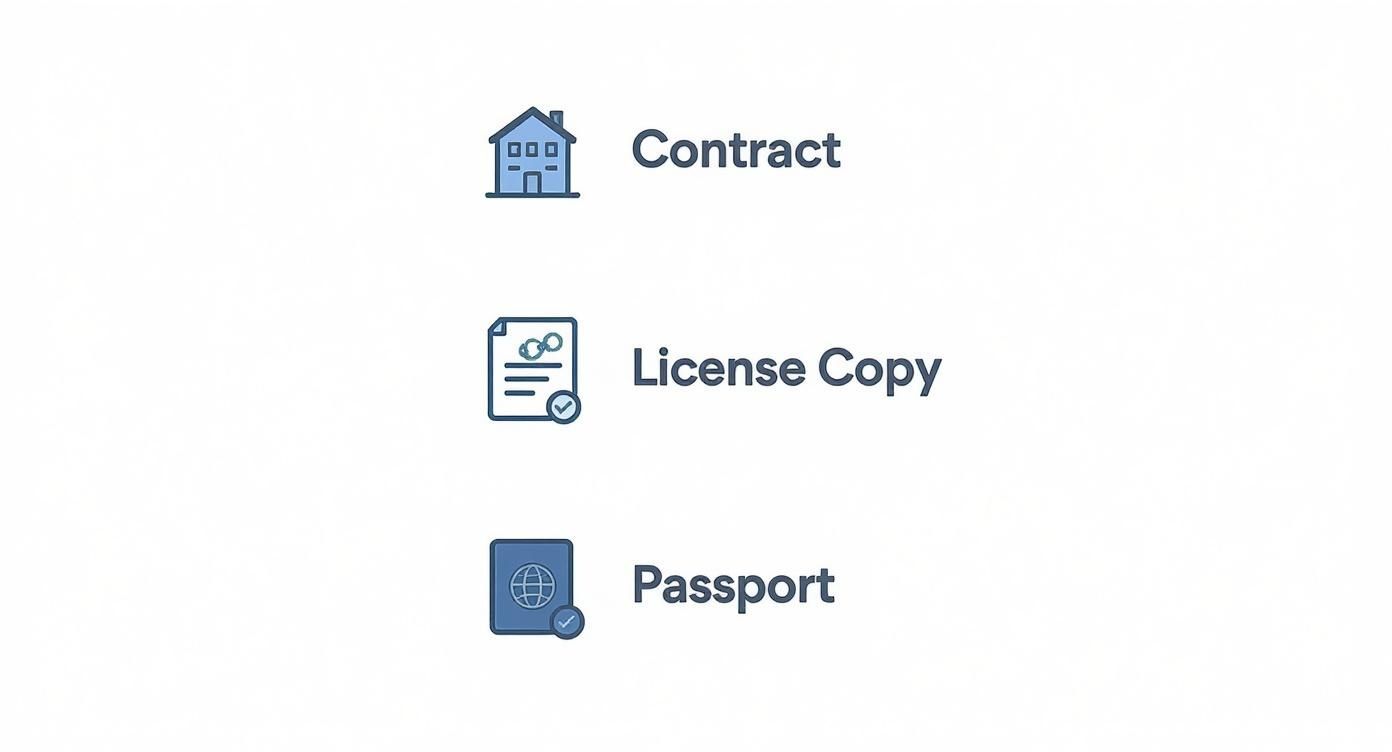
Essentially, getting your tenancy contract, licence copy, and partner passports ready is the bedrock of a smooth digital submission.
Settling Fees and Awaiting Your New Licence
With the payment voucher in hand, the next step is to settle the fees. You can do this directly through the portal using various online payment options. It’s a secure and straightforward transaction that officially moves your application into the final stage. If you're looking for ways to make administrative tasks like this even smoother, exploring AI business agent services can be a smart move to help manage these digital government interactions.
So, what happens after you've hit 'pay'? Honestly, the wait is usually pretty short. For most standard renewals, the DET processes everything and issues the updated trade licence within 1 to 3 working days. This quick turnaround is one of the biggest perks of the digital system. Your new licence will land in your inbox, ready to print and display.
I remember a client, a consulting firm, whose Ejari was expiring just two weeks before their licence renewal. They acted fast, renewed their tenancy contract, and got the Ejari updated right away. Because of that, they got their payment voucher without a hitch and had the new licence in their hands just 24 hours after paying. It just goes to show how being prepared can really speed things up.
Working with a Corporate Service Provider
Of course, you don't have to go it alone. Many business owners opt to use a corporate service provider to handle the renewal. Why? Because these firms live and breathe this stuff. They manage the entire process for you—from checking documents and submitting the application to paying the fees and chasing up the final licence.
There are some real benefits to this approach:
- Fewer Headaches: They make sure every form is filled out perfectly and all documents are up to date, which means no frustrating rejections.
- More Time for You: You can stay focused on what you do best—running your business—while they handle the admin.
- Expert Backup: As specialists in both mainland and free zone setups, they know exactly how to navigate any curveballs the process might throw.
With 24/7 support services, a good provider is always on hand to give you updates or answer questions. Their whole game is about creating a hassle-free experience so you can keep enjoying the tax benefits of doing business in the UAE without any interruptions.
Breaking Down the Cost of Your License Renewal
When it comes to renewing your trade license in Dubai, the last thing you want are financial surprises. Getting a handle on the costs ahead of time is crucial for keeping your business finances in order and ensuring a smooth, stress-free process. The total amount you'll pay isn't just one flat fee; it’s a combination of several different charges.
At the heart of it is the basic renewal fee from the Department of Economy and Tourism (DET). But on top of that, you'll see a few smaller, mandatory fees like the Knowledge Dirham and Innovation Dirham, which support various government initiatives. It's also worth remembering that if your business activities need special sign-offs from other authorities, those will come with their own price tags.
What Goes into the Final Bill?
The final figure on your payment voucher depends on a few key variables. You’ll need to account for all of them to budget accurately.
- Your Office Space: For mainland companies, this is a big one. Your annual office rent plays a direct role in calculating the fees. You also can't forget about the Ejari registration fee – it's a mandatory cost for validating your tenancy contract.
- Government and Municipality Fees: This is the core chunk of the renewal expense. The exact amount can vary quite a bit, depending on your company's legal structure and the specific business activities listed on your license.
The New Mandatory Audit Rule
One of the most significant changes in recent years is the requirement for many companies to submit audited financial statements. This isn't just a bit of extra paperwork; it adds a whole new layer of compliance and cost to the renewal process. You'll need to hire a certified audit firm, which is an expense you should build into your annual budget well in advance.
Getting your head around these costs before the renewal is due is the best way to avoid financial headaches. It lets you budget properly and have the funds ready to go when the payment voucher arrives, preventing any hold-ups.
While the exact costs for a mainland renewal can be a bit of a moving target, we can look at the free zones for a solid benchmark. In the DMCC free zone, for instance, the trade and service license renewal fee for 2025 stands at AED 20,265 per year. Keep in mind, this figure doesn't cover variable costs like your office lease, employee visas, or those now-essential audited financials.
To get a more detailed perspective, you can learn more about the renewal costs of a business license in the UAE. Partnering with a specialist who provides clear, cost-effective business setup solutions can make all the difference. They'll give you an upfront, itemised breakdown of every fee, so you can budget with absolute confidence.
Common Renewal Mistakes and How to Avoid Them

While renewing your trade license in Dubai should be a routine part of your annual business cycle, it’s surprisingly easy to get tripped up. I’ve seen many entrepreneurs run into the same avoidable hurdles, leading to frustrating delays, unexpected fines, and sometimes even outright rejection. Knowing what these common pitfalls are is half the battle.
One of the most common showstoppers? The Ejari certificate. Your tenancy contract and its corresponding Ejari registration are the official proof of your company's physical address. If your Ejari expires even a day before you submit your renewal, the authorities will reject your application on the spot. It’s a simple oversight that can bring the entire process to a grinding halt.
Another classic mistake is submitting incomplete or outdated paperwork. It could be something as simple as forgetting a partner’s new passport copy or missing a signature and stamp on the BR/1 form. Think of each document as a vital piece of a puzzle—one missing element and your application gets flagged for review, adding weeks to your timeline.
Missing Key Deadlines and External Approvals
When it comes to renewals, timing really is everything. Procrastinating until the last minute is a recipe for disaster. It leaves you zero buffer to fix any errors that might pop up and dramatically increases your chances of missing the expiry date, which means you'll be hit with some pretty steep monthly fines.
A more complex, but equally frequent, issue is forgetting to get the necessary external approvals. This is especially critical for businesses operating in regulated fields.
- Healthcare clinics, for example, must secure pre-approval from the Dubai Health Authority (DHA).
- Restaurants and food trading companies need the go-ahead from the Dubai Municipality.
- Educational institutions can't proceed without a nod from the Knowledge and Human Development Authority (KHDA).
Trying to renew your license without these permissions in hand is a non-starter. Your application will be denied, full stop. The right way to do it is to identify all required third-party approvals and get them sorted before you even think about submitting your application to the Department of Economy and Tourism.
"The most common delays we see stem from expired tenancy contracts and missing external approvals. A proactive approach, starting at least a month before expiry, can eliminate 90% of potential issues."
By keeping these common missteps in mind, you can build a clear and effective renewal strategy. Of course, if you'd rather sidestep these headaches entirely, partnering with a specialist in mainland company formation in Dubai can be a real game-changer. A good corporate service provider will manage every last detail, ensuring documents are perfect, deadlines are hit, and all approvals are secured. It frees you up to focus on what you do best—running your business—with the confidence that your renewal is being handled flawlessly, often with the backing of 24/7 support for complete peace of mind.
Your Dubai Trade License Renewal Questions Answered
When you're running a business in Dubai, renewing your trade license is an annual task you can't ignore. It's perfectly normal to have a few questions about the specifics, especially with rules and requirements sometimes shifting. Getting the right answers upfront can save you a world of headaches, time, and money down the line.
Let's break down some of the most common questions we hear from entrepreneurs just like you.
What Happens If I Miss My Renewal Deadline?
Forgetting to renew your license on time is a serious misstep with immediate knock-on effects. The moment your license expires, the Department of Economy and Tourism (DET) starts imposing monthly fines for every single month you're late.
But it gets worse than just financial penalties. Your company’s corporate bank account could be frozen, completely paralysing your ability to make payments or receive funds. On top of that, you’ll be blocked from all visa services, so forget about sponsoring new staff or renewing visas for your current team. If left unresolved for too long, your company could even be blacklisted, making it incredibly difficult to do business at all.
Can I Renew My License with an Expired Ejari?
For any mainland company, the answer is a hard no. Your Ejari is your official, attested proof of a physical business address, and the system is built to enforce this. The online renewal portal simply won't let you proceed if your Ejari has expired.
This means your first move must be to renew your tenancy contract with your landlord. Once that's done, you need to get the new contract registered on the Ejari portal. Only then can you even think about starting the license renewal itself.
Your Ejari and your trade license are tied at the hip. Think of renewing your Ejari as step zero in your annual compliance checklist. Get it sorted first to avoid a major bottleneck with the DET.
Is Submitting an Audited Financial Report Mandatory?
Increasingly, yes. This is becoming a standard requirement for many companies, not just on the mainland but in several free zones as well. The authorities are pushing for greater financial transparency, and audited reports are a key part of that initiative.
Don't leave this to the last minute. You need to line up a certified audit firm well before your license is due to expire. A proper audit takes time—often several weeks—and you can't finalise your renewal without that report in hand. Be sure to factor the time and cost into your annual planning.
Can I Change My Business Address During Renewal?
You can, but it makes things a lot more complicated. Changing your address isn't a minor tweak; it's a formal license amendment. This means you have to get a new tenancy contract, register the new Ejari, and then submit a separate application to the DET to officially update the address on your license.
The renewal can only happen after the address amendment is fully approved. Frankly, a much smarter way to do it is to handle the address change as a completely separate process before you kick off the renewal application. It keeps things clean and avoids unnecessary delays.
Navigating the renewal process doesn't have to be a source of stress. At 365 DAY PRO Corporate Service Provider LLC, we are the best corporate service provider in Dubai, Abu Dhabi & Sharjah, ready to handle all the details for you.
✅ Specialists in Mainland Company Formation in Dubai & Abu Dhabi
✅ Specialists in Freezone Company Formation across the UAE
✅ 24/7 Support Service – Always here when you need us
✅ Cost-Effective Business Setup Solutions tailored to your needs
✅ Enjoy UAE Tax Benefits for International Entrepreneurs
📞 Call Us Now: +971-52 923 1246
💬 WhatsApp Us Today for a Free Consultation at https://365dayproservices.com