For expats setting up a life in the UAE, one of the most important milestones is bringing your family over. Securing a UAE spouse visa is the official path to doing just that, allowing a legal resident to sponsor their husband or wife and grant them residency. It’s the key to truly making the Emirates your family’s home.
Bringing Your Spouse to the UAE

Starting a new chapter here often feels incomplete until your loved ones are with you. The spouse visa, which falls under the broader category of a family or dependent visa, is designed precisely for this. It ensures that legally married couples can live together, giving the sponsored spouse the same residency rights as the sponsor.
This process is available to any expatriate with a valid UAE residency visa who meets specific criteria. It doesn’t matter if you’re a salaried employee at a mainland company or an entrepreneur running a free zone business—the ability to sponsor your spouse is a fundamental benefit of living and working here.
Who Is Eligible to Sponsor a Spouse?
Eligibility really boils down to your professional status and, most importantly, your financial stability. The UAE government has clear guidelines to make sure sponsors can properly support their dependents. In a country with over 9 million foreign nationals, the family visa system is a well-oiled machine.
To sponsor your spouse, you must have a valid UAE residency visa and proof of suitable accommodation (like an Ejari). Crucially, you also need to meet a minimum monthly salary, which recent updates from the ICP have set at a standard AED 4,000 for sponsoring immediate family. You can find more details on the latest requirements for the spouse visa in the UAE on inzone.ae.
The two main pillars of your application will be:
- Minimum Salary: You have to hit a specific income threshold to prove you can financially support your spouse.
- Proof of Accommodation: A registered tenancy contract is required to show you have adequate housing.
A common myth is that the sponsorship process is a bureaucratic nightmare. The truth is, if you meet the core salary and housing requirements with the right paperwork, it’s a surprisingly straightforward and systematic process. The authorities just need to see clear, verifiable proof that you can provide for your family.
Key Differences for Salaried vs. Self-Employed Sponsors
While the goal is the same, how you prove your income depends entirely on your employment status. If you’re a salaried employee, your path is pretty clear-cut: you’ll need a salary certificate and a labour contract issued by your employer.
It’s a different story for a business owner or investor. Instead of a salary certificate, you’ll need to provide other evidence of your financial standing. This could mean presenting company bank statements for the last few months, providing an audited financial report, or showing other proof of your investment and income.
To make it clearer, here’s a quick breakdown of the core requirements.
UAE Spouse Visa Eligibility at a Glance
This table offers a quick summary of the fundamental requirements for sponsoring a spouse in the UAE, highlighting the differences between salaried individuals and business owners.
| Requirement | Salaried Employee | Business Owner / Investor |
|---|---|---|
| Minimum Salary | AED 4,000 per month (or AED 3,000 + accommodation) | Varies; must show sufficient, stable income |
| Proof of Income | Official Labour Contract & Salary Certificate | Company Bank Statements (3-6 months), Audited Financials, Trade Licence |
| Residency | Must hold a valid UAE Residence Visa | Must hold a valid UAE Investor/Partner Visa |
| Accommodation | Registered Tenancy Contract (e.g., Ejari) | Registered Tenancy Contract (e.g., Ejari) |
| Marriage Proof | Attested Marriage Certificate | Attested Marriage Certificate |
Both routes are equally valid, but the key to a smooth application is preparing the correct financial documents from the very beginning.
Getting Your Paperwork in Order
Let’s be honest, the paperwork is the most tedious part of any visa process. For a UAE spouse visa, getting it right the first time is everything. Think of it as building a case file for the authorities; you want it to be so complete and clear that they have no reason to question it.
A single missing document or a stamp in the wrong place is the number one reason applications get rejected right out of the gate. That means delays, frustration, and often, extra costs. So, before you even think about heading to an AMER centre, you need to have every single document prepared and properly verified.
What You’ll Need as the Sponsor
As the person sponsoring your spouse, you need to prove you’re a legal resident with a stable income and a proper place to live. The documents are fairly standard, but they have to be current and clear.
Make sure you have high-quality colour copies of these:
- Your Passport & Residence Visa: Your passport needs at least six months of validity left. The visa page should be clear and up-to-date.
- Your Emirates ID: A copy of the front and back is a must.
- Salary Certificate: This isn’t just a letter; it has to be an official, recent certificate from your employer, issued in Arabic on company letterhead, clearly stating your monthly salary.
- Labour Contract: You’ll need a copy of your official contract. You can usually download this straight from the Ministry of Human Resources and Emiratisation (MOHRE) app or their website.
- Tenancy Contract (Ejari): This proves you have accommodation. In Dubai, it’s the Ejari; in Abu Dhabi, it’s the Tawtheeq. It must be valid.
What Your Spouse Needs to Provide
For your husband or wife, the focus is on confirming their identity and your legal relationship. It’s a shorter list but just as critical.
Get these ready for your spouse:
- Passport Copy: Again, a clear colour copy is needed, and it must have at least six months of validity.
- Passport-Sized Photos: These need to be recent and professional, with a white background. Don’t just use any old photo; make sure it meets the specific size and quality standards for UAE immigration.
Of all the documents, one stands out as needing special, and often lengthy, preparation: your marriage certificate.
The All-Important Marriage Certificate Attestation
Your marriage certificate is the legal proof of your relationship, and the UAE government needs to be certain it’s authentic. A simple copy won’t do. It has to go through a rigorous attestation process, which is basically a chain of official stamps that verifies it across borders.
Here’s how that journey typically works:
- Home Country Verification: It starts in the country where you got married. The certificate must be attested by the Ministry of Foreign Affairs (or an equivalent department).
- UAE Embassy Stamp: Next, the UAE Embassy or Consulate in that same country needs to add its stamp of approval.
- Final UAE Stamp: Once the document arrives in the UAE, it needs one last stamp from the Ministry of Foreign Affairs (MOFA) here.
A Word of Advice from Experience: Don’t leave this to the last minute. The entire attestation chain, from your home country’s ministry to the final MOFA stamp in the UAE, can easily take several weeks, sometimes longer. Start this process well before you plan to submit the visa application.
For instance, if you were married in the UK, your certificate first goes to the UK’s Foreign, Commonwealth & Development Office (FCDO). From there, it goes to the UAE Embassy in London. Finally, it gets stamped by MOFA here in Dubai or Abu Dhabi. Each stage has its own fee and timeline.
This isn’t just red tape; it’s how the UAE ensures the documents it accepts are genuine. Trying to find a shortcut or skipping a step will get your file rejected on the spot. This is one area where a professional PRO service like 365 DAY PRO can be a lifesaver. They handle attestations day in and day out, know the specific requirements for different countries, and can manage the entire headache-inducing process for you.
The Spouse Visa Application Journey
With all your documents attested and organised, you’re ready to dive into the actual application process. This is where the paperwork turns into action. The whole journey is a series of distinct steps that take you from an entry permit to a full-blown residence visa, and knowing the flow is the key to keeping things stress-free.
Think of it as a clear path: first, you get permission for your spouse to enter or stay in the UAE for residency purposes. Next up are the essential health and identity checks. The final step is getting that all-important visa stamped in their passport, officially making them a UAE resident. Knowing whether to head to an AMER centre, a medical facility, or an Emirates ID office at each stage will save you a ton of time and hassle.
Kicking Off with the Entry Permit
First things first: you need an entry permit (often just called an entry visa). This is the official green light from the authorities to start the residency process. How you get this permit depends on one crucial factor: is your spouse currently inside or outside the UAE?
- If Your Spouse is Outside the UAE: You’ll apply for a standard entry permit. Once it’s issued, this permit is usually valid for 60 days, giving your spouse a two-month window to fly into the UAE. The moment their plane lands, the clock starts ticking on the rest of the visa process.
- If Your Spouse is Inside the UAE: Maybe they’re already here on a tourist visa, or perhaps their old visa was just cancelled. In this case, you’ll apply for what’s known as a “change of status” or an “in-country” visa. This is a game-changer because it lets them stay in the country while the residency is processed, completely avoiding the need to exit and re-enter.
This is where the documents you gathered for yourself, your spouse, and your marriage all come together.
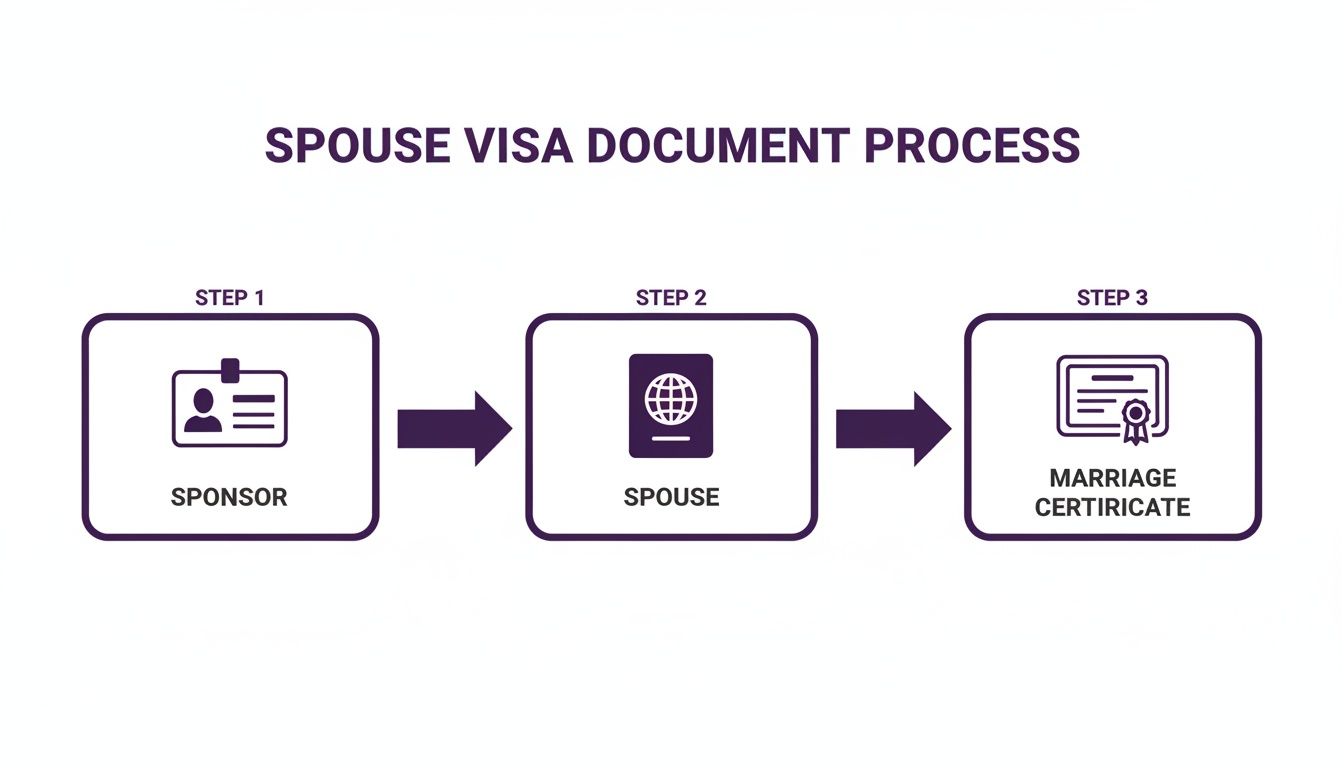
As you can see, the application really rests on three pillars: proving your identity as the sponsor, your spouse’s identity, and the legal proof of your relationship.
The Mandatory Medical Fitness Test
As soon as the entry permit is in hand and your spouse is in the country, the next stop is the medical fitness test. This is a non-negotiable step for anyone over 18 applying for a residence visa, designed to screen for specific communicable diseases and safeguard public health.
The screening is straightforward, usually just a blood test and a chest X-ray. They primarily check for HIV/AIDS and Tuberculosis. It’s important to know that a positive result for active Tuberculosis will almost certainly lead to the visa being denied.
You have to get this done at a government-approved medical fitness centre. In Dubai, these are run by the Dubai Health Authority (DHA), but every emirate has its own designated facilities. You can often pay a bit more for VIP or 24-hour express services if you’re in a hurry. The results are typically sent straight to the immigration authorities electronically, which is one less thing for you to worry about.
Securing the Emirates ID
While the medical test is happening, you should get the ball rolling on the Emirates ID application. This card is the official ID for every UAE resident and you’ll need it for practically everything – from opening a bank account to renting an apartment.
There are two parts to this process:
- The Application: You’ll fill out the form at an authorised typing centre or online via the Federal Authority for Identity, Citizenship, Customs and Port Security (ICP) website.
- The Biometrics: Your spouse will then need to go to an Emirates ID service centre for their biometrics appointment. This is where they take fingerprints and a photograph.
A pro tip: book the biometrics appointment as soon as you can. The waiting times can sometimes stretch for a few days, so it’s best to get in the queue early.
The Final Step: Visa Stamping
This is the finish line. Once the medical test is passed and the Emirates ID application is underway, you can finally submit your spouse’s passport for the residence visa stamping. This is the physical visa sticker placed inside their passport that officially confirms their legal residency status.
The validity of their visa will be linked to yours. So, if you hold a two-year employment visa, your spouse will also get a two-year visa.
This is where professional support can be a real lifesaver. An experienced PRO service provider like 365 DAY PRO Corporate Service Provider LLC lives and breathes this system. They’ll make sure your application is lodged perfectly, keep you updated on its progress, and even handle the passport collection and delivery. It turns what can be a confusing, multi-step headache into a simple, managed task.
Navigating the Service Centres
You’ll be dealing with a few different government service centres along the way. Knowing who does what is incredibly helpful:
- AMER Centres (Dubai): In Dubai, these are your main hubs for all visa and residency services, overseen by the General Directorate of Residency and Foreigners Affairs (GDRFA). You’ll visit an AMER centre for the initial entry permit and the final visa stamping.
- Tasheel Centres: These centres are focused on labour-related services for the Ministry of Human Resources and Emiratisation (MOHRE). You probably won’t deal with them for the spouse visa itself, but you’ve likely encountered them for your own employment contract.
- Typing Centres: These authorised private offices are essential. They prepare and type out all the official application forms (in Arabic, as required) and submit them through the correct government portals. Using a good typing centre is your best defence against small errors that can cause big delays.
Understanding the Costs and Timelines

Before you dive into the paperwork, let’s talk numbers and dates. Getting a handle on the costs and processing times for a UAE spouse visa is one of the most important things you can do. It helps you plan properly and avoids any last-minute financial scrambling or stressful delays.
So, what should you really budget for, and how long will you be waiting?
A Transparent Look at Spouse Visa Fees
The good news is that the total cost isn’t one big, scary lump sum. Instead, it’s a series of smaller fees you’ll pay at different points in the application. The final figure can shift a bit depending on which emirate you’re in and whether your spouse is applying from inside or outside the UAE, but the structure is pretty consistent.
Here’s a realistic breakdown of what you’ll be paying for:
- Entry Permit: This is your starting point. The fee changes based on where your spouse is. Applying for someone outside the UAE is different from an “in-country status change,” where they are already here on a visit visa.
- Medical Fitness Test: Everyone needs one. The cost depends on how quickly you need the results. The standard service is the cheapest, but for an extra fee, you can get it done in 48 hours, 24 hours, or even a few hours with the VIP service.
- Emirates ID Application: A standard government fee for the two-year resident ID card. It’s a mandatory part of the process.
- Visa Stamping and Application Fees: This covers the government fee for placing the visa sticker in the passport, plus the service charges from the typing centre that prepares and submits your file.
Think of it this way: budgeting for a spouse visa is a series of manageable steps, not a single mountain to climb. Knowing these costs upfront means no nasty surprises, keeping the process smooth and on track.
Based on what we’ve seen with recent applications in Dubai, the all-in cost—from opening the file to getting the visa stamped—typically lands somewhere between AED 3,500 and AED 5,000. If you want a deeper dive into the numbers, you can discover more insights about UAE family residence visa costs and requirements.
Mapping Out the Processing Timeline
“How long will it take?” It’s the million-dirham question. The entire process for a spouse visa can be surprisingly quick, often wrapping up in a couple of weeks, but it all depends on a few moving parts.
Here’s a step-by-step look at a realistic timeline:
- Getting the Entry Permit: Once your complete application is in the system, the entry permit is usually the fastest part. You can expect it to be approved within 24 to 48 hours.
- The Medical Test Results: After the medical screening is done, the standard waiting time for results is about 2 to 3 working days. If you’re in a real hurry, the express options can have them back to you the same day.
- Emirates ID Biometrics: The application itself is quick, but you need an appointment for the fingerprinting and photo. Depending on how busy the centres are, you might get a slot in a couple of days or have to wait up to a week.
- Final Visa Stamping: With the “medically fit” certificate and Emirates ID application in hand, the final step is getting the visa sticker in the passport. This usually takes about 3 to 5 working days.
All in, if your documents are in perfect order and you don’t hit any public holidays, the whole journey from application to stamped visa can be done in about 7 to 10 working days.
New Ways to Sponsor Your Spouse: A Look at Professional and Investor Visas
The old rules for sponsoring a spouse in the UAE are no longer the only game in town. The system has really opened up, especially for professional women and investors who are putting down roots here. These aren’t just minor tweaks; they’re significant new pathways that reflect the UAE’s modern outlook.
It’s about more than just hitting a certain salary number now. Understanding how your professional standing or investment portfolio can secure your family’s residency is key. Let’s break down what this means in practice.
A Big Shift: More Women Sponsoring Their Families
One of the most welcome changes we’ve seen is the rise of professional women sponsoring their husbands and children. It wasn’t that long ago that this was almost unheard of, with sponsorship being seen as a man’s role. Today, the UAE has moved with the times, empowering women in certain professions to be the primary sponsor for their family.
This is a direct result of the UAE’s push to attract top global talent and create a secure environment for female professionals. If you’re a woman working in specific fields, you can absolutely be the one to sponsor your husband. Some of the most common professions we see doing this are:
- Healthcare: Doctors, surgeons, and other medical specialists.
- Education: Teachers, university professors, and senior academic staff.
- Engineering: Engineers with specific, recognised qualifications.
- Judiciary: Judges and certain other legal professionals.
For women in these roles, the process is straightforward. You’ll need your own valid residence visa, a salary that meets the required threshold (which can sometimes be higher than for male sponsors), and all the usual attested documents, like your marriage certificate.
This isn’t just a procedural update. It’s a powerful statement that acknowledges the massive contribution female expats make to the UAE’s economy and society. It shows that the country truly values and supports professional women and their families.
The numbers back this up. In 2025, women made up nearly 50% of all visa applicants, a huge jump driven by the UAE’s reputation for safety and its flexible remote work policies. Inquiries from female business travellers shot up by 27% year-over-year, and leisure applications grew by 33%. This clearly points to more women taking the lead as the principal sponsors for their families. You can read more about these empowering shifts for female visa applicants in the UAE.
The Golden Visa: An Investment in Your Family’s Future
For those with the means, the UAE Golden Visa is the gold standard for long-term residency, and it makes sponsoring your spouse incredibly simple. This elite visa is designed for investors, entrepreneurs, and highly skilled professionals who are contributing to the country’s future. When you qualify, you’re not just securing a visa for yourself—you’re securing one for your entire family.
The most direct route for many is real estate. If you purchase a property worth AED 2 million or more, you can get a 10-year renewable residence visa. The best part? This visa automatically covers your spouse and children, giving you a level of stability that’s hard to beat.
This completely changes the conversation. Instead of a separate, sometimes complex spouse visa application, their residency becomes a built-in benefit of your investment. It’s a smart way to merge your financial planning with your family’s relocation goals. The perks are significant, too, like being able to stay outside the UAE for long stretches without your visa being cancelled. For anyone looking at different global options, it’s worth exploring various business and investment migration pathways to see how the UAE’s offer compares.
Got Questions? We’ve Got Answers
Even with the best guide, there are always a few “what if” scenarios that pop up. This is where experience really counts. We’ve compiled some of the most common questions we hear from clients every day – the real-world situations that can trip you up if you’re not prepared.
Think of this as the final piece of the puzzle, giving you the confidence to handle whatever comes your way during the spouse visa process.
What Happens if My Spouse Visa Application Is Rejected?
First off, don’t panic. A rejection notice feels like a major setback, but it’s rarely the final word. The key is to quickly figure out why it was rejected. While the immigration authorities don’t hand you a detailed report, our experience shows it almost always boils down to a handful of common issues.
The usual suspects are:
- Simple Document Errors: This is the most frequent culprit. It could be anything from a missing signature, a passport copy that’s not perfectly clear, or a document that has expired.
- A Failed Medical Test: Unfortunately, if the medical screening shows a positive result for certain communicable diseases, it will result in a denial.
- Security Flags: Sometimes an application gets flagged during routine security checks. These can be tricky to navigate on your own and often require professional help to resolve.
- A Vague Job Title: If the profession listed on your visa is too generic (like “Executive”) and doesn’t clearly support the required salary, it can raise red flags.
Once you’ve pinpointed the problem, you can fix it and re-apply. A document error is an easy fix – just submit a fresh application with the corrected paperwork. If the reason isn’t immediately obvious, that’s the time to call in an expert to diagnose the issue properly before you spend more time and money.
Can My Spouse Work on a Family Visa?
Yes, absolutely! This is one of the biggest advantages of sponsoring your spouse. Once their residence visa is stamped in their passport and they have their Emirates ID, they are fully and legally able to work in the UAE.
They will still need a work permit (often called a labour card) from the Ministry of Human Resources and Emiratisation (MOHRE). This is a straightforward process that their new employer will manage. The great news is your spouse stays under your sponsorship. The company doesn’t have to provide a new visa, just the permit to work.
This gives your family incredible flexibility, allowing your partner to build their career without the pressure of finding a company willing to sponsor their entire residency from day one.
Do We Have to Renew the Spouse Visa?
A UAE spouse visa isn’t a “set it and forget it” document. It has an expiry date and needs to be renewed. Its validity is always linked to the sponsor’s visa. So, if you hold a two-year employment visa, your spouse’s visa will also be valid for two years.
You’ll need to start the renewal process before the current one expires. It’s much like the first application and involves a few key steps:
- A new medical fitness test.
- Applying for a renewed Emirates ID.
- Submitting updated documents, like your renewed Ejari (tenancy contract) and a recent salary certificate.
Our Pro Tip: Kick off the renewal process at least 30 days before the visa expires. This gives you a comfortable buffer to sort out any unexpected delays without risking overstay fines.
Can I Sponsor My Spouse if We Got Married in a Different Country?
Of course. It makes no difference where in the world you were married, provided the marriage is legally recognised and you have the official certificate to prove it.
The most critical part is getting that certificate properly attested. For example, let’s say you’re an American national who got married in the UK. Your marriage certificate must first be attested by the UK’s Foreign Office, then stamped by the UAE Embassy in London, and finally receive its last attestation from the Ministry of Foreign Affairs (MOFA) here in the UAE. The attestation journey always follows the country where the document was issued, not your nationality.
Navigating the details of a spouse visa application, handling renewals, or figuring out a rejection can feel overwhelming. 365 DAY PRO Corporate Service Provider LLC are specialists in every aspect of visa processing and PRO services. We ensure your family’s residency is handled smoothly and correctly, so you can focus on what matters most—starting your new life together in the UAE.
✅ Best Corporate Service Provider in Dubai, Abu Dhabi & Sharjah
✅ Specialists in Mainland Company Formation in Dubai & Abu Dhabi
✅ Specialists in Freezone Company Formation across the UAE
✅ 24/7 Support Service – Always here when you need us
✅ Cost-Effective Business Setup Solutions tailored to your needs
✅ Enjoy UAE Tax Benefits for International Entrepreneurs
📞 Call Us Now: +971-52 923 1246
💬 WhatsApp Us Today for a Free Consultation at https://365dayproservices.com