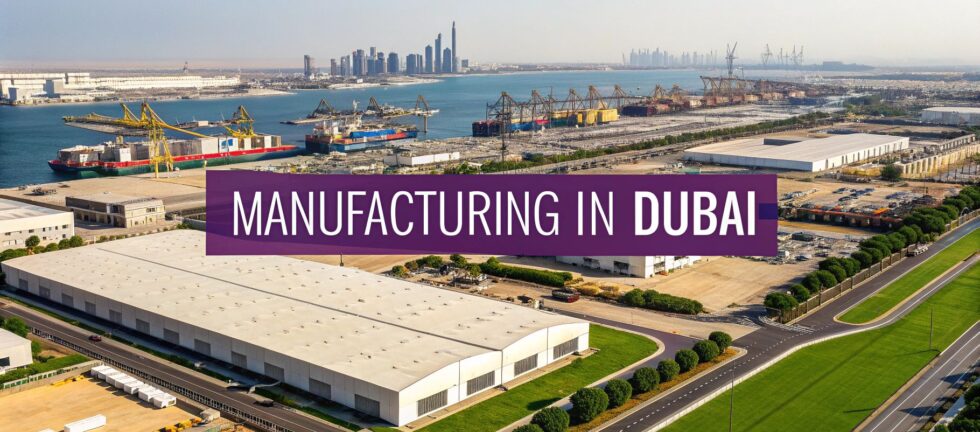
Dubai isn't just a place to do business; it's a launchpad for strategic growth and global reach, especially for manufacturing companies. The government here has rolled out the red carpet with forward-thinking policies, incredible infrastructure, and attractive financial perks, making it a magnet for producers from all over the world.
It’s a stable, future-focused platform designed for success.
Why Dubai Is a Global Manufacturing Hub
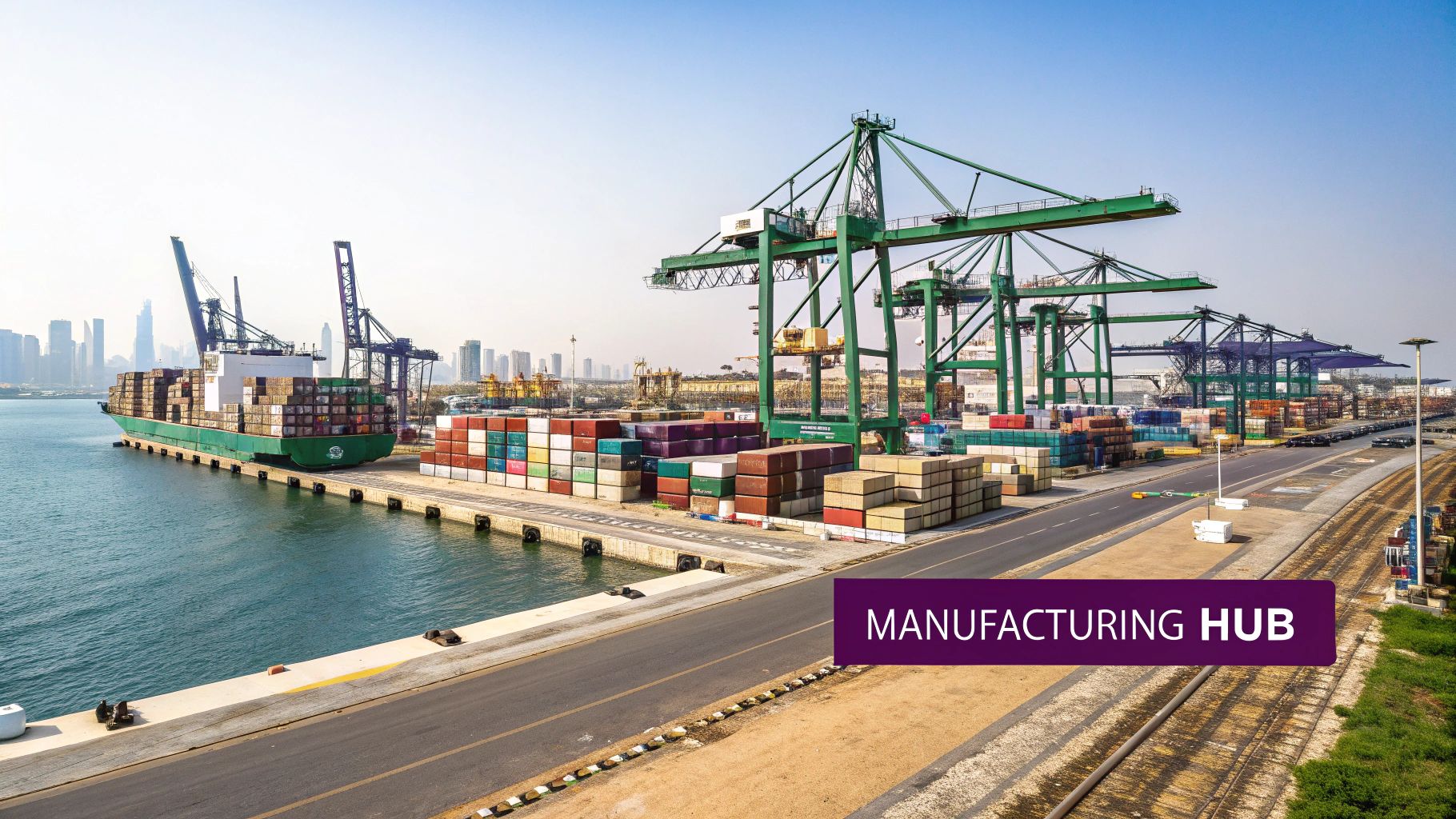
Dubai’s evolution into a top-tier manufacturing centre didn't happen by chance—it's the product of meticulous, long-term planning. The city's leaders understood early on that a strong economy is a diverse one, and that insight fuelled massive investment into creating the perfect environment for industrial businesses to flourish.
At the core of this success lies a logistics network that's simply world-class. If you think of the supply chain as the lifeblood of a manufacturing business, then Dubai’s Jebel Ali Port is the powerful heart. As one of the world's busiest ports, it pumps goods through a sophisticated network of modern highways and airports, connecting businesses to the rest of the globe with incredible efficiency. This seamless connectivity slashes transit times and cuts operational costs, handing companies a major competitive edge.
A Genuinely Pro-Business Environment
The government in Dubai doesn't just tolerate businesses; it actively champions them. Manufacturers are seen as genuine partners in the city's growth, not just tenants. You can see this philosophy in the regulatory framework, which is built for clarity and speed. The whole system is designed to cut through bureaucratic red tape, letting entrepreneurs get on with what they do best: producing and expanding.
This commitment is also clear in the development of specialised industrial zones. These aren't just plots of land; they are purpose-built ecosystems offering tailored infrastructure and services for specific industries, creating powerful hubs where innovation and collaboration thrive.
Dubai's economic game plan is all about diversification and innovation. The emirate has successfully become more than just a location—it’s an accelerator for industrial growth, offering unmatched access to markets across the Middle East, Africa, and Asia.
Real Growth and Strong Sectors
The proof is in the numbers. In the first quarter of 2025 alone, Dubai's manufacturing sector saw a remarkable 5% increase in growth, driven by the expansion of its industrial zones and strong export demand. It’s a clear sign that the government's proactive policies are working and that the sector is incredibly resilient.
This dynamic industrial landscape is home to major players across a wide range of fields. To get a feel for the action on the ground, just look at the guides detailing the leading glass and aluminum manufacturing companies in Dubai, which really highlights the sector's strength and depth.
From advanced materials to everyday consumer goods, the sheer diversity of industries proves Dubai can support almost any manufacturing operation. It all adds up to a compelling proposition for any business aiming to build a solid regional presence and a global footprint.
Choosing Your Jurisdiction: Mainland vs Free Zone
You’ve decided Dubai is the right launchpad for your manufacturing venture. Great! The next big question is where exactly in Dubai to set up shop. This isn't just about picking a location on a map; it's a strategic decision that will shape your market access, ownership rights, and the very rules you operate by. You have two main paths: setting up on the Dubai Mainland or within one of its many specialised Free Zones.
Let's use an analogy. Think of it like deciding where to open a new restaurant. Do you open on a busy high street in the city centre (the Mainland), or inside a huge, exclusive resort complex (a Free Zone)?
The high street gives you direct access to every person in the city, but you'll have to follow standard city regulations. The resort offers amazing facilities, special incentives for businesses, and a captive audience of international tourists, but you can only really sell to people inside the resort. Each has distinct advantages, and the right choice depends entirely on your business plan.
The Dubai Mainland Advantage: Unrestricted Market Access
Setting up your manufacturing company on the Dubai Mainland plugs you directly into the UAE's local economy. You'll get your licence from the Department of Economy and Tourism (DET), which gives you the freedom to sell and move your products anywhere across the UAE. No agents, no middlemen, no barriers.
This is the number one reason to choose a Mainland setup. If your primary customers are here in the UAE—whether you're supplying to local construction projects, stocking shelves in retail stores, or selling directly to consumers—a Mainland industrial licence is the most direct path. It also opens the door to bidding on lucrative government contracts and operating seamlessly across all seven emirates.
In the past, this route required a local Emirati partner, but recent legal changes now allow for 100% foreign ownership for many manufacturing activities. This shift has made the Mainland a far more appealing option for international entrepreneurs looking for maximum flexibility to tap into local market growth.
The core benefit of a Mainland licence is geographical freedom. It’s an all-access pass to the entire UAE market, letting you sell, distribute, and grow your business without hitting any internal borders.
The Power of Free Zones: Specialised Industrial Hubs
On the other hand, Dubai's Free Zones offer a powerful package of incentives, especially for businesses geared towards export and international trade. These are specific economic areas with their own independent rules and regulations, all designed to attract foreign investment. For manufacturing, hubs like Jebel Ali Free Zone (JAFZA) and Dubai Industrial City are purpose-built ecosystems ready for production.
The benefits of a Free Zone are hard to ignore:
- 100% Foreign Ownership: This has always been the standard in Free Zones, giving you complete control.
- Full Repatriation of Profits: You are free to send all capital and profits back to your home country without any restrictions.
- Tax Exemptions: Businesses here typically enjoy 0% corporate tax and are exempt from import and export duties.
- Simplified Logistics: Most manufacturing Free Zones are strategically located next to major seaports and airports, providing world-class infrastructure and streamlined customs processes.
The image below gives you a snapshot of the key sectors already thriving in Dubai's manufacturing scene, which can help you see where your venture might fit.
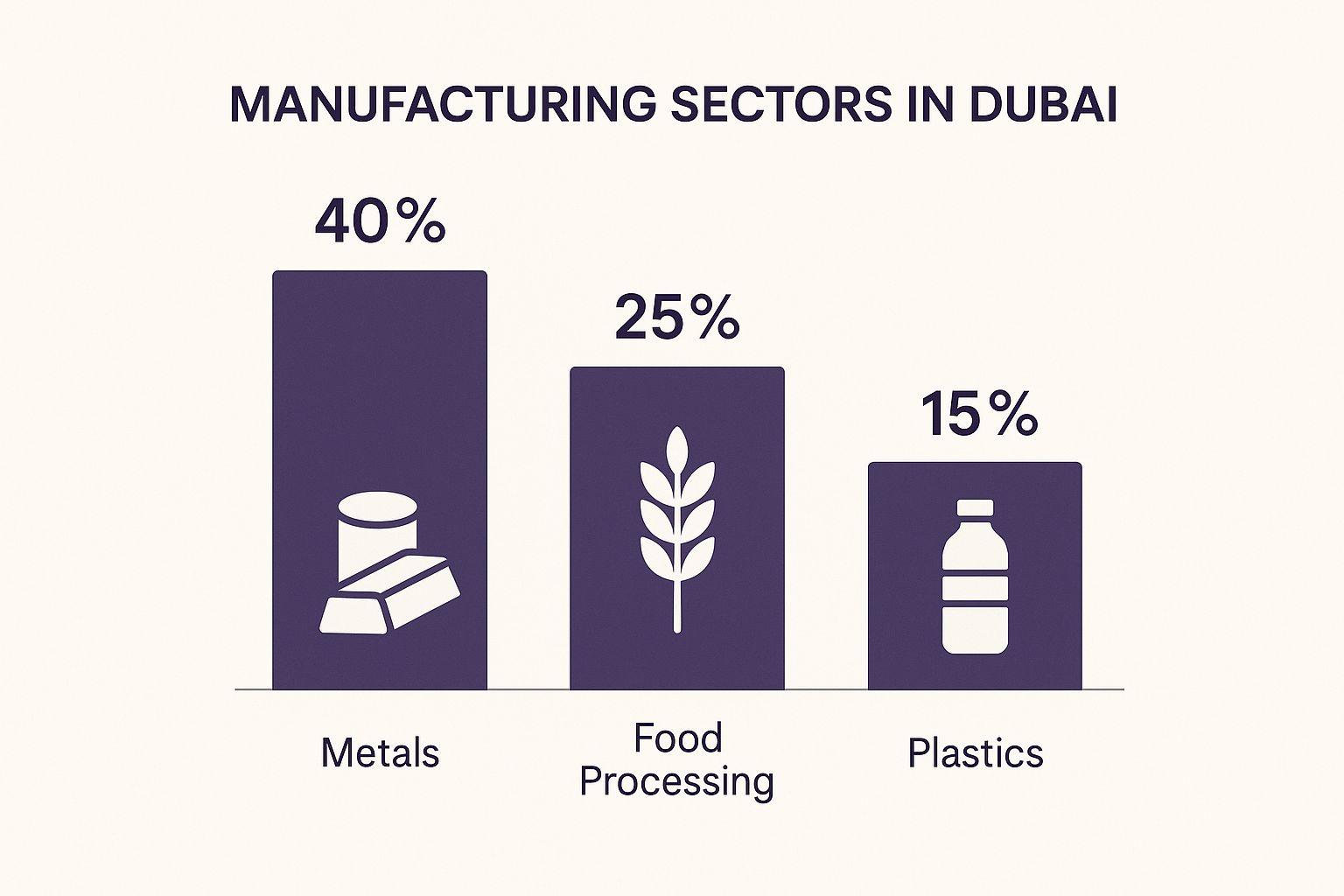
The data clearly shows that foundational industries like metals, food and beverage, and plastics are major players in the local economy.
So, what's the catch? The trade-off for all these perks is that a Free Zone company is generally restricted to doing business within its zone or internationally. If you want to sell directly to the UAE Mainland market, you'll usually need to appoint a local distributor. This makes Free Zones the perfect choice for manufacturers who plan to import raw materials, produce goods in Dubai, and then export the finished products to the rest of the world.
Mainland vs Free Zone Setup for Manufacturing
Making the right decision from the start is critical. This table breaks down the key differences to help you weigh your options based on your specific business goals.
| Feature | Mainland | Free Zone |
|---|---|---|
| Market Access | Unrestricted access to the entire UAE market and government contracts. | Limited to the Free Zone and international markets. Requires a local agent for Mainland sales. |
| Ownership | 100% foreign ownership now available for most manufacturing activities. | 100% foreign ownership has always been a standard feature. |
| Taxation | Subject to UAE Corporate Tax (9% on profits over AED 375,000). | Typically 0% Corporate and Personal Tax, with exemptions on import/export duties. |
| Office/Facility | Can rent or own facilities anywhere on the Dubai Mainland. | Must lease a warehouse or land within the specific Free Zone. |
| Licensing Authority | Department of Economy and Tourism (DET). | The specific Free Zone Authority (e.g., JAFZA). |
| Best For… | Businesses targeting the local UAE market, government tenders, and pan-emirate distribution. | Export-oriented businesses, international trade, and those seeking maximum tax efficiency. |
Ultimately, choosing between Mainland and a Free Zone isn't about which one is "better" but which one is the best fit for your unique vision. A clear understanding of your supply chain, target customers, and long-term growth strategy will point you down the right path.
Navigating the Industrial Licence Process
Getting an industrial licence is the absolute cornerstone of manufacturing in Dubai. It’s far more than a piece of paper; it's your official green light from the government to start turning raw materials into finished goods. Think of it as the master blueprint for your factory—without it, the project simply can't get off the ground.
The whole process unfolds in stages, and each one demands a sharp eye for detail and strict compliance with local rules. Nail these steps, and you’ll ensure your operation is legal, safe, and built to last. This is where leaning on an experienced corporate service provider can be a game-changer, as they can guide you through the entire journey.
The Initial Approval and Trade Name
Your first move is securing an initial approval. This comes from the authority governing your chosen jurisdiction, whether it's the Department of Economy and Tourism (DET) for a Mainland setup or a specific Free Zone authority. This preliminary nod confirms your proposed manufacturing activity is welcome and that you, as the owner, are good to go.
At the same time, you'll need to lock in a unique trade name. Your chosen name has to play by the UAE's rules—nothing offensive, misleading, or too close to an existing brand. Getting both the initial approval and your trade name sorted lays the legal groundwork for everything else.
Drafting Legal Documents and Securing a Facility
With your first permissions in the bag, it's time to formalise your company's structure. This means drafting a Memorandum of Association (MOA), which is the legal document that spells out who owns what, what the business does, and how it will run. It’s a mandatory step, and the document must be properly notarised.
You also need to find a home for your operations. This involves leasing a suitable factory, warehouse, or industrial plot that meets the specific needs of your manufacturing process. Your lease agreement—known as an Ejari in Dubai Mainland—is a vital piece of the puzzle you'll need for the final licence application.
Obtaining an industrial licence is a sequential process where each step unlocks the next. From legal documentation to physical infrastructure, every component must be perfectly aligned to gain final approval from all government bodies.
You can't overstate the economic importance of this sector. In the first quarter of 2025, the UAE's manufacturing industries were a powerhouse, contributing 13.4% to the nation's non-oil GDP, trailing only trade and finance. This really drives home why the licensing process is so meticulous.
Final Clearances and Licence Issuance
The final stretch is often the most intensive, as it involves getting the sign-off from several external government bodies. These approvals are all about making sure your facility is up to scratch on health, safety, and environmental standards.
Here are the key players you'll be dealing with:
- Dubai Municipality: They'll scrutinise your facility plans to ensure they align with building codes, environmental regulations, and waste management protocols.
- Dubai Civil Defence: Fire safety is their domain. Your factory layout, fire suppression systems, and emergency plans will have to meet their stringent requirements.
- Other Relevant Authorities: Depending on your product—be it food, chemicals, or pharmaceuticals—you might need further approvals from specialised government departments.
Operating in a global hub like Dubai also means you'll be dealing with international shipping. Getting a handle on logistics is crucial, and mastering customs clearance procedures will help you streamline both imports and exports.
Once you’ve collected all these external approvals and submitted them, the licensing authority will issue your final industrial licence. This is the permit that officially lets you start production, turning your manufacturing vision into a reality. With 24/7 support, a specialist in Mainland and Free Zone company formation can make this entire process feel smooth and straightforward.
A Realistic Look at Costs and Financial Perks
Let's get down to the brass tacks: what does it actually cost to get a manufacturing operation off the ground in Dubai? Before you can even think about production lines and profit margins, you need a crystal-clear picture of the initial financial outlay. Think of it less as a single price tag and more as a series of strategic investments to build a compliant and operational factory.
First up are the non-negotiables – the foundational fees. This is your industrial licence, your trade name registration, and the various government approvals that give you the legal green light to start manufacturing.
After that, the biggest line item on your initial budget will almost certainly be your physical space. The cost to rent a warehouse or factory can swing wildly. It all depends on whether you're setting up in a prime, established industrial zone or a more up-and-coming area, not to mention the square footage your production line demands.
Key Investment Areas for Your Budget
To avoid any nasty surprises down the road, it's smart to break down your budget into a few key areas. Each one is a critical piece of the puzzle, and planning for them individually will keep your finances on track.
- Licensing and Registration: This bucket holds all the government fees for your industrial licence, company registration, and the cost of drafting essential legal documents like your Memorandum of Association.
- Facility and Infrastructure: Here, you'll account for the annual rent on your factory, any security deposits, and the initial fit-out costs to get the space ready for your machinery and workflow.
- Capital Equipment: This is a big one. It covers purchasing, shipping, and installing all the machinery you need to actually make your product.
- Employee Visas and HR: Don't forget your people. Every employee will need a residence visa, an Emirates ID, and medical insurance. These costs, piled on top of recruitment expenses, add up fast.
The real trick is balancing those hefty setup costs with your long-term operational budget. Finding a business setup solution that understands your specific needs can make all the difference in managing these early investments, ensuring your capital is put to work efficiently without cutting corners on quality or compliance.
Powerful Financial Incentives to Drive Your Growth
While the setup costs are real, Dubai offers some powerful financial perks that more than level the playing field. These incentives are specifically designed to ease the financial pressure on industrial investors and make the entire proposition of manufacturing in Dubai incredibly attractive.
The most famous advantage, of course, is the UAE's tax environment. Even with the new 9% corporate tax on profits over AED 375,000, it remains one of the most competitive rates you'll find anywhere in the world. For international business owners, this pro-business tax structure allows for highly efficient profit repatriation, meaning you can keep more of your earnings to fuel growth.
You can see this approach working in the numbers. Dubai's manufacturing output hit an impressive AED 8.7 billion in just the first quarter of 2025. It’s a clear sign of just how central the sector is to the emirate's economic health. You can explore more about Dubai's economic strengths to get the bigger picture.
Free Zone Advantages and Government Support
If your business model is geared towards export, setting up in a Free Zone can be a game-changer. Companies in these special economic zones often enjoy a complete exemption from customs duties on any raw materials or equipment they import. This alone can translate into massive savings, directly boosting your profit margins.
On top of that, the UAE government is actively championing industrial growth. National initiatives like 'Make it in the Emirates' open doors to government-backed financing and lucrative procurement contracts, creating a genuinely supportive environment for manufacturers. Working with a corporate service provider who knows how to navigate these programmes can give you access to these incentives, giving your business a serious leg up from day one.
Getting a Strategic Edge with Expert Business Setup
Starting a manufacturing business in Dubai is about more than just buying machinery and sourcing materials. It’s an investment in navigating a complex regulatory world where every single detail matters. The road from a great idea to a running factory is full of legal hurdles and government approvals. This is why bringing in a corporate service provider isn't a luxury—it's a core strategic move.
Think of it like this: you're the expert on your product, your supply chain, and your market. The business setup specialist is the expert on building the legal and administrative structure around it. They handle the bureaucracy, make sure the foundation is solid, and get all the permits lined up so you can stay focused on what you do best.
Turning Bureaucracy into a Clear Process
Getting an industrial licence means dealing with multiple government bodies, from the Department of Economy and Tourism to the Dubai Municipality and even Civil Defence. Each department has its own set of rules, documents, and timelines. One small misstep can cause major delays and add unexpected costs, throwing your entire launch plan off track.
This is where specialists in Mainland and Free Zone company formation prove their worth. They have a deep understanding of local laws and existing relationships with government authorities. They can take what feels like a confusing maze and turn it into a straightforward, predictable path.
Their know-how covers key steps, including:
- Jurisdiction Analysis: They’ll give you practical advice on whether a Mainland or Free Zone setup is the right fit for your specific business, helping you avoid a costly mistake right at the beginning.
- Document Management: They handle the meticulous work of preparing, submitting, and tracking all your paperwork, from the initial Memorandum of Association to final lease agreements.
- Government Liaison: They act as your representative, securing the necessary approvals and saving you from spending countless hours on administrative tasks.
More Than Just Paperwork: A Full Support System
The best corporate service providers do much more than just help you get set up. They become long-term partners, providing a safety net for all your ongoing operational needs.
Choosing the right corporate service provider is like hiring an experienced co-pilot for your business journey. They don’t just hand you a map; they help you navigate turbulence, communicate with air traffic control, and ensure you land smoothly and on schedule.
This kind of partnership is designed to give you complete peace of mind. For instance, with 24/7 support services, you always have someone to call if a question or problem pops up—which is incredibly valuable when you're managing a business across different time zones. Plus, cost-effective business setup packages ensure you get top-tier service without breaking your initial budget.
This comprehensive approach also means they make sure you're set up to take full advantage of the UAE tax benefits available to entrepreneurs. By structuring your company correctly from the start, they help you build a financially sound operation that boosts profitability and fuels long-term growth in Dubai's competitive market.
Your Top Questions About Manufacturing in Dubai, Answered
Thinking about setting up a factory in Dubai? You’re not alone. It’s a huge step, and naturally, you’ve got questions. As a major hub for industry, Dubai offers some incredible opportunities, but you need to know the lay of the land to make the right calls.
Let's dive into some of the most common things investors ask when they're looking to get started here. We'll give you straight, practical answers to help you see the path forward, from picking a profitable sector to understanding the local rules.
What Are the Most Profitable Manufacturing Sectors in Dubai?
This is the big question, isn't it? Finding your niche is everything in a market as energetic as Dubai's. While there's a lot of room to play, a few sectors consistently stand out.
Right now, Food and Beverage (F&B) processing is a massive winner. The UAE imports a lot of food, but there's a huge appetite for locally produced goods, driven by a growing population and a world-class hospitality scene. Think about it – every hotel, restaurant, and supermarket needs a steady supply.
The construction materials sector is another one that just keeps booming, thanks to the constant stream of new real estate and infrastructure projects. We're also seeing strong performance from companies making chemicals, plastics, electronics, and Fast-Moving Consumer Goods (FMCG). They're all backed by strong local demand and fantastic logistics for exporting. Plus, with the government's 'Make it in the Emirates' initiative, there's a big push for innovation in high-tech and sustainable manufacturing.
Can I Get 100 Percent Foreign Ownership on the Dubai Mainland?
Yes, you absolutely can, and this has been a huge development for foreign investors. Thanks to recent legal changes, you can now have 100% ownership of your manufacturing business on the Dubai Mainland for most activities.
This is a big deal because it means you no longer need a local Emirati partner holding 51% of your company. You get full control over your operations, your vision, and your profits. Just keep in mind that not every single business activity qualifies, so it's a crucial detail to confirm.
The ability to retain full ownership on the Mainland has been a game-changer, making it a highly attractive jurisdiction for manufacturers who want direct access to the local UAE market without sharing equity.
To be sure your specific industrial activity is on the approved list, you'll need to check with the Department of Economy and Tourism (DET). An easier route is to work with a company formation specialist who already knows the ins and outs and can make sure you’re structured perfectly from the get-go.
What Is an Industrial Licence and How Long Is It Valid?
Think of an Industrial Licence as your golden ticket to operate. It’s the official, non-negotiable permit from the government that allows your business to legally turn raw materials into finished goods. It covers everything that happens inside your factory walls—from processing and production to finishing and packaging.
Without it, you simply can't operate legally. Here in Dubai, this licence is valid for one year and needs to be renewed annually. The renewal isn't just paperwork; it’s a check-in to ensure your business continues to meet all the required operational, health, safety, and environmental standards. It's how the authorities maintain the high bar for manufacturing in Dubai.
What Environmental Regulations Must My Factory Follow?
Dubai takes sustainability seriously. The UAE is committed to responsible industrial growth, which means all manufacturing plants must follow strict environmental rules. This isn't just a suggestion—it's a core requirement for getting and keeping your industrial licence.
Before you get your final approvals, you'll need the sign-off from authorities like the Dubai Municipality's Environmental Department. This usually involves a few key steps:
- Submitting an Environmental Impact Assessment (EIA): A detailed report explaining how your factory might affect the environment and, more importantly, what you'll do to minimise that impact.
- Presenting Waste Management Plans: You need a solid plan for how you’ll handle and dispose of industrial waste responsibly.
- Meeting Quality Standards: Your facility has to prove it can operate within set air and water quality limits to prevent pollution.
Getting all this right can feel overwhelming. That’s why many businesses partner with a corporate service provider. They can ensure your facility is designed and run in full compliance from day one, helping you avoid costly fines or delays. Finding specialists who offer smart, cost-effective business setup solutions is the best way to ensure a smooth, compliant launch.
Ready to make your move into the UAE's manufacturing scene? As the best corporate service provider in Dubai, Abu Dhabi & Sharjah, we guide entrepreneurs like you through every single step. We are specialists in Mainland company formation in Dubai & Abu Dhabi and specialists in Freezone company formation across the UAE, making the entire process simple so you can focus on the rewards. With our 24/7 support service, we are always here when you need us. Let us help you enjoy the full UAE tax benefits for international entrepreneurs with our cost-effective business setup solutions tailored to your needs.
📞 Call Us Now: +971-52 923 1246
💬 WhatsApp Us Today for a Free Consultation at https://365dayproservices.com