Starting a business in Dubai doesn't have to break the bank. In fact, you can get a successful venture off the ground with a budget somewhere between AED 15,000 to AED 30,000. The secret isn't cutting corners; it's about making smart, strategic choices from the very beginning.
Things like picking the right cost-effective Free Zone and using flexible options like virtual offices can make all the difference. Thousands of startups have already proven that a low-cost business setup in Dubai is not just possible, but a well-trodden path to success.
Launching Your Dubai Business on a Smart Budget
When people think of starting a company in Dubai, they often picture swanky high-rise offices and a massive initial investment. But the reality for many savvy entrepreneurs is far more practical and financially astute. A low-cost business setup is all about making informed decisions that fit your specific goals.
This budget-conscious approach doesn't limit your company’s potential. On the contrary, it builds a much stronger, more resilient foundation. By channelling your initial funds into core activities—like growth, marketing, and operations—instead of pricey overheads, you're investing in what truly matters.
The Strategic Advantage of Starting Lean
Starting lean in Dubai is easier than you might think, thanks to a government framework designed to attract global talent and investment. The government's vision actively encourages innovation and makes life easier for SMEs through incubators and funding programmes. This support is a big reason why operational costs can be kept so manageable.
Between 2022 and 2023 alone, over 20,000 new businesses launched in Dubai. Many of them leveraged the benefits of Free Zones, which really highlights just how accessible this market is. It's an environment that lets you build your brand and test the waters without getting locked into huge financial commitments. Even early decisions, like exploring cost-effective brand naming strategies, can have a surprisingly big impact on your startup budget.
Your First Critical Decision: Free Zone vs. Mainland
The very first decision you need to make—and the one that will have the biggest impact on your setup costs—is choosing your business jurisdiction. Are you going to set up in a Free Zone or on the Mainland?
This choice influences everything: your ownership structure, office requirements, and the scope of business activities you're allowed to conduct. To keep costs down, you need to understand the fundamental differences.
A Free Zone offers 100% foreign ownership and is often the most budget-friendly route, but it typically limits you to doing business internationally or within that specific zone. A Mainland setup, on the other hand, gives you unrestricted access to the entire UAE market, which can be crucial for certain business models but often comes with higher initial costs.
Let's break down the key distinctions to help you see which path aligns with a low-cost strategy.
Free Zone vs Mainland Key Differences at a Glance
| Feature | Free Zone Setup | Mainland Setup |
|---|---|---|
| Ownership | 100% foreign ownership is the standard. | 100% foreign ownership available for most activities; some require a UAE national partner. |
| Market Access | Can trade internationally and within the specific Free Zone. Direct trade within the UAE Mainland is restricted. | Unrestricted access to trade anywhere in the UAE and internationally. |
| Office Space | Flexible and often cheaper options, including flexi-desks and virtual offices. Physical space is not always mandatory. | A physical office lease (Ejari) is typically required for licensing. |
| Initial Cost | Generally lower, with many competitive, all-inclusive packages available. | Tends to be higher due to office rent, approvals, and other associated fees. |
| Approvals | Approvals are managed by the single Free Zone authority, making the process faster and simpler. | Requires approvals from multiple government bodies, such as the DED and ministry-specific entities. |
Choosing the right jurisdiction is the cornerstone of a cost-effective setup. For most startups and service-based businesses aiming to minimise initial outlay, a Free Zone is the clear winner.
Partnering with specialists who understand the ins and outs of both Mainland and Free Zone company formation can provide tailored, cost-effective solutions that align perfectly with your budget and business ambitions.
With the right guidance, navigating these early steps becomes a clear path, not a complex maze. Making these smart, foundational choices is your first step towards enjoying the UAE's incredible tax benefits and launching a successful, low-cost business in Dubai. Your journey starts here.
Choosing Your Jurisdiction for Maximum Cost Efficiency
The first, and arguably most important, decision you'll make when setting up a business in Dubai is choosing between a Free Zone and the Mainland. This isn't just a box-ticking exercise; it directly impacts your ownership structure, where you can operate, and, crucially, your costs. Getting this right from the very beginning is the cornerstone of a lean, cost-effective launch.
For most new entrepreneurs, especially those in fields like consulting, e-commerce, or creative services, a Free Zone is the clear winner for keeping costs down. The biggest reason? You get 100% foreign ownership. This is a huge deal. It means you don’t need a UAE national sponsor or a local service agent, which can come with hefty annual fees on the Mainland.
By opting for a Free Zone, you're not just saving money; you're also simplifying your entire corporate structure. It’s a game-changer for startups and solo entrepreneurs who need to watch every dirham.
Spotlight on Budget-Friendly Free Zones
Now, not all Free Zones are priced the same. Some are specifically built to be incubators for startups and small businesses, offering incredibly competitive packages that bundle everything—your license, registration, and basic facilities—into one manageable fee.
Think of places like Sharjah Publishing City Free Zone (SPCFZ) or the International Free Zone Authority (IFZA). They've carved out a niche by being incredibly cost-effective. What makes them stand out?
- Low Initial Licensing Fees: Their packages are designed to get you started without a massive upfront investment.
- Minimal Office Requirements: You can often get by with a virtual office or a flexi-desk, which saves you a fortune in annual rent.
- Streamlined Processes: Less red tape means less of your time and money is wasted on complicated paperwork.
Choosing a Free Zone that caters to SMEs is more than a one-time saving. It's about plugging into an ecosystem built for lean, agile operations, letting you focus on growing your business instead of worrying about high overheads.
When a Mainland Setup Makes Sense
While a Free Zone is the go-to for most budget-conscious founders, sometimes a Mainland license is simply non-negotiable. If your business plan involves trading directly within the local UAE market, opening a physical shop, or bidding on government projects, the Mainland is where you need to be.
But just because it's necessary doesn't mean it has to break the bank. You can still be smart about costs on the Mainland. For instance, if you're in a service industry, a professional license is often a more affordable route than a commercial one. This setup typically requires a Local Service Agent instead of a 51% local partner, which can significantly lower your annual fees.
Let’s look at a real-world example. A freelance digital marketer could easily set up in a media-focused Free Zone, pay a low annual fee, and keep full ownership of their company. On the other hand, an entrepreneur looking to import and sell goods across the UAE would have no choice but to get a Mainland trading license. The Mainland setup will have higher initial costs, sure, but it’s a required investment to unlock direct access to the local market. It’s all about a strategic trade-off between cost and market access.
A Realistic Breakdown of Your Dubai Setup Costs
Trying to nail down a budget for your low-cost business setup in Dubai can feel like you're trying to hit a moving target. Let's cut through the noise and get into the real numbers. Knowing exactly what you’re paying for is the best way to craft a smart budget and dodge those nasty financial surprises later on.
Your costs will generally fall into two buckets: mandatory government fees and optional (but often necessary) service fees. The government fees are set in stone—think trade licence, registration, and immigration cards. Service fees cover things like having a consultant handle the admin for you or getting help with visa processing.
Core Government and Administrative Fees
The big-ticket item on your list will almost always be the trade licence fee. This isn't a one-size-fits-all cost; it really depends on what your business does and where you set it up. A general trading licence in Mainland Dubai, for instance, will have a much higher price tag than a freelance permit in one of the more affordable Free Zones.
On top of the licence, you'll need to budget for a few other standard government charges:
- Registration Fees: This is a one-off payment to get your company name and details officially on the books with the authorities.
- Establishment Card Fee: Think of this as your company's link to the immigration department. You absolutely need it to start applying for staff visas.
- Visa Costs: Every residence visa comes with its own string of fees for the application, medical fitness test, and Emirates ID processing.
This infographic gives you a quick visual on the typical starting costs, comparing a Free Zone setup to a Mainland one. It really drives home the potential savings a Free Zone offers right out of the gate.
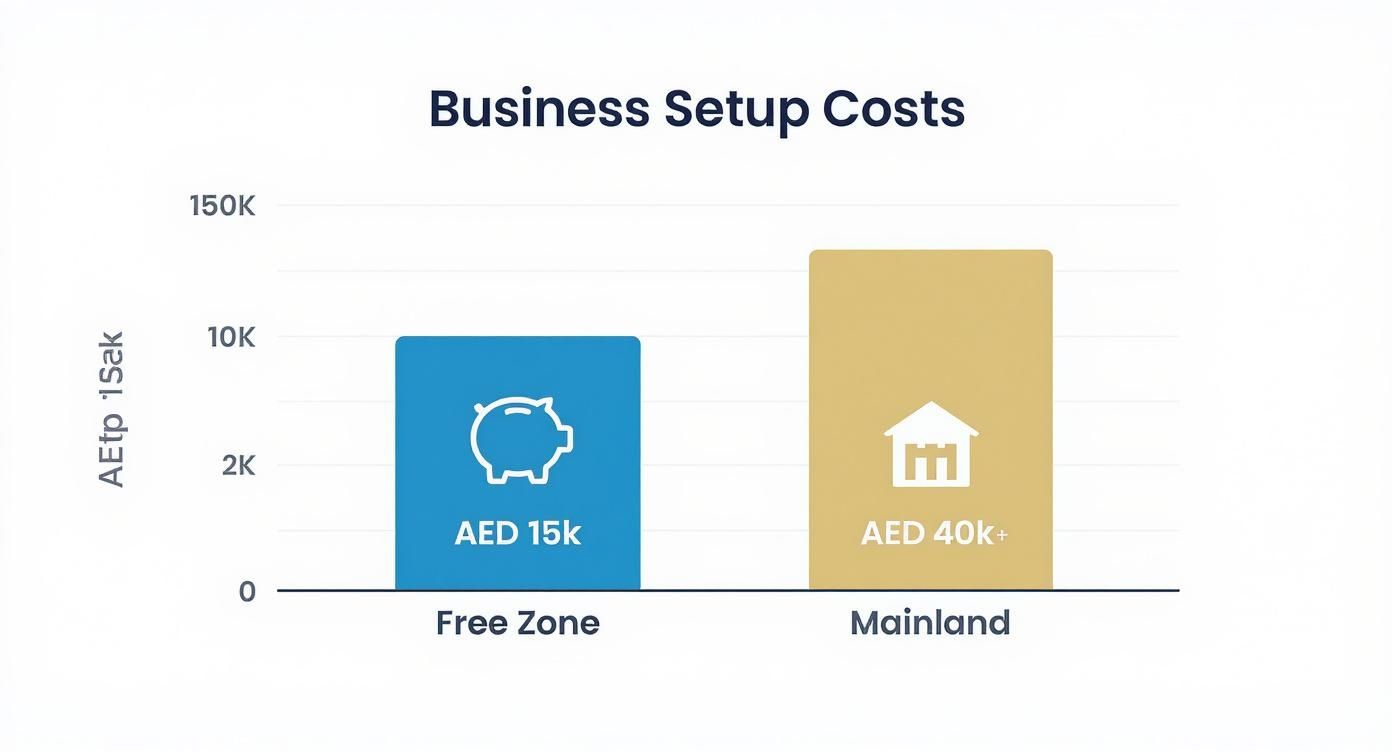
As you can see, a Free Zone is often the most practical starting point for new entrepreneurs who need to keep their initial outlay as low as possible.
Office Space and Professional Services
Your choice of office space is another huge variable in your budget. If you're aiming for a genuinely low-cost setup, a traditional office lease is probably off the table. Smart entrepreneurs are looking at more agile solutions like virtual offices or flexi-desks. They give you a legitimate business address and access to facilities without locking you into an expensive long-term contract.
The numbers back this up. By 2020, over 75% of new companies in Dubai were setting up in Free Zones, where these lean office solutions are standard. Digging deeper, government data from 2023 revealed that over 65% of new business licences were for SMEs with less than AED 100,000 in capital. This just highlights the massive shift toward starting lean. You can find a more detailed breakdown by reading the full analysis on Dubai business setup trends on ifza.com.
Partnering with a good corporate service provider means you get a clear, all-in-one quote right from the start. It takes the guesswork out of budgeting and ensures your package is built for what you actually need, not what someone wants to sell you. And the 24/7 support is a lifesaver.
To make this all a bit more concrete, let's look at how these costs stack up in a few common scenarios.
Sample Cost Estimates for Dubai Business Setups
The table below breaks down estimated costs for three different business types. Use it as a guide to see what a realistic budget might look like for your own venture and to help you plan without any last-minute shocks.
| Expense Item | Freelance Consultant (Free Zone) | E-commerce Startup (Free Zone) | Service SME (Mainland) |
|---|---|---|---|
| Trade Licence & Registration | AED 7,500 – 10,000 | AED 12,000 – 15,000 | AED 25,000 – 35,000 |
| Establishment Card | AED 1,500 – 2,000 | AED 1,500 – 2,000 | AED 2,000 – 2,500 |
| 1 Residence Visa | AED 3,500 – 5,000 | AED 3,500 – 5,000 | AED 5,000 – 6,500 |
| Virtual Office/Flexi-Desk | Included or AED 2,000 – 4,000 | Included or AED 3,000 – 5,000 | N/A (Physical office required) |
| Sponsorship/Local Agent | N/A | N/A | AED 8,000 – 15,000 (Annual) |
| Approximate Total | AED 12,500 – 21,000 | AED 17,000 – 27,000 | AED 40,000 – 59,000 |
Remember, these are estimates. Your final costs will depend on your specific business activity, the Free Zone you choose (if applicable), and the number of visas you need. However, this should give you a solid foundation for your financial planning.
Getting Your Paperwork Right Without Breaking the Bank
Administrative hurdles can easily blow up your budget if you’re not careful. A simple mistake on a form, or misinterpreting a small requirement, can lead to frustrating delays. More importantly, it can mean expensive re-submission fees. This is where a smart approach to paperwork stops being a chore and becomes a key part of your low-cost business setup in Dubai.
The process isn't just about filling in blanks. It’s about deeply understanding what each authority needs for every document—from passport copies and utility bills to a solid, well-thought-out business plan. Nailing these details on the first try is where you save the real money.
The Must-Have Documents and Where People Go Wrong
Before you can even think about submitting your application, you need to have a core set of documents in hand. The exact list can change a bit depending on the jurisdiction, but you can almost always count on needing these:
- Passport Copies: For every shareholder and the person you appoint as manager.
- Visa Status Pages: This is for anyone who is already a resident in the UAE.
- A Detailed Business Plan: This is non-negotiable for certain professional activities and is a huge help when opening your corporate bank account.
- Trade Name Options: You'll need to come up with a few names that follow UAE naming rules.
One of the most frequent and costly mistakes I see is with document attestation. Any degrees or professional certificates from outside the UAE have to be legally attested through a specific, multi-step process. If you mess this up, your entire application grinds to a halt, and you'll end up paying for the whole attestation process all over again.
A rejected trade name or a document that wasn't attested correctly isn't just an annoying delay—it's a direct hit to your startup budget. Every time you have to resubmit, you're spending money that should have been going into growing your business.
Why Expert Guidance Is Worth Its Weight in Gold
This is exactly why bringing in a specialist is a smart financial move. Instead of learning the hard way through expensive trial and error, you can lean on a team that does this every single day. Think of a corporate service provider as your buffer against common admin mistakes. They know which trade names are likely to get approved and will make sure every piece of paper is perfect before it ever lands on a government official's desk.
By working with experts who know the ins and outs of both Mainland and Freezone company formation, you ensure your application is handled precisely, no matter which path you take. They manage everything from the initial submission to the final approval, catching potential errors before they cost you. This proactive approach is fundamental to a genuinely cost-effective setup, saving you both money and precious time. It’s all about using expert knowledge to make every dirham count, with the peace of mind that comes from having 24/7 support.
Insider Tips to Minimise Ongoing Operational Costs
Getting your trade licence is a huge milestone, but it's really just the beginning. The true test of a sustainable low-cost business setup in Dubai is how you manage your day-to-day running costs. If you want to build a business that lasts, you have to run a lean operation right from the start.
This isn't about cutting corners on things that matter. It's about being clever and avoiding the kind of heavy, fixed overheads that can sink a new venture before it even gets going. Think of it as building a resilient business model that can adapt to market changes without being weighed down. This way, your money goes into growth, not just keeping the lights on.

Embrace Flexible Workspace Solutions
For most new businesses, the biggest and most daunting ongoing expense is office rent. A traditional lease can lock you into a long-term contract with a massive upfront payment. Luckily, there are far more agile alternatives that keep your overheads surprisingly low.
- Virtual Office Packages: These are perfect for satisfying many licensing requirements. You get a professional business address and mail handling services without paying for a physical space you might not need yet.
- Co-Working Spaces: These are more than just a desk. Co-working hubs are brilliant for networking with other entrepreneurs and operate on flexible, pay-as-you-go models.
Outsource Non-Core Functions
Hiring full-time employees for specialised roles like accounting or Public Relations Officer (PRO) services can be a huge financial burden for a startup. Outsourcing these functions is a much smarter, more cost-effective move.
When you engage a corporate service provider for PRO services, you only pay for the specific support you need, like visa renewals or document clearances. The same goes for accounting—you get professionally managed books without the salary and overheads of an in-house finance team. For a deeper dive, check out these proven business cost reduction strategies that work for any growing company.
The goal is to transform fixed salary costs into variable, on-demand expenses. This gives your business the agility to scale its support structure up or down based on actual needs, directly protecting your bottom line.
Leverage the UAE's Favourable Tax Environment
Beyond just operational savings, the UAE’s tax system is structured to help new businesses thrive. While a 9% federal corporate tax has been introduced, it only applies to profits over AED 375,000.
This high threshold is a game-changer. It means many startups and SMEs will pay 0% corporate tax during their crucial early years. Every single dirham of profit can be reinvested directly back into the business to fuel growth. When you combine smart operational choices with these incredible tax benefits, you create a powerful financial foundation for your Dubai company right from day one.
Common Questions About Setting Up a Business on a Budget in Dubai
Thinking about starting a business in Dubai, especially when you're watching your budget, will naturally stir up a lot of questions. Getting clear, honest answers is the first step to making your move with confidence. Let's tackle some of the most common things we hear from international entrepreneurs planning a low-cost business setup in Dubai.
These are the real-world questions we get asked all the time. The answers come from our direct experience helping people just like you navigate the process, from visas and bank accounts to those pesky hidden costs.
Can I Get a UAE Residence Visa with a Low-Cost Free Zone Licence?
Yes, absolutely. This is one of the biggest perks of even the most affordable packages out there. Most low-cost free zones, like SPCFZ or IFZA, include eligibility for at least one residence visa as a core part of their standard offer.
This means that even a basic trade licence or a freelance permit usually comes with a visa allocation, giving you the legal right to live and work in the UAE. The whole process is surprisingly efficient and is typically handled by the free zone authority or your setup consultant, making it a fairly straightforward part of getting established.
Is It Difficult to Open a Corporate Bank Account for a Low-Cost Company?
It’s not necessarily difficult, but it definitely requires careful preparation. UAE banks are serious about compliance and due diligence. For a new, low-cost company—especially one without a physical office—you need to build a strong, professional case.
This means having a solid business plan, providing clear evidence of your planned activities, and showing a realistic financial forecast. You need to prove you're a legitimate business.
This is where working with an experienced corporate service provider really pays off. They have existing relationships with different banks and know which ones are more open to specific business models, like a new freelancer or an e-commerce startup. Their guidance can make all the difference in getting your application approved.
They’ll help you make sure your paperwork is complete and professional, which is exactly what the banks want to see.
What Are the Hidden Costs I Should Watch Out For?
Unexpected expenses almost always pop up when the initial planning isn't detailed enough. These so-called "hidden" costs can quickly derail a tight budget if you aren't ready for them.
Here are a few common ones to keep on your radar:
- Document Attestation Fees: This is a big one, especially for any professional or educational certificates you earned outside the UAE.
- Medical and Emirates ID Fees: These are mandatory costs tied to every residence visa application, but they're often left out of initial budget calculations.
- Trade Name Rejection Fees: If the company names you propose don't meet the UAE's naming rules, you might have to pay a fee to resubmit new options.
- Annual Renewal Fees: This is crucial—your trade licence and any facility rentals are not one-time payments. They have to be renewed every single year.
A good, transparent service provider will always give you a fully itemised quote that clearly separates the one-time setup fees from the recurring annual costs. Don't be afraid to ask for that breakdown.
Do I Need a Local UAE Partner for a Low-Cost Business?
For the overwhelming majority of low-cost business models, the answer is a firm no. This is one of the main reasons free zones are so popular. They are built on the principle of 100% foreign ownership.
This structure was created specifically to attract international business owners, slashing both the cost and complexity of getting started. While some very specific business activities on the Mainland might still require a Local Service Agent, recent government reforms have opened up thousands of activities to 100% foreign ownership. For a truly low-cost setup, a free zone is almost always the most direct path to avoiding any partner-related costs.
Navigating the details of a low-cost business setup in Dubai is much easier when you have an expert in your corner. We are the best corporate service provider in Dubai, Abu Dhabi & Sharjah, specialising in creating cost-effective, practical solutions tailored to your needs.
✅ Specialists in Mainland Company Formation in Dubai & Abu Dhabi
✅ Specialists in Freezone Company Formation across the UAE
✅ 24/7 Support Service – Always here when you need us
✅ Cost-Effective Business Setup Solutions tailored to your needs
✅ Enjoy UAE Tax Benefits for International Entrepreneurs
Our specialists are here to offer 24/7 support, ensuring your launch is smooth, affordable, and perfectly matched to your business goals.
📞 Call Us Now: +971-52 923 1246
💬 WhatsApp Us Today for a Free Consultation