So, you're thinking about setting up a business in the UAE. It's a smart move. The basic path involves a few key decisions: picking your jurisdiction (Mainland or Free Zone), defining your business activity and legal structure, nailing down a trade name, and then getting your licence. Following this roadmap lets you plug into one of the world's most dynamic economic hubs, complete with some serious tax advantages and solid government backing.
Why the UAE Is a Top Hub for Global Entrepreneurs

Founders from every corner of the world are flocking to the UAE, and it's not just about its prime geographic location. The country has been meticulously crafting a business ecosystem designed for growth and innovation. This isn't just a tax haven; it's a launchpad for new ventures to really take off.
A huge part of this appeal comes directly from the government's proactive mindset. They've set ambitious economic goals and are backing them up with real, tangible initiatives that make the UAE incredibly attractive for entrepreneurs. This forward-thinking approach creates a stable and progressive environment, giving international investors the confidence that they're entering a market built for the long haul.
A Pro-Business Environment Built for Growth
What really strikes you when you get here is the vibrant startup culture, which is supported by absolutely world-class infrastructure. Cities like Dubai and Abu Dhabi aren't just commercial centres—they're genuine innovation hubs. You have access to a global talent pool, state-of-the-art logistics, and some of the best digital connectivity on the planet. For any business looking to operate efficiently on both a local and global scale, that's a game-changer.
Here’s a quick rundown of what makes the environment so welcoming:
- Strategic Government Initiatives: The rulebook is constantly being updated to make life easier for foreign entrepreneurs. The move to allow 100% foreign ownership in many sectors was a massive signal of this.
- Access to Global Markets: You're literally at the crossroads of Europe, Asia, and Africa. This gives you unparalleled access to some of the world's fastest-growing consumer markets.
- Favourable Tax Policies: With no personal income tax and competitive corporate tax rates (including special relief for small businesses), you get to keep more of your earnings and reinvest them back into the business. Enjoy UAE Tax Benefits for International Entrepreneurs with expert guidance.
The UAE’s drive to build a world-leading entrepreneurial ecosystem isn't just talk. It's reflected in its consistent top rankings in global reports. This dedication provides a secure and encouraging platform for founders to launch and scale their ventures.
Backed by Investment and Recognition
This supportive environment isn't just a feeling; it's backed by international validation. For the fourth year in a row, the UAE ranked first globally in the Global Entrepreneurship Monitor report for 2024–2025. That's a powerful testament to its thriving entrepreneurial spirit. You can even read the full report on the UAE's top global ranking.
The government is also putting its money where its mouth is. Look at the “Projects of the 50” initiative, which has allocated around $8.7 billion to boost the SME sector. That’s serious commitment.
This powerful mix of government support, incredible infrastructure, and a strategic location means that figuring out how to start a business in the UAE is your first step towards unlocking a world of opportunity.
Choosing Your Business Jurisdiction: Mainland vs Free Zone
The very first crossroad you'll face when setting up shop in the UAE is deciding where to base your company. This isn't just about picking an office location; it's a strategic choice between a Mainland and a Free Zone jurisdiction.
This decision is foundational. It directly impacts who you can do business with, the ownership structure of your company, and how you can operate. Getting this right from the start will save you a world of headaches and money down the road.
Think of it this way: a Mainland company gives you a key to the entire UAE domestic market, while a Free Zone company offers a launchpad for international trade. Each has a distinct purpose, and one is not inherently better than the other—it all comes down to your specific business model.
Mainland: The Gateway to the Local UAE Market
If your business needs to be on the ground, interacting directly with the local market, then a Mainland setup is non-negotiable. We're talking about businesses like a high-street café in Jumeirah, an IT consultancy firm chasing government tenders, or a marketing agency serving local Emirati brands.
A Mainland company is registered with the Department of Economic Development (DED) in the emirate you choose, giving you the freedom to trade anywhere inside the UAE without restriction. You can open multiple branches, rent a physical office wherever you please, and work directly with any client, public or private.
It used to be that Mainland companies required a local Emirati sponsor, but recent legal reforms have changed the game. Now, 100% foreign ownership is possible for over 2,000 business activities, making it a far more attractive option for international entrepreneurs who want full control.
Just remember, Mainland companies are part of the local economy. This means they are subject to the standard 9% corporate tax on profits over AED 375,000 and must comply with all UAE federal regulations.
Choosing a Mainland setup is a strategic decision for businesses aiming for deep integration within the UAE domestic market. It provides the flexibility to operate and expand physically across the emirates, which is crucial for any client-facing or retail-focused enterprise.
Free Zone: The Hub for International Operations
What if your target audience isn't in the UAE? If your business is geared towards international or regional trade, a Free Zone is likely your best bet.
Imagine you're running a logistics firm from Sharjah that coordinates global shipments, or a software startup in Dubai Internet City with clients across the MENA region. For these kinds of operations, a Free Zone is perfect.
The UAE has more than 40 Free Zones, many of which are tailored to specific industries like tech, media, or commodities. The perks are significant:
- Complete Foreign Ownership: You maintain 100% control of your business without needing a local partner.
- Tax Exemptions: You can benefit from 0% corporate tax on qualifying income and avoid import/export duties.
- Simplified Setup: The registration process is generally faster and less bureaucratic than on the Mainland.
The primary trade-off? A Free Zone company is restricted from trading directly with the UAE Mainland market. To reach local customers, you'd typically need to partner with a local distributor or agent, which adds an extra layer of complexity and cost.
When you're weighing your options, the legal structure is also a key piece of the puzzle. Understanding the benefits of having a limited company, for instance, can help you decide on the right framework for your new venture, whether it's in a Free Zone or on the Mainland.
Mainland vs Free Zone At a Glance
To help you visualise the differences, here’s a straightforward comparison of the key features.
| Feature | Mainland Company | Free Zone Company |
|---|---|---|
| Market Access | Unrestricted access to the entire UAE local market, including government contracts. | Restricted to operating within the Free Zone and internationally. Cannot trade directly on the Mainland. |
| Ownership | 100% foreign ownership available for over 2,000+ activities. Some strategic sectors may still require a local partner. | 100% foreign ownership is the standard. |
| Office Space | Can rent physical office space anywhere within the chosen emirate. | Must lease office or warehouse space within the specific Free Zone. |
| Corporate Tax | Subject to 9% corporate tax on profits exceeding AED 375,000. | 0% corporate tax on qualifying income for a specified period (often renewable). |
| Customs Duties | Standard import/export duties apply for goods entering the UAE market. | 0% customs duty on goods imported into and exported from the Free Zone. |
| Business Activities | Wide range of commercial, professional, and industrial activities available. | Activities are often specific to the theme of the Free Zone (e.g., media, tech). |
| Visa Eligibility | Visa eligibility is generally tied to the size of the physical office space. | Visa packages are offered by the Free Zone authority, often not linked to office size. |
This table should make the core distinctions clear, but the best choice always depends on your specific business goals.
Making the Right Choice for Your Business
Let’s put this into practice. A digital marketing agency planning to work with hotels and retailers in Dubai absolutely needs a Mainland licence to sign contracts and operate locally. On the other hand, an e-commerce business that warehouses its products in Jebel Ali Free Zone (JAFZA) to ship them globally is a perfect fit for a Free Zone setup.
Your target market dictates your jurisdiction. It’s that simple. As Specialists in Mainland Company Formation in Dubai & Abu Dhabi and Specialists in Freezone Company Formation across the UAE, we ensure your choice aligns perfectly with your long-term vision.
The Nuts and Bolts of Company Formation
Once you’ve pinpointed the right jurisdiction, it’s time to roll up your sleeves and get into the actual process of setting up your company. This is where your vision starts taking legal shape. While the path might look a bit intimidating with its various checkpoints, breaking it down into manageable stages makes it far less daunting.
Think of this phase as laying the foundation for your business's future. Getting these early steps right is non-negotiable, as even small mistakes can lead to frustrating delays and extra costs down the line. Let’s walk through what it really takes to bring your UAE company to life.
Nailing Down Your Business Activities and Trade Name
Before you fill out a single form, you need to be crystal clear about what your business will actually do. UAE authorities require you to pick your business activities from a very specific, pre-approved list. This decision is critical because it directly influences the kind of licence you’ll get—whether it's commercial, professional, or industrial. You can select several activities, but they generally need to fall under the same licence category.
For instance, if you're launching a digital marketing agency, you might select activities like "Social Media Marketing Services" and "Advertising," which both fit neatly under a professional licence. A mismatch here is a common reason for application rejection, so it pays to be precise.
Next up is choosing and reserving your trade name. The UAE has strict rules about this. Your name can't be offensive, linked to religion, or sound too similar to an existing local or global brand. It also needs to end with the legal acronym, like "LLC" or "FZE." This isn't just a formality; the name has to be officially approved and reserved with the relevant economic department or Free Zone authority before you can move forward.
Getting the Go-Ahead: Initial Approval and Legal Docs
With your activities and name sorted, the next hurdle is securing initial approval. This is basically a no-objection certificate from the government, giving you the green light to proceed. It’s a key step that allows you to start drafting legal documents and even look for an office.
This is also when you formalise your company's internal structure. For many setups, a crucial document here is the Memorandum of Association (MOA). This legal agreement sets out the company's constitution, defining everything from shareholder responsibilities and business objectives to how the capital is structured.
For other structures, like a sole proprietorship, you might need a Local Service Agent (LSA) agreement instead. Whatever the document, it needs to be drafted with care, signed by all partners, and properly attested by a notary public.
"Securing initial approval is a key milestone. It’s the government's green light, indicating that your business concept and structure are compliant. From this point on, the process becomes about execution and finalising the remaining requirements."
Finding a Home for Your Business
Every single company in the UAE, whether it's on the Mainland or in a Free Zone, must have a registered physical address. There’s no way around this—it’s a core requirement for getting your trade licence. The kind of space you need will depend heavily on your jurisdiction and what your business does.
For a Mainland company, this usually means leasing a physical office and getting an Ejari (the official government tenancy contract registration). Keep in mind, the size of your office often determines how many employee visas you can apply for later.
Free Zones, on the other hand, offer more flexible solutions:
- Flexi-desks: Perfect for freelancers or new startups, offering a shared desk and a low-cost address.
- Serviced Offices: A private, ready-to-go office within the Free Zone’s business centre.
- Physical Offices/Warehouses: Larger, dedicated spaces for established businesses with teams or inventory needs.
Your signed tenancy contract is a mandatory piece of paper you’ll need for the final licence application.
Why You Should Consider a Corporate Service Provider
Let's be honest—juggling all of this can be a massive administrative headache. From dealing with the Department of Economic Development to drafting a flawless MOA and chasing government approvals, it’s a lot to handle. This is exactly where a professional firm can be a game-changer. They live and breathe this stuff, ensuring every document is perfect and submitted on time.
Working with the Best Corporate Service Provider in Dubai, Abu Dhabi & Sharjah can mean the difference between a smooth launch and one bogged down by delays. These experts become your representative, handling all the back-and-forth with government bodies. Their existing relationships and deep knowledge of local rules can dramatically speed things up.
By handing this work over to specialists, you get to focus on what you do best: refining your business strategy, talking to potential clients, and getting ready for a successful launch. They take the guesswork out of the process, offering Cost-Effective Business Setup Solutions tailored to your needs and a clear path to getting that trade licence in your hands.
Nailing Your Licence and Capitalising on Tax Perks
Once you've mapped out your company's structure and picked a jurisdiction, you're ready for the next make-or-break step: getting the right trade licence. This isn’t just a formality; it’s the official green light from the government that allows you to legally conduct your specific business activities.
Getting this right from the start saves you from a world of potential headaches, like fines or even being forced to stop operations. It's all about matching the licence to the business activities you’ve already defined.
This visual guide breaks down the core stages, from getting your paperwork in order to locking down your office space.
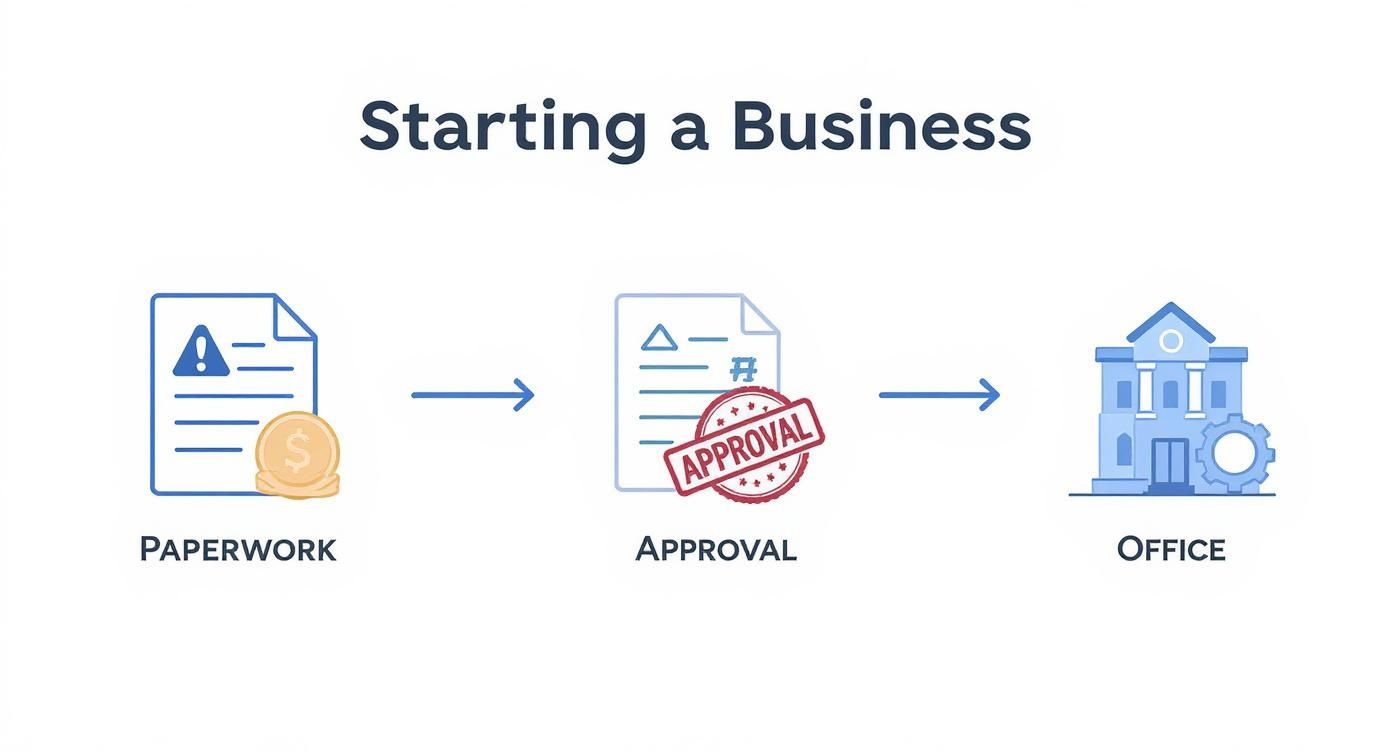
As you can see, having all your documents sorted before applying for approvals is key. This smooths the path to finalising your physical location and getting down to business.
Choosing the Right Licence for Your Operations
In the UAE, business licences are generally grouped into three main categories. Think of them as different keys for different doors—you need the one that fits your business model perfectly.
- Commercial Licence: This is your go-to if you're in the business of buying and selling goods. It covers everything from retail shops and real estate agencies to import/export and general trading. If your revenue comes from moving physical products, this is the one you'll need.
- Professional Licence: Tailored for service-based businesses, this licence is for those whose value lies in their expertise, talent, or intellectual skills. We're talking consultants, designers, accountants, and IT specialists. A major plus here is the ability to have 100% foreign ownership, even on the Mainland, typically by appointing a UAE national as a Local Service Agent (LSA).
- Industrial Licence: If your plans involve manufacturing, processing, or assembling products, an industrial licence is required. This applies to factories, workshops, and any kind of production facility. Be prepared for a more rigorous approval process, as you'll need sign-offs from various ministries to ensure you meet safety and environmental standards.
For instance, if you plan to import electronics and sell them online or in a physical store, you're firmly in the Commercial Licence camp. But if you're a marketing strategist offering advisory services, you'd be looking at a Professional Licence.
The UAE Tax Landscape: A Clear Advantage
Let's be honest, one of the biggest draws for entrepreneurs flocking to the UAE is its financial environment. The country has masterfully built a reputation as a low-tax hub, meaning you get to keep more of your hard-earned profits to reinvest and grow the business.
While the introduction of a 9% corporate tax on profits over AED 375,000 has modernised the UAE's financial framework, it's still one of the most competitive rates you'll find anywhere in the world. Crucially, the government has been very strategic in carving out protections for startups and small businesses.
The UAE’s tax system is designed to be a strategic asset, not a financial drag. With targeted reliefs and a continued commitment to zero personal income tax, the government gives entrepreneurs the breathing room they need to innovate, hire, and scale.
Unlocking the Small Business Relief Scheme
This is a true game-changer for anyone figuring out how to start a business in the UAE. The Small Business Relief scheme is specifically designed to support startups and SMEs.
Here’s the deal: if your business generates annual revenue below AED 3 million (that’s about USD 820,000), you qualify for a 0% corporate tax rate. This is a massive leg-up, easing the financial pressure while you find your footing in the market. To learn more about how the government supports new ventures, check out these startup incentives in the UAE on garant.ae.
This powerful incentive, which is in place until the end of 2026, is part of a much bigger picture. When you combine it with the complete absence of personal income, capital gains, and inheritance taxes, you get an incredibly robust financial foundation.
It’s simple: the money you make stays with you. This empowers you to either pour it back into your company’s growth or simply enjoy the fruits of your labour.
Post-Setup Essentials: Visas, Banking, and Compliance
Getting that trade licence in your hands feels like you’ve crossed the finish line. It’s a huge achievement, but really, it’s just the starting gun for the next phase: turning your licensed company into a living, breathing, and fully operational business.
This is where the real work begins. It’s all about getting you and your team on the ground, setting up the financial backbone of your company, and making sure you stay on the right side of the law. These are the hurdles where many new entrepreneurs stumble, getting bogged down in red tape just when they need momentum.
Securing Residence Visas for Yourself and Your Team
Your trade licence is more than just a piece of paper; it’s your ticket to living and working in the UAE. As the business owner, you’re now eligible for an investor or partner visa, which is usually valid for two years. This is the critical first step before you can even think about sponsoring your family or employees.
The process has a few key milestones you’ll need to hit:
- Get the Establishment Card: Before anything else, your company needs an Establishment Card. Think of it as your company's official registration with the immigration authorities (the GDRFA).
- Apply for an Entry Permit: With the card sorted, you can apply for your own entry permit. This is what allows you to enter the country specifically for residency purposes.
- The Medical and Emirates ID: Once you're in the UAE, you'll need to pass a medical fitness test at a government-approved health centre. At the same time, you'll go for a biometrics appointment to get your Emirates ID card – your official identification here.
- The Final Visa Stamp: After the medical is clear and the Emirates ID application is in, the final step is getting that visa stamped right into your passport.
This same basic pathway applies to any staff you bring on board. Getting this sequence right is crucial because any delays can directly impact your launch timeline.
Opening Your Corporate Bank Account
This is the one step that trips up more new business owners than almost any other. If you're learning how to start a business in the UAE, don't underestimate this. Banks here have very strict Know Your Customer (KYC) and anti-money laundering regulations, which can make the process feel incredibly slow and intrusive.
The key to success is preparation. Come ready to tell your story. They’ll want to see a solid business plan, know who your clients and suppliers are, and understand exactly how you’ll make money. The bank needs to be completely convinced your business is legitimate and has a genuine presence here.
I’ve seen so many founders get caught off guard by the depth of questioning from banks. It's not a simple box-tickin g exercise. You’re building a case for your business. Having a physical office and proof of real activity in the UAE makes your application infinitely stronger.
Staying Compliant with Ongoing Regulations
Your legal duties don't stop when you get your licence. The UAE has a robust compliance framework that every business must follow to ensure transparency and meet global standards. Getting this wrong can lead to some eye-watering fines.
There are two major regulations you need to have on your radar from day one:
- Ultimate Beneficial Owner (UBO): Every company must keep a register of who ultimately owns and controls it. This isn't just internal paperwork; you have to file this information with the authorities to ensure complete transparency.
- Economic Substance Regulations (ESR): To prove your business isn't just a shell company for tax purposes, ESR requires certain businesses to show they have real "economic substance." This means you must be conducting your main income-generating activities right here in the UAE, with enough qualified staff and physical resources to do the job properly.
Trying to manage all these post-setup tasks can feel like a full-time job in itself. It’s why having ongoing support is so important. Knowing you have access to a 24/7 Support Service – Always here when you need us means you're never alone when a question about a visa renewal or a compliance filing pops up.
Got Questions About Setting Up in the UAE? We've Got Answers.
As you get closer to launching your business, the big-picture planning gives way to specific, practical questions. It's totally normal. Suddenly, details about ownership, real costs, and timelines become the most important things to figure out.
We get these questions all the time from entrepreneurs just like you. So, we've put together some straight-talking answers based on our hands-on experience helping businesses get started in the UAE. Think of this as your final check-in before you dive in.
Can a Foreigner Really Own 100% of a UAE Business?
Yes, you absolutely can. This has been a game-changing update to the UAE's business laws. For most business activities, you can now have 100% foreign ownership, whether you set up on the Mainland or in a Free Zone.
This is a huge deal. It got rid of the old rule that required a local Emirati sponsor to hold 51% of the shares in many Mainland companies. Now, international founders can have complete control. It's worth remembering, though, that a handful of strategic sectors, like banking and some financial services, still have their own specific ownership rules.
What’s the Real Minimum Cost to Start a Business in Dubai?
There’s no single price tag, and anyone who gives you one without asking questions isn't giving you the full picture. The cost really depends on a few key decisions you make. The biggest factors will be your choice of jurisdiction (Mainland vs. a Free Zone), the specific business activity you're licenced for, and how many visas you'll need.
To give you a rough idea:
- A basic Free Zone package with one visa and access to a shared desk space can start from around AED 15,000.
- A Mainland setup is usually a bigger investment, mainly because you'll need to factor in the cost of a physical office lease and approvals from the Department of Economic Development (DED).
My best advice? Insist on a fully itemised quote from any setup provider you talk to. It should clearly list every single fee—licence, registration, visa processing, Establishment Card—the works. This is the only way to budget properly and make sure there are no nasty surprises down the line.
How Long Does It Actually Take to Get Set Up?
The timeline can be surprisingly fast or take a few weeks. It all boils down to the jurisdiction you choose and how organised your paperwork is from day one.
Some of the more modern Free Zones, especially those built for freelancers and tech companies, are incredibly efficient and can issue a licence in as little as 24 to 48 hours. A Mainland company, on the other hand, is a bit more of a process. You're looking at one to three weeks because it involves getting approvals from different government bodies, including the DED and sometimes specific ministries.
The fastest way to speed things up? Have every single document correct and ready before you submit anything. Even a small mistake can cause a delay. This is where working with a specialist really pays off—they know the common pitfalls and can help you avoid them.
Still have questions? Our team is on standby to help you sort through the details. 💬 WhatsApp Us Today for a Free Consultation or 📞 Call Us Now: +971-52 923 1246 to get advice that's actually relevant to your business plan.
Ready to make your UAE business a reality? Let 365 DAY PRO Corporate Service Provider LLC take care of the heavy lifting. We offer clear, cost-effective solutions for both Mainland and Free Zone setups, making sure your journey is as smooth as possible. Start your business with us today