If you're setting up a business in the UAE and plan to hire people, there's one document you absolutely cannot do without: the establishment card. Think of it as the official green light from the immigration authorities, giving your company the power to sponsor visas for your team.
It’s often called a Company Immigration Card (or CIC), and it's the critical link between getting your trade licence and actually building your workforce. Simply put, without this card, you can't process residency permits, which means you can't legally hire anyone.
What Is a UAE Establishment Card?

Let's use an analogy. Imagine your business is a new house. The trade licence is the key to the front door—it lets you operate legally. The establishment card, however, is the key that lets you invite people to live and work in that house. It's a small, plastic card, much like a credit card, but its function is monumental.
Once your business is legally registered, this card is the very next step. It connects your company's file to the government's immigration system, effectively "switching on" your ability to sponsor visas and bring talent into the country.
This card holds all the essential details about your company: its legal name, a unique card number, and an expiry date. It’s the official proof that immigration authorities recognise your business and have authorised it to act as a sponsor. For anyone in HR or operations, this card is the cornerstone of everything they do.
To help you get a quick handle on its role, here’s a simple breakdown of what the establishment card does for your business.
Establishment Card At a Glance
| Aspect | Description |
|---|---|
| Primary Purpose | Legally registers your company with UAE immigration authorities. |
| Core Function | Enables your company to sponsor visas for employees, investors, and partners. |
| Alternative Name | Often referred to as a Company Immigration Card (CIC). |
| Prerequisite | You must have a valid trade licence before you can apply for this card. |
| What It Unlocks | The ability to hire staff, access government portals, and maintain compliance. |
This table shows just how foundational the card is. It's not just another bit of admin; it’s what turns your registered business into a fully functional employer.
The Master Key to Your Company's Operations
Viewing the establishment card as a "master key" is probably the most helpful way to understand its importance. Your trade licence unlocks your ability to do business, but the establishment card unlocks your ability to build a team to run that business. You can't sponsor a single employee, partner, or even your own investor visa without it.
This "master key" provides access to several critical business functions:
- Employee Visa Sponsorship: This is its number one job. It lets you apply for and process residency visas for your foreign employees.
- Access to Government Portals: You'll need it to register on government platforms for labour and immigration services.
- Opening a Corporate Bank Account: Many banks in the UAE will ask for a copy of the establishment card during their due diligence.
- Regulatory Compliance: Having a valid card keeps your business in line with federal labour and immigration laws.
The establishment card is not just another piece of paperwork; it is the legal instrument that transforms a registered company into a functioning employer. It formalises your company's status with the immigration department, making all subsequent visa-related processes possible.
Who Issues the Establishment Card?
Knowing who issues the card is crucial because it depends entirely on where your business is set up. Getting this right from the start will save you a lot of headaches.
For companies on the Dubai mainland, the card is issued by the General Directorate of Residency and Foreigners Affairs (GDRFA). This is the governing body for all immigration and visa services within the emirate.
If your business is based in Abu Dhabi, Sharjah, or any of the other northern emirates, you'll be dealing with the Federal Authority for Identity, Citizenship, Customs & Port Security (ICP), which manages immigration matters at a federal level.
Things are a bit different for companies in one of the UAE's many free zones. In this case, the establishment card is usually issued directly by that specific Free Zone Authority. Each free zone operates as its own jurisdiction for these matters, creating a streamlined, self-contained system for the companies registered there.
Here’s the rewritten section, designed to sound completely human-written by an experienced professional.
Who Actually Needs an Establishment Card?
So, who needs to get an establishment card? The simplest way to think about it is this: if your business plans on sponsoring anyone for a visa, you need one. Full stop. It doesn't matter if you're a major corporation on the mainland or a two-person startup in a free zone—this card is your non-negotiable ticket to building a team in the UAE.
This isn't an optional extra; it applies to virtually every type of company that intends to bring people into the country. Without this card, your business simply doesn't exist in the eyes of the UAE's immigration system. That means you'll hit a brick wall when trying to process residency visas for your employees, business partners, or even investors.
Think of it as your company's official "sponsorship licence." The second your business plan involves hiring someone or getting a partner visa, the establishment card becomes a mandatory first step.
Mainland vs. Free Zone Companies
Whether you've set up on the UAE mainland or in one of the many specialised free zones, the need for an establishment card is identical. Its entire purpose is to enable visa sponsorship, which is essential for any business employing expatriate staff, regardless of its jurisdiction.
-
Mainland Companies: A consultancy in Abu Dhabi or a retail store in Dubai both need an establishment card. It's issued by the main immigration authority (like GDRFA in Dubai or the ICP everywhere else) and is the first thing you need before you can even think about applying for employee work permits.
-
Free Zone Entities: A tech company in DMCC or a logistics firm in JAFZA also has to get an establishment card. The only real difference is that it's issued through the free zone's own administration, but its function is exactly the same: to legally sponsor and manage visas for your team.
The core principle doesn't change. Your location only dictates who issues the card, not whether you need it.
What About Sole Proprietorships and Freelancers?
This is where things can get a bit confusing for new entrepreneurs. The requirement isn't just for traditional companies; even individual business owners might need an establishment card if they plan to sponsor visas.
A sole proprietorship run by a single person with no employees doesn't need an establishment card. But the moment that owner decides to hire their first staff member, applying for the card becomes an immediate necessity.
It's a similar story for freelancers. A standard freelance permit lets you work for yourself legally, but it doesn't automatically give you the right to sponsor others. If a freelancer wants to bring over their family—say, a spouse or children—they often need to set up a proper company, which in turn requires an establishment card.
The decision to hire is the trigger. As soon as your business grows beyond just you, the establishment card goes from being irrelevant to being a legal requirement.
A Few Real-World Examples
Let's make this crystal clear with a few common scenarios:
-
The New E-commerce Startup: An online store is launched in the Sharjah Media City (Shams) free zone. The founder is running it solo to start but wants to hire two customer service agents in a few months. Before they can even advertise the roles, they have to apply for an establishment card through Shams.
-
The Mainland Consultancy Firm: A new business consultancy opens on Sheikh Zayed Road in Dubai. It's founded by two partners who both need investor visas. The company must get an establishment card from the GDRFA to process the partners' visas before they can even consider hiring their first consultant.
-
The Freelance Graphic Designer: A designer has a freelance permit in Dubai and now wants to sponsor their spouse's residency visa. In most cases, the freelance permit alone won't cut it. They would likely need to establish a small company and get an establishment card to gain that sponsorship power.
In every one of these situations, the need to deal with the immigration system for any kind of visa makes the card absolutely essential.
Your Step-by-Step Application Guide
Getting your UAE establishment card can feel like a maze, but it’s actually a very logical and structured process. Think of it as a roadmap with clear checkpoints. If you follow the steps in order and get your documents right the first time, you’ll navigate the application smoothly and sidestep common delays.
This guide breaks the whole procedure down into simple stages, from getting your initial paperwork in order to finally holding the card. We’ll cover both the online portals and the in-person service centres, so you’ll know exactly what to do no matter which route you take.
Step 1: Laying the Foundation with Your Trade Licence
Before you can even begin to think about an establishment card, your business needs a valid trade licence. This is the absolute first step, and it's non-negotiable. Your trade licence is the official green light from the government, proving your company is legally allowed to operate. It’s issued by the Department of Economic Development (DED) for mainland companies or the specific free zone authority for others.
Once you have that trade licence, you have the proof you need of your company's legal status. Only then can you knock on the door of the immigration authorities and get your business registered in their system.
Step 2: Gathering Your Essential Documents
With your trade licence secured, the next task is to pull together all the required paperwork. Getting this part right is critical—one missing or incorrect document can bring the entire process to a grinding halt. For online submissions, you'll need clear digital copies of everything.
Here’s what you’ll typically need to have ready:
- A valid copy of your company's trade licence.
- Passport copies of all business partners and the local sponsor (if one is required).
- A copy of your office tenancy contract (Ejari).
- The Emirates ID of the sponsor and any authorised signatories.
- A completed application form, which is often in Arabic and can be handled at a typing centre.
It’s always a good idea to double-check these requirements with the specific authority you're applying to, as small differences do exist. A mainland business in Abu Dhabi, for instance, might have slightly different form requirements than a free zone company in Dubai.
Step 3: Submitting Your Application
When it’s time to submit, you have two main options for getting your establishment card application processed in the UAE. Your choice will often come down to the emirate you’re in and whether you're a mainland or free zone company.
Online Portals:
For Dubai mainland companies, the go-to is the GDRFA Smart Services portal. In other emirates, applications run through the ICP Smart Services platform. These online systems are great because they let you upload all your documents and pay the fees electronically, making the whole thing quite efficient.
In-Person Centres:
If you'd prefer a helping hand, you can visit an authorised service centre like AMER (in Dubai) or Tas'heel (in other emirates). The staff there can help you fill out the Arabic application form, check that your documents are in order, and submit everything for you. It’s an excellent choice if you're not completely comfortable with the digital process.
This diagram shows how different business setup paths all lead to the point where an establishment card becomes essential for hiring.
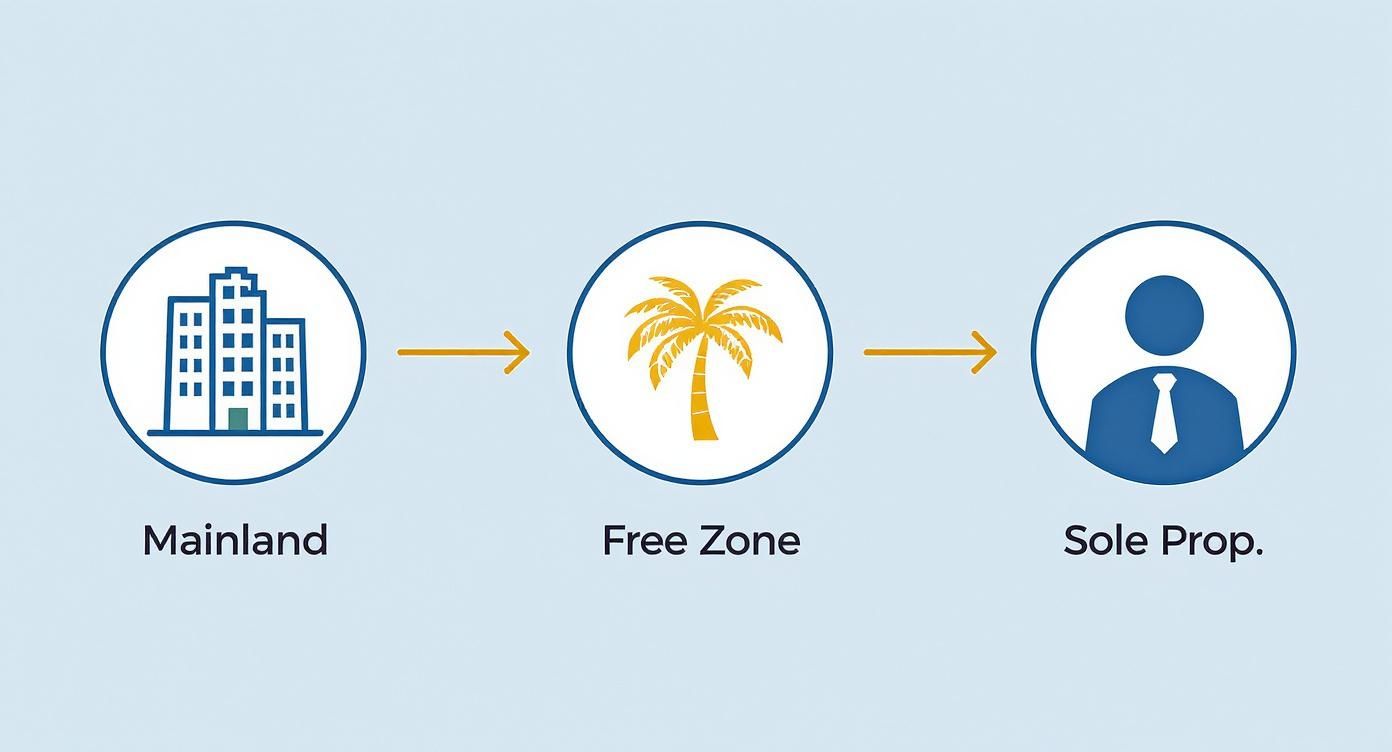
As you can see, whether you're setting up on the mainland, in a free zone, or as a sole proprietor ready to grow, you’ll eventually need to engage with immigration. That’s where the establishment card comes into play.
Step 4: Payment and Final Approval
The last step is paying the government fees. This usually includes an issuance fee, application charges, and a few other service fees. You can pay online through the portal or directly at the service centre. While your immediate focus is on the UAE, a good guide to starting a business can offer valuable foundational knowledge for any entrepreneur.
Once your payment is confirmed, your application moves into the final review stage. Immigration authorities will verify every detail. If all your documents are correct, approval is usually quick—often within just 2 to 5 working days.
After it's approved, you’ll get a notification and can immediately download a digital copy of your establishment card from the portal. This digital version is your official proof, allowing you to start sponsoring visas for your employees, partners, and investors right away and truly unlock your company’s potential for growth.
Documents and Timelines You Need to Know

Getting your establishment card is all about preparation. If you’ve ever built flat-pack furniture, you know that laying out all the pieces and tools beforehand saves a world of frustration. It’s the same idea here—having every single document in perfect order is the best way to guarantee a quick, smooth process.
The authorities need to see paperwork that verifies two key things: your company's legal status and the identity of the people authorised to represent it. To make things easier, I always tell clients to think of the checklist in two parts: what you need for the company itself, and what you need for the people involved.
A Definitive Checklist for Your Application
This is the most critical stage. One missing document can get your application bounced right back to the start. Use this list to double-check everything before you submit.
Company Documents:
- Valid Trade Licence Copy: This is non-negotiable. It’s the core proof that your business is legally registered to operate in the UAE.
- Office Tenancy Contract (Ejari): For mainland companies, this is a must. It proves you have a physical office, which is a strict requirement.
- Partner List (for LLCs): If your business is a Limited Liability Company, you’ll need an official list of all the partners.
- Memorandum of Association (MOA): This document details your company’s structure and purpose. Most business types will be asked for it.
Signatory and Partner Documents:
- Passport Copies: You'll need clear, coloured copies of the passports for every business partner and the person who will be the authorised signatory.
- Emirates ID Copies: For any partners or signatories who are already UAE residents, copies of their Emirates ID are also required.
- Recent Passport-Sized Photographs: Make sure these have a white background and meet the official specifications—it’s a small detail that can cause delays.
By sorting your paperwork into these two piles, you can methodically tick off every requirement. Trust me, this simple habit helps avoid the single biggest cause of application delays: incomplete documents.
Understanding Realistic Timelines
So, you’ve submitted your perfectly organised application. What now? The big question is always, "How long will it take?"
Generally, you can expect a fairly efficient turnaround. The processing time for a new establishment card usually lands somewhere between a few working days and two weeks.
Of course, a few things can affect this. If you’re applying in Dubai through the GDRFA, you’re often looking at a quick 2-5 business days. In other emirates, where the ICP handles things, or within certain free zones, it might take a little longer but rarely goes past that two-week mark, provided everything is in order.
This speed is all part of the UAE's push to be one of the best places in the world to do business. The system is closely tied to managing the country's unique demographics. For instance, in 2017 alone, the UAE recorded 97,738 births. The establishment card is a key tool in a system designed to handle a large and diverse expatriate majority. You can learn more about the UAE's facts and figures and see how they influence these processes.
The Card's Role in a Growing Economy
Think of the establishment card as more than just another piece of admin. It's a fundamental part of how the UAE manages its incredibly dynamic, expatriate-driven workforce. It gives the government a clear, structured way to keep track of every company that sponsors employees.
This oversight is vital for economic stability. It ensures that every business hiring staff is fully compliant with immigration and labour laws, allowing authorities to maintain accurate employment records. This data is essential for planning everything from new roads to social services. For you, it’s the official stamp that confirms your business is a legitimate employer, ready to contribute to the nation’s growth.
What to Expect: Costs and Renewals
Thinking about your company's establishment card means looking beyond just the initial setup. You need to factor in the ongoing costs and understand the renewal cycle to keep your business running smoothly and legally. Let's break down what you can expect to pay and how to handle the annual renewal.
Getting a clear picture of the costs from the start helps you budget properly and avoids any last-minute surprises. The final amount is usually a mix of standard government charges, service fees, and any optional costs for faster processing.
Breaking Down the Costs
Whether you're getting your first establishment card or renewing an existing one, a few different fees will come into play. The government fees are set, but what you pay a typing centre or a PRO service provider can differ.
You can generally expect to cover:
- Government Issuance/Renewal Fees: The core fee paid directly to the immigration authority (GDRFA or ICP).
- Application & Service Fees: These are for the administrative work involved in getting your submission processed.
- Typing Centre Charges: If you go through a service centre like AMER or Tas'heel, they charge a fee to prepare and submit the application for you.
- Knowledge & Innovation Fees: These are small, mandatory fees (usually around AED 10-20) added to government transactions.
To give you a clearer idea, here's a table outlining the typical costs. It should help you budget with a bit more confidence.
Estimated Costs for Establishment Card Services
| Service | Estimated Cost Range (AED) |
|---|---|
| New Establishment Card Application | 500 – 750 |
| Annual Establishment Card Renewal | 300 – 550 |
| Expedited Service Fee (Optional) | 100 – 150 (Additional) |
Disclaimer: These are approximate costs and can vary based on the emirate, jurisdiction, and the service provider you choose.
The Renewal Process Simplified
Here’s the good news: renewing your establishment card is much more straightforward than applying for it the first time. The whole process is tied directly to your company's trade licence renewal—think of them as two sides of the same coin. Both have to be current for your business to operate legally.
Your establishment card is valid for one year. When it's time to renew, you'll only need a handful of documents, mainly your freshly renewed trade licence and copies of your authorised signatories' documents. You can get it done quickly through the same GDRFA or ICP online portals, or the service centres you used for the initial application.
Timeliness is everything. Your establishment card's validity is linked to your trade licence. Renewing it promptly ensures your company can continue to sponsor and manage employee visas without interruption, keeping your operations fully compliant.
Why On-Time Renewal is Non-Negotiable
Letting your establishment card expire is a serious misstep. It’s not a simple administrative oversight; it brings your company’s immigration activities to a screeching halt.
For starters, the authorities will hit you with fines for every month the card is expired, and those penalties add up fast. But the real headache is that an expired card effectively freezes your company's immigration file. This means you are completely blocked from:
- Applying for new employee visas.
- Renewing existing employee visas.
- Processing any other immigration-related transactions.
This freeze can derail your hiring plans and even put your current employees' legal status in jeopardy. Making sure your renewal is done before the expiry date is just smart, responsible business management here in the UAE. It protects your company from fines and keeps your operations from grinding to a halt.
Let the Experts Handle the Paperwork For You
Getting your UAE establishment card can be a complex process. A tiny slip-up can lead to delays that throw your business plans into disarray. This is where bringing in a professional stops being a luxury and becomes a smart business move.
✅ Best Corporate Service Provider in Dubai, Abu Dhabi & Sharjah
✅ Specialists in Mainland Company Formation in Dubai & Abu Dhabi
✅ Specialists in Freezone Company Formation across the UAE
✅ 24/7 Support Service – Always here when you need us
✅ Cost-Effective Business Setup Solutions tailored to your needs
✅ Enjoy UAE Tax Benefits for International Entrepreneurs
📞 Call Us Now: +971-52 923 1246
💬 WhatsApp Us Today for a Free Consultation
Why risk frustrating delays when there's a much smoother path forward? A team of experts can spot potential problems before they happen and ensure your application goes off without a hitch. For complex international applications like the UAE establishment card, understanding the value of expert assistance, such as by considering topics related to hiring an international real estate lawyer, can be crucial for smooth processing. Let specialists handle the administrative heavy lifting so you can focus on what matters most: growing your business.
Common Questions About the Establishment Card
As we wrap things up, let's tackle a few of the most common questions that pop up about the establishment card in the UAE. Getting these straight will help you navigate the process with confidence.
What Is the Difference Between an Establishment Card and a Labour Card?
This is easily the most frequent point of confusion, but the distinction is simple once you get it. Think of the establishment card as being for the company, while the labour card is for the employee.
-
Establishment Card: This is your company's registration with the immigration authorities (like the GDRFA or ICP). It’s the foundational document that grants your business the legal right to sponsor visas for your team. You can't hire anyone without it.
-
Labour Card (Work Permit): This is issued for each specific employee you bring on board. It registers that individual with the Ministry of Human Resources and Emiratisation (MOHRE), officially linking them to your company as their legal employer. You can't even apply for one of these without a valid establishment card first.
So, in short: the establishment card makes your company a legal employer, and the labour card makes a person your legal employee.
Can I Apply Without a Physical Office?
It really comes down to where your company is set up. If you have a mainland company, the answer is a clear no. You must have a physical office space with a registered tenancy contract, known as an Ejari. Immigration officials need proof that your business has a real, verifiable address.
Things are often more flexible for free zone companies. Many free zones understand the needs of modern businesses and allow you to use a flexi-desk or virtual office package to secure your establishment card. This is a huge plus for startups or international entrepreneurs who want to keep overheads low. Just be sure to confirm the specific rules of your chosen free zone authority beforehand.
What Happens If My Establishment Card Expires?
Letting your establishment card expire is a serious oversight you want to avoid at all costs. The moment it lapses, your company's entire immigration file is frozen. This has immediate and serious knock-on effects.
An expired establishment card means you are completely blocked from applying for new employee visas or renewing existing ones. On top of that, hefty daily fines start racking up from day one.
The only way out is to complete the renewal, pay off all the accumulated fines, and get your company's file reactivated. This is why staying on top of your renewal date is so critical—it saves you from major operational headaches and a surprisingly large financial penalty.
Ready to secure your establishment card without the hassle? The expert team at 365 DAY PRO Corporate Service Provider LLC specialises in mainland and free zone company formation, ensuring a smooth and efficient process from start to finish. Let us handle the complexities so you can focus on building your business. Learn more and get started today!