Securing an employment visa in Dubai isn't just a single application; it's a multi-stage journey that takes you from a job offer to legal residency. The whole process really boils down to five key milestones that your employer will manage for you: getting an entry permit, completing the in-country medical fitness test, applying for your Emirates ID, signing the official labour contract, and finally, stamping the visa in your passport.
Your Roadmap to a Dubai Employment Visa
Moving to Dubai for a new job is a huge step, and knowing what to expect with the visa process makes all the difference. Think of this guide as your practical roadmap, breaking down the entire employment visa journey from the very beginning to the final stamp. It's less of a single event and more a series of connected steps involving you, your employer (who acts as your sponsor), and several key government departments.
Your employer does most of the heavy lifting. They're the ones who will deal directly with authorities like the Ministry of Human Resources and Emiratisation (MOHRE) and the General Directorate of Residency and Foreigners Affairs (GDRFA). Your main job is to provide all the right documents promptly and show up for your medical and biometrics appointments on time.
Setting Realistic Timelines
The UAE government is known for its efficiency, but it's still smart to have a realistic timeline in mind. While individual steps can be processed surprisingly quickly, the entire journey from start to finish usually takes a bit longer than the official estimates suggest.
This is a common point of confusion for newcomers.
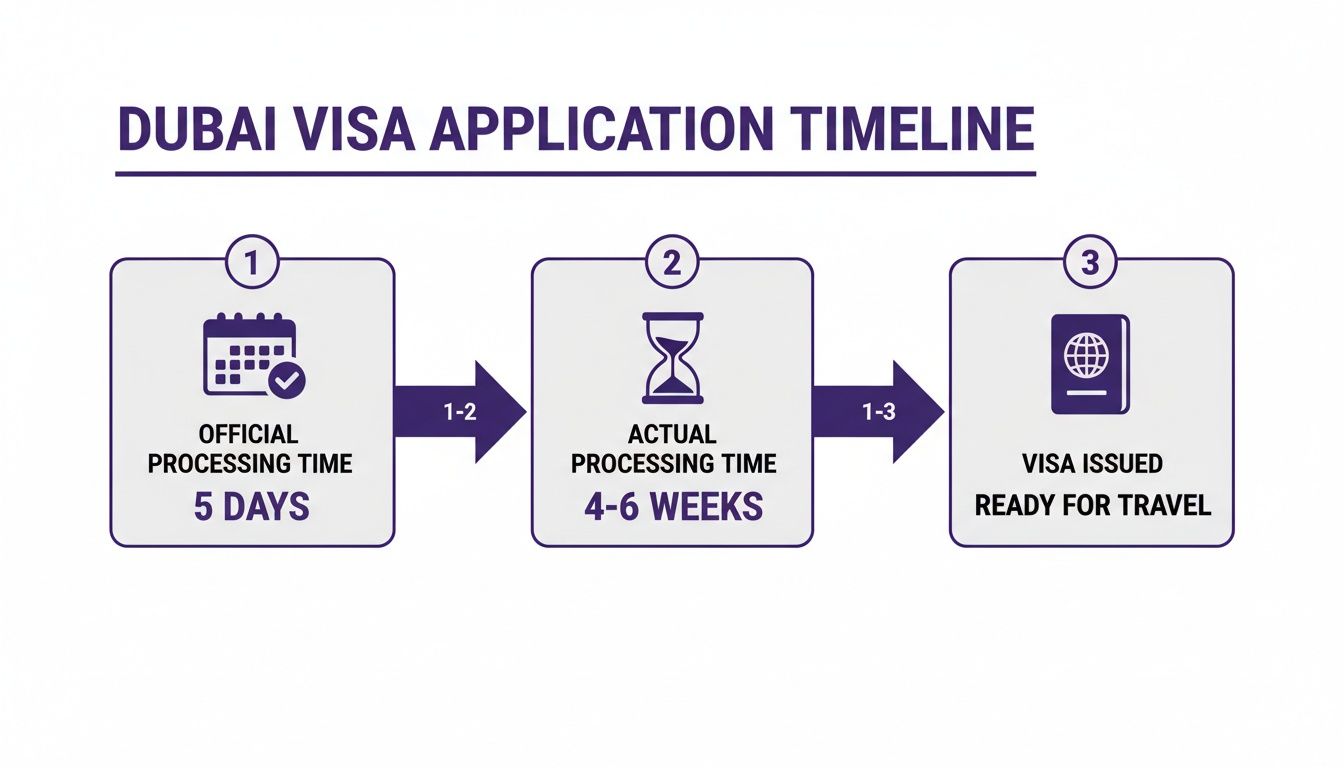
As you can see, there's a difference between the government's processing window and what you'll likely experience in practice. The total time depends on coordinating all the different approvals and appointments.
The good news is that the Dubai employment visa process has been massively simplified. What used to be a complicated process with up to 15 different stages has been condensed into just 5 major steps. This huge overhaul means a procedure that once took 30 days can now, in a perfect world, be wrapped up in as little as 5 working days.
However, once you factor in gathering documents, waiting for approvals, and booking appointments, a more practical timeframe is between 4 to 6 weeks. You can always find more details on the latest UAE visa timelines and updates on Govanator.com.
To help you visualise the journey, here’s a quick breakdown of the main stages you’ll go through.
Dubai Employment Visa Key Stages at a Glance
| Stage | Primary Purpose | Typical Duration |
|---|---|---|
| Entry Permit | To allow the employee to legally enter the UAE for employment purposes. | 2-5 working days |
| Medical Fitness Test | To screen for specific communicable diseases as required by UAE law. | 1-2 working days |
| Emirates ID Biometrics | To capture fingerprints and a photograph for the mandatory national ID card. | 1-2 working days |
| Labour Contract Signing | To formalise the employment agreement under MOHRE regulations. | 1-3 working days |
| Visa Stamping | The final step; placing the residency visa sticker in the employee's passport. | 3-5 working days |
Each stage is a critical piece of the puzzle, and a delay in one can easily hold up the next.
Key Takeaway: The process is a partnership. Your employer drives the application, but your timely cooperation is essential. Delays in providing documents or missing appointments can extend the timeline significantly. This is where a professional PRO service becomes invaluable, coordinating every step to ensure efficiency and prevent unnecessary hold-ups.
Getting Your Entry Permit Sorted Before You Fly
Your journey to working in Dubai kicks off well before you even think about packing. This first, critical stage is all handled by your new employer, but it sets the foundation for everything that follows. Think of it as getting the official green light for you to enter the UAE to start your job.
First, your employer has to get a work permit approval from the Ministry of Human Resources and Emiratisation (MOHRE). This is essentially the government confirming that you, a foreign national, have been approved to fill a specific role. Once that’s in hand, they move on to the immigration authorities (like the GDRFA in Dubai) to get your employment entry visa.
This entry visa—often called a 'pink visa' because of its colour—is your ticket into the country for work purposes. It's usually valid for 60 days, which gives you a two-month window to land in Dubai and get the rest of the process done on the ground.
Your Part in This Early Stage
Even though your employer is doing the heavy lifting with the applications, they can't do it without your documents. Honestly, getting your paperwork in order, correctly and quickly, is the most important thing you can do at this point. Any hold-ups here will push back your start date, guaranteed.
Here’s what you’ll need to have ready:
- A High-Resolution Passport Copy: Your passport needs at least six months of validity left, plus a few blank pages. Make sure the scan is in colour and perfectly clear.
- Passport-Sized Photographs: These have to meet the UAE's specific standards, which almost always means a plain white background. Don't dig up an old photo; it's worth getting fresh ones taken.
- Attested Educational Certificates: This is a big one and a common stumbling block. For most professional jobs, your highest degree needs to be officially attested. This involves getting it stamped by the UAE Embassy in your home country and then again by the Ministry of Foreign Affairs (MOFA) here in the UAE. Start this as early as possible.
A quick tip from experience: The attestation process can be tricky. Your employer's PRO should give you the exact steps, but a missed stamp or the wrong signature can send you right back to the beginning, costing you weeks.
What's Happening on the Employer's End?
While you're gathering your documents, your employer is compiling their own file. They'll combine your paperwork with their corporate documents, like the company’s trade licence and establishment card, and submit everything through the official government systems.
Which system they use, however, is a crucial detail. It all depends on where the company is registered, and this is where you see the first major split in the visa process.
Mainland vs. Free Zone: The First Big Difference
The route to getting your entry permit looks quite different depending on whether your new company is on the Mainland or in a Free Zone.
-
Mainland Companies: If the business is registered with the Department of Economic Development (DED), they'll process the application through MOHRE, usually via a service centre like Tas'heel. This is the standard procedure for most businesses operating in the local Dubai market.
-
Free Zone Companies: Businesses set up in zones like JAFZA, DMCC, or Dubai Media City have their own government service portals. The Free Zone authority itself acts as your sponsor and handles the initial application before passing it to immigration. People often find this a bit more direct, as it's all managed within that Free Zone's own system.
No matter which path is taken, the goal is the same: securing that approved entry permit. A common delay at this stage can be a routine security check. Another potential snag is a mismatch between your qualifications and the job title—for instance, trying to get an "Engineering Manager" visa with a business degree can cause the application to be flagged or rejected outright.
Here at 365 DAY PRO, we live and breathe both Mainland and Free Zone visa processing. We know exactly how to align an application with MOHRE and immigration rules to avoid these common, and often costly, mistakes. If you're looking to set up a business and need this process handled seamlessly, just WhatsApp Us Today for a Free Consultation.
The In-Country Steps: Your Medical Test and Emirates ID
So, you’ve landed in Dubai with your entry permit—congratulations! The next chapter of your employment visa process happens right here in the city. You technically have a 60-day window to get everything sorted, but my advice is to get the ball rolling immediately. There are two critical tasks you’ll need to tackle almost at the same time: the medical fitness test and your Emirates ID biometrics appointment.
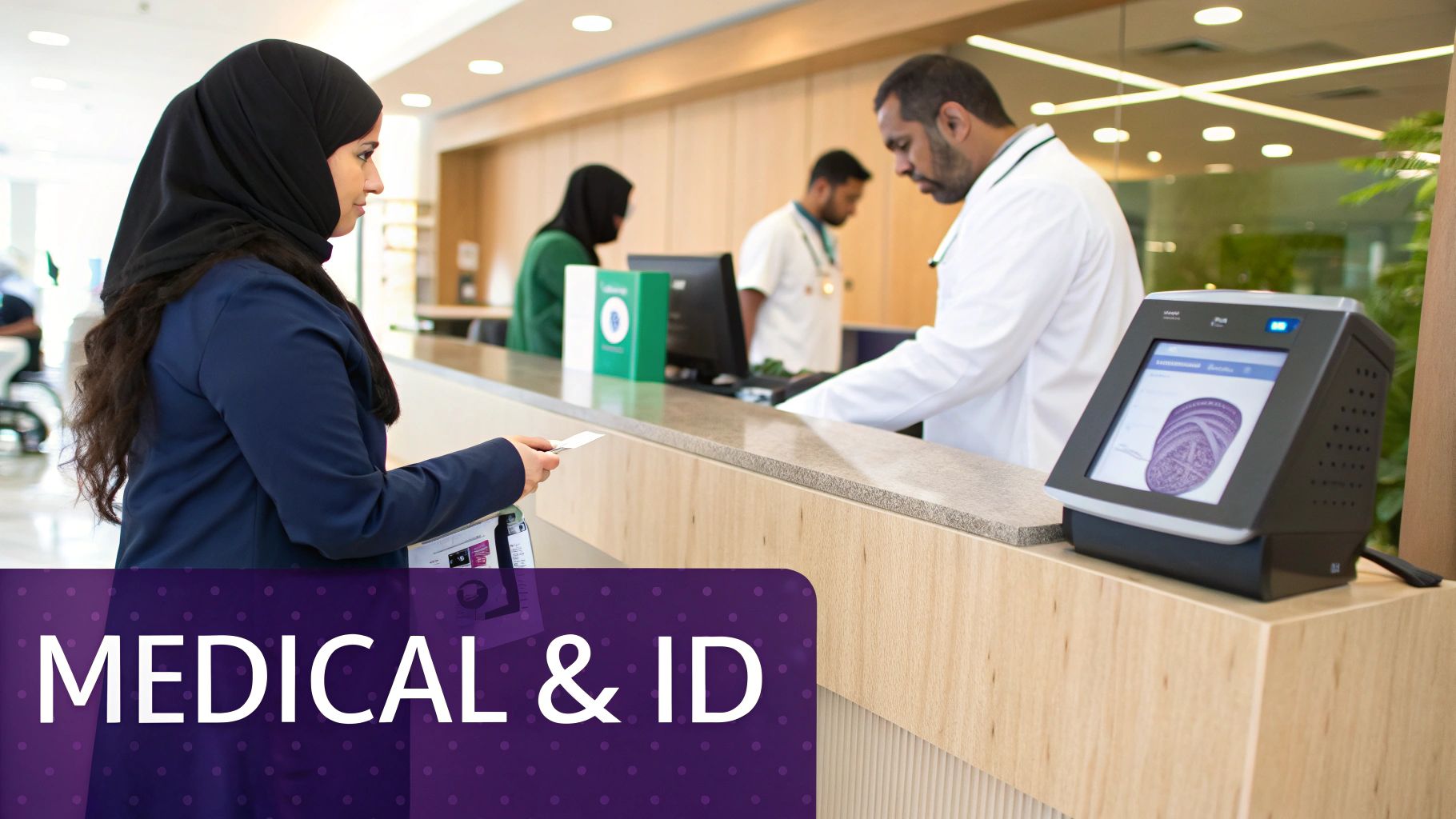
Getting through these steps smoothly is what turns that temporary entry paper into your full residency visa. While your company's PRO is there to guide you, knowing what's coming will make the whole experience far less daunting.
First Up: The Medical Fitness Test
This is a non-negotiable health screening for every expat aiming to become a resident. The government's main goal here is to protect public health by screening for certain communicable diseases. Don't stress about it; the test is surprisingly quick, usually just a blood test and a chest X-ray.
The screening specifically looks for:
- HIV/AIDS
- Hepatitis B & C
- Tuberculosis (TB)
It’s crucial to understand that a positive result for active TB or HIV will, unfortunately, mean your visa application cannot proceed. You'll be sent to a designated government-approved medical fitness centre to get this done.
How Fast Do You Need the Results?
One thing you'll quickly learn about Dubai is its focus on efficiency, and the medical test is a perfect example. There are different service levels you can choose from, which really just dictates how quickly you get your results. Your employer will foot the bill, but it's good to know what's available.
- Standard Service: You'll typically get your results back within 24 hours.
- Urgent Service: Need them faster? This option can deliver results in about 4 hours.
- VIP Service: For the fastest turnaround, this premium service gets your results in as little as 2 hours, often with the added perk of a more comfortable lounge and quicker processing.
Your company's PRO will likely have a standard procedure and will book the service that aligns with their timeline for getting your visa stamped. Your job is simply to show up to the appointment they schedule for you, on time.
Next Stop: Your Emirates ID Biometrics
As soon as your medical test is done, the focus shifts to your Emirates ID. This little card is your everything in the UAE. You’ll need it to open a bank account, rent an apartment, get a phone plan, and access government services. It’s fundamentally linked to your residency visa.
The application itself is usually started by your PRO right after your entry permit is issued. You'll then get a specific appointment time to visit a service centre for the Federal Authority for Identity, Citizenship, Customs & Port Security (ICP).
Insider Tip: Treat this like a formal appointment. Dress modestly—a collared shirt is a good bet. For the photo, they need a clear shot of your face, so avoid anything that might obstruct it (unless for religious reasons).
At the centre, they will capture your biometrics, which sounds technical but is very simple. It just involves:
- Fingerprinting: A quick digital scan of all your fingerprints.
- Photograph: They'll take a digital photo right there that meets specific government standards.
The process is fast, but waiting times can be unpredictable. This is a classic "bring your original passport and entry permit" situation—photocopies are a no-go. Forgetting your documents or missing the appointment is one of the most common reasons the employment visa process in Dubai gets delayed.
This is where having a reliable corporate service provider makes a world of difference. At 365 DAY PRO, we don't just tell you what to do; we manage the entire sequence. We book the medical, schedule the biometrics, and can even arrange transport. We make sure you know exactly what to bring, where to go, and when to be there, taking all the guesswork and stress out of the equation.
For cost-effective solutions that streamline these crucial steps, WhatsApp Us Today for a Free Consultation.
Getting Your Visa Stamped and Labour Contract Signed
You’ve cleared the medical tests and had your biometrics taken for the Emirates ID. You're now on the home stretch of the employment visa process in Dubai. This is the final, official step where the residency permit is physically placed in your passport, cementing your legal status as a UAE resident. It’s a huge milestone—the moment you officially transition from visitor to resident.
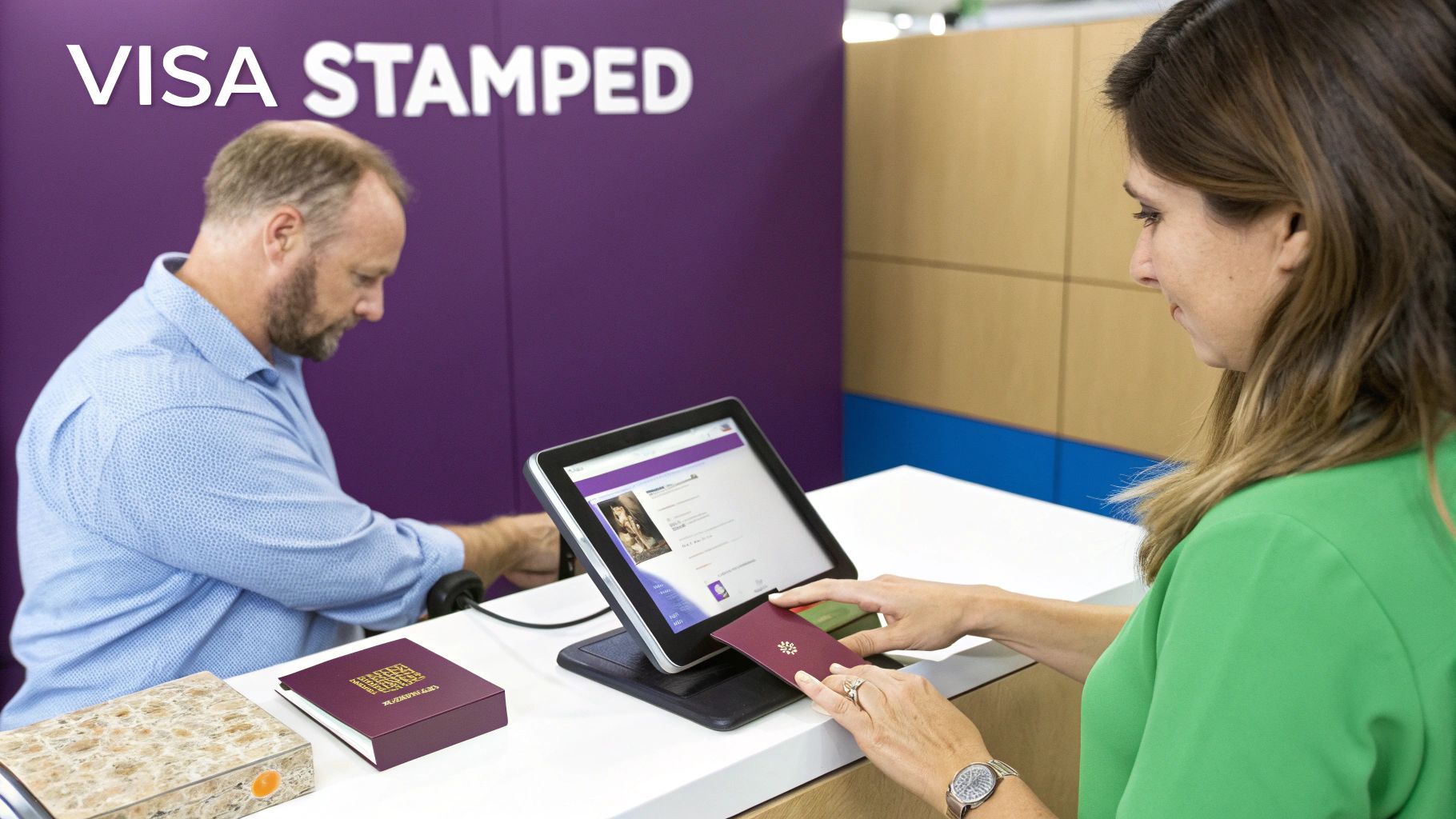
The stamping itself is fairly hands-off for you. Your company’s Public Relations Officer (PRO) takes your original passport, the passed medical fitness report, and the Emirates ID application receipt to the immigration authorities. Once everything checks out, they affix the visa sticker inside your passport and return it.
But before that final stamp, there's one critical document that needs your attention: the official labour contract.
What to Look for in Your Official Labour Contract
This isn't just another piece of paper; it's the legal foundation of your employment here. Whether it's issued by the Ministry of Human Resources and Emiratisation (MOHRE) for a Mainland company or a specific Free Zone authority, this contract is the one that counts. It legally supersedes any offer letter you previously signed.
Take the time to read this document line by line. Seriously. Check that your salary, job title, allowance breakdown, and notice period all match what you originally agreed to. It's not uncommon for discrepancies to pop up, and once your signature is on that contract, those are the legally binding terms.
Expert Insight: Pay close attention to how your salary is broken down into "basic salary" and "allowances." Your end-of-service gratuity is calculated based on your final basic salary. A lower basic means a smaller final payout when you eventually leave the company, so it's a detail you can't afford to overlook.
Signing Your Contract in the Digital Age
Forget about trekking to a government office to sign stacks of paper. The UAE has streamlined this process beautifully. Today, most labour contracts are signed digitally.
You'll usually get an SMS from MOHRE with a link to download the MOHRE UAE app. From there, you can securely view and e-sign your official labour contract. The whole thing is quick, incredibly convenient, and just as legally binding as a wet-ink signature.
Signing the contract formalises your employment and generates your digital labour card, which serves as official proof that you're legally sponsored and employed.
Mainland vs. Free Zone: The Final Hurdles
While the big steps—contract review and visa stamping—are the same everywhere, the specific administrative path can vary depending on where your company is registered.
- Mainland Companies: If your employer is licensed by the Department of Economic Development (DED), the process is handled by MOHRE and the General Directorate of Residency and Foreigners Affairs (GDRFA). Your PRO will manage all the submissions through their official government channels.
- Free Zone Companies: For companies in zones like DMCC or JAFZA, the Free Zone authority is your sponsor. They handle the final contract and visa stamping through their own portals, acting as the middleman with the immigration department.
No matter the jurisdiction, the result is identical: a stamped residency visa in your passport and your brand-new Emirates ID in the mail. You are officially a Dubai resident.
As specialists who handle both Mainland Company Formation in Dubai and Free Zone setups every day, we know the ins and outs of each system. If you need help figuring out the best route for your business, WhatsApp Us Today for a Free Consultation.
Budgeting for Your Dubai Employment Visa: Costs and Timelines
When you're bringing a new hire to Dubai, two of the biggest questions are always: "How much will this cost?" and "How long will this take?" Getting these wrong can cause serious headaches, from blown budgets to delayed start dates. Let's break down what you can realistically expect.
The total outlay for a new employment visa typically lands somewhere between AED 3,000 and AED 7,500. That's a pretty wide range, and the final figure really depends on a few moving parts.
What Goes Into the Final Visa Cost?
Think of the total cost as a sum of several smaller fees. The specific services you need for your new employee will determine the final bill.
Here are the main variables I see in my day-to-day work:
- Where Your Company is Registered: The government fees and administrative processes are different for Mainland companies versus those set up in a Free Zone.
- How Fast You Need It: If you're in a rush, you can pay for VIP or express services for things like the medical test or final visa stamping. It costs more, but it can shave off valuable days.
- The Employee's Location: Bringing someone in from outside the UAE involves a slightly different (and sometimes pricier) process than converting a visit visa for someone already in the country.
- Standard Government Fees: These are non-negotiable. They cover the work permit, the initial entry visa, the mandatory medical screening, the Emirates ID application, and the visa stamping itself.
Overlooking even one small fee can throw your entire onboarding budget off track. I've seen it happen. This is where working with a professional PRO service pays for itself—we give you a clear, all-in quote from the start, so there are no surprises.
A Realistic Timeline From Start to Finish
From the moment you submit the first application to getting that visa stamped in the passport, you should set aside 4 to 6 weeks. While some individual steps are quick, the entire process is sequential, meaning you can't start one part until the previous one is fully approved.
Here’s a rough breakdown of that timeline:
- Initial Approvals (5-7 working days): This is the first hurdle. We're getting the green light from both MOHRE and the immigration authorities for the work permit and entry visa.
- Arrival and In-Country Steps (3-5 working days): Once the employee lands in Dubai, the clock starts on their medical fitness test and the biometrics appointment for their Emirates ID.
- Final Visa Stamping (3-5 working days): With the medical results in hand, all documents are submitted for the final step—getting the residence visa physically placed in the passport.
Remember to factor in living expenses during this waiting period. The employee will need to manage their finances while settling in, which often includes figuring out the best ways to stay connected internationally.
Mainland vs. Free Zone: Key Differences in the Visa Process
The UAE's workforce is incredibly diverse, with 8.84 million expatriates making up about 88% of the population. This huge demand for talent means the visa system is always busy. Knowing whether you're following the Mainland or Free Zone route is fundamental to getting it right.
While the end goal is the same—a valid employment visa—the path to get there differs significantly depending on your company's jurisdiction. Here’s a quick comparison to highlight the main distinctions.
Mainland vs Free Zone Visa Process Key Distinctions
| Aspect | Mainland Company Process | Free Zone Company Process |
|---|---|---|
| Sponsoring Authority | The company sponsors through the Ministry of Human Resources & Emiratisation (MOHRE) and GDRFA. | The specific Free Zone Authority (e.g., DMCC, JAFZA) acts as the official sponsor. |
| Governing Body | The UAE Labour Law, overseen directly by MOHRE, applies to all contracts and procedures. | You're governed by the specific rules and regulations set by that individual Free Zone. |
| Application Portal | Applications are typically processed through government service centres like Tas'heel and Amer. | Everything is handled through the Free Zone’s own dedicated online portal. |
| Required Documents | You'll need standard corporate documents, like your DED trade licence and establishment card. | In addition to standard docs, you'll need Free Zone-specific ones, like your office lease agreement. |
Understanding these nuances from the outset is crucial for a smooth process. It avoids incorrect submissions and unnecessary delays, whether you're setting up on the mainland or in a free zone.
As specialists in both Mainland Company Formation in Dubai & Abu Dhabi and Freezone Company Formation across the UAE, we've managed this process thousands of times. We know the potential pitfalls and how to navigate them efficiently.
For expert guidance tailored to your business, Call Us Now: +971-52 923 1246.
Navigating the Dubai employment visa process can feel like a maze, even when you have a map. While the steps are laid out, the path is full of administrative hurdles where one small misstep can cause serious delays. This is precisely why bringing a professional corporate services provider on board isn't just a convenience—it's a strategic move that turns a stressful process into a seamless one.
Think of an expert Public Relations Officer (PRO) as your guide through the labyrinth of government requirements. They've seen it all before. They know the common pitfalls that can completely derail an application, from incorrect document attestations and mismatched job titles to missing a crucial deadline. Their real value shines through at every single stage of the journey.
Avoiding Risks and Staying Compliant
Right from the get-go, a good PRO service ensures every piece of pre-arrival paperwork is perfect. They're the ones who will handle submissions on tricky government portals, book those medical and biometrics appointments efficiently, and keep you in the loop with real-time updates so you're never left guessing.
This isn't just about saving time; it's about actively managing risk. Immigration rules can and do change, and a PRO's job is to stay on top of those shifts, ensuring you're always fully compliant.
When you hand over the complex admin work to an expert team, you free up your own resources. You can then focus on your core business and, just as importantly, on creating a genuinely welcoming onboarding experience for your new hire.
A Smooth Start for Your New Team Members
A hassle-free visa process sets a fantastic tone for an employee's entire time with your company. With the demand for talent in Dubai higher than ever, efficiency is key. Just look at the numbers: over 200,000 employment visas were issued in 2023 alone. This surge reflects Dubai's growing population and underscores why you need an expert touch to manage immigration. You can explore detailed insights on UAE employment visas on businesslinkuae.com to get a better sense of these trends.
As specialists in both Mainland and Free Zone Company Formation, we provide practical, cost-effective business setup and visa solutions built around what you actually need. Plus, with our 24/7 support, we’re always here when you need us.
If you'd like to chat about how we can make your visa processes and other corporate services run smoothly, just get in touch.
📞 Call Us Now: +971-52 923 1246
💬 WhatsApp Us Today for a Free Consultation
Questions We Hear All the Time About Dubai Visas
Even when you have a clear plan, the Dubai employment visa process can throw a few curveballs. Knowing the answers to the most common questions we get from clients can save a lot of headaches for both the company and the new hire.
So, how long is the visa actually good for? This is a big one. Your standard Dubai employment visa is typically valid for two years. The good news is that renewing it is much easier than the first time around. As long as you're staying with the same company, it's mostly just a new medical test to get it extended for another two years.
What if I Want to Change Jobs or Fail My Medical?
People often ask about switching jobs. Yes, you absolutely can. Once you resign, you get a 30-day grace period. Your old employer has to cancel your current visa, and only then can your new company kick off the application process for your new one.
The medical fitness test is another major point of concern. You have to be aware of the health requirements. If the tests come back positive for certain communicable diseases, like HIV or active Tuberculosis, the visa application will be rejected. In these cases, the individual is usually required to leave the country.
Here's a critical point that many people miss: The company pays for everything. According to UAE Labour Law, your employer is legally required to cover all costs for your visa, medical test, and Emirates ID. They cannot and should not deduct these fees from your salary.
Life in Dubai goes beyond just the visa, of course. Newcomers often have practical questions about setting up their lives here, which includes getting online. It’s a smart move to get familiar with local regulations by understanding VPN usage and internet restrictions in the UAE. Being prepared makes the whole move feel much smoother.
Having an expert in your corner means you get the right answers, fast. At 365 DAY PRO Corporate Service Provider LLC, we are recognised as the Best Corporate Service Provider in Dubai, Abu Dhabi & Sharjah. Our expertise includes:
✅ Specialists in Mainland Company Formation in Dubai & Abu Dhabi
✅ Specialists in Freezone Company Formation across the UAE
✅ 24/7 Support Service – Always here when you need us
✅ Cost-Effective Business Setup Solutions tailored to your needs
✅ Helping you enjoy UAE Tax Benefits for International Entrepreneurs
📞 Call Us Now: +971-52 923 1246
💬 WhatsApp Us Today for a Free Consultation: https://365dayproservices.com