
So, you're thinking about a Dubai company setup? It's a fantastic move, landing you right in the middle of a global economic powerhouse. As the Best Corporate Service Provider in Dubai, Abu Dhabi & Sharjah, we've helped countless entrepreneurs navigate this process. This guide is designed to cut through the jargon and give you the real-world advice you actually need.
Let's start with the big picture: incredible tax advantages, a government that genuinely wants entrepreneurs to succeed, and unparalleled access to international markets.
Why Dubai Is Your Next Business Destination

Dubai has grown far beyond its reputation as a luxury travel spot. It’s now a vibrant, dynamic hub for international business and a magnet for ambitious founders. The city’s strategic location, acting as a natural bridge between East and West, gives you a logistical edge that's hard to find anywhere else.
For anyone looking to operate internationally, this means you’re on the doorstep of massive markets across the Middle East, Africa, Asia, and Europe. It’s a game-changer.
The Core Advantages for Entrepreneurs
The UAE government has been very deliberate in creating an environment where businesses can thrive. They've rolled out the red carpet for foreign investment and talent, and it shows. The most obvious draw? The tax regime. As an international entrepreneur, you can enjoy UAE tax benefits that make it an incredibly efficient place to run a global operation from.
But it's not just about the taxes. The infrastructure is absolutely world-class. We're talking about state-of-the-art ports and airports, incredible digital connectivity, and everything a modern business needs to operate smoothly at a global scale. This solid foundation supports a huge range of industries, from tech and finance to logistics and tourism.
Of course, setting up a company is only one part of the equation. It's also a major life decision. Getting practical advice on preparing for your move abroad can help you manage the personal side of this exciting business venture.
Your Foundational Choice: Mainland or Free Zone
Your first and most important decision is where to set up your company. This choice between a mainland and a free zone setup will dictate how your business operates, who you can sell to, and how you can grow. It's a critical fork in the road.
- Mainland Company Formation: This is the way to go if you want to trade directly within the UAE market without any restrictions. If your customers are here in Dubai and across the Emirates, a mainland licence is usually your best bet.
- Free Zone Company Formation: These are brilliant for businesses focused on international trade or services. Free zones offer major perks, including 100% foreign ownership and their own unique regulatory rules, which can be a huge advantage.
Choosing between a mainland and a free zone setup is the first strategic checkpoint. Your decision will impact everything from your market access and ownership structure to your long-term operational costs. It’s crucial to align this choice with your core business model from day one.
As Specialists in Mainland Company Formation in Dubai & Abu Dhabi and Freezone Company Formation across the UAE, our team is here to help you figure out the most cost-effective solution for your specific goals. With our 24/7 Support Service, you’ll always have an expert to guide you through this foundational choice.
📞 Call Us Now: +971-52 923 1246
💬 WhatsApp Us Today for a Free Consultation
Choosing Your Jurisdiction: Mainland vs. Free Zone
Right out of the gate, you’ll face a foundational decision: where to set up your company in Dubai. This isn't just about picking an address; it's a choice that will define who you can do business with, what your ownership structure looks like, and how freely you can operate. The core of this decision is choosing between a mainland and a free zone setup.
Let's break it down. If your business plan involves trading directly with customers anywhere in the UAE, a mainland license is non-negotiable. Think of it as your all-access pass to the local market. Want to open a boutique in a Dubai mall, offer consulting services to other local companies, or bid on lucrative government tenders? You’ll need to be a mainland entity. This structure plants you firmly within the UAE’s economy.
On the flip side, a free zone company is purpose-built for international trade and operations. These are specialised economic hubs that roll out the red carpet for global entrepreneurs with massive incentives like complete foreign ownership and zero taxes. If you're consulting for clients in Europe or trading goods outside the UAE, a free zone offers a streamlined and highly cost-effective base of operations.
Understanding Mainland Company Formation
Going the mainland route gives you the freedom to operate anywhere and everywhere in the UAE. You can rent an office in a gleaming Downtown Dubai skyscraper or set up a workshop in the industrial heart of Al Quoz—there are no geographical handcuffs on your business.
The real prize here is direct market access. With a mainland license from the Department of Economy and Tourism (DET), you can engage with the entire local economy without needing any middlemen. It’s the go-to choice for businesses like restaurants, construction firms, and law practices whose bread and butter is the local Emirati market. As Specialists in Mainland Company Formation in Dubai & Abu Dhabi, we guide countless entrepreneurs through the formation maze, ensuring they get to market without a hitch.
The Power of Free Zone Company Formation
The UAE is home to more than 40 free zones, and many are tailored to specific industries—think media, tech, or finance. They operate as powerful, self-contained business ecosystems where the setup process is often quicker and less bureaucratic than on the mainland.
The biggest draws are the incredible financial perks. You get 100% foreign ownership (no local partner required), the ability to send all your profits home, and complete exemption from import and export duties. This makes free zones a magnet for international business owners looking for a tax-efficient hub to run their global ventures.
Choosing a free zone is a strategic decision for international entrepreneurs. It offers a cost-effective, tax-efficient base to manage global operations, with the flexibility to scale without the complexities of direct local market regulations.
Starting up in a free zone can also be lighter on the wallet initially. Registration fees are often lower, and you can opt for flexible office solutions like a flexi-desk instead of committing to a physical office lease. With over 2,000 business license types available, the possibilities are immense. To get a better grasp of the numbers, you can discover more insights about Dubai free zone benefits and how they play into long-term planning.
Mainland vs Free Zone: A Direct Comparison
To help you visualise the differences, we've put together a quick comparison. Every business is unique, so looking at these features side-by-side can help clarify which path aligns best with your goals.
| Feature | Mainland Company | Free Zone Company |
|---|---|---|
| Business Scope | Can trade directly within the UAE and internationally. | Primarily trades internationally and within its designated free zone. |
| Ownership | 100% foreign ownership for most activities. | 100% foreign ownership is standard. |
| Office Space | Physical office space is usually mandatory. | Flexible options, including virtual offices and flexi-desks. |
| Visas | Number of visas depends on the size of the office space. | Visa eligibility is pre-packaged with the setup. |
| Government Approvals | Requires approvals from DET and other relevant bodies. | Approvals are managed by the specific free zone authority. |
| Auditing | Annual audit and financial statement submission is required. | Auditing requirements vary by free zone. |
Ultimately, this table is a starting point. The best choice depends entirely on the nuances of your business plan.
Making the Right Choice for Your Business
So, how do you decide? It really boils down to one simple question: "Who are my customers?" If your answer is "people and businesses inside the UAE," then a mainland setup is almost certainly your best bet. If your clients are scattered across the globe, a free zone is likely the more strategic and efficient choice.
Let's take a software company as an example. If they’re creating bespoke systems for hotels and retailers here in Dubai, they’ll need a mainland license to operate legally. But if that same company is building a mobile app for a worldwide audience, setting up in a tech-focused hub like Dubai Internet City makes far more sense.
Our job as the Best Corporate Service Provider in Dubai, Abu Dhabi & Sharjah is to walk you through these scenarios. We deliver practical, Cost-Effective Business Setup Solutions tailored to your needs. With our 24/7 support service, we're always here when you need us to help you weigh the pros and cons, ensuring your Dubai venture starts on the strongest possible foundation.
Navigating Company Registration and Licensing
Alright, you've weighed the pros and cons and picked your path—mainland or free zone. Now the real fun begins. This is where your business idea stops being just a plan and starts becoming a legitimate, legal entity in Dubai. Think of it as a series of checkpoints, and knowing the route ahead can save you from some serious headaches and delays.
First Things First: Your Trade Name and Legal Paperwork
Before you do anything else, you need to lock in a trade name. This is more than just picking something that sounds good; it has to be officially approved. For a mainland business, that means getting the nod from the Dubai Department of Economy and Tourism (DET). If you're in a free zone, you'll deal with that specific zone's authority.
There are rules, of course. Your name can't be offensive, linked to any religion, or sound like a famous existing company. Getting this sorted out properly from the start is crucial—a rejected name can stop your application in its tracks.
At the same time, you'll need to get your foundational legal documents in order. The big one here is the Memorandum of Association (MoA). This is essentially the constitution of your company, spelling out who owns what, what the business will do, and the roles of each partner. It has to be drafted correctly and notarised, so attention to detail is key. If you're new to this, exploring the basics of company formation can provide some helpful context.
This decision tree gives you a straightforward way to see how your target market should influence your initial choice.
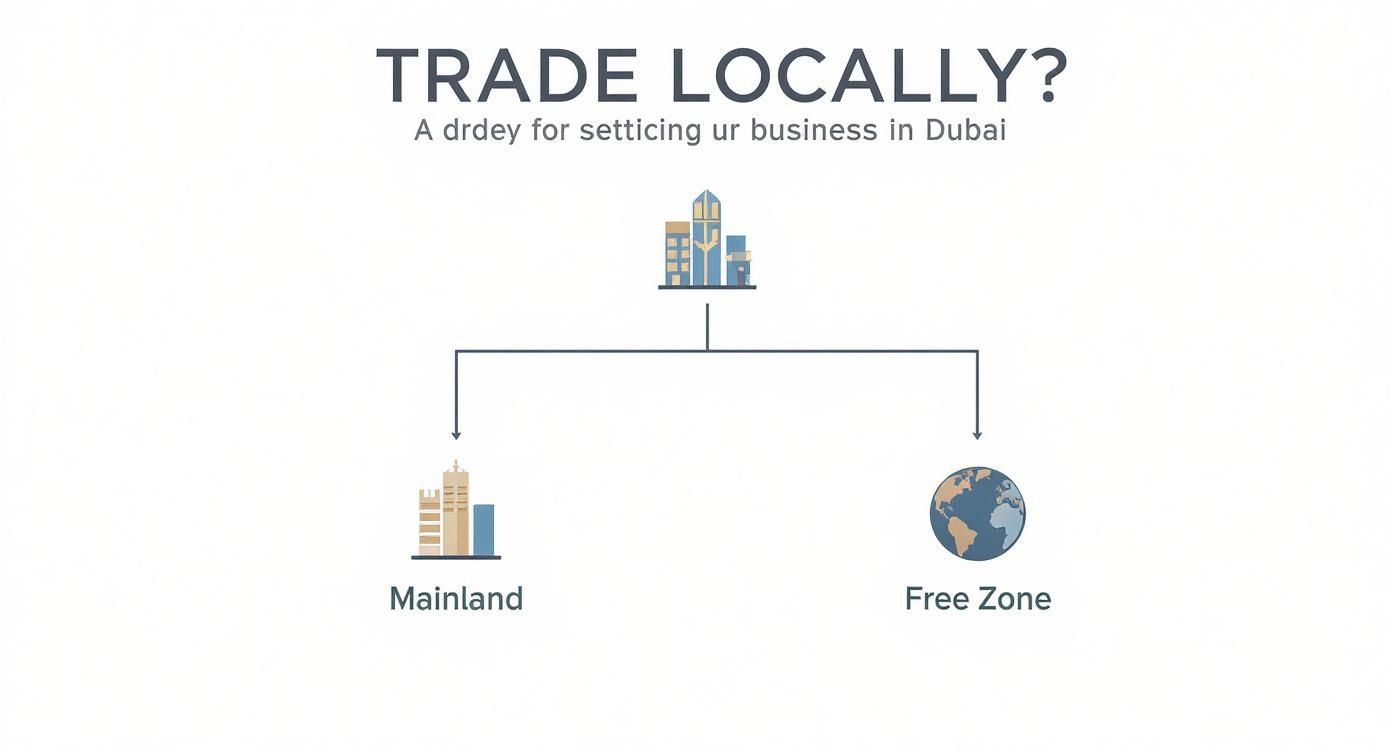
As you can see, if your goal is to trade directly within the UAE, a mainland setup is your most direct route.
Getting Your Documents in Order
With your trade name approved and MoA drafted, it's time to gather all the necessary paperwork. I can't stress this enough: almost every delay I've seen at this stage comes down to incomplete or incorrect documents. Being meticulously organised here will save you a world of frustration.
You're essentially building a complete profile of your business and its key people for the authorities.
Here’s a checklist of what you’ll typically need:
- A completed application form: Make sure it's filled out perfectly, as required by the DET or your chosen free zone.
- Passport copies: You'll need clear, valid copies for every shareholder and the company's manager.
- A solid business plan: Many free zones, and even some mainland activities, will want to see a detailed plan covering your goals, market research, and financial forecasts.
- Your notarised Memorandum of Association (MoA): The one we just talked about.
- A Board Resolution: This is a formal document that officially appoints the manager or director of the company.
Having all these documents ready to go—and attested where required—is half the battle won. Working with a business setup consultant can be a huge help here, as they'll make sure everything is in the right format.
The Final Stretch: Submission and Approval
Once you submit the complete package, it goes for review. This is where you need a bit of patience. Mainland companies are reviewed by the DET, while free zone applications are handled by their own internal administration. Each has its own process and timeline.
The registration journey is a process of validation. Every document you submit, from your passport to your business plan, builds a case for your company's legitimacy and viability in the eyes of the UAE authorities. Precision and completeness at this stage are the fastest way to get your trade license.
If everything checks out, you’ll get an initial approval. This is your green light to finalise your office lease—a must-have for getting the final licence, especially on the mainland. Once your tenancy contract (known in Dubai as an Ejari) is registered, you can make the final payment for your trade licence.
The moment that licence is issued, you're officially in business. Your company is now legally registered and ready to operate in the UAE. As specialists in both Mainland and Freezone Company Formation across the UAE, we handle this entire maze for our clients, ensuring the path to your licence is as smooth and efficient as possible.
Securing Visas and Corporate Bank Accounts

Holding your new trade licence is a fantastic milestone in your Dubai company setup journey, but it’s not the finish line. To really get your business up and running, you’ll need two more crucial pieces: residency visas for yourself and your staff, and a corporate bank account to handle your finances. These are the steps that turn your legal paperwork into a fully operational business.
Getting through this stage is what separates a company that just exists on paper from one that can actually trade, hire people, and grow. It's the point where your business gets its physical presence and financial independence in the UAE.
The Path to Residency: Your Investor and Employee Visas
With your company officially registered, it can now act as a sponsor for visas. This is one of the biggest perks of setting up in Dubai. It creates a clear pathway to residency for you as the owner (through an investor visa) and for any employees you bring on board.
The journey starts by getting an Establishment Card for your company, which basically registers it with the immigration authorities. Once that's sorted, you can apply for an entry permit. This lets you enter the UAE specifically to finalise your residency, which involves a medical fitness test and providing biometrics for your Emirates ID card.
This process is pretty standard, whether your business is on the mainland in Dubai or Abu Dhabi, or set up in one of the UAE’s many free zones. Each visa gives the holder the right to live and work legally in the country, open a personal bank account, and even sponsor their own family members.
Unlocking Your Corporate Bank Account
This is, without a doubt, the part of the process that trips up most new entrepreneurs. Opening a corporate bank account in the UAE isn’t as simple as walking in with your new trade licence. Banks here are incredibly thorough with their due diligence to comply with international anti-money laundering (AML) rules. They need to be convinced you’re running a legitimate, viable business.
Your application will be put under a microscope. Banks want to understand your business model, where money will be coming from and going to, and who your clients and suppliers are. Going in unprepared can lead to frustrating delays or even an outright "no."
A corporate bank account is your company’s financial lifeblood. UAE banks are meticulous in their compliance checks, so presenting a clear, professional, and transparent business case isn't just helpful—it's essential for a timely approval.
Think of it as pitching your business all over again, but this time to a risk assessment team. They’ll likely ask for a detailed business plan, profiles of the shareholders, and sometimes even proof of your past business experience.
Preparing for the Bank's Due Diligence
To give yourself the best shot at a smooth and quick approval, you need to have your documents and your story straight. A clear, well-organised application makes the bank's job easier and signals that you’re a serious professional.
Here’s a checklist of what you should have ready to go:
- Complete Company Documents: This means your trade licence, Memorandum of Association (MoA), and any other registration certificates.
- Shareholder and Manager Information: You’ll need clear copies of passports, UAE visa pages (once issued), and Emirates IDs for all key people involved.
- A Detailed Business Plan: This document should clearly explain your business activities, who you plan to sell to, your financial projections, and the background of the shareholders.
- Proof of Business Legitimacy: This is where you can really strengthen your case. Think contracts with potential clients, agreements with suppliers, or even a professional business website.
Successfully opening an account all comes down to showing the bank that your company has a real purpose and a solid plan. Our role as corporate service providers is to guide you through this critical step, helping you prepare an application package that meets the bank's strict requirements so you can enjoy the full tax benefits the UAE offers. With our 24/7 support, we're here to answer your questions and help you present your business in the best possible light.
Staying Compliant After Your Company Is Formed
Getting your trade licence in hand is a fantastic milestone, but it's really the starting line, not the finish line. Think of it as being handed the keys to your new car; now you have to keep it serviced, insured, and running smoothly. The UAE has built a world-class business environment on a foundation of clear, fair regulations, and staying on the right side of them is just good business sense.
This isn't about jumping through bureaucratic hoops for the sake of it. It's about maintaining the health and legal standing of your company. Your business is a living entity, and just like any healthy organisation, it has annual obligations that demonstrate your commitment to being a transparent and responsible member of the UAE’s business community.
Key Regulations You Can't Ignore
Right from the start, there are two major compliance frameworks you need to get familiar with: the Economic Substance Regulations (ESR) and Anti-Money Laundering (AML) laws. Don't make the mistake of thinking these are only for big multinational corporations; they apply to businesses of all sizes and the authorities take them very seriously.
-
Economic Substance Regulations (ESR): This is all about proving you have a real, functioning business here. If your company is involved in certain "Relevant Activities"—like banking, insurance, or even just acting as a holding company—you must demonstrate a genuine economic presence in the UAE. This means your core, income-generating work actually happens here and the business is managed and directed from within the country.
-
Anti-Money Laundering (AML): The UAE is a major financial hub, and with that comes a strong commitment to preventing illegal financial flows. AML and Combating the Financing of Terrorism (CFT) laws mean that businesses in specific sectors have to be vigilant. If you're a real estate agent, an auditor, or a dealer in precious metals, for example, you have strict obligations to vet your clients and report any suspicious transactions.
Getting a handle on how these rules apply to your specific business activity is crucial. It’s the best way to steer clear of some very significant penalties down the road.
Keeping Your Company in Good Standing
Beyond those big frameworks, a few routine responsibilities are absolutely essential for keeping the lights on. If you let these slide, you're looking at fines, a freeze on your operations, or even having your licence renewal rejected.
At the very heart of this is proper bookkeeping and accounting. Every single business in the UAE is legally required to maintain accurate financial records for at least five years. This isn't just a suggestion for good practice; it’s a legal mandate that becomes absolutely critical when it's time for annual audits or filing your Corporate Tax returns.
Ongoing compliance is the backbone of a sustainable business in the UAE. It’s a continuous process of timely renewals, accurate record-keeping, and adherence to regulatory standards that protects your investment and ensures your freedom to operate.
The Annual Renewal Cycle
Your trade licence isn't a "buy it once, own it forever" document. It has to be renewed every year with the authority that issued it, whether that's the DET for a mainland company or the administration of your chosen free zone. This process is your company's official annual health check.
So, what does that usually involve?
- Renewing Your Tenancy Contract: For most mainland setups, you’ll need a valid office lease (Ejari) for the year ahead.
- Securing Necessary Approvals: Depending on your business activity, you might need to get renewed approvals from other government departments.
- Submitting the Application: Once all your documents are in order, you'll submit the formal renewal application.
- Paying the Fees: After your application is approved, you settle the renewal fees and your updated trade licence is issued.
Missing that renewal deadline can be painful, leading to financial penalties and potentially jeopardising your company's visas. As specialists who handle both mainland and Freezone company formation across the UAE, we manage this entire process for our clients. We provide 24/7 support to make sure every deadline is hit without any stress on your end. This proactive approach lets you focus on what you do best—running your business—while we keep your compliance in expert hands.
Why a Corporate Service Provider Is Your Best Asset
You could absolutely try to set up your Dubai company on your own. But honestly, the smarter move is to partner with a specialist—a corporate service provider who knows the ropes and can turn a bureaucratic maze into a clear path to launch. As the Best Corporate Service Provider in Dubai, Abu Dhabi & Sharjah, we make the process seamless.
This isn't just about saving time; it's about avoiding expensive mistakes. A single wrong document or missed deadline can derail your plans for weeks. Think of an expert partner as your shield, handling all the government liaison, paperwork, and legal bits and pieces with precision so you don't have to.
Specialists in Mainland and Free Zone Formation
Every business is different. Maybe you're aiming to tap into the local UAE market with a mainland company formation in Dubai, or perhaps your vision is global, operating from a tax-efficient free zone. Whatever your goal, getting the right advice from the start is priceless.
A good provider doesn't just hand you a generic package. They get to know your business and create a Cost-Effective Business Setup Solution tailored to your needs. They essentially become specialists in your success, making sure the jurisdiction and licence you end up with are perfectly aligned with where you want to go.
So, what does that expert guidance actually look like?
- Navigating Jurisdictions: We'll give you clear advice on whether a mainland setup in Dubai or Abu Dhabi, or a free zone in Sharjah, is the best fit.
- Cost Efficiency: Our job is to find the most financially sensible way for you to launch, steering you clear of unnecessary fees.
- Tax Optimisation: We'll make sure your company is structured to fully leverage the UAE tax benefits for international entrepreneurs.
More Than Just Setup, It's a Partnership
Imagine having an expert on call whenever a question pops into your head, day or night. With our 24/7 Support Service, we're always here when you need us. This level of continuous support is what turns a simple service into a real partnership.
A corporate service provider is your strategic advantage. They handle the bureaucratic complexities so you can dedicate 100% of your focus to what truly matters—building your business, serving your clients, and driving growth.
Let me give you a real-world example. An international e-commerce brand wanted a logistics hub in a Dubai free zone and a mainland office for local marketing. Because we are Specialists in Mainland Company Formation in Dubai & Abu Dhabi and Freezone Company Formation across the UAE, we coordinated both setups simultaneously, getting their entire operation launched in record time. Trying to manage that alone would have been a nightmare. It’s that kind of strategic execution that shows the true value of having an expert in your corner.
Answering Your Top Questions About Setting Up in Dubai
When you're looking to set up a company in Dubai, a lot of questions pop up. It’s completely normal. After helping hundreds of entrepreneurs get started, we’ve heard them all. Let’s get you some straight answers to the most common ones so you can move forward with confidence.
How Much Will It Really Cost?
This is usually the first thing people ask, and the honest answer is: it depends. Your total investment is shaped by your decisions—whether you go for a mainland or free zone setup, your business activity, your office needs, and visa requirements. The key is finding a path that fits your budget. We specialize in creating Cost-Effective Business Setup Solutions tailored to your needs.
How Long Does the Setup Process Take?
Time is money, right? The good news is that things move pretty quickly here. A free zone company can sometimes be up and running in just a few days. A mainland business might take a week or two, especially if you need extra approvals. Our job, as Specialists in Mainland Company Formation in Dubai & Abu Dhabi and the various free zones, is to make this process as quick and smooth as it can be.
Can I Get a UAE Residency Visa with My Company?
Yes, and this is a huge benefit of setting up your business here. Once your trade licence is issued, your company can sponsor you for an investor or partner visa. These are typically valid for two or three years and are renewable.
Think of your new company as your direct ticket to UAE residency. It’s more than just a visa; it allows you to live and work here legally, sponsor your family, open personal bank accounts, and truly settle into life in the Emirates.
This visa is what turns your business from a name on paper into your fully operational home base in the UAE.
Do I Need a Physical Office in Dubai?
This is another classic "it depends" situation. For a mainland company, you'll almost certainly need a physical address with a registered Ejari (the official tenancy contract) to get your licence finalised.
Free zones, on the other hand, offer more flexibility. Many allow you to start with a flexi-desk or a virtual office package. This is a fantastic option for consultants, freelancers, or international business owners who don’t need a permanent physical spot, making Freezone Company Formation an incredibly popular choice. We can walk you through these options to find what works best for your business model.
Tapping into the UAE tax benefits for international entrepreneurs is a massive draw, and our team is here to make sure your company is structured perfectly. With our 24/7 Support Service, you'll always have an expert on hand to guide you through every step.
📞 Call Us Now: +971-52 923 1246
💬 WhatsApp Us Today for a Free Consultation
At 365 DAY PRO Corporate Service Provider LLC, we turn complex setup procedures into a seamless journey toward your business success.
Discover our hassle-free business setup solutions