
It’s a question I hear all the time: can a non-resident really open a bank account in Dubai? The short answer is yes, and it's a powerful tool for global entrepreneurs.
While you can open a personal account as a non-resident, it comes with limitations. The most common and strategic path is to establish a UAE company first. This key step allows you to open a full-featured corporate bank account, turning a simple financial tool into a launchpad for international business and investment.
Why a Dubai Bank Account Is Your Global Business Gateway

Having a bank account in Dubai is about much more than just a place to hold funds. It's a foundational move toward unlocking serious international growth. For entrepreneurs and investors, it’s your direct line to the dynamic markets across the Middle East and North Africa (MENA), all from a stable, globally respected financial hub.
The UAE’s entire economic structure is built on stability and a pro-business mindset. This gives international business owners tremendous confidence, knowing their capital is secure within a tightly regulated system. And of course, the country’s favorable tax policies are a massive draw for anyone looking to optimize their financial operations.
Understanding Your Options Personal vs Corporate
It's absolutely critical for a non-resident to understand the difference between personal and corporate accounts. They serve very different purposes.
A personal non-resident account is usually a basic savings account. It often comes with limitations, like no checkbook, and typically requires a high minimum balance to avoid fees. These accounts are most useful for property owners or investors who just need a local account for a few specific transactions.
A corporate bank account, on the other hand, is the real deal. You open this through your UAE-registered company (either on the mainland or in a free zone), and it gives you full banking functionality. It’s built for business—sending and receiving payments, managing payroll, and even accessing credit lines. This is the path most international entrepreneurs I work with choose.
If you're exploring this route, getting a handle on the legal side is essential. A fantastic starting point is reading up on the Law of Companies and Branches in Free Trade Zones in UAE, which gives you the critical context for setting up shop.
To make the choice clearer, here’s a quick breakdown:
Personal vs Corporate Accounts for Non-Residents at a Glance
| Feature | Personal Non-Resident Account | Corporate Non-Resident Account |
|---|---|---|
| Primary Use | Savings, property-related transactions, personal investments | Day-to-day business operations, international trade, payroll, B2B payments |
| Account Holder | The individual non-resident | The UAE-registered company (Free Zone or Mainland) |
| Functionality | Limited (often savings only, no checkbook) | Full-featured (checking, credit/debit cards, online banking, trade finance, credit facilities) |
| Requirement | Passport, visa, proof of address, source of funds documentation | Company trade license, shareholder documents, board resolution, passport copies of signatories |
| Typical Minimum Balance | Often high to avoid monthly service fees | Varies widely by bank and account type, but generally expected to maintain a healthy balance |
| Best For | Individuals with specific, limited financial needs in the UAE | Entrepreneurs and businesses operating internationally or with clients/suppliers in the region |
Ultimately, a corporate account provides the flexibility and credibility needed to operate a legitimate business, making it the superior choice for nearly all commercial ventures.
The UAE has cemented its status as a global financial center. This is clearly reflected in its highly banked population—a strong sign of a mature and accessible banking infrastructure that serves both residents and international business owners exceptionally well.
A Beacon of Financial Accessibility
The UAE’s commitment to financial inclusion has built a truly sophisticated banking ecosystem. In fact, the UAE has become one of the world's most banked nations, with 94% of residents holding personal bank accounts as of 2025.
That’s a huge leap from just 85% back in 2021, a statistic that highlights just how quickly the country's financial services have developed. This robust and welcoming infrastructure is precisely what makes Dubai such an ideal base for your international financial operations.
Getting Your Paperwork in Order: Eligibility and Documents
Before you can even think about which bank to choose, you need to get a firm grip on who actually qualifies for a Dubai bank account for non residents and what documents you'll need to have ready. The rules can feel a bit tangled at first, but it all really comes down to one crucial difference: are you opening a personal or a corporate account?
For most entrepreneurs and business owners I work with, a corporate account is the only practical way forward. While personal non-resident accounts do exist, they're usually just basic savings accounts. They often come with hefty minimum balance requirements and, critically, no checkbook—making them completely unsuitable for actually running a business.
The smartest move is to set up a UAE company first, either on the mainland or within a free zone. This simple step makes your business a resident entity, which is what truly opens the door to a fully functional corporate bank account. Think of your new company as the official key to Dubai's entire banking system.
The Core Document Checklist for Your Company
When you walk into a bank to open an account for your new UAE business, be prepared for some serious due diligence. Showing up with a complete, well-organized file of documents isn't just a good idea; it's essential. It’s the single biggest thing you can do to speed up the process.
Here’s the baseline of what every bank will ask for:
- Company Trade License: This is your official permission slip to do business in the UAE, issued by the economic department or your free zone authority.
- Memorandum of Association (MOA) / Articles of Association (AOA): These are the foundational legal documents that spell out your company's structure, who the shareholders are, and what you plan to do.
- Share Certificates: Simple proof of who owns what percentage of the company.
- Board Resolution: A formal, signed document from the company’s directors that officially authorizes opening the account and names who can sign on its behalf.
- Passport and Visa Copies: You'll need crisp, clear copies of valid passports for every shareholder and signatory. If anyone already has a UAE Residence Visa, include a copy of that as well.
- Emirates ID Copies: For any shareholders or signatories who are already UAE residents.
This list is your starting point—the absolute must-haves. From here, the bank's compliance team will dig a little deeper to get the full story on your business.
Supporting Documents: Telling Your Business's Story
Beyond the legal necessities, you'll need to provide some context. The bank needs to understand who you are and what your business does. This is all part of their standard "Know Your Customer" (KYC) procedure.
Get ready to also provide these supporting items:
- A Solid Business Plan: Don't just throw something together. It needs to clearly explain your business model, who your customers are, your revenue projections, and the kinds of transactions you'll be making.
- Proof of a Business Address: This is usually your office tenancy contract, also known as an Ejari in Dubai.
- Utility Bills: A recent bill for your office and for the personal home addresses of the shareholders is a common way to verify addresses.
- Source of Funds Declaration: A straightforward explanation of where the initial investment money came from.
- CVs for Each Shareholder: A professional resume for every owner helps the bank feel comfortable with the experience and expertise behind the company.
A huge mistake I see people make is treating this like a simple checklist. The bank is actively assessing risk. A meticulously prepared file, complete with a clear business plan and transparent shareholder info, sends a powerful message: you're a serious, legitimate operation.
Real-World Scenarios and the Attestation Hurdle
The exact documents you need will shift a bit depending on your specific business. A freelancer setting up in a free zone, for example, will have a much simpler MOA than a mainland company with multiple international corporate owners.
Let's look at two quick examples:
- The Solo Consultant: A marketing expert from the UK sets up a one-person company in a free zone. Her file is lean: trade license, passport, and a straightforward business plan detailing her international client base. The process is usually quite smooth.
- The Trading Company: An investor from India partners with a local Emirati to start a mainland trading business. This setup requires a far more detailed MOA, all the partner's local documents, and a robust business plan that explains their entire import/export model.
One final, critical detail is document attestation. If any of your company or personal documents come from outside the UAE, they’ll almost certainly need to be attested. This is a formal verification process that involves the UAE Embassy in your home country and then the Ministry of Foreign Affairs (MOFA) here in the UAE. It can be a slow, bureaucratic process, so you need to start early. This is precisely where a specialist can save you from major headaches and delays, ensuring every piece of paper is correctly prepared and verified from the get-go.
Choosing the Right Bank for Your Needs in Dubai
Picking a bank in Dubai isn't just about finding a place to park your cash. It's a critical strategic move that can either supercharge your business or tie you up in knots. I’ve seen it time and again: choosing the wrong bank leads to frozen funds, blocked transfers, and a mountain of compliance paperwork. It’s not about the biggest name on the building; it’s about finding the bank whose internal policies and risk appetite actually match your business model.
As a non-resident, your checklist for a bank looks completely different from a local's. Forget high-interest savings accounts and fancy credit card deals. You need to dig deeper. Does the bank actually understand international business? Is their compliance team flexible or rigid? How good is their remote support when you’re in a different time zone and a wire transfer goes missing? These are the questions that truly matter.
Traditional Giants vs. New-Age Digital Banks
You've got a choice in Dubai's banking world. On one side, you have the established titans like Emirates NBD and First Abu Dhabi Bank (FAB). On the other, you have nimble, digital-first players like Wio Bank. Each has its place, and the right fit depends entirely on your business.
The big, traditional banks bring a sense of stability and a massive physical presence. They’re often the go-to for companies that need complex trade financing or handle large, predictable streams of cash. The flip side? Their onboarding can feel like navigating a maze of bureaucracy, and they can be hesitant if your business model doesn't fit into their neat, traditional boxes.
Digital banks, on the other hand, usually offer a much smoother ride with slick apps and faster online account opening. We find they’re a great match for freelancers, consultants, and e-commerce entrepreneurs. The trade-off is they might not offer the same depth of complex corporate services, and their thresholds for cash deposits and withdrawals can be more restrictive.
What Really Matters When You Decide
When you’re comparing options for a Dubai bank account for non residents, you need to cut through the marketing fluff and focus on the things that will impact your daily operations.
- Minimum Balance Requirements: This is your first hurdle. Don't underestimate it. Corporate accounts for companies owned by non-residents can require you to maintain an average monthly balance anywhere from AED 50,000 to over AED 250,000. If you dip below that, you’ll get hit with hefty monthly penalties that can easily run several hundred dirhams. Be brutally honest about your cash flow before you commit.
- International Transfer Fees & Forex Rates: You’re an international business, which means money will constantly be crossing borders. You need to scrutinize the fine print on their fee schedule for every incoming and outgoing wire. Just as important are their foreign exchange (forex) margins. A seemingly tiny difference of a few percentage points can quietly cost you thousands of dollars over the course of a year.
- The Online Banking Experience: Your online portal is your branch. Is it actually user-friendly, or is it a clunky relic from the early 2000s? Can you set up everything you need remotely, including international payments and beneficiary lists? A bad online platform isn’t a minor inconvenience; it’s a major bottleneck for your entire operation.
- The Compliance Department's Attitude: This is an insider tip, but it's pure gold. Some banks just "get" international business structures better than others. Their compliance teams are more experienced with foreign ownership and cross-border transactions. A bank that understands your model is far less likely to flag legitimate payments and freeze your account, saving you immense frustration.
The concept of a "best" bank is a myth. The right bank for a mainland trading company that deals in a lot of cash is probably the worst possible choice for a solo tech consultant in a free zone billing clients in the US and Europe. Your business model has to be the driving force behind your decision.
Comparing Top UAE Banks for Non-Resident Needs
To make this more concrete, here’s a look at how some of the popular banks stack up from the perspective of an international entrepreneur. This isn’t an exhaustive list, but it highlights how different banks cater to different needs.
| Bank | Typical Minimum Balance (Corporate) | Best For | Key Feature for Non-Residents |
|---|---|---|---|
| Emirates NBD | AED 50,000 – AED 200,000+ | Established mainland businesses and those needing extensive branch access. | Strong reputation, a wide range of corporate services, and a robust online platform. |
| Mashreq Bank / Neo | Varies (often AED 35,000+) | Tech-savvy businesses, SMEs, and entrepreneurs who value digital efficiency. | Excellent digital banking experience and a forward-thinking approach to modern business models. |
| Wio Bank | Pay-as-you-go / Tiered plans | Freelancers, startups, and digital-first businesses needing fast, remote onboarding. | Fully digital setup process, transparent fees, and designed for the modern gig economy. |
| First Abu Dhabi Bank (FAB) | AED 100,000+ | Larger corporations and high-net-worth individuals seeking wealth management services. | Immense stability, international presence, and a full suite of premium banking solutions. |
As you can see, the right choice is all about alignment. A freelancer would likely thrive with Wio Bank's digital-first approach and low barrier to entry, whereas a larger trading enterprise would benefit from FAB's deep trade finance capabilities.
Making the right choice from the start saves you a world of trouble down the line. As the Best Corporate Service Provider in Dubai, Abu Dhabi & Sharjah, we have working relationships and direct experience with the onboarding teams at all the major UAE banks. We know their quirks and their risk appetites, allowing us to guide you to a partner that won't just approve your account but will actually support your growth.
Navigating the Account Opening Process From Start to Finish
Opening a Dubai bank account for non residents isn’t something that happens in a day. It's a structured process, and knowing what's coming will save you a lot of headaches. Think of it less like a simple application and more like a series of checkpoints, starting with your document submission and ending with a critical in-person meeting.
Your first move is to hand over your complete document package. But this isn't just a paper-pushing exercise. You're making your first impression on the bank. A clean, well-organized file immediately signals that you're a serious professional running a legitimate business.
The Due Diligence Deep Dive
Once your application is in, it disappears into the bank's internal review system for what's known as due diligence. This is where the compliance department takes over. They will meticulously go through your company’s ownership, shareholder backgrounds, and exactly what your business plans to do.
This stage can feel like a black box and often takes the most time. Banks here are under immense pressure to comply with strict anti-money laundering (AML) and counter-terrorism financing (CFT) laws. They have to be absolutely sure about who they're banking with.
They are looking for clear answers to a few core questions:
- Who really owns the company? They need to identify the Ultimate Beneficial Owners (UBOs).
- Where is the money coming from? You have to clearly show the source of your initial capital.
- What will your transactions look like? They need to get a feel for the types of payments you'll be making and receiving, how often, and to/from which countries.
This infographic gives you a simple framework for how to think about this before you even start an application.
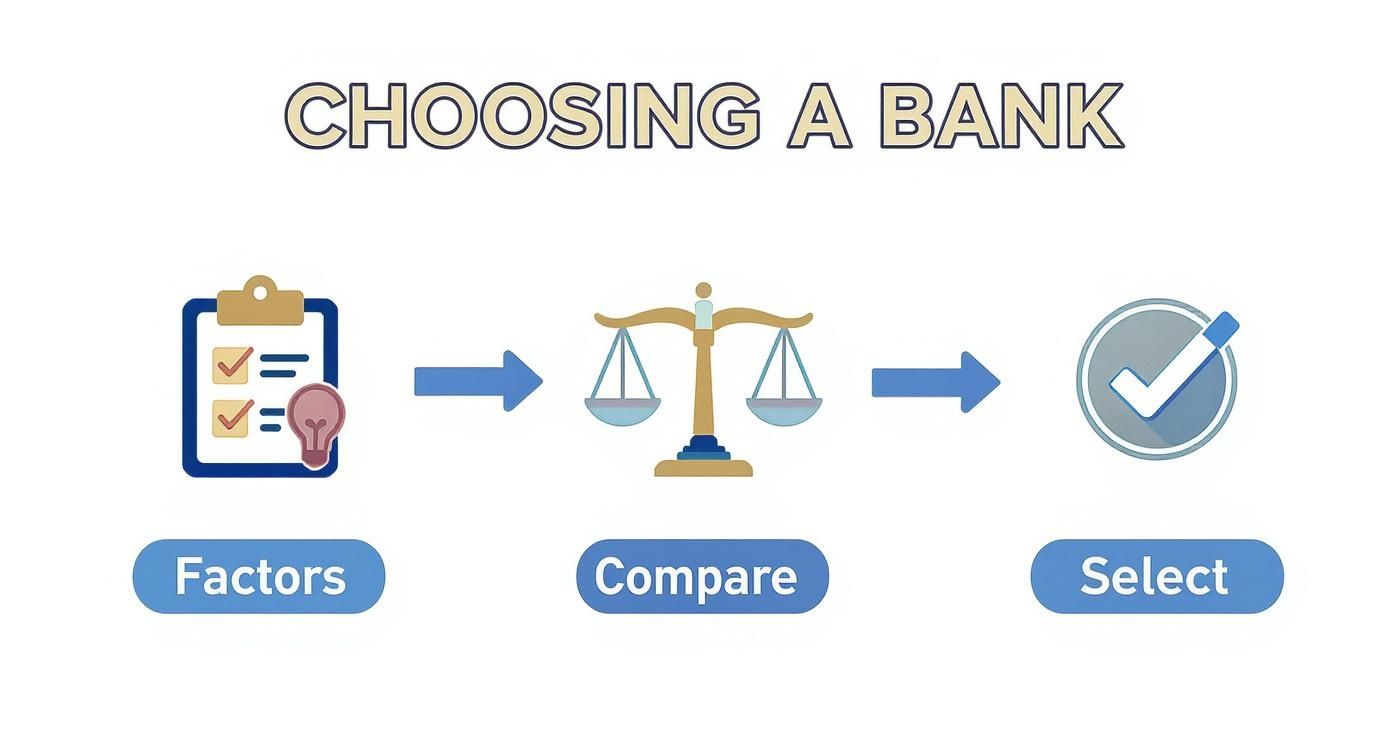
It really is that straightforward. First, you need to understand the key factors like minimum balance requirements and international transfer fees. Then, compare your options head-to-head before you pick the one that fits your business best.
The Make-or-Break KYC Interview
After the background checks, the bank will call you in for a Know Your Customer (KYC) interview. For almost every bank in Dubai, this is a non-negotiable, in-person meeting. At least one account signatory has to show up in the UAE.
This meeting is your chance to put a human face to your application. It’s much more than a formality. The relationship manager will have your file in front of them and will ask pointed questions to better understand your business.
Treat this interview like a high-stakes investor pitch. Your entire goal is to build trust. The best way to do that is by explaining your business model clearly, confidently, and honestly.
To make a great impression, be ready to talk specifics:
- Your Business Model: Don't use jargon. Instead of saying, "We leverage a B2B SaaS platform," try, "We sell software that helps construction companies manage their project budgets." It’s simple and clear.
- Your Customers: Who are you selling to? Where are they? How do they find you?
- Your Transactions: Be specific. For example: "We expect a monthly wire of around $20,000 from our main client in Germany and will be sending weekly payments to three different suppliers in China."
This kind of detail shows the bank your activity is predictable and legitimate—which is exactly what their compliance team needs to hear to sign off on your account.
A Realistic Look at Timelines
One of the biggest frustrations I see comes from unrealistic timeline expectations. Getting your account fully operational—from application to having your debit card and online login—can take anywhere from two weeks to three months.
A few things can really slow things down:
- Your Nationality and Residence: If you're from a country considered high-risk, expect a longer, more detailed review.
- Your Business Complexity: A simple one-person consultancy will get approved much faster than an international trading company with multiple shareholders.
- Your Application: Honestly, most delays come down to this. One missing document or a vague answer can stop the whole process cold.
We do more than just help with paperwork. We guide you through the whole game. Our 24/7 support service helps you prepare for the KYC interview, ensures your business plan proactively answers the bank’s questions, and we deal with the bank directly for you. As specialists in Mainland Company Formation in Dubai & Abu Dhabi and Freezone Company Formation across the UAE, we know how to position your application to get it approved as quickly as possible.
Navigating Common Hurdles and Rejection Risks
Getting that Dubai bank account approved can feel like the final boss battle in setting up your business. It's where many entrepreneurs hit a wall, facing frustrating delays or even an outright "no." But knowing where the landmines are is the best way to avoid them.
The biggest challenges almost always circle back to the bank’s rigorous compliance checks. These aren't just arbitrary hoops to jump through; they're part of a global system to prevent financial crime. Your goal is to make the compliance officer's job easy by giving them a clear, logical, and rock-solid application.
Incomplete or Vague Paperwork
The top reason for rejection is painfully simple: messy paperwork. A single missing signature, a passport copy that’s a day expired, or a shoddy document translation can bring everything to a grinding halt. Banks have zero wiggle room here. If the file isn't perfect, it's rejected.
Vague information is just as bad. A business plan that says you'll "engage in international trade" is a classic red flag. The bank wants to know what goods, which countries, and who your key partners are. Ambiguity creates risk, and banks hate risk.
The compliance team is essentially trying to build a profile of you and your business. Think of your application not as a form, but as the story of your company. If that story is full of holes and fuzzy details, you look like a gamble they won't take.
The fix? Get organized before you even start. Create a digital master file with every single document scanned, labeled, and ready to go. Go through the bank’s checklist with a fine-tooth comb. This bit of prep work can save you weeks of headaches.
The Wrong Bank for Your Business
Here’s a hard truth: not every bank wants your business. Some are old-school, comfortable with traditional models like local real estate or straightforward trading. Walk in with a crypto-adjacent startup or a complex SaaS model, and you'll likely get a polite but firm rejection. It’s not you, it’s their risk appetite.
This is where having someone in your corner who knows the landscape is a game-changer. We know which banks are startup-friendly and which prefer established players. We can point you toward an institution that actually gets your industry, massively boosting your odds.
Certain business models always require a more strategic choice of bank:
- High-Volume E-commerce: If you're processing thousands of small, international payments, you need a bank with a top-notch digital backend, not one that’s still figuring out its app.
- General Trading: Juggling multiple product types and shipping routes puts you under a microscope. You need a bank experienced with complex trade finance.
- Consulting and Services: The "product" is intangible, so you have to work harder to prove the legitimacy of your income and services.
Failing the Compliance Stress Test
Every application gets put through the wringer on Anti-Money Laundering (AML) and Counter-Financing of Terrorism (CFT) rules. Banks are on high alert for a few key things:
- Source of Funds: Where did the money to start your business come from? "Personal savings" won't cut it. Be prepared to show bank statements, proof of a property sale, or other documentation that tells a clear story.
- Transaction Patterns: Your business plan needs to match the money moving through your account. A huge, unexpected transfer that doesn’t fit your projected activity will trigger an immediate review.
- High-Risk Nationalities: It's an unfortunate reality, but applicants from countries on international sanctions lists face a much tougher road. It’s not impossible, but expect a far deeper level of due diligence.
Working with a corporate service provider gives you a serious edge. We help you build a business profile that answers the compliance team's questions before they even ask them. Our team can speak their language and liaise directly with the bank, smoothing over any complex points and presenting your application in the strongest light. With our cost-effective business setup solutions and years of experience, we help turn potential rejections into successful new accounts.
Your Questions About Non-Resident Banking in Dubai, Answered
When you're looking into a Dubai bank account for non-residents, a lot of questions pop up. It's a different system, and it's easy to get lost in the details. Let's tackle some of the most common things we get asked by entrepreneurs and investors who are right where you are now.
Can I Open a Dubai Bank Account Without a Residence Visa?
Yes, but it's not the full-featured account you're probably looking for. For personal use, you can open a savings account without a residence visa. The catch? These accounts are pretty limited—they usually don't come with a checkbook and often demand a high minimum balance. They're definitely not cut out for business.
The smart move, and the one we always recommend for non-residents, is to set up a UAE company first. Whether it's on the mainland or in a free zone, your new company acts as the "resident" entity. This is your golden ticket to opening a proper corporate bank account with all the features you need to run your business effectively.
What’s a Realistic Minimum Balance for a Corporate Account?
This is where you need to pay close attention, because the answer really depends on the bank. For corporate accounts tied to non-resident owners, banks are looking for a solid commitment. This usually means keeping a significant average monthly balance to steer clear of some pretty steep fees.
Be prepared for figures anywhere from AED 50,000 to over AED 250,000. It all comes down to which bank you choose and the specific account package. If your balance dips below that magic number, you could be looking at monthly penalties of several hundred dirhams. Always get this figure in writing before you commit, and make sure it aligns with your company’s cash flow.
A word of advice from experience: that minimum balance isn't a friendly suggestion—it's a hard rule. A common pitfall is picking a bank with a requirement that's just a bit too high, which ends up creating constant financial pressure and unnecessary costs down the road.
How Long Does It Actually Take to Open the Account?
Patience is key here. The timeline can be a bit of a moving target, depending on your business activity, your nationality, and how deep the bank needs to dig during its due diligence. If your application is straightforward and you've got all your ducks in a row, you could be looking at a turnaround of two to four weeks after you’ve submitted everything and had your KYC interview.
But, if you have a more complex ownership structure, involve what banks consider high-risk nationalities, or if there are any hiccups with your documents, the process can stretch out to two or even three months. Delays are part of the game, but with an expert helping you prepare, you can sidestep many of the common hurdles.
Is My Money Actually Safe in a UAE Bank?
Without a doubt. The UAE banking sector has a well-earned reputation for being rock-solid and secure. Everything is governed by the Central Bank of the UAE, which enforces some of the strictest regulations you'll find anywhere.
The banks here are serious about international compliance, especially when it comes to Anti-Money Laundering (AML) and Counter-Financing of Terrorism (CFT) rules. This creates a secure, transparent environment for everyone. You can be confident that your funds are in one of the most stable and respected banking systems globally, giving you one less thing to worry about.
Getting the answers to these questions is one thing; using them to build a successful application is another. That's where we come in. Our entire focus is on helping international entrepreneurs navigate this process smoothly, from setting up the right company to getting that crucial bank account approved. We’re the partners you need to enjoy UAE tax benefits for international entrepreneurs.
📞 Call Us Now: +971-52 923 1246
💬 WhatsApp Us Today for a Free Consultation at https://365dayproservices.com