

The biggest question I get from entrepreneurs is, "Mainland or free zone?" The answer really boils down to where you plan to do business. A mainland company gives you the freedom to trade anywhere across the UAE, opening doors to the local market and lucrative government contracts. On the other hand, a freezone company is essentially a launchpad for international business, operating within a designated economic area with certain restrictions on local trade.
Choosing Your UAE Business Jurisdiction
Getting this first step right is absolutely critical. Your choice between a mainland or free zone setup will define your company's entire framework—from its legal structure and where you can operate to its ultimate growth potential. Having guided countless clients through both Mainland Company Formation in Dubai & Abu Dhabi and Freezone Company Formation across the UAE, I've seen firsthand how this decision shapes a business's future.
Let's simplify it. Both options come with the UAE's fantastic tax advantages, but they're built for different goals. If your business model involves dealing directly with the local UAE market—think a retail shop, a local consultancy, or a restaurant—then a mainland setup is the way to go. But if your focus is on import/export, international services, or e-commerce for a global customer base, a free zone is almost certainly the better fit.
Choosing the right jurisdiction isn't just a legal formality; it's a strategic decision that aligns your business model with the right market. Mainland offers freedom within the UAE, while freezones provide a gateway to the world.
To help you see the differences more clearly, I've put together a quick comparison table. It highlights the most important distinctions between these two powerful options. My team and I focus on delivering cost-effective business setup solutions tailored to your needs, and our 24/7 support service means we’re always here when you need us.
Mainland vs Freezone At a Glance
This table breaks down the core differences at a high level, giving you a clear, side-by-side view to start your decision-making process.
| Attribute | Mainland Company | Freezone Company |
|---|---|---|
| Market Access | Unrestricted access to the entire UAE market. | Restricted to the freezone and international markets; requires a local agent for mainland trade. |
| Business Ownership | Up to 100% foreign ownership for most activities. | 100% foreign ownership is standard. |
| Office Requirement | A physical office space is mandatory. | Flexible options, including virtual desks and shared offices, are available. |
| Governing Body | Department of Economic Development (DED) in the respective emirate. | The specific Free Zone Authority (e.g., DMCC, JAFZA). |
As you can see, the trade-offs are clear. Mainland offers unparalleled market access within the country, while free zones provide operational flexibility and a structure designed for global trade.
Mainland vs. Free Zone: Understanding the Core Differences
Before you can really get to grips with the practicalities of setting up a business in the UAE, you need to understand the fundamental difference between a mainland and a free zone company. They aren't just slightly different options; they are two completely separate economic environments, each with its own set of rules, regulators, and ideal use cases. Your choice here will dictate where you can work, who you can sell to, and how your business can grow.
A mainland company is, for all intents and purposes, an onshore UAE business. It's registered with the Department of Economic Development (DED) in the emirate you choose, like Dubai or Abu Dhabi, and operates under UAE federal law. This is the traditional route, and its biggest advantage is total freedom to trade anywhere in the country.
This structure allows you to open branches across the emirates, sell directly to any customer or business, and, most importantly, bid on high-value government contracts. It’s about being fully integrated into the local economy.
Diving into the Mainland Framework
Think of the mainland as the economic engine of the UAE. It’s built for businesses that want to tap into the local market and deal directly with the domestic population. The entire regulatory system is managed by government bodies that ensure you’re operating in line with national laws.
Let's say you're a consultant wanting to work with clients in both Dubai and Abu Dhabi. A mainland licence is your only real option. It gives you the legal standing to operate and issue invoices anywhere in the UAE. As specialists in Mainland Company Formation in Dubai & Abu Dhabi, we help business owners navigate the DED’s specific requirements to get registered and trading without a hitch.
The mainland is all about unrestricted access. If you need to operate across emirate borders or work with government bodies, this is the only path forward.
Free zones, on the other hand, are a completely different animal. They are designated economic areas—over 40 of them across the UAE—designed specifically to attract foreign investment. Each free zone is its own little world, with its own governing authority and its own set of rules and incentives, completely separate from the mainland framework.
The Self-Contained World of Free Zones
When you set up in a free zone, you're not answering to the DED; you're regulated by that specific Free Zone Authority. A business in the Dubai Multi Commodities Centre (DMCC) follows DMCC rules. One in Jebel Ali Free Zone (JAFZA) answers to JAFZA. It’s a model built from the ground up to support international trade.
The big draw is the incentives: 100% foreign ownership, 100% repatriation of profits, and exemptions from customs duties. For an international logistics company, setting up in JAFZA is a no-brainer—they get access to a world-class port and can move goods globally without paying local duties.
- Governing Body: Each zone has its own authority (e.g., DMCC Authority, JAFZA).
- Legal System: You operate under the specific regulations of that free zone.
- Market Focus: The primary goal is to facilitate international trade, import/export, and global services.
This strategic separation is what makes free zones so powerful for the right kind of business. Our expertise as specialists in Freezone Company Formation across the UAE is all about matching international entrepreneurs with the one zone that perfectly fits their industry and global goals. And with our 24/7 support service, we're always on hand to help you understand these critical differences and find the most cost-effective solution.
A Detailed Comparison of Operational Factors
When you look past the high-level legal frameworks, it’s the practical, day-to-day operational details that really separate a mainland setup from a free zone. Your choice will dictate everything from who can own your company and the scope of your business licence to where you can physically work and how many people you can hire. These are the details that define your business reality on the ground.
As specialists in both Mainland and Free Zone company formation, we’ve guided countless entrepreneurs through these critical decisions. Our focus is always on finding a cost-effective business setup solution that fits your specific business model, backed by our 24/7 support.
Navigating Company Ownership Rules
Historically, the biggest operational difference was always about ownership. Free zones built their reputation on offering 100% foreign ownership—a huge draw for international entrepreneurs who wanted complete control without needing a local partner.
For decades, mainland companies required a UAE national to hold a 51% majority share. However, recent legal reforms have completely changed the game. Now, the vast majority of mainland business activities also permit 100% foreign ownership, putting them on equal footing with free zones in this respect.
This legal shift is a game-changer. While 100% foreign ownership is no longer a unique free zone benefit, certain strategic activities on the mainland—particularly in sensitive sectors like defence or banking—may still have specific ownership requirements.
This change levels the playing field, letting you base your decision on more critical factors like market access and operational scope, rather than just ownership.
The infographic below gives a simple visual summary of who governs each jurisdiction.
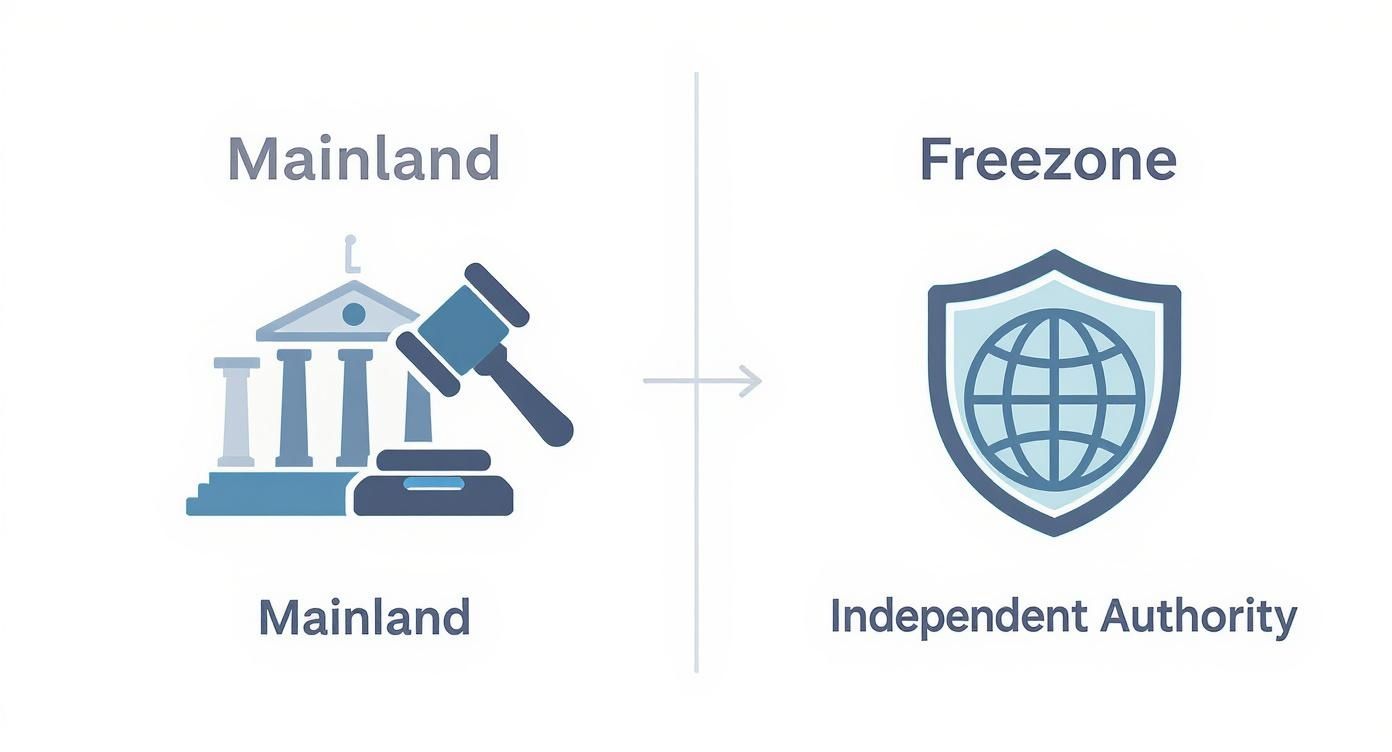
It’s a clear illustration: mainland companies fall directly under government departments, while free zones operate as self-regulated economic territories.
The Scope of Your Business Licence
The business licence you hold dictates what your company is legally allowed to do, and this is where the strategic differences really come into play.
A mainland licence, issued by the Department of Economic Development (DED) in each emirate, typically offers a much broader scope. You can often bundle several related activities under a single licence, giving you the flexibility to pivot or expand your services as your business grows. For instance, a mainland trading company can import, export, and distribute a huge range of products anywhere in the UAE.
Free zone licences, on the other hand, are usually more specialised and tied to a specific industry. A media company in Dubai Media City gets a licence for media activities; a tech startup in Dubai Internet City gets one for IT services.
- Mainland Licence: Gives you a wider scope of activities, making it ideal for multi-faceted businesses wanting to serve the entire local market.
- Freezone Licence: More niche and industry-specific, perfect for specialised companies with an eye on international trade.
This specialisation can be a major plus, as it creates powerful industry hubs where like-minded businesses can collaborate and innovate.
Understanding Office and Workspace Requirements
Your choice of jurisdiction directly impacts your physical workspace obligations, which is a major factor in your initial setup costs and ongoing overheads.
For mainland companies, a physical office is non-negotiable. You must have a commercial space registered with Ejari, the official tenancy contract registration system. The minimum space is generally around 200 square feet, but this can vary.
Free zones are known for offering a far more flexible range of workspace solutions, which is a huge advantage for startups, freelancers, and international entrepreneurs looking to keep initial costs down.
Common Freezone Office Options:
- Flexi-Desk: A shared desk facility that gives you a professional address and meets the minimum requirement for a small number of visas.
- Shared Office: A dedicated desk in a co-working environment, offering a bit more permanence than a flexi-desk.
- Physical Office: Private, fully-furnished offices of all sizes are also readily available for businesses needing their own space.
Depending on the jurisdiction, there may also be different virtual address options available, which can dramatically lower your setup and running costs.
How Visa Eligibility Is Determined
Finally, your ability to hire employees is directly linked to your jurisdiction and your office setup. For any business with growth ambitions, this is a crucial piece of the puzzle.
With a mainland company, your visa eligibility is directly tied to the size of your office. The general rule of thumb is one visa for every 80-100 square feet of office space. This model offers almost unlimited potential for team growth—if you need more visas, you simply lease a bigger office.
Free zones approach this differently. Your visa allocation is usually determined by the specific package you buy. A basic flexi-desk package might come with one or two visas, while a small physical office package might include five or six.
While a mainland setup offers greater scalability for large teams, freezone visa packages are often a highly cost-effective solution for startups and SMEs with smaller staffing needs.
Getting more visas than your free zone package allows is usually possible, but it often means upgrading your entire package or leasing more space, which can be a more rigid process than the straightforward mainland approach. As specialists, we can help you choose the structure that allows you to enjoy UAE tax benefits for international entrepreneurs and best supports your long-term staffing and growth plans.
Where Can You Do Business? Market Access and Operational Scope
The single biggest difference between a mainland and a free zone company comes down to one simple question: where can you do business? This isn't just a minor detail; it fundamentally defines your customer base, your operational boundaries, and ultimately, your potential for growth within the UAE. Getting this right from the start is crucial.
A mainland company gives you the keys to the kingdom. It offers unrestricted freedom to trade, sell, and offer services directly to anyone, anywhere in the UAE. From a small shop in a Dubai souk to a corporate office in Abu Dhabi, you can operate without limitations. This is the classic, go-to-market model.
This isn't just about consumer sales. It means you can open branch offices across the Emirates, set up a physical retail store, and send an invoice to any client in the country, no questions asked.
Mainland: Your Ticket to the Entire UAE Economy
If your business plan revolves around the local UAE market, a mainland setup is really the only practical choice. It's built for full integration into the country's commercial fabric. This integration comes with a massive perk that's often overlooked: the ability to bid on government contracts.
Government tenders represent a huge revenue stream in the UAE, but they're off-limits to free zone companies. Only mainland-registered businesses can compete for these lucrative projects. For anyone in construction, professional consulting, or IT services, this access alone can be the deciding factor between steady business and explosive growth.
As specialists in Mainland Company Formation in Dubai & Abu Dhabi, we always tell clients aiming for local market dominance that this jurisdiction is non-negotiable.
The Free Zone: A Hub for International Trade
A free zone company, on the other hand, is built for a completely different purpose. Think of it as a strategic international hub, perfectly designed for import/export, global services, and trading with markets outside the UAE. Its scope is deliberately limited to its own geographical zone and the rest of the world.
Here’s the crucial point many entrepreneurs miss: a free zone company is legally barred from trading directly on the UAE mainland. Your business is essentially ring-fenced, operating from a low-tax, easy-setup base but cut off from the local customer base next door.
The entire concept of a free zone is to boost international business, not to serve the local market. It’s fantastic for global operations but requires a specific workaround if you want to sell within the UAE.
So, how do free zone businesses get their products or services into the local market? They need a middleman.
Bridging the Gap: Using a Local Distributor
To tap into the wealthy UAE market, a free zone company has to appoint a mainland-licensed distributor or agent. This local partner becomes your hands and feet on the ground, handling all sales, distribution, and invoicing within the UAE on your behalf.
This isn't as simple as a handshake. The arrangement comes with a few moving parts:
- A Formal Agreement: You'll need a rock-solid distribution contract that clearly lays out the terms, responsibilities, and of course, the commission structure.
- Sharing Your Revenue: Your local partner will take a cut, either as a percentage of sales or a flat fee, which you need to factor into your pricing and profit margins.
- Relying on Their Logistics: You're now dependent on your distributor's warehousing, delivery network, and customer service infrastructure inside the UAE.
It's a workable solution, but it adds a layer of complexity and cost. It's the trade-off you make for the undeniable benefits of a free zone, like its streamlined setup process. As the Best Corporate Service Provider in Dubai, Abu Dhabi & Sharjah, a big part of what we do is helping clients structure these distribution agreements so they are both legally sound and commercially smart.
Financial Implications: Costs and Taxation
Getting a clear, realistic picture of the finances involved is fundamental to a successful business launch in the UAE. The path you choose—mainland or free zone—comes with its own distinct cost structure and tax obligations that will shape your budget from day one and for years to come. Digging into these financial differences isn't just a box-ticking exercise; it's a critical step in making the right decision for your company's future.
Making the right call at the very beginning is key. As a leading corporate service provider in Dubai, we've helped countless businesses craft cost-effective setup solutions that align perfectly with their financial goals, ensuring they can take full advantage of the UAE's favourable tax environment. If you ever need to clarify these crucial financial details, our 24/7 support is always here to help.

Initial Setup and Renewal Fees
The upfront investment needed to get your doors open varies quite a bit between the two jurisdictions. A mainland company formation usually involves a more detailed list of fees paid out to various government bodies. Think of the Department of Economic Development (DED), the Dubai Chamber of Commerce, and the Ministry of Economy—each has its own part to play, and its own fee.
Free zones, on the other hand, often package everything together, which can seem more straightforward and sometimes cheaper at first glance. These bundles typically combine registration, licensing, and even a basic office solution into a single annual fee, making them very appealing for startups. But it’s essential to look past the headline figure.
- Mainland Costs: These are typically itemised. You'll see charges for trade name approval, initial approval, attestation of your Memorandum of Association (MoA), and the trade licence fee itself. Sometimes, that licence fee is even linked to your office rent.
- Free Zone Costs: The cost here is all about the package you choose. A simple freelance permit or a one-visa package will naturally be much less expensive than a setup requiring a large physical office and multiple visas. Renewal fees are generally consistent year after year unless you need to upgrade your package.
At the end of the day, the real difference between mainland and free zone setup costs boils down to your specific requirements, especially things like the size of your office and how many visas you'll need.
Understanding the UAE Corporate Tax Landscape
The arrival of the UAE Corporate Tax has added a new, important layer to financial planning. Mainland companies fall directly under this federal law. The good news is that its structure is designed to support smaller businesses:
- Taxable income up to AED 375,000 is taxed at a 0% rate.
- Any taxable income that goes over AED 375,000 is taxed at a standard rate of 9%.
This tax applies to the vast majority of mainland businesses, making it a predictable operational cost you can plan for.
Free zone companies, however, can tap into some major tax advantages. If a business in a free zone meets certain criteria, it can be designated a "Qualifying Free Zone Person." This special status allows it to continue enjoying a 0% corporate tax rate on its "Qualifying Income." This usually means income from trading with businesses outside the UAE or with other companies located in the same or even different free zones.
It's crucial to note that any income you generate from selling directly to the mainland market will, unless it falls under very specific conditions, likely be subject to the standard 9% corporate tax. Getting this distinction right is vital for accurate financial forecasting.
Customs Duties and Import Costs
If your business involves trading physical goods, customs duties are a huge financial factor to consider. This is another area where the difference between mainland and free zone is night and day.
When a mainland company imports goods into the UAE, it typically faces a standard customs duty of 5% on the value of those goods. This cost is then naturally factored into the final price of products sold within the local market.
In contrast, one of the biggest draws of operating from a free zone is the exemption from these customs duties. A free zone entity can bring in goods from abroad, store them, and then re-export them to international markets without ever paying that 5% levy. This duty-free environment is precisely what makes free zones such powerful hubs for logistics, international distribution, and trading companies.
But there's a catch. If that same free zone company decides to sell its imported goods into the UAE mainland, those goods must first clear customs. At that point, the standard 5% duty will be applied. This is an absolutely essential calculation for any business thinking about a hybrid model, and consulting with specialists in both mainland and free zone formation can help you model these costs accurately.
Making the Right Choice for Your Business
Figuring out whether to set up on the mainland or in a free zone can feel like a major hurdle. But it doesn't have to be. The best choice always boils down to one thing: your business model and who you plan to sell to. Let’s break down everything we've covered into a practical way to help you decide.
The whole mainland vs. free zone debate often clears up the moment you define your target market. If your business needs to trade directly with customers and companies across the UAE, a mainland setup is the only way to go. Think about a restaurant chain with locations in Dubai and Abu Dhabi, a legal consultancy advising local clients, or a construction firm wanting to bid on government contracts. All these businesses depend on that unrestricted access to the local economy, which is something only a mainland licence delivers.
On the other hand, if your sights are set on an international audience, a free zone is probably your best bet. An e-commerce business shipping globally, a creative agency producing content for clients in Europe, or a trading company managing assets worldwide will find a free zone’s internationally-focused environment a much better fit.
A Quick Checklist to Guide Your Decision
To cut through the noise, just ask yourself these two simple questions. Your answers should point you clearly in one direction.
- Who am I actually selling to? If your answer is "customers inside the UAE," then mainland is your winner. If your clients are mostly outside the country, a free zone will likely be a more practical and cost-effective launchpad.
- Do I need a physical presence across the Emirates? If you're planning on opening multiple branches, showrooms, or offices in different emirates, you’ll need a mainland licence. If you can run your entire operation from a single location, a free zone works perfectly well.
The core difference between mainland and free zone companies really comes down to market access, ownership rules, and operational scope. Mainland companies have the unique advantage of being able to operate anywhere in the UAE and can tap into lucrative government tenders. Free zone companies, by design, are geared for international trade and operate within their specific zone.
While free zones were historically the only option for 100% foreign ownership, recent legal changes have opened this up for most mainland activities too. A significant financial differentiator remains, though: mainland businesses usually pay a 5% customs duty on imported goods, whereas free zone companies often benefit from exemptions. You can find a comprehensive comparison of UAE business setups to dig deeper into these specifics.
Your choice of jurisdiction is more than just a legal box to tick—it's the strategic foundation for your entire business. Getting this right from day one, by aligning your setup with your market, is the single most important step you can take.
Making the right decision from the start ensures your business is built on solid ground. As the Best Corporate Service Provider in Dubai, Abu Dhabi & Sharjah, our expertise lies in creating practical, cost-effective setup solutions that are built around your specific goals. With our 24/7 support service, we're always on hand to guide you through this crucial process.
Ready to take the next step?
📞 Call Us Now: +971-52 923 1246
💬 WhatsApp Us Today for a Free Consultation
Frequently Asked Questions
Choosing between a mainland and free zone setup always brings up some practical, make-or-break questions. Before you lock in a jurisdiction, you need clear answers. Here’s a straightforward look at what entrepreneurs ask us most often.
Can a Free Zone Company Do Business in Mainland Dubai?
The short answer is no, not directly. A free zone company is legally ring-fenced and can't just start invoicing clients or selling goods on the UAE mainland.
To tap into that lucrative market, you have two main options. You can either partner with a mainland-licensed distributor to handle local sales, or you can go through the process of setting up a fully licensed branch of your company on the mainland.
Is It Cheaper to Set Up in a Free Zone or Mainland?
On the surface, a free zone often looks cheaper. You'll see attractive packages with flexible desk options that seem very cost-effective at first glance.
But the real cost is tied to your business model. A mainland company might have a higher upfront cost for a physical office, but it saves you from paying a local distributor a cut of your revenue forever. That’s a mandatory, ongoing expense for any free zone business selling locally.
Think in terms of total cost of ownership over a few years, not just the initial licence fee. Don't forget to factor in potential distributor commissions or the future cost of opening a mainland branch.
Which Jurisdiction Is Better for Employee Visas?
If you plan on building a big team, a mainland company almost always wins. Your visa allocation is directly tied to the size of your physical office space, with no hard cap. This gives you fantastic scalability as your headcount grows.
Free zones, on the other hand, usually offer a fixed number of visas with their licence packages. While this works perfectly for startups and small teams, getting more visas than your package allows can get complicated and expensive. It often means upgrading your entire package or leasing a bigger office within the zone.
Ready to make the right move for your UAE business? As the Best Corporate Service Provider in Dubai, Abu Dhabi & Sharjah, we live and breathe both Mainland and Free Zone company formations. We create practical, cost-effective business setup solutions and offer 24/7 support to make your setup completely seamless. Contact us for a free consultation today!