So, you're looking to set up a business in the UAE's capital. Getting your business license in Abu Dhabi is your first, most crucial step. Think of it as more than just a piece of paper; this legal permit is your key to unlocking one of the world's most dynamic economic ecosystems, complete with incredible tax benefits and strategic global connections. For any serious entrepreneur, it's non-negotiable.
Why Abu Dhabi Is the Right Move for Your Business

When people think of business in the UAE, Dubai often steals the spotlight. But savvy entrepreneurs and established corporations are increasingly looking to Abu Dhabi, and for good reason. It's not just about the impressive skyline; it’s a powerhouse of strategic economic growth with some very distinct advantages.
The emirate is aggressively pushing to diversify its economy away from oil. This has created fertile ground for innovation in sectors like technology, finance, tourism, and logistics. You can feel the momentum.
This ambition is backed by real government support for new businesses. We've seen firsthand how initiatives are being rolled out to simplify the setup process, cut through red tape, and create a stable, predictable environment for investment. Securing a business license in Abu Dhabi isn't just a regulatory hurdle—it's your entry into a genuinely supportive and forward-thinking commercial landscape.
A Strategic Business Hub
Abu Dhabi’s appeal goes far beyond its local market. Geographically, it's perfectly positioned as a crossroads between East and West. This gives businesses incredible access to markets across the Middle East, Africa, Europe, and Asia—a massive advantage if you're in trade, import-export, or logistics.
Here's what that strategic location really means for your business:
- Global Connectivity: You have world-class airports and seaports right on your doorstep, making international trade and travel incredibly efficient.
- Favourable Tax Environment: The benefits are significant. We're talking zero personal income tax and a highly competitive corporate tax rate. Enjoy UAE Tax Benefits for International Entrepreneurs.
- Economic Stability: The emirate’s economy is solid, backed by one of the world's largest sovereign wealth funds. This provides a secure foundation for long-term business planning.
Choosing the right location is one of the most critical decisions an entrepreneur makes. Abu Dhabi offers a unique blend of stability, government support, and strategic access that few other global cities can match, making it an ideal launchpad for ambitious ventures.
Consider this guide your practical roadmap. We're going to break down every stage of getting your business license in Abu Dhabi, from picking the right license type and navigating the application to handling all the post-setup requirements. As Specialists in Mainland Company Formation in Dubai & Abu Dhabi, we can turn what seems like a complex process into a clear, manageable path to success. And with our 24/7 Support Service, you're never alone on this journey.
Choosing the Right Business License for Your Venture
Picking the right business license in Abu Dhabi is one of the most important calls you'll make when starting out. This isn't just about paperwork; the license you choose defines what your business can legally do, shapes your legal structure, and can even affect your ability to bid for government work. Getting this wrong from the get-go often leads to expensive and time-consuming changes later on.
Think of it this way: you wouldn't use a city car for a desert safari. The vehicle has to match the terrain. In the same way, your business license must be perfectly suited to your actual business activities.
In Abu Dhabi, your options generally fall into three main categories: Commercial, Industrial, and Professional. Each one is built for a specific kind of business.
The Commercial License: For Traders and Retailers
A Commercial License is your ticket to the world of buying and selling. It’s built for any business involved in trading goods. This covers everything from import/export and general trading to real estate and e-commerce. If your business is about moving tangible products, this is almost certainly the license you need.
For instance, a new logistics company handling warehousing and distribution for online sellers would need a commercial license. The same goes for someone launching an e-commerce store selling handmade jewellery across the UAE—this license is essential to legally manage stock and process sales.
The Industrial License: For Manufacturers and Producers
If your business is all about making things—manufacturing, producing, or assembling—you'll need an Industrial License. This permit gives you the green light to convert raw materials into finished goods. Abu Dhabi is pushing hard to grow its industrial sector, so you'll find great infrastructure for factories and production lines.
A business setting up a facility to assemble electric vehicle components or a factory to process and package local dates would fall squarely in this category. Be prepared for a more involved setup process here, as it usually requires securing a physical factory or warehouse and getting approvals from various environmental and industrial authorities.
The Professional License: For Experts and Consultants
The Professional License is designed for service providers, consultants, and artisans who earn a living based on their skills and expertise. Think consultants, lawyers, auditors, marketing agencies, graphic designers, and IT specialists. Your qualifications and experience are central to this license.
One of the big advantages here is that a Professional License often allows for 100% foreign ownership on the mainland. The catch is you must appoint a Local Service Agent (LSA). An LSA acts as your administrative liaison with government departments but has no equity in your company, leaving you with complete control over your operations.
A digital marketing agency offering SEO and social media management services would get a professional license. But if that same agency decided to start selling custom-built computer hardware to its clients, it would need a commercial license for that activity. The difference is clear: are you selling your expertise, or are you selling a physical product?
To help you see the differences at a glance, here’s a breakdown of the main license types.
Comparing Abu Dhabi Business License Types
Choosing the right license comes down to the core activity of your business. This table simplifies the decision by outlining who each license is for and what you need to consider.
| License Type | Best For (Business Activities) | Key Consideration | Example Business |
|---|---|---|---|
| Commercial | Trading, import/export, e-commerce, real estate, retail. Any business buying and selling goods. | Often requires a local Emirati partner holding 51% shares, though 100% foreign ownership is now possible for many activities. | An online store selling electronics, a car rental agency, or a general trading company. |
| Industrial | Manufacturing, production, assembly, processing of raw materials into finished products. | Requires a physical factory or workshop and approvals from specific industrial and environmental bodies. | A food processing plant, a furniture manufacturing workshop, or a textile factory. |
| Professional | Service-based activities relying on skill, craft, or expertise. Consulting, IT, marketing, design, legal services. | Allows for 100% foreign ownership on the mainland with the appointment of a Local Service Agent (LSA). | A management consultancy firm, a law firm, a graphic design studio, or an IT support company. |
This table is a starting point. The list of available activities is extensive, and sometimes your business might even need a combination of activities that fall under different license types.
A Modern Option: The Tajer Abu Dhabi Initiative
The government in Abu Dhabi understands that the old rules don't always fit new business models. That's why they launched the Tajer Abu Dhabi license—a real game-changer for freelancers, startups, and home-based entrepreneurs. It allows you to get a fully legitimate license without needing to rent a physical office right away.
The response has been massive. These "trader" licenses, designed for small and medium businesses, saw a huge 20% increase, jumping from 5,989 to 7,187 in just one year. What started in 2017 with only 30 approved activities now covers over 1,200 different business pursuits. The best part? You can operate without a physical office for the first three years, which is a massive help for founders who are testing an idea in fields like e-commerce, consulting, or online services. You can read more about this impressive growth in new economic licenses on adra.gov.ae.
Making the right choice for your business license in Abu Dhabi depends entirely on what you plan to do now and in the future. As Specialists in Mainland Company Formation in Dubai & Abu Dhabi, we've guided countless entrepreneurs through this process. We can look at your business plan and map out the most direct, compliant, and cost-effective path for you.
Unpacking the Mainland Licence Application Process
Getting a mainland business licence in Abu Dhabi isn't just about filling out forms; it's a strategic process where each step builds on the last. Think of it less as a checklist and more as laying the foundation for a house. If the early stages aren't solid, you'll run into problems later.
The real challenge isn't the official steps themselves, but understanding the unwritten rules, getting the sequence right, and knowing what documents to have ready. Let's walk through it from a practical, on-the-ground perspective.
First, it helps to know which sandbox you're playing in. The main licence categories are straightforward.
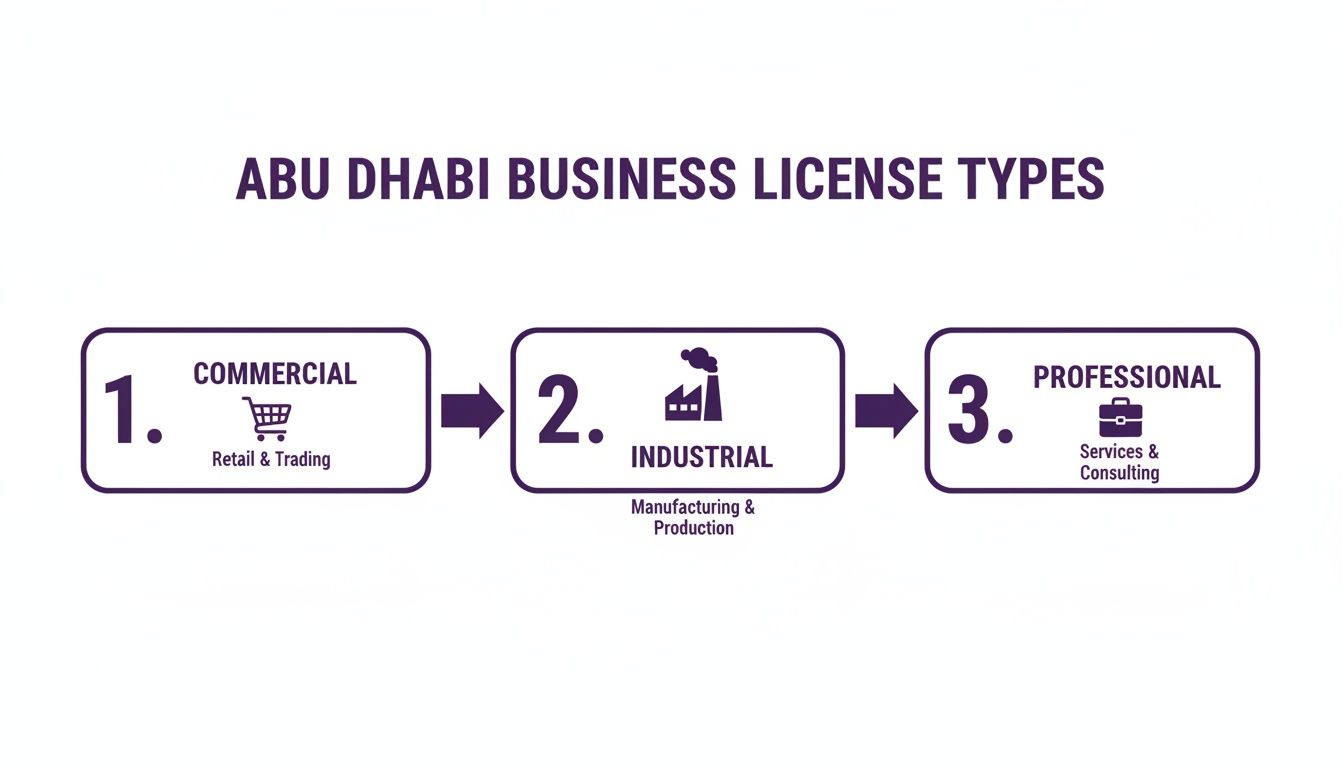
Whether you're selling goods, manufacturing products, or offering your expertise, the fundamental path to getting licensed shares a common structure.
Laying the Groundwork: Business Activities and Legal Structure
Before you even dream up a company name, you have to lock down exactly what your business will do. This means choosing from a very specific list of business activities defined by the Abu Dhabi Department of Economic Development (ADDED). This is, without a doubt, the most critical decision you'll make at the start.
Why is it so important? Your chosen activities will directly determine:
- The licence type you need (Commercial, Professional, etc.).
- The legal structures available to you, like a Limited Liability Company (LLC) or a Sole Establishment.
- Whether you’ll need special approvals from other government departments.
- If your business is eligible for 100% foreign ownership.
For example, setting up a general trading company is a completely different ballgame from launching an IT consultancy. The trader needs a commercial licence, while the consultant needs a professional one. This choice alone impacts your ownership options, liability, and setup costs. This is where we come in—we help entrepreneurs match their vision to the right activities and legal form, saving them time and money right from the beginning.
Securing Your Identity: The Trade Name Reservation
With your activities defined, it's time to name your venture. Your trade name in Abu Dhabi has to be unique and follow a clear set of rules. You can't use anything offensive, linked to political or religious groups, or that sounds too much like a famous global brand.
The reservation itself is done online via the ADDED portal. You'll want to submit a few options, just in case your first choice is already taken or doesn't meet the criteria. Getting that name approval is often the moment the whole project starts to feel real.
A classic mistake we see is picking a name that's too broad or doesn't align with the business activity. The authorities will reject a misleading name. For instance, you can't call your IT consultancy "Abu Dhabi General Trading" – it creates a mismatch with your professional licence activities and will be flagged immediately.
Gaining Initial Approval: A Critical Checkpoint
Once your trade name is reserved, the next step is to apply for Initial Approval. This is essentially the government giving you a preliminary nod. It’s an official confirmation that there are no objections to your proposed business, allowing you to move forward with the more substantial legal and logistical tasks.
Don't underestimate this document. You'll need it to start drafting legal agreements and, crucially, to sign an office lease. It's the piece of paper that validates your business concept in the eyes of the regulators.
Formalising the Partnership: The Memorandum of Association
For most companies, especially LLCs, the Memorandum of Association (MOA) is the legal backbone of the business. This document spells everything out: the company's purpose, partner responsibilities, share capital, and how profits and losses are handled.
The MOA must be drafted with absolute precision in both Arabic and English, complying with UAE Commercial Companies Law. After it's drafted, all partners (or their legal representatives) must sign it in front of a public notary in Abu Dhabi. This makes the agreement official and legally binding. Our team ensures your MOA is airtight, protecting all parties and preventing compliance headaches down the road.
Establishing a Physical Base: The Tenancy Contract
In Abu Dhabi, a mainland company needs a physical address. It’s non-negotiable for most activities. You must provide a valid tenancy contract for a commercial space, which is then registered in Abu Dhabi's Tawtheeq system.
This is a major planning and budget item. The lease has to be issued in your company's approved trade name, which is why the Initial Approval must come first. The registered tenancy contract is one of the last key documents needed before the final licence is issued.
The Final Push: Submission and External Approvals
With your trade name, initial approval, notarised MOA, and tenancy contract all in hand, you're ready for the final submission to ADDED.
But wait, there's one more layer. Depending on your business, you might need a green light from other government bodies. For example:
- A medical clinic will need a sign-off from the Department of Health.
- An engineering firm requires clearance from the Abu Dhabi Municipality.
- A foodstuff trading company must get approvals from the Abu Dhabi Agriculture and Food Safety Authority (ADAFSA).
Honestly, this is where most applications get bogged down. Each external body has its own process, fees, and timeline. Juggling these requires experience and a good working knowledge of the system. As your partner, we handle all this legwork, chasing approvals and making sure your file doesn't just sit in a queue. With our 24/7 Support Service, we make sure a complex process feels straightforward because we're always here when you need us. 📞 Call Us Now: +971-52 923 1246
How Much Does a Business License in Abu Dhabi Actually Cost?
When you’re setting up a business in Abu Dhabi, it's easy to fixate on the final licence fee. But the reality is, that single number is just one part of a much bigger financial puzzle. A successful launch depends on mapping out every single cost, not just the obvious ones. Overlooking the smaller government fees or third-party expenses can leave you with unexpected bills right when you need your capital the most.
Think of it this way: getting your licence isn't a single transaction. It’s a series of paid milestones, and each one gets you a step closer to opening your doors.
The Core Government Fees You Can't Avoid
The bulk of your initial setup costs will go directly to the Abu Dhabi Department of Economic Development (ADDED) and other government bodies. These are fixed charges that form the bedrock of your budget.
Here’s what you should plan for:
- Trade Name Reservation: Your first official expense. This fee secures your company name, confirming it’s unique and follows all the naming rules.
- Initial Approval Certificate: This is a big step. Paying this fee gets your business plan and shareholder information reviewed by the authorities, giving you the official nod to move forward.
- Licence Issuance Fee: This is the main event – the cost for the licence itself. The amount can vary wildly depending on your business activities and company structure.
- Commercial Registration Fee: An additional fee to get your business officially listed in the commercial registry.
While these fees are standard, the exact costs can change with little notice. This is where having a local expert helps; they'll know the current rates down to the last dirham.
Don't Get Caught by the "Hidden" Costs
What trips up many new entrepreneurs are the costs beyond the government's direct fees. These are often the most significant expenses, and failing to budget for them is a classic mistake that can cripple a new venture.
Make sure these are factored into your budget from day one:
- Office Rent and Tawtheeq: Most mainland businesses need a physical address. This means budgeting for annual rent and the fee to register your tenancy contract on the official Tawtheeq system.
- Visa Processing: You’ll need an investor visa, and likely visas for your team. Each one is a multi-step process with separate fees for the entry permit, medical test, Emirates ID application, and the final visa stamping.
- External Approvals: Is your business in a specialised field like healthcare, engineering, or education? If so, you'll need separate approvals from other ministries or government departments, and each comes with its own price tag for applications and inspections.
The biggest budgeting error we see is underestimating the total cost of becoming operational. The licence is just the entry ticket. A realistic budget covers rent, key personnel visas, and any special permits. That’s what ensures you have the cash flow to actually start trading, not just exist on paper.
Factoring in Timelines and Delays
In business, time is always money. A straightforward licence application can be processed fairly quickly if all your paperwork is perfect. But delays are common, especially if you need those external approvals. Every week you're held up is another week of expenses piling up before you've made a single sale.
For solid financial planning, you need to look at the complete picture of costs and potential income. This is where understanding financial tools like break-even analysis can be incredibly helpful, giving you a clear view of when your business will actually start turning a profit.
As the Best Corporate Service Provider in Dubai, Abu Dhabi & Sharjah, we focus on providing Cost-Effective Business Setup Solutions tailored to your needs. We give you one clear, all-inclusive quote right at the start. It bundles every government fee, visa cost, and service charge into a single, predictable package. No surprises, no hidden fees. This lets you budget with absolute confidence and get back to what you do best—building your new Abu Dhabi enterprise.
Life After the License: Visa Processing and PRO Services

Holding your new business license in Abu Dhabi feels like crossing the finish line, but in many ways, it's just the start of the race. Your company is officially born, but now the focus shifts from setup to actually living and working here, and that means visas and ongoing compliance.
This is where the paperwork really kicks in, and having an expert partner makes all the difference. The steps that come next are every bit as critical as the ones that got you the license in the first place.
Securing Your Residency: The Investor Visa
With your company legally formed, the very next thing on your to-do list is sorting out your own residency. As the business owner, you're eligible for an Investor Visa, which gives you the right to live and work in the UAE.
It's a multi-stage process, and you’ll be dealing with several different government departments. Here’s a rundown of what to expect:
- Establishment Card: First, we get your company registered with the immigration authorities to issue its Establishment Card.
- Entry Permit: With that card, we can apply for your entry permit, which is the green light to start the in-country visa stamping process.
- Medical Fitness Test: You'll need to complete a mandatory medical screening at a government-approved health centre.
- Emirates ID Biometrics: This involves a quick trip to a Federal Authority for Identity and Citizenship (ICA) centre to give your fingerprints and photo for your Emirates ID.
- Visa Stamping: The final step. Your passport is submitted to immigration, and they place the official residency visa sticker inside.
Each of these steps has its own forms, fees, and processing times. Getting them done in the right order and without errors is key to getting you settled and back to focusing on your business. This is where our 24/7 Support Service truly shines, guiding you at every single point.
The Essential Role of PRO Services
Once your own visa is stamped, you'll probably start thinking about hiring staff. This is where professional Public Relations Officer (PRO) services become absolutely essential. A good PRO team is your company’s official link to all government departments. They handle employee visas, labour contracts, document attestations, and pretty much any other official paperwork you can think of.
Think of a PRO service as your outsourced government relations department. They navigate the complex bureaucracy—the online portals, the queues, the changing regulations—so you can pour all your energy into growing your business.
Effective PRO support is not a one-time thing; it’s an ongoing partnership that keeps your business compliant and running smoothly. This includes:
- Annual License Renewals: Making sure your business license in Abu Dhabi is renewed on time, every year, to avoid hefty fines.
- Document Attestations: Handling the legalisation of official papers needed for everything from opening bank accounts to signing commercial contracts.
- Regulatory Compliance: Keeping you informed about changes in labour laws, visa rules, and other government policies that affect your business.
This long-term support is vital, especially in a booming market. Just look at the Abu Dhabi Global Market (ADGM), which recently issued a record-breaking 1,869 new licenses in the first half of a single year—that's a 47% jump from the year before. With the total number of active licenses now over 11,000, it’s clear that thousands of investors are relying on expert guidance to manage their setup and operations.
Of course, living here involves more than just business paperwork. You'll also need to arrange things like health insurance options for expatriates in the UAE. As Specialists in Freezone Company Formation across the UAE, we provide Cost-Effective Business Setup Solutions tailored to your needs that cover you from day one and well into the future.
Common Questions About Setting Up in Abu Dhabi
Starting a new business is a big step, and when you're doing it in a new country, you're bound to have questions. It’s completely normal. When entrepreneurs look to set up in Abu Dhabi, they often run into the same uncertainties around ownership rules, how long everything takes, and what the real requirements are.
Getting straight answers is key. You need to know what you’re getting into so you can plan properly and avoid hitting those common speed bumps. Here are the questions we get asked the most, with answers drawn from our daily experience helping people get their business license in Abu Dhabi.
Can I Really Own 100% of My Business Without a Local Sponsor?
Yes, for most business activities, you absolutely can. This is one of the biggest and most positive changes we’ve seen in UAE commercial law. The government now allows 100% foreign ownership for a huge list of mainland companies, which has really opened the doors for international entrepreneurs.
But, it's not a universal green light. A handful of specific industries, often those with strategic national importance, might still require an Emirati partner. The only way to know for sure is to check the official list for your specific business activities with the Abu Dhabi Department of Economic Development (ADDED). As this is our bread and butter, we're always on top of the latest updates and can give you a clear "yes" or "no" for your specific venture.
Honestly, How Long Will It Take to Get My License?
This is the million-dirham question, and the honest answer is: it depends. The timeline for getting your business license in Abu Dhabi can be quick, but several things can affect the speed. It really comes down to the type of business you're in, your chosen legal structure, and how organised your paperwork is.
If you have a straightforward activity and all your documents are spot-on, the process can be surprisingly fast – sometimes just a matter of days. However, if your business needs approvals from other government bodies, like the Health Authority or an engineering council, you have to account for their processing times. This can add a few weeks. The best way to keep things moving is to make sure your application is flawless from the start; that's where having an expert on your side really prevents those frustrating delays.
What’s the Real Difference Between a Mainland and a Free Zone License?
This is probably the most critical decision you'll make, as it dictates where and how you can do business. They're built for different goals.
-
Mainland License: Think of this as your key to the entire UAE market. You can trade directly with any customer or company, anywhere in the country. Crucially, it also allows you to bid for potentially massive government contracts.
-
Free Zone License: This license is designed for businesses focused on international trade. Your operations are generally limited to within your chosen free zone and overseas. If you want to sell on the mainland, you typically have to go through a local distributor.
Choosing between mainland and a free zone isn't about which is "better," but which is the right fit for your business model. If your target customers are in the UAE, or you want to work with government departments, a mainland license is a must. If your focus is exporting and you want the specific benefits of a free zone environment, that's your path.
Do I Actually Need to Rent an Office to Get a License?
For most mainland business licenses, the answer is yes. You’ll need a physical office space and must provide a tenancy contract registered in Abu Dhabi's Tawtheeq system. This is the government's way of confirming your business has a legitimate physical address in the emirate.
However, Abu Dhabi has recognised that not everyone needs a traditional office from day one. There are now more flexible, modern options. For instance, the 'Tajer Abu Dhabi' license and certain freelance permits were created specifically for startups and solo entrepreneurs. They allow you to get up and running without the immediate overhead of an office lease, giving you a chance to test the market first.
Getting answers is the first step, but turning those answers into a registered, operational business is the real work. At 365 DAY PRO Corporate Service Provider LLC, we are Specialists in Mainland Company Formation in Dubai & Abu Dhabi and Specialists in Freezone Company Formation across the UAE. We provide clear, cost-effective solutions and 24/7 support to make sure your setup is as smooth as possible. WhatsApp Us Today for a Free Consultation and let's get started.