
Starting a business in Dubai all comes down to three key decisions: what you’ll do, how you'll structure it legally, and where you'll be based. That last part—choosing your jurisdiction—is a big one. You're looking at setting up on the Mainland, in a Free Zone, or Offshore, and each path offers a completely different set of advantages.
Your Quick Guide to a Dubai Business License
Think of your Dubai business license as the blueprint for your company. It's not just a permit; it's the legal DNA that dictates where you can set up shop, who you can do business with, and the specific rules of the game you'll be playing by. Getting this right from the start is crucial for your long-term success, influencing everything from taxes to hiring.
The whole process starts with a simple question: What is your business going to do? The answer will point you toward a Commercial license for trading, a Professional license for services, or an Industrial license if you're manufacturing goods. Once that's settled, you face what is easily the most important decision: where to establish your base. Mainland, Free Zone, or Offshore?
Core Jurisdictions at a Glance
Let's break down these three paths to make that choice a little easier. Each jurisdiction is built for different ambitions. Are you aiming to tap directly into the local UAE market? Or maybe you need a holding company for international assets? Understanding how they differ is the first step to a smooth setup.
It's a decision more and more entrepreneurs are making. Dubai's welcoming environment has turned it into the region's commercial heart. In fact, by March 2025, the city had nearly 990,000 active business licenses on its books—that’s a massive 59% of all licenses across the entire UAE. You can get a deeper look into Dubai's business dominance in this insightful report.
Ultimately, the right choice boils down to what your business actually needs to operate. As specialists in both Mainland and Free Zone company formation, we help entrepreneurs find practical, cost-effective setups so they can take full advantage of the UAE's tax benefits.
A business license is more than a permit; it's your company's passport to operate within one of the world's most dynamic economic hubs. Choosing the right jurisdiction unlocks the specific benefits your business needs to thrive.
To help you see the differences side-by-side, the table below gives a quick snapshot of what each option entails. It’s a great way to see which path aligns best with your vision.
Comparing Dubai's Business Jurisdictions
| Feature | Mainland License | Free Zone License | Offshore License |
|---|---|---|---|
| Ownership Structure | 100% foreign ownership for most activities | 100% foreign ownership guaranteed | 100% foreign ownership guaranteed |
| Scope of Business | Can trade directly anywhere in the UAE | Can trade within the free zone and internationally | Cannot trade within the UAE market |
| Visa Eligibility | High eligibility, based on office size | Eligibility depends on the free zone package | No visa eligibility provided |
| Office Requirement | Physical office space is mandatory | Flexi-desk or virtual offices available | Registered agent's address is sufficient |
As you can see, the "best" option is really about what works for your specific business model. Whether you need the freedom of the Mainland, the global connectivity of a Free Zone, or the asset protection of an Offshore company, Dubai has a structure designed to fit.
Choosing Your Jurisdiction: Mainland, Free Zone, or Offshore?
Deciding where to set up your company is the first and most critical step on your Dubai business journey. This one choice has a ripple effect on everything that follows—who can own the business, where you can operate, how many visas you can get, and your path to future growth. It all comes down to knowing what you want to achieve.
Let’s break it down with a simple analogy. Think of a Mainland business license as opening a shop on the busiest high street in the country. You have an all-access pass to the entire UAE economy, allowing you to trade directly with anyone, anywhere in the local market. You can also bid on those big-ticket government contracts. It’s the go-to option for anyone serious about building a strong presence right here in the UAE.
A Free Zone business license, on the other hand, is like setting up in a specialised, high-tech business park designed for global trade. These zones are magnets for international entrepreneurs, offering incredible perks like 100% foreign ownership, zero corporate taxes, and hassle-free customs. While you can't trade directly with the mainland market, free zones are perfect for businesses focused on import/export, consulting, or serving regional and international clients.
The Mainland Advantage: Diving into the Local Market
A Mainland license, issued by Dubai's Department of Economy and Tourism (DET), gives you total freedom to operate across the UAE. This is the classic, most direct route for any business that needs a physical presence, like a retail store, a restaurant, or a local service provider, and wants to engage directly with customers on the ground.
If your game plan includes working with government agencies or other mainland companies, this is your only real option. A Mainland setup also gives you the freedom to rent an office anywhere in Dubai, not just in a specific zone. This flexibility is key, as your capacity for employee visas is often tied to the size of your commercial space. As specialists in Mainland company formation in Dubai, we can help you navigate these requirements to find the perfect setup for your goals.
Choosing the Mainland means you're planting your flag firmly in the UAE's vibrant domestic economy. It’s the path for entrepreneurs who want to build a household name and become part of the local fabric.
The Strategic Appeal of a Free Zone: A Global Launchpad
The UAE boasts over 40 free zones, and many are tailored to specific industries, creating powerful ecosystems for tech, media, finance, or commodities. Setting up in one of these zones is a game-changer for international business owners. The biggest draw? The guarantee of 100% foreign ownership, which means you don't need a local Emirati partner.
These zones also offer world-class infrastructure, incredible networking events, and refreshingly straightforward admin processes. If your business model is built on consulting, e-commerce, or international trade, a free zone provides a highly efficient and cost-effective base of operations, all while letting you enjoy the full tax benefits the UAE is famous for.
This decision tree gives you a bird's-eye view of the key differences:
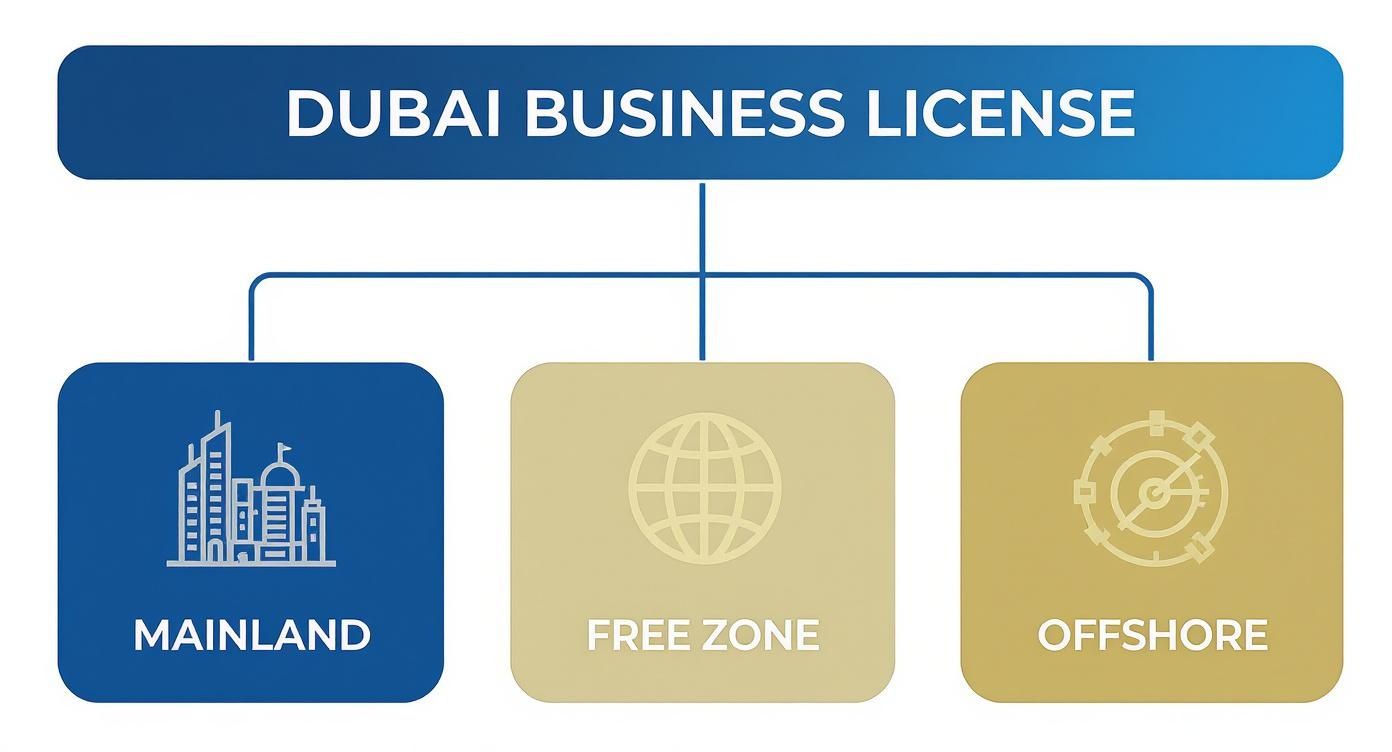
As the infographic shows, it’s all about your target market. Are you focused on the local scene, the global stage, or simply protecting your assets?
The Niche Role of an Offshore Company: Your Global Vault
Finally, we have the Offshore company. This one's a different beast entirely. It’s less about running a day-to-day business and more about creating a secure legal structure to hold your assets. An Offshore company, typically registered in a jurisdiction like the Jebel Ali Free Zone (JAFZA), is a legal entity that is not permitted to conduct any business within the UAE itself.
So, what’s it for? Its primary functions are highly specific:
- Asset Protection: A secure, tax-neutral way to hold property or other valuable investments.
- International Trading: A vehicle for facilitating global trade transactions that happen outside the UAE.
- Holding Company: A structure for owning shares in other companies, both inside and outside the country.
This setup is purely a strategic tool for international investors and high-net-worth individuals. It offers confidentiality and optimised wealth management but doesn't grant residency visas or allow for local operations.
The Step-by-Step Guide to Your Dubai Business Licence
Getting a business licence in Dubai isn't just about filling out forms; it's a structured process, almost like building a house. You need to lay a solid foundation before you can even think about putting up the walls. Each step is there for a reason, making sure your business is legally sound, properly categorised, and ready to operate within Dubai's framework.
The journey actually starts with a strategic decision, not paperwork. You need to be crystal clear about what your business will do. This single choice dictates the type of licence you'll need—Commercial, Professional, or Industrial—and which government departments you'll need to get a nod from.
Nailing this down from the start is critical. Trying to change or add business activities later on can be a real headache and an expensive one at that. A clearly defined scope makes the entire path forward much smoother.
The First Hurdles: Trade Name and Initial Approval
Once you've locked in your business activities and legal structure, it's time to give your company an identity. This means reserving a unique trade name with the right authority—for a mainland company, that's usually the Department of Economy and Tourism (DET). The name has to follow certain rules: it can't be offensive, already taken, or clash with public morals.
With your name approved, you'll apply for your Initial Approval. Think of this as a preliminary green light from the authorities. It's their way of saying, "We have no objection to you setting up this business." This is a huge milestone, as it gives you the confidence to move on to the bigger legal and logistical steps, like drafting official documents and finding an office.
The Initial Approval Certificate is your permission slip to proceed. It essentially validates your business idea and clears the way for you to finalise your company's legal framework and operational setup.
Making It Official: Your Business Structure
With the Initial Approval in your pocket, the next job is to formalise your company's legal DNA. This involves drafting a Memorandum of Association (MOA) or, for sole establishments, a Local Service Agent (LSA) agreement. The MOA is the legal bedrock of your company, spelling out the rules, roles, responsibilities, and shareholdings of all partners.
This document isn't something to rush. It needs to be carefully drafted and then attested by a notary public. It’s the internal rulebook for your company, so every detail matters. For many entrepreneurs coming from abroad, this is where getting expert advice really pays off, ensuring everything lines up perfectly with UAE Commercial Companies Law.
Next, you need a business address—and the rules differ depending on your setup.
- Mainland Companies: You're required to have a physical office space with a registered tenancy contract, known as an Ejari. The size of this office often determines how many employee visas you can apply for.
- Free Zone Companies: Here, you'll often find more flexible and cost-effective options, like flexi-desks or virtual offices, which are perfect for startups and solo consultants.
This tenancy contract is non-negotiable for your final application. It's the official proof that your business has a legitimate home in Dubai.
The Final Stretch: Submission and Licence Issuance
The last step is to gather all your documents for the final submission. This bundle will include your approved trade name, the Initial Approval Certificate, the attested MOA, your tenancy contract, and passport copies for all shareholders. The authorities will then review the entire application.
Once everything is verified and all the fees are paid, your official business licence is issued. This whole process has a lot of moving parts, and a simple paperwork mistake can cause frustrating delays. This is exactly why many entrepreneurs choose to partner with company formation specialists.
A good corporate service provider handles every submission, deals with the government departments on your behalf, and makes sure you're compliant at every stage. They can turn a potentially complicated process into a smooth, efficient, and stress-free experience, often with a 24/7 support service to guide you from start to finish.
Understanding the Documents and Costs Involved
Getting your business license in Dubai comes down to two things: the paperwork you need and the price you'll pay. Let's be honest, figuring this out upfront is the secret to a smooth, stress-free setup. Think of it like planning a big trip – you wouldn’t head to the airport without your passport and a clear budget, right? The same logic applies here.
Handing over a complete and accurate file to the authorities is half the battle. One missing document or a small error can cause frustrating delays, pushing back your launch date and costing you precious time.
Your Essential Document Checklist
While the exact list can shift a little depending on your business activity and whether you're in a free zone or the mainland, a core set of documents is always required. Getting these organised from the start puts you in a great position to move fast once you’re ready.
Here’s a practical checklist of what you'll almost certainly need:
- Passport Copies: Have clear, valid copies for every shareholder and the company manager. This is non-negotiable.
- Visa and Entry Stamp: If you're already inside the UAE, you’ll need to provide a copy of your visa and the stamp showing when you entered.
- Application Form: This is the official form from the licensing authority, like the DET for mainland or the specific free zone authority you've chosen.
- Business Plan: For some professional activities or specific free zones, a well-thought-out business plan is essential to show that your idea is viable.
- Attested Educational Certificates: If you're applying for a professional licence, you'll likely need to have your degree or other qualifications officially attested to prove your expertise.
- Memorandum of Association (MOA): For any company with more than one shareholder, a notarised MOA is needed. It’s the rulebook for your company, detailing ownership and how it will be run.
- Trade Name Reservation Certificate: This is the proof that your chosen company name has been approved and is officially reserved for you.
- Initial Approval Certificate: Think of this as the green light from the authorities, giving you permission to move forward with the rest of the licensing steps.
Pulling these documents together is the real groundwork of your company formation. It’s a detail-oriented process where getting it right the first time saves a lot of headaches later.
Demystifying the Investment in Your Dubai Business
One of the first questions on every entrepreneur's mind is, "So, how much is this actually going to cost?" The answer isn't a single price tag but a combination of different fees and expenses. Understanding this breakdown is the key to planning your finances properly and avoiding any nasty surprises down the road.
The good news is that recent government initiatives have made starting a business more affordable than ever. Dubai's trade license reforms, which came into effect in 2025, were a strategic move to lower the entry barriers for startups and SMEs. By cutting costs and speeding up timelines, they've genuinely changed the game for new entrepreneurs. You can learn more about these pivotal reforms on persianhorizon.com.
Budgeting for your Dubai business license isn't about finding a single price tag. It's about understanding each component fee—from initial government charges to your office rent—to build a realistic and comprehensive financial plan.
To give you a clearer picture, let's look at what these costs might look like. The table below compares the estimated expenses for a standard commercial trade license in Dubai Mainland versus a popular Free Zone. Keep in mind these are ballpark figures; the final cost will depend on your specific business activity and choice of location.
Estimated Cost Breakdown for a Dubai Business License
| Cost Component | Estimated Mainland Cost (AED) | Estimated Free Zone Cost (AED) |
|---|---|---|
| Initial Approval Fee | 500 – 1,000 | 500 – 1,000 |
| Trade Name Registration | 620 – 2,000+ | Included in package |
| Office Rent (Ejari) | 15,000+ (Physical Office) | 5,000+ (Flexi-Desk) |
| Memorandum of Association | 1,500 – 3,000 | Included in package |
| Final Licence Issuance Fee | 8,000 – 15,000 | 10,000 – 20,000 (Package) |
| Total Estimated Cost | 25,620 – 36,000+ | 15,500 – 26,000+ |
As you can see, the costs can vary quite a bit. A business setup specialist can give you a precise quote tailored to your venture, helping you find the most cost-effective business setup solutions so you can take full advantage of the UAE's amazing tax benefits.
Keeping Your Licence in Good Shape: Renewals and Changes
Getting your business licence in Dubai is a fantastic first step, but it's really just the beginning of your journey. It's best to think of your licence less like a one-time purchase and more like a crucial annual subscription that keeps your business legally compliant in the UAE. It’s a document that needs to evolve right along with your company.
This means you’ll be dealing with two main things: yearly renewals and the occasional amendment. Getting both right is essential. Messing them up can lead to hefty fines, operational headaches, and legal issues you really don't want. Staying on top of these tasks keeps you in good standing with the authorities, whether it's the Department of Economy and Tourism (DET) for a mainland company or your specific free zone authority.
The Yearly Renewal Ritual
Every single business licence in Dubai has to be renewed annually. There’s no getting around it. The process itself isn't complicated, but you absolutely have to have your ducks in a row. If you miss that deadline, you could be looking at penalties, a freeze on your company's bank account, or even the suspension of visas for you and your staff.
To make sure your renewal goes off without a hitch, you'll generally need a few key documents ready:
- A Valid Tenancy Contract: You need to prove you have a physical place of business. For mainland companies, this is your Ejari; for free zones, it’s your lease agreement. Either way, it must be valid for the year ahead.
- Your Original Business Licence: The authorities will need to see your current licence before issuing the new one.
- External Approvals: Some business activities require a thumbs-up from other government departments. If that's you, you'll need to get those approvals renewed as well.
From day one, adopting meticulous record keeping for all your business activities will make renewals and future amendments a thousand times easier.
Updating Your Licence as Your Business Evolves
Let's be honest, businesses don't stay static. You'll expand, pivot, and restructure. Whenever a fundamental detail about your company changes, your licence needs to be officially updated to match. This process is called an amendment.
You’ll need to file for an amendment when you’re:
- Adding or Removing a Business Activity: Thinking of launching a new service? You must add that activity to your licence first.
- Changing Your Company Name: A rebrand isn’t official until your licence says so.
- Updating Shareholder Information: If a new partner comes on board or one leaves, the shareholder structure has to be legally updated.
- Changing Your Business Location: Moving offices? Your new address must be registered with the licensing authority immediately.
An outdated licence isn't just a simple slip-up; it's a serious compliance risk. To grow smoothly and legally in Dubai's fast-paced market, your licence must be a perfect reflection of your current business operations.
Handling these renewals and amendments means dealing with government portals and making sure every piece of paperwork is spot on. It can be a real time-sink. This is where having ongoing professional support truly pays off. A good corporate service provider can handle all of this for you, from visa paperwork to licence updates, often with 24/7 support. That frees you up to focus on what you do best: running and growing your business.
Working With a Business Setup Specialist
Trying to get a business license in Dubai on your own can feel like trying to navigate the city's streets during rush hour without a GPS. Sure, you might get there eventually, but the frustration, wrong turns, and wasted time are almost guaranteed. This is where a business setup specialist comes in—they’re your local guide who knows every shortcut.
Think of them as the architect for your company's foundation. They take what seems like a mountain of paperwork and confusing regulations and turn it into a clear, step-by-step plan. They know the ins and outs of both mainland and free zone setups, making sure every form is filled out perfectly and submitted on time. This kind of expertise doesn't just save you a headache; it saves you time and money.
Why Expert Guidance Is Your Best Bet
Bringing a specialist on board isn't just about handing off paperwork. It's about having a strategic partner who’s as invested in your successful launch as you are. The payoff is immediate, giving your new business the strong start it needs to thrive.
This kind of support is more important than ever. The UAE’s business scene is booming, with an incredible 200,000 new economic licenses issued in 2024 alone. In such a fast-moving market, getting expert help to launch quickly and correctly is a huge advantage. You can dive deeper into the recent surge in UAE business registrations.
As the best corporate service provider in Dubai, Abu Dhabi & Sharjah, a good specialist will handle everything:
- Mainland Company Formation in Dubai & Abu Dhabi: They are specialists with deep-rooted knowledge of local rules, perfect for businesses targeting the local market.
- Freezone Company Formation Across the UAE: They are specialists who know the nuances of every major UAE free zone, helping you pick the ideal hub for your international operations.
- Guaranteed Accuracy: All your documents are prepared and submitted correctly the first time, so you don't have to worry about rejections or hold-ups.
- Government Liaison: They deal directly with authorities like the Department of Economy and Tourism, saving you from getting tangled in red tape.
- Strategic Advice: They help you choose the right jurisdiction and legal structure based on your actual business goals and budget.
The Smartest Way to Get Started
It might seem counterintuitive, but hiring a professional service is often the most cost-effective business setup solution. A good consultant will steer you away from costly rookie mistakes, like picking the wrong business activity or leasing an unsuitable office, which can set you back thousands down the line.
Partnering with a specialist turns the business setup process from a potential obstacle into a strategic advantage, ensuring you are positioned to fully enjoy the UAE tax benefits available to international entrepreneurs from the very beginning.
Plus, the best firms don't just disappear once your license is in hand. They offer ongoing 24/7 support service – they're always there when you need them for crucial next steps like processing visas, opening a corporate bank account, and handling your annual renewals. This long-term support means you can stay compliant and focus all your energy on what really matters: growing your business.
Your Questions Answered
Starting a business in Dubai is exciting, but it’s natural to have questions. Getting the right answers from the get-go is the difference between a smooth launch and a frustrating one. Let’s tackle some of the most common queries we hear from entrepreneurs just like you.
Think of this as your practical cheat sheet. We're cutting through the jargon to give you the clear, straightforward advice you need to make smart decisions for your new company.
Can I Get a Dubai Business License Without a Physical Office?
Absolutely. This is one of the biggest perks of setting up in a UAE free zone. Most free zones are built for modern business and offer flexible options like flexi-desks or virtual office packages. These are perfect for consultants, freelancers, and digital startups who don't need a dedicated, full-time office space.
For mainland businesses, the traditional rule was a hard-and-fast "yes" – you needed a physical office with a registered tenancy contract, known as an Ejari. But things are changing. The rules are becoming more flexible, and some mainland business activities can now get licensed without a permanent physical address. It's best to chat with a consultant who knows the latest regulations for your specific industry.
How Long Does It Take to Get a Business License in Dubai?
This really depends on a few key things: where you set up (mainland or free zone), what your business does, and how organised your paperwork is. There’s no single answer.
For instance, a straightforward free zone license can be surprisingly quick, sometimes turned around in just a few working days if no special approvals are needed. A mainland license, on the other hand, is a bit more involved. It usually takes anywhere from one to four weeks because it often has to pass through several government departments for approvals.
Here's a pro tip: Working with a business setup specialist can seriously speed things up. They know the system inside and out, making sure every form is filled out correctly the first time, which helps you sidestep the common mistakes that cause delays.
What Is the Difference Between a Commercial and a Professional License?
It all comes down to what your business does. Think of it this way:
- A Commercial License is for any business involved in trading – buying and selling goods, import/export, or running a retail shop.
- A Professional License is for service-based businesses that trade on expertise and skill. This includes consultants, designers, auditors, and other specialists.
The biggest difference used to be about ownership. For years, only professional licenses on the mainland could have 100% foreign ownership (with a Local Service Agent). But recent legal changes have been a game-changer, now allowing 100% foreign ownership for most commercial businesses, too. This has made the need for a local sponsor far less common.
Do I Still Need a Local Sponsor for My Business in Dubai?
For most entrepreneurs setting up today, the answer is a resounding "no." If you're in any of the UAE's free zones, you get 100% foreign ownership, full stop. It’s one of their main attractions.
On the mainland, the old rule requiring an Emirati sponsor to own 51% of the shares has been scrapped for over a thousand business activities. While a few key strategic sectors still need a local partner, the vast majority of businesses can now be fully foreign-owned. A setup expert can give you the final word based on your specific business activity, ensuring your company is structured correctly right from the start.
Navigating the ins and outs of getting a business license in Dubai doesn't have to be complicated. With the right partner, it can be a smooth and straightforward process. At 365 DAY PRO Corporate Service Provider LLC, we live and breathe mainland and free zone company formation. We offer clear, cost-effective solutions and 24/7 support to help you get your business off the ground successfully.
📞 Call Us Now: +971-52 923 1246
💬 WhatsApp Us Today for a Free Consultation at https://365dayproservices.com