

Opening a bank account in the UAE isn't just a box to tick on your to-do list. Think of it as laying the financial foundation for your life or business in one of the world's most exciting economic hubs. It's the key that unlocks everything, giving you the stability and access you need to thrive here.
Why a UAE Bank Account is a Must-Have

Before we get into the nitty-gritty of documents and applications, let's talk about why this is so important. This isn't just about stashing cash; it's about plugging your personal or business life directly into a powerful financial ecosystem built for international trade and growth.
For anyone setting up a company here, a corporate bank account is non-negotiable. It's the bedrock of your local operations. This account builds trust with your clients, makes paying your team straightforward, and lets you connect to local payment systems. Honestly, trying to run a business in the UAE without one is a non-starter—you'll need it for everything from signing an office lease to taking payments from customers.
Personal vs. Corporate Accounts: Know the Difference
It's crucial to understand that these two account types are worlds apart. They serve completely different functions and have their own unique set of rules and requirements.
- Personal Accounts: These are for residents to handle their everyday money matters—getting paid, covering bills, and saving up. The number one requirement you'll face is having a valid UAE residency visa and your Emirates ID.
- Corporate Accounts: Built for registered businesses (whether Mainland, Free Zone, or Offshore), these demand a stack of official company documents. Expect to provide your trade licence, Memorandum of Association, and more. Banks are also much more thorough with their background checks for these accounts.
I see this all the time: new entrepreneurs try to run business transactions through their personal accounts. This is a massive red flag for banks. It can get your account frozen or shut down fast and create serious compliance headaches. Keep your personal and business finances strictly separate from day one.
A Secure and Booming Financial Centre
The UAE's banking system has a reputation for being solid, well-managed, and forward-thinking. This gives you peace of mind that your money is safe, whether you're a resident saving for the future or an international company managing its capital.
The numbers speak for themselves. The sector's financial strength is always growing—for instance, UAE banks held investment levels of AED 774.3 billion by April 2025, a jump of 16.2 percent from the year before. You can read more about the UAE's dynamic financial ecosystem and its consistent growth to see the bigger picture.
As the Best Corporate Service Provider in Dubai, Abu Dhabi & Sharjah, we can tell you from experience: getting the right bank account is the first, most critical step for any successful venture.
📞 Call Us Now: +971-52 923 1246
💬 WhatsApp Us Today for a Free Consultation
Your Guide to Opening a Personal Bank Account
Opening a personal bank account in the UAE is, thankfully, much more straightforward than setting up a corporate one. While business banking can feel like navigating a maze, personal banking is a well-trodden path for residents. The whole game is about preparation—get your documents in order before you even think about walking into a branch.
The single most important document you need for a proper, full-featured current account is your UAE residency visa. This is the key that unlocks the door. It tells the bank you're a legitimate resident, not just a visitor. Without it, you’ll likely be limited to basic non-resident savings accounts, which have a lot of restrictions.
Choosing the Right Type of Personal Account
Before you get lost in the paperwork, take a moment to figure out what you actually need. UAE banks offer a few different flavours of accounts, and picking the right one from the start will save you a headache later.
- Current Accounts: Think of this as your daily driver. It’s where your salary lands, where your bills get paid from, and what your debit card is linked to. You'll get a chequebook, which is still surprisingly important for things like rental payments here.
- Savings Accounts: This is for stashing cash away. You’ll earn a little bit of interest, but the main goal is to keep this money separate from your daily spending. Banks often limit the number of free withdrawals per month to encourage you to actually save.
- Fixed Deposit Accounts: Got a chunk of money you won’t need to touch for a while? A fixed deposit account will give you a better interest rate in exchange for locking up your funds for a set term—say, six months, a year, or even longer.
For anyone moving to the Emirates, a current account is the first priority. It’s the hub for your entire financial life here, from getting paid to setting up direct debits for your flat or phone plan.
Your Definitive Document Checklist
UAE banks are serious about their Know Your Customer (KYC) rules. The fastest way to get your application approved is to have every single document perfectly prepared. I can't tell you how many times I've seen applications get stuck for weeks simply because of a blurry copy or a missing stamp.
Here’s exactly what you’ll need to have ready:
- Passport Copy with Visa Page: A clear, colour copy of your passport’s main page and the page with your stamped UAE residency visa.
- Emirates ID Copy: A copy of the front and back of your valid Emirates ID. This is absolutely mandatory; they won't even start the application without it.
- Salary Certificate: This is an official letter from your employer, printed on their letterhead and stamped, that confirms your job title and monthly salary. Some banks have a specific template they prefer, so it’s always a good idea to ask.
- Proof of Address: This isn't always a strict requirement, especially if your company provides your accommodation. But it's smart to have a recent utility bill or your tenancy contract (the Ejari in Dubai) ready just in case.
Pro Tip: Don't just make photocopies; make high-quality colour copies. And always bring your original documents with you to the bank. The staff will need to see them to verify the copies. It’s a simple step that can save you a second trip.
Setting Realistic Timeline Expectations
Once you have all your documents in hand and submit them correctly, the process for a personal bank account opening in the UAE moves along pretty quickly.
After your in-person meeting at the branch, you can expect to get your account number and initial approval within 2 to 5 business days. A few days later, your welcome kit with your new debit card and chequebook will arrive by courier, which usually takes another 3 to 5 business days. All told, you can be up and running in a little over a week.
As Specialists in Mainland Company Formation in Dubai & Abu Dhabi and across the UAE, we guide clients through these steps every single day. We understand that a smooth start is crucial, which is why our team offers 24/7 Support Service. If you have questions, our experts are always here when you need us.
Your Blueprint for a Corporate Bank Account in the UAE
Opening a corporate bank account in the UAE is a different beast altogether compared to a personal one. This is often the first real bureaucratic test for new entrepreneurs, and frankly, it's where many get stuck. Your corporate account is the lifeblood of your business, so getting it right means understanding that the bank’s requirements go way beyond a simple checklist.
It all starts with your company's legal structure. This single decision sets the stage for the entire banking process, as every bank here has its own risk appetite and due diligence process for different types of business entities.
How Your Company Type Dictates the Banking Process
The very foundation of your company—whether it’s registered on the Mainland, in a Free Zone, or as an Offshore entity—is the first thing a bank will look at. Each one has different implications for what your business can do, and as a result, for the bank's compliance checks.
-
Mainland Companies: These are the businesses licensed by the Department of Economic Development (DED) in an emirate like Dubai or Abu Dhabi. They have the flexibility to trade anywhere in the local UAE market and work directly with government entities. For the most part, banks see Mainland companies as transparent and well-regulated, which can make opening an account relatively straightforward, assuming your paperwork is flawless.
-
Free Zone Companies: If you're registered in one of the UAE’s many free zones (think DMCC or JAFZA), you get great perks like 100% foreign ownership and tax breaks. Banks, however, will look very closely at which free zone you're in and what your business actually does. A company in a long-standing, reputable free zone with a proper physical office is almost always viewed more favourably than one with a basic flexi-desk setup.
-
Offshore Companies: Entities set up in places like JAFZA or RAK ICC are built for international trade, holding assets, and investments. They aren't allowed to do business inside the UAE. Because of this non-resident nature, banks put offshore companies under a microscope. Be prepared for a much tougher and longer due diligence process if you go this route.
This quick visual guide helps map out your initial path based on your residency status.
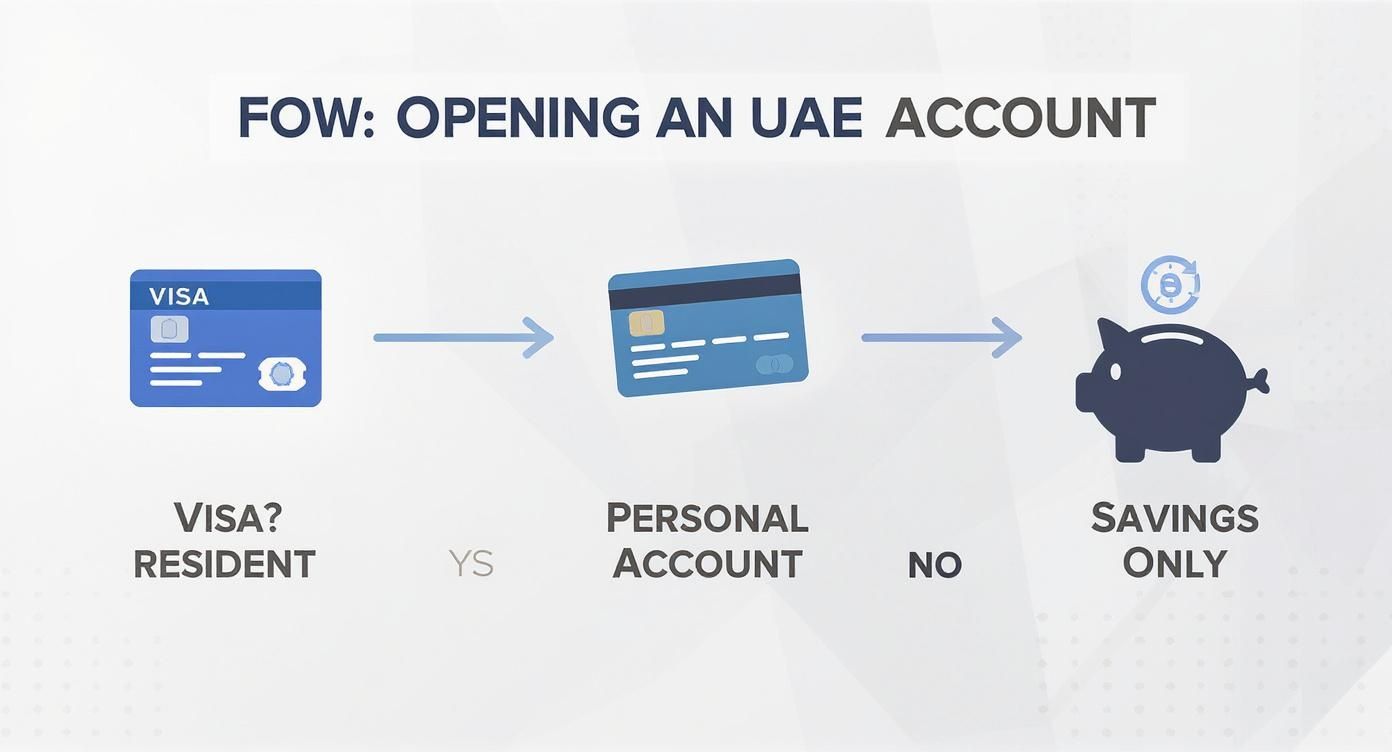
As you can see, holding a UAE residency visa is the key that unlocks a full-featured personal account. Without it, non-residents are usually restricted to more basic savings accounts.
The Essential Document Arsenal for Your Business
While each bank might have its own little quirks, there’s a core set of documents you absolutely must have ready for any corporate account application. Getting these perfectly prepared, signed, and attested is the first—and most critical—step to success.
Here's what you'll almost certainly need:
- A certified copy of your valid company Trade Licence.
- Your Certificate of Incorporation/Registration, proving your company exists legally.
- The Memorandum of Association (MOA) and Articles of Association (AOA), which detail your company's purpose, who the shareholders are, and how it’s run.
- The company's Share Certificates.
- Clear copies of the Passport, Visa, and Emirates ID for every shareholder and authorised signatory.
- A formal Board Resolution, authorising the account opening and naming the people who can sign on its behalf.
- Proof of your business address, which is usually a copy of your office lease agreement (known as Ejari in Dubai).
A classic mistake I see all the time is underestimating the importance of a physical office lease. Banks often view a flexi-desk or a virtual office as a potential red flag, especially for a brand-new business. A real, tangible office space gives your application a huge boost in credibility.
Proving Your "Economic Substance": The Unwritten Rules
Beyond just the paperwork, banks need to see that your company has real economic substance in the UAE. This is a regulatory requirement to prove your business isn't just a "shell company" on paper but a genuine operation with a real purpose here.
This is where you need to build a compelling business profile. Your business plan shouldn't be a generic template; it needs to be detailed and professional, clearly laying out your business model, target customers, projected revenues, and the kind of transactions you expect. You're telling the bank a story, and it needs to be a convincing one that matches your company's licensed activities.
For example, if you're setting up a new general trading company, you'll be under intense scrutiny. You'll need to show who your suppliers are, who your potential customers are, and what you'll be trading. Having pro-forma invoices or letters of intent from future clients ready to go can make a world of difference. It shows the bank you're transparent and helps build that crucial trust with their compliance team.
Facing the Biggest Hurdles Head-On
The two biggest challenges you'll likely face when opening a corporate bank account in the uae are the bank's deep-dive due diligence and the high minimum balance requirements. Banks here operate under very strict anti-money laundering (AML) and know-your-customer (KYC) rules, which means they will thoroughly investigate the background of every single shareholder.
The minimum balance is the other big factor. You might see some banks advertising "zero balance" accounts, but these often come with hefty monthly fees if your balance dips below a certain level. For a standard SME corporate account, you should be prepared for a minimum average monthly balance anywhere from AED 25,000 to over AED 250,000.
Opening a corporate account here requires meticulous preparation and a smart, strategic approach. As Specialists in Freezone Company Formation across the UAE, we guide our clients through this maze to ensure their application ticks all the right boxes from day one. To get started on the right foot, Call Us Now at +971-52 923 1246 to discuss your specific situation.
How to Choose the Right Bank for Your Needs
Picking a bank in the UAE isn't just about finding the nearest branch. It's about finding a financial partner that genuinely supports your business or personal goals. It's easy to get drawn in by flashy ads, but the best choice lies in the details that actually match what you need.
The good news is that you're entering a healthy market. The UAE banking sector has shown some seriously strong performance recently, with deposits growing even faster than lending. This stability is great for new customers because it means banks are well-positioned to offer competitive services. You can dig into the numbers yourself by checking out the latest UAE banking performance metrics.
Local Giants vs. International Players
One of the first decisions you'll face is whether to go with a big local name like Emirates NBD or First Abu Dhabi Bank (FAB), or an international powerhouse like HSBC or Standard Chartered. Each path has its own pros and cons, especially when it comes to the process of a bank account opening in the UAE.
Local banks usually have a massive physical presence—more branches, more ATMs, and a better feel for the local business landscape. This can sometimes mean they're a bit more flexible with requirements, especially for those setting up a Mainland company formation.
On the other hand, international banks are the clear winner if your finances cross borders. If you’re constantly sending or receiving money from abroad, their global networks can save you a small fortune in fees and speed up transfer times. They’re often the go-to for multinational companies or individuals who need their banking to be as mobile as they are.
To help you visualise the differences, here’s a quick comparison of what you can generally expect from each type of bank.
Comparing Bank Types in the UAE
| Feature | Major Local Banks (e.g., FAB, Emirates NBD) | International Banks (e.g., HSBC, Standard Chartered) |
|---|---|---|
| Branch & ATM Network | Extensive network across all Emirates. | Fewer physical branches, concentrated in major cities. |
| Local Market Knowledge | Deep understanding of local business practices. | Strong global perspective but may be less flexible locally. |
| International Transfers | Can be more expensive with more intermediary banks. | Often faster and cheaper due to a global network. |
| Onboarding Process | Sometimes more accommodating for new local businesses. | Can have stricter, more standardised compliance checks. |
| Digital Banking | Rapidly improving, with some offering excellent platforms. | Top-tier, mature platforms with robust global features. |
| Relationship Management | Strong relationship-based model, especially for businesses. | Often service-oriented, with dedicated high-net-worth services. |
Ultimately, the right choice depends on your specific operations. A local trader might value the accessibility of a local bank, while an international consultant would likely lean towards a global institution.
What Really Matters When You Choose
Look beyond the welcome bonuses and focus on the factors that will impact your finances every single day.
- Minimum Balance Policies: This is a big one, especially for startups and SMEs. Some banks are happy with an average monthly balance of AED 25,000, while others might ask for AED 250,000 or more. If you dip below that threshold, you could be hit with painful monthly penalties.
- The Full Fee Structure: Get your hands on the schedule of charges and read the fine print. Look for hidden costs like fees for inward payments, issuing chequebooks, or simply maintaining the account. A "zero balance" account might seem like a great deal, but it could have higher transaction fees that cost you more in the end.
- Digital Banking Experience: A clunky app or a frustrating online portal is more than just an annoyance; it's a time sink. Try to get a demo of the user interface and make sure it has the features you need, like bulk payments, payroll tools, or easy-to-download statements.
- Future Growth Potential: Think about what you'll need tomorrow. Does the bank have a good reputation for providing business loans or trade finance? A bank that's willing to discuss credit options after you’ve built a six-month history is a real partner in your growth.
A common pitfall is choosing a bank just because it has a low minimum balance. A bank that provides a dedicated relationship manager who actually understands your business can be infinitely more valuable, even if it has a higher barrier to entry.
Is "SME-Friendly" Just a Buzzword?
Plenty of banks market themselves as being "SME-friendly," but the reality on the ground can be very different. A truly supportive bank is one with a clear, straightforward onboarding process. They get that a new business won't have years of financial statements and are willing to look at a strong business plan and the credibility of the founders.
Having gone through this process countless times for clients in Freezone company formation, we know which banks walk the walk and which ones just put up roadblocks. Our 24/7 Support Service is built on this practical experience. If you're trying to figure out the best fit, WhatsApp Us Today for a Free Consultation and we can share insights for your specific situation.
Insider Tips to Avoid Getting Your Application Rejected
Opening a bank account in the UAE, especially for a business, often boils down to one simple thing: rock-solid preparation. After guiding hundreds of companies through this maze, I’ve seen how tiny oversights can snowball into weeks of delays or even a flat-out rejection. It’s not just about having the right documents; it’s about presenting a bulletproof case to the bank’s compliance department.
The number one reason applications get stuck in limbo? Incomplete or inconsistent paperwork. A passport copy that’s even slightly blurry, a trade licence that’s a day out of date, or a business plan that doesn't perfectly align with your company’s legal documents can stop the whole process dead in its tracks. You have to treat your application package like you’re submitting evidence in court—every single detail has to be flawless.
Critical Takeaway: Banks don't give you points for a nearly-complete application. It's either 100% correct and ready for review, or it's pushed aside. There’s no in-between, so I always tell clients to check, double-check, and then have someone else check every single page before it goes out the door.
Painting a Clear Picture for the Compliance Team
Once your paperwork is in order, the real challenge begins: satisfying the bank's rigorous Know Your Customer (KYC) and due diligence checks. You need to tell a compelling and, most importantly, a believable story about your business. A vague description of what you do is an immediate red flag for any compliance officer.
To get ahead of this, it helps to understand the "why" behind their scrutiny. These verification processes are strict for a reason, and they're not just unique to banking. For a broader view, it's worth understanding KYC requirements in finance and how they're applied in other industries. It gives you a sense of the global standards banks are trying to meet.
Get ready to answer some pointed questions with absolute clarity:
- Source of Funds: Where is the initial capital coming from? Don’t just say "savings." Have proof ready to go, whether that’s personal bank statements, investor agreements, or loan documents.
- Transaction Profile: What kind of payments will you be making and receiving? Be specific. Are you expecting lots of small transactions or a few large ones? Which countries will you be sending money to or receiving it from? The more detail, the better.
- Client & Supplier Base: Who will you be doing business with? Nothing adds credibility like showing pro-forma invoices or letters of intent from potential clients and suppliers.
Think about it from their perspective: the bank is managing risk. Your job is to hand them so much clear, verifiable information that they see your business as a transparent, low-risk partner they want to work with.
Knowing When to Call in an Expert
While opening a personal account is usually straightforward, a corporate account is a completely different ball game. The regulations are complex, the scrutiny is intense, and what one bank accepts, another might reject. This is where getting professional help can make all the difference.
A corporate service provider, particularly one that lives and breathes Mainland and Freezone company formation, does a lot more than just paperwork. We know the unwritten rules and specific preferences of different banks. We can help you frame your business activities in a way that aligns with a bank's risk appetite and prepare you for their questions before they even ask them.
You should seriously consider getting expert help if:
- Your business deals with international trade, especially across multiple countries.
- Your ownership structure is complex, with several shareholders or foreign parent companies.
- You're in a sector that gets extra scrutiny, like general trading.
Bringing in a specialist turns a stressful guessing game into a clear, strategic plan. Our team provides 24/7 support precisely because we know how frustrating and time-sensitive this process can be. If you want to get it right the first time, Call Us Now: +971-52 923 1246 and we’ll guide you through.
The Future of Banking in the UAE
Things are getting simpler when it comes to opening a bank account in the UAE. You can feel the constant push to improve the financial landscape here, driven by the government's ambition to create a world-class global finance hub. This isn't just talk; their strategies for financial inclusion and the speed at which they're adopting FinTech are working.
Embracing Financial Innovation
One of the most impressive changes has been bringing more people into the formal banking system. Just a few years ago, in 2021, about 85 percent of residents had a personal bank account. Now? That figure has jumped to 94 percent.
This leap puts the UAE right up there with major developed economies like the United States. You can see this detailed in the World Bank's Global Findex Database, which tracks these kinds of banking penetration rates.
This growth is being fuelled by FinTech. New technologies are completely changing the user experience, making banking easier and more efficient for everyone. As the country continues to lean into this, it's clear that emerging tech will play a huge role. To get a sense of where things are headed, you can explore the latest trends in new cryptocurrencies for 2025 and see how the digital finance world is evolving.
The key takeaway is clear: the UAE isn't just keeping up; it's actively building the future of finance. This forward-thinking approach makes it an excellent place for entrepreneurs and investors who need a banking partner that is both stable and modern.
Your Next Step in the UAE
Trying to find your way through this dynamic environment, especially when it comes to corporate banking, really benefits from having an expert guide. As the Best Corporate Service Provider in Dubai, Abu Dhabi & Sharjah, we live and breathe this stuff. We are Specialists in Mainland Company Formation in Dubai & Abu Dhabi and Specialists in Freezone Company Formation across the UAE.
We provide Cost-Effective Business Setup Solutions tailored to your needs, and our 24/7 Support Service means we are always here when you need us. If you're ready to Enjoy UAE Tax Benefits for International Entrepreneurs, a free consultation is the best place to start mapping out your path to success.
📞 Call Us Now: +971-52 923 1246
💬 WhatsApp Us Today for a Free Consultation
Your Top UAE Banking Questions Answered
We get a lot of questions about the specifics of opening a bank account here in the UAE. Let's tackle some of the most common ones that might still be on your mind.
Can I Open a UAE Bank Account Without a Residency Visa?
This is a big one. For personal accounts, if you're a non-resident, you're generally looking at a savings account. These are useful, but they don't come with a chequebook and usually demand a higher minimum balance to keep them active. If you want a full-service current account, a valid UAE residency visa and your Emirates ID are non-negotiable.
When it comes to corporate accounts, even if the business owner lives abroad, the person signing for the account must be physically present in the UAE at some stage of the process. There's no getting around that in-person verification.
What Is a Typical Minimum Balance for a Business Account?
The answer really depends on the bank you choose. For a corporate account, you could be looking at a minimum balance anywhere from AED 25,000 on the low end to well over AED 250,000 for more premium packages.
Be cautious of banks promoting "zero balance" accounts. While they sound great, they often come with steep monthly fees if your balance dips below a certain hidden threshold. My advice? Always ask for the complete schedule of charges before you sign anything. It'll save you a lot of headaches later.
How Long Does the Account Opening Process Take?
There's a huge difference between personal and business accounts here.
If you're a resident with all your paperwork perfectly in order, a personal account can be up and running in just a few business days.
Corporate accounts are a different story entirely. You should budget for a much longer timeframe, typically anywhere from two to six weeks. The final timeline really hinges on factors like your specific business activity, how complex your company structure is, and, most importantly, how organised your documentation is for the bank's compliance checks.
Trying to figure out company formation and bank accounts on your own can be a real challenge. 365 DAY PRO Corporate Service Provider LLC are experts in setting up both Mainland and Freezone companies. We provide affordable, straightforward solutions with 24/7 support to get your business off to a flying start. Let us manage the red tape so you can get back to what you do best.
📞 Call Us Now: +971-52 923 1246
💬 WhatsApp Us Today for a Free Consultation at https://365dayproservices.com