So, what exactly is the UAE freelance visa? Think of it less as a single document and more as a complete package. It’s your golden ticket to living and working legally in the country as an independent professional, all without being tied to a traditional employer.
Essentially, it’s a two-part deal: you get a freelance permit, which is your licence to operate your business, and a residence visa, which is your permission to live here. Together, they give you the freedom to build your career on your own terms while enjoying the stability of life in the UAE. This guide will walk you through every step of making that happen.
Why Freelancers Are Flocking to the UAE
Picture this: running your freelance business from one of the world’s most dynamic hubs, a place buzzing with visionary projects and incredible opportunities. The UAE has really come into its own as a top destination for independent professionals from all over the globe. It’s moved far beyond its old reputation for just luxury and is now a serious powerhouse for talent and innovation.
This shift didn’t happen by chance. It’s the direct result of smart economic strategies and forward-thinking government policies aimed squarely at attracting skilled people like you.
The UAE is deliberately building a vibrant gig economy, creating the perfect environment for freelancers to thrive. The government’s goal is crystal clear: forge a knowledge-based economy driven by a diverse pool of international talent. The UAE freelance visa is the key that unlocks this opportunity, giving you official residency and the autonomy to operate legally, open a corporate bank account, and settle in for the long term.
A Government-Backed Push for Talent
The government isn’t just paying lip service to the freelance movement; they’re actively backing it. The country has an ambitious goal to issue 100,000 freelance licences by 2025, which sends a powerful message about its commitment to independent professionals.
A major part of this push is the Green Visa, a five-year residency permit specifically for freelancers, investors, and entrepreneurs. Since it was introduced in 2022, over 25,000 Green Visas have already been issued, proving just how much demand there is for this kind of flexibility. You can find more details about these government initiatives and their impact on freelancers.
We’ve designed this guide to be your go-to resource for navigating this exciting landscape. We’ll cover everything from the most in-demand industries to the nitty-gritty of the application process. Having an expert partner by your side can make all the difference.
✅ Best Corporate Service Provider in Dubai, Abu Dhabi & Sharjah
✅ Specialists in Mainland Company Formation in Dubai & Abu Dhabi
✅ Specialists in Freezone Company Formation across the UAE
✅ 24/7 Support Service – Always here when you need us
✅ Cost-Effective Business Setup Solutions tailored to your needs
✅ Enjoy UAE Tax Benefits for International Entrepreneurs📞 Call Us Now: +971-52 923 1246
💬 WhatsApp Us Today for a Free Consultation
Ready to make your move? Let’s get started.
Understanding Your Permit and Visa
So, you’re looking to freelance in the UAE. The very first thing to get your head around is the two key pieces of the puzzle: the freelance permit and the residence visa. People often mix these up, but understanding how they’re different—and how they work together—is your first real step to setting up shop here.
Think of your freelance permit as your professional green light. It’s essentially your business licence, the official document that says, “Yes, you are legally allowed to offer your skills and services to clients in the UAE.” Without it, you’re not operating above board.
Then you have the residence visa. This is your personal permission slip to live here long-term. It’s what lets you rent an apartment, open a bank account, and truly settle into life in the Emirates. For any freelancer planning to live here, you absolutely need both.
How the Permit Unlocks Your Visa
There’s a clear order of operations you have to follow. First, you secure your freelance permit. This is usually done through one of the many free zones. Once that permit is approved, it’s your golden ticket to apply for the residence visa.
In a way, your freelance permit becomes your “sponsor.” It replaces the need for a traditional company to sponsor you, which is a huge deal. This is what gives you total control and the professional independence that makes the UAE so attractive to freelancers worldwide.
The concept is simple, really: Your permit authorises your work, and your visa authorises your life in the UAE. As a resident freelancer, one can’t function without the other.
This two-part system is designed to give you both professional legitimacy and the stability to build a life here. The UAE government gives freelancers full control with 100% foreign ownership of their permits. This means no local partner is needed, giving you complete freedom—a major reason why free zones in Dubai, Abu Dhabi, and Sharjah are such hotspots for talent.
Freelance Permit vs Residence Visa at a Glance
To put it even more simply, let’s break down what each one does. Getting this right from the start will save you a ton of headaches when you’re gathering documents and figuring out the application steps.
| Feature | Freelance Permit (Licence) | Residence Visa |
|---|---|---|
| Primary Purpose | To legally authorise your freelance business activities and services. | To legally reside in the UAE for a long-term period (typically 1-3 years). |
| Who Issues It? | An authorised free zone or mainland authority. | The General Directorate of Residency and Foreigners Affairs (GDRFA). |
| What It Enables | The ability to invoice clients, market your services, and operate professionally. | Opening a bank account, renting property, and getting an Emirates ID. |
| Prerequisite | None – this is the first document you apply for. | A valid freelance permit and establishment card. |
This side-by-side view makes it clear: the permit is for your business, and the visa is for you.
While this guide is all about the UAE’s specific setup, you’ll find similar structures in other countries popular with remote workers. If you’re curious about how it compares globally, it’s worth looking into the general digital nomad visa requirements to see how this work-first, residency-second model is applied elsewhere.
Choosing the Right Free Zone for Your Business
Picking the right free zone is probably the single most important decision you’ll make when setting up as a freelancer in the UAE. Think of a free zone as a dedicated business park, each with its own “personality.” They’re special economic areas designed to attract people like you with fantastic perks like 100% foreign ownership and zero personal income tax.
Each free zone is a unique ecosystem. Some are buzzing creative hubs, perfect for media types, while others are built for tech wizards or general consultants. Your choice isn’t just about getting a licence; it’s about finding your business’s home. It will shape your running costs, who you connect with, and even the kind of work you’re legally allowed to do. Getting this right from the start means matching the free zone’s vibe and rules with your own professional goals.
What to Look for in a Free Zone
Before you get lost comparing a dozen different options, it helps to know what you’re actually looking for. Not all free zones are created equal, especially when it comes to freelancers. What works for a massive logistics company is almost certainly the wrong fit for a solo graphic designer.
Here’s a simple checklist of what really matters:
- Your Permitted Activities: First things first, does the free zone actually cover what you do? A media-focused zone can’t give you a permit for IT consulting. This is the non-negotiable first check.
- The Real Cost: Look at the total cost. That means the initial licence fee, the visa application, the establishment card, and crucially, the annual renewal fees. Some zones look cheap upfront but hit you with higher renewal costs later.
- Location and Perks: While most freelancers work from a laptop anywhere, some zones offer tangible benefits like access to co-working desks, slick meeting rooms, and other business facilities. Think about whether you’ll actually use these and consider the zone’s physical location.
- Reputation and Community: A well-known free zone with a thriving community can be a goldmine for networking. Do a little digging to see what kind of people and companies are already based there. Are they your potential clients or collaborators?
- Visa Quota: Your freelance package will come with one residence visa for you. If you’re planning on bringing your family over, you need to be sure the free zone allows for family sponsorship and understand exactly what that process involves and costs.
A Practical Comparison of Popular Free Zones
To show you how different these can be, let’s look at three of the most popular free zones that freelancers flock to. Each has a clear edge, making them a better fit for different kinds of independent professionals.
Dubai Media City (DMC) and Dubai Knowledge Park (DKP)
I’m grouping these two because they’re neighbours and run by the same people. DMC and DKP are the big leagues for creative and knowledge-based professionals in Dubai. DMC is the place to be for anyone in media, advertising, and marketing, while DKP is the hub for trainers, educators, and HR consultants.
Best For: Media pros, marketers, content creators, educators, and corporate trainers.
Pros: A highly prestigious business address, unbeatable networking with major global brands, and a genuinely vibrant community.
Cons: You’ll pay for that prestige. Costs are generally higher here than in other emirates, and the list of approved activities is quite specific.
Choosing DMC or DKP is a statement. It puts you right in the middle of the action in your industry, but be prepared for the premium price tag that comes with it.
Ras Al Khaimah Economic Zone (RAKEZ)
Head a bit north to Ras Al Khaimah, and you’ll find RAKEZ. It has quickly become a favourite for freelancers who want affordability and a massive amount of choice. It’s known for a simple, budget-friendly setup and one of the widest ranges of business activities available anywhere.
- Best For: A huge variety of freelancers, from management consultants and e-commerce sellers to general traders.
- Pros: Very competitive pricing, an incredible list of over 1,500 business activities to choose from, and a really supportive setup for new businesses.
- Cons: It’s located further from the main business hubs of Dubai and Abu Dhabi. This might be a deal-breaker if you need to be in the city for client meetings regularly.
RAKEZ is a fantastic all-rounder. It strikes a perfect balance between low costs and extensive options, making it a brilliant choice for freelancers who work remotely and don’t need a Dubai address.
Ajman Free Zone (AFZ)
Another top pick for freelancers watching their budget is Ajman Free Zone. It’s famous for having one of the fastest and easiest setup processes around, along with some of the most affordable freelance packages in the country. Plus, its close proximity to Dubai makes it a very practical option.
- Best For: New freelancers, digital nomads, and anyone looking for the absolute fastest and cheapest way to get set up in the UAE.
- Pros: Often the lowest setup costs you’ll find, super-fast licence and visa processing times, and plenty of flexible packages.
- Cons: The facilities and networking scene aren’t as developed as what you’d find in Dubai’s more established zones.
If your main priorities are speed and keeping initial costs down, Ajman Free Zone is hard to beat. It’s a straightforward, legitimate, and accessible route to getting your UAE freelance visa without breaking the bank.
Figuring all this out can feel like a lot, but a specialist in Freezone Company Formation can cut through the noise and give you advice tailored to your specific situation, ensuring your choice is the right one for your business now and in the future.
The Complete Freelance Visa Application Process
Getting your UAE freelance visa can feel like a mountain to climb, but it’s really just a series of manageable steps. Think of it as a five-phase project. If you tackle each stage one by one, you can move through the whole thing with confidence, turning a complex process into a simple checklist.
This is your playbook for making your freelance dream a reality here in the UAE. From getting your first documents together to finally holding your new Emirates ID, we’ll walk you through everything. The secret? Stay organised and know exactly what’s needed at every turn.
Step 1: Preparing Your Core Documents
Before you even think about which free zone to choose, your first job is to get all your paperwork in order. This is the foundation of your entire application, and getting it right from the start will save you a world of headaches later. Rushing this step is the most common reason for delays, so take your time and be meticulous.
You’ll need a standard set of personal and professional documents to get the ball rolling.
- Passport and Visa: A high-quality colour copy of your passport is a must. If you’re already in the UAE, you’ll also need a copy of your current visa page.
- Passport-Sized Photograph: This needs to be a recent, professional photo with a plain white background.
- Your CV or Portfolio: This is your chance to prove you’re a pro. It shows your experience and demonstrates you have the right skills for your chosen freelance activity.
- Educational Certificates: You’ll need copies of your university degree or any other relevant professional qualifications. In many cases, these will need to be properly attested.
- Bank Reference Letter: A simple letter from your bank confirming your account is in good standing is often required to prove you’re financially stable.
Step 2: Applying for the Freelance Permit
With your document file ready to go, the next move is to apply for your freelance permit (which is often called a licence) from your chosen free zone. This is the official green light that lets you operate legally. You’ll submit your document package along with the free zone’s own application form.
Once they approve it, the free zone issues your permit. Right after that, they’ll generate an Establishment Card. Don’t underestimate this document—it’s what links your new freelance business to the immigration system and allows you to start the visa process. It essentially puts your one-person company on the map with the authorities.
Step 3: Securing Your Entry Permit and Changing Status
Now that you have your freelance permit and establishment card, it’s time to get your residence visa sorted. The first part of this is getting an Entry Permit. Think of it as the key that unlocks the door to your residency process under your new freelance status.
If you’re already in the UAE on a tourist visa or a cancelled residence visa, you’ll need to do what’s called a “status change” or an “in-country visa change.” It’s a standard procedure that formally switches your visa status from visitor to resident, all without you having to fly out of the country. This is usually handled smoothly by typing centres or a service provider like 365 DAY PRO.
A crucial point for many UAE freelance visas is proving you can support yourself financially. For instance, some remote work visas require you to show an active employment contract with a non-UAE company, a monthly income of at least USD 5,000, and the last three months of bank statements. Other routes, like the Green Visa, ask for proof of an annual income of at least AED 360,000 over the past two years. It’s wise to learn more about the specific financial requirements for a Dubai freelancer visa to make sure you tick all the boxes.
This simple visualisation shows the initial decision-making flow before you begin your application.
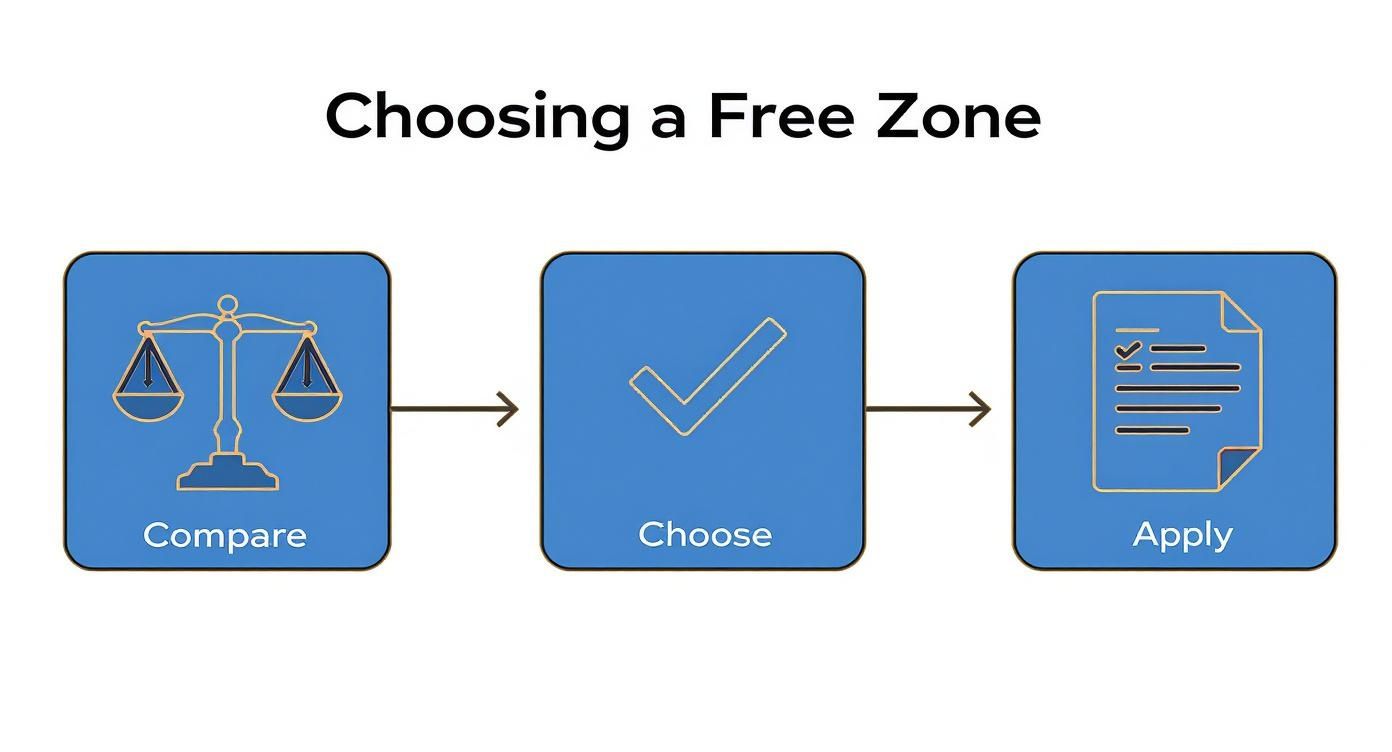
The process always starts with a careful comparison of free zones to ensure the one you choose aligns with your business activity and budget before applying.
Step 4: Completing Your Medical Test and Biometrics
You’re on the home stretch now. With your status officially changed, you have to complete two mandatory procedures here in the UAE: the medical fitness test and the biometrics appointment for your Emirates ID.
The medical test is a straightforward health screening for communicable diseases, carried out at a government-approved health centre. You’ll usually get the results back within 24-48 hours. Around the same time, you’ll visit a Federal Authority for Identity and Citizenship (ICA) centre to give your fingerprints and have your photo taken for your Emirates ID card.
Essential Document Checklist for Your Application
To give you a clearer picture, here’s a quick-glance table of the documents you’ll be handling throughout this process. Having these organised is the key to a smooth application.
| Document | Purpose | Key Notes |
|---|---|---|
| Passport Copy | Primary form of identification. | Must be high-resolution colour and valid for at least 6 months. |
| Passport Photo | For use on official documents like the permit and Emirates ID. | Must be recent and on a pure white background. |
| Current Visa Copy | Required if you are applying from within the UAE. | For tourists or residents. |
| CV / Portfolio | To prove your professional expertise in the chosen freelance activity. | Tailor it to highlight relevant skills and experience. |
| Attested Degree | Verifies your educational qualifications. | The attestation process can take time, so start early. Not always required. |
| Bank Reference Letter | Shows financial stability to the free zone authority. | A standard letter from your personal bank is usually sufficient. |
| Entry Permit | Allows you to proceed with the in-country residency steps. | Issued after your freelance permit is approved. |
| Medical Test Results | Confirms you are medically fit for residency. | A mandatory step for all residence visa applicants. |
Having these documents ready will make the entire process, from Step 1 to Step 5, much faster and less stressful.
Step 5: Receiving Your Residence Visa and Emirates ID
This is the final hurdle: the visa stamping. Your passport is submitted to the immigration authorities, and they will place the official residence visa sticker inside. This usually takes a few working days. Once you get your passport back with the fresh visa stamp, you are officially a UAE resident.
A short while later, your Emirates ID card will be printed and delivered to you, marking the end of your application journey. All in all, you can expect the entire process to take anywhere from two to four weeks, assuming all your paperwork is correct and there are no unexpected hold-ups.
A Realistic Breakdown of the Costs
Let’s talk money. Before you jump into the exciting world of freelancing in the UAE, you need a clear-eyed view of the investment involved. Knowing the real costs—from the initial setup to the yearly renewals—is the key to starting your journey on solid financial ground and avoiding nasty surprises later.
Think of the expenses in two main buckets: the one-time fees to get you started, and the recurring costs to keep your business running legally. The initial setup is the big one, covering everything from your freelance permit to your medical check and Emirates ID.
One-Time Setup Fees Explained
Your first major expense is the freelance permit itself, which usually starts around AED 7,500. But that’s not the whole story. When you add in the establishment card, visa stamping, medical test, and Emirates ID processing, the total initial investment typically lands somewhere between AED 15,000 and AED 25,000.
Why such a wide range? A few things come into play:
- Your Chosen Free Zone: A prestigious Dubai free zone will almost always cost more than one in, say, Sharjah or Ras Al Khaimah.
- Visa Duration: Some free zones offer two or three-year visa packages. The upfront cost is higher, but it can save you money and hassle in the long run.
- Your Location: Applying from inside the UAE (e.g., while on a tourist visa) often requires an extra “status change” fee, which you wouldn’t pay if applying from abroad.
Recurring Annual Renewal Costs
Once you’re up and running, you need to budget for annual renewals. This isn’t a one-and-done deal. The main recurring expense is your freelance permit renewal, which is a bit like renewing a trade licence. This fee keeps you legally compliant to work for another year.
Your residence visa and Emirates ID also need to be renewed, usually every one to two years, depending on your initial package. The good news is these renewal fees are much lower than the initial setup costs, but they are a crucial part of your annual business budget.
Think of these costs as an investment in your career. Partnering with a good business setup specialist ensures you’re not just paying fees, but getting real value and a package that actually fits what you need.
Remember to factor in your day-to-day operational costs, too. If you work with clients overseas, for example, you’ll need to find the cheapest way to call internationally to keep communication smooth without breaking the bank.
Hidden Costs to Keep in Mind
Beyond the big-ticket items, a few smaller costs can pop up. You’ll likely need to get your educational certificates officially attested, which can add a few hundred dirhams to the bill.
And don’t forget health insurance—it’s mandatory for getting a residence visa. The price of insurance plans can vary dramatically depending on the coverage you want, so it’s worth exploring your options to find a plan that meets the legal requirements without being excessively expensive.
Why Partner with 365 DAY PRO
Figuring out the UAE freelance visa process can feel like a maze. You have to pick the right jurisdiction, tackle stacks of paperwork, and keep track of strict deadlines. It’s an exciting move, for sure, but the red tape can be a real headache. This is exactly where bringing in a specialist can make all the difference, turning a complex process into a simple one.
You don’t have to go it alone. Think of 365 DAY PRO as your dedicated guide, here to walk you through every single step. We handle the heavy lifting so you can keep your focus where it belongs: on your work.
We Handle Everything from Start to Finish
Our team has years of hands-on experience setting up businesses in both Mainland and Freezone jurisdictions across Dubai, Abu Dhabi, and Sharjah. This means we can give you impartial, smart advice that’s built around your specific freelance career and what you want to achieve long-term. We don’t do cookie-cutter packages; we put together cost-effective solutions that fit your exact needs and budget.
Our goal is simple: to give you complete peace of mind. We take care of the complexities for you.
With 365 DAY PRO, you get a partner who is genuinely invested in your success. We’ll navigate the bureaucracy, speak with the government authorities on your behalf, and make sure every ‘i’ is dotted and ‘t’ is crossed. You can launch your freelance career in the UAE with total confidence.
From that first chat about your options all the way to getting that final visa stamped in your passport, we’re with you. Our support doesn’t stop once the paperwork is filed—we also make sure you’re set up to take full advantage of the significant UAE tax benefits for international entrepreneurs.
Real Support, Whenever You Need It
What really makes us different is our commitment to you. We know that questions pop up, especially when you’re making a big move to a new country. It’s natural to feel a bit uncertain.
That’s why we offer a 24/7 Support Service. Our team is always on standby to clear things up, answer your questions, and give you the help you need, right when you need it. We’re not just another service provider; we’re your trusted advisors here in the UAE.
Ready to make the move without the stress? Let’s get it done.
- 📞 Call Us Now: +971-52 923 1246
- 💬 WhatsApp Us Today: Get a Free Consultation
Let’s work together to turn your freelance dream into a thriving reality.
Frequently Asked Questions
Jumping into the world of freelancing in the UAE is exciting, but it’s natural to have a few questions pop up along the way. We get it. Here are some straightforward answers to the most common queries we hear from freelancers just like you, covering everything from bringing your family over to understanding your tax situation.
Can I Sponsor My Family on a Freelance Visa?
Yes, you absolutely can. This is one of the best perks of getting a UAE freelance visa. Once your own residence visa is stamped and you have your Emirates ID in hand, you can start the process of sponsoring your family. This includes your spouse, children, and in some cases, even your parents, as long as you meet the specific requirements.
The process usually involves proving you earn a certain minimum salary each month (the exact amount can vary by free zone) and providing official documents like an attested marriage certificate for your spouse and birth certificates for your kids. It’s a clear-cut procedure that lets you settle down in the UAE with your loved ones by your side.
Am I Required to Pay Income Tax as a Freelancer?
Here’s some great news: one of the biggest attractions for freelancers moving to the UAE is the tax-friendly environment. As an individual freelancer, you are not required to pay any personal income tax on your earnings. That means you keep 100% of the money you make.
But, you do need to be aware of Corporate Tax. If your freelance business turnover hits more than AED 375,000 in a year, you’ll need to register for it. This isn’t the same as personal income tax; it applies to your business earnings once you cross that specific threshold.
Do I Need Health Insurance?
Without a doubt. Having valid health insurance is mandatory for getting a residence visa in the UAE. You’ll need to show proof that you’re covered before the final visa can be stamped in your passport. This isn’t just for freelancers; it’s a rule for every resident.
Since you won’t have a company policy to fall back on, it’s up to you to arrange your own insurance. Your plan has to meet the minimum requirements set by the local health authority, like the Dubai Health Authority (DHA). Skipping this can lead to fines and will definitely cause problems when it’s time to renew your visa.
Getting a compliant health insurance plan isn’t just a box to tick—it’s a crucial step. It keeps you on the right side of the law and, more importantly, protects you from what can be very high medical bills in the UAE.
Can I Work with Clients on the UAE Mainland?
This is a really important question, and the short answer is: it depends on your permit. Typically, a freelance permit from a free zone gives you the green light to work with companies inside that same free zone and with clients anywhere outside the UAE.
Taking on projects directly for clients on the UAE mainland can sometimes be tricky. Many free zones, however, now offer special permits or dual licences to make this possible. Another route is to work with mainland businesses through a registered intermediary. To be absolutely sure, it’s always a good idea to chat with experts in Mainland Company Formation in Dubai & Abu Dhabi to understand exactly what your licence allows.
Figuring out the fine print of free zone rules, visa sponsorship, and tax laws can feel overwhelming. At 365 DAY PRO Corporate Service Provider LLC, we specialise in providing affordable business setup solutions that fit your specific freelance goals. With our hands-on expertise and 24/7 support, we’ll make your move into the UAE freelance scene as smooth as possible.
✅ Best Corporate Service Provider in Dubai, Abu Dhabi & Sharjah
✅ Specialists in Mainland Company Formation in Dubai & Abu Dhabi
✅ Specialists in Freezone Company Formation across the UAE
✅ 24/7 Support Service – Always here when you need us
✅ Cost-Effective Business Setup Solutions tailored to your needs
✅ Enjoy UAE Tax Benefits for International Entrepreneurs
📞 Call Us Now: +971-52 923 1246
💬 WhatsApp Us Today for a Free Consultation: Get a Free Consultation