
Setting up a business in Dubai mainland is a game-changing move. It’s your all-access pass to the entire UAE economy, letting you trade anywhere, open up shop on any street, and bid for those big-ticket government contracts. For any entrepreneur with serious ambitions in the region, this is the path that unlocks real, unfiltered growth.
As a leading Corporate Service Provider in Dubai, Abu Dhabi & Sharjah, we specialize in making this process seamless. We offer cost-effective business setup solutions tailored to your unique needs, ensuring you can fully enjoy the UAE’s significant tax benefits for international entrepreneurs.
Why a Dubai Mainland Setup is Your Gateway to the UAE Market
Choosing a mainland company isn’t just about ticking a legal box; it’s a core part of your business strategy. This setup is built for entrepreneurs who want to dive deep into the local market. Unlike a free zone company, a mainland licence tears down the geographical walls, letting you connect directly with a massive and wealthy customer base right across the UAE.
Of course, getting your business off the ground requires capital. It’s a smart move to start exploring startup funding options early on. A solid financial plan is just as crucial as your business licence when you’re launching into a competitive arena like Dubai.
Comparing Your Options: Mainland vs. Free Zone
Before diving in, it’s helpful to see how these two popular setups stack up against each other. Each has its own strengths, but the right choice really depends on your specific business goals.
Dubai Mainland vs Free Zone At a Glance
| Feature | Dubai Mainland Company | Dubai Free Zone Company |
|---|---|---|
| Trading Area | Unrestricted trade across the entire UAE. | Generally restricted to the specific free zone and international markets. |
| Office Location | Can rent or own an office anywhere in the mainland. | Must have a physical or virtual office within the designated free zone. |
| Government Contracts | Eligible to bid directly on lucrative government tenders. | Usually not eligible to bid on government projects. |
| Business Activities | Access to a vast list of over 2,000 commercial activities. | Limited to activities permitted by the specific free zone authority. |
| Ownership | 100% foreign ownership is now possible for most activities. | 100% foreign ownership has always been a key feature. |
This table gives you a quick snapshot, but the freedom to operate anywhere and engage directly with the local market is often the deciding factor for entrepreneurs choosing the mainland route.
The Real Advantage of Mainland Operations
The biggest draw for a mainland company is its total operational freedom. This is the ideal structure if you plan to open a physical location like a retail shop, a café, or a service centre anywhere in Dubai or the other six emirates. It also puts you in the running for high-value government tenders—a massive market segment that free zone companies often can’t access.
This competitive edge is why so many entrepreneurs go for it. In fact, mainland businesses consistently make up about 60% of all new company setups in Dubai, especially in booming sectors like retail, construction, and tech.
What’s in It for International Entrepreneurs?
A mainland setup offers some powerful perks specifically designed for global business ambitions. The entire structure is geared towards long-term stability and growth in the region.
Here are the key benefits:
- Total Market Access: You can operate freely across all seven emirates, from the bustling streets of Dubai and Abu Dhabi to the growing markets in Sharjah and beyond.
- Huge Range of Activities: Pick from thousands of approved business activities, giving you the flexibility to adapt and expand as your business evolves.
- Bid on Government Projects: Get your foot in the door to secure profitable contracts from various UAE government bodies.
- Benefit from the UAE Tax System: Take full advantage of the UAE’s incredibly favourable tax environment, a major plus for maximising your profits.
A mainland licence is more than just paperwork. It’s a clear signal that you’re serious about embedding your business in the UAE’s economy and building real, lasting relationships with customers and partners across the country.
Getting through this process smoothly requires a bit of know-how. Partnering with a specialist in Mainland Company Formation in Dubai & Abu Dhabi is a smart, cost-effective way to get it done right. Their expertise ensures everything from licensing to visas is handled correctly, so you can keep your focus where it belongs: on launching your business.
Taking Advantage of 100 Percent Foreign Ownership
Not long ago, setting up a business in Dubai mainland came with a significant string attached: you needed a local Emirati sponsor who would hold a 51% majority share in your company. For many international entrepreneurs, this was the biggest hurdle, a deal-breaker even, as it meant giving up ultimate control over their own venture.
Then everything changed.
In a move that truly signaled Dubai’s ambition to be the world’s top business destination, the government did away with this requirement for most business activities. This wasn’t just a minor legal tweak; it was a fundamental shift that put foreign investors firmly in the driver’s seat. It brought the mainland framework in line with global standards, offering the kind of autonomy and security that serious investors demand.
Finally, Full Control and Operational Freedom
The most powerful outcome of this reform is simple: you, the foreign investor, get complete control. Without a majority shareholder, the ship is yours to steer. Every single decision—from day-to-day operations and hiring to long-term strategy and even how you exit the business—is yours alone.
This freedom has a real, practical impact on how you run your company:
- Faster, Sharper Decisions: You can react to market opportunities or challenges instantly. There’s no need to consult or get approval from a majority partner, which means no more delays.
- Keep What You Earn: While the UAE has always been friendly to profit repatriation, 100% ownership makes it crystal clear. Every dirham of profit your business generates is yours to manage, reinvest, or send home.
- Your IP Stays Yours: If you’re in tech, creative services, or any field where intellectual property is your main asset, this is huge. Full ownership means your patents, trademarks, and trade secrets are locked down tight within your own company.
This isn’t just about what’s on paper. It’s about giving international entrepreneurs the confidence to build their business in Dubai on their own terms, without having to compromise on control.
What Kind of Businesses Can Be 100% Foreign-Owned?
The scope of this reform is massive. The government has greenlit over 1,000 commercial and industrial activities for full foreign ownership, making it relevant for a huge range of business ideas.
Let’s look at a few real-world examples:
- A Software Development Agency: You can set up your tech firm on the mainland, own all the code and IP you create, and directly bid for lucrative contracts with UAE clients, including government departments.
- An E-commerce and Trading Business: You can import goods, manage your own warehousing and logistics, open retail shops anywhere in Dubai, and keep all the profits from your sales without a local partner.
- A Marketing Consultancy: You can launch your agency with total freedom, building your brand and serving clients without a silent partner influencing your business strategy or taking a cut.
This policy shift has had a dramatic effect. As part of its push to enhance global competitiveness, the UAE’s updated company laws ignited a surge in new businesses. By 2025, more than 1,500 new companies had been set up under this new ownership structure. The fact that the average setup time was just 7–10 working days shows just how much demand there is and how efficient the government has become in supporting it. You can explore more insights on how Dubai is attracting global investors on kgrnaudit.com.
The Old Sponsorship Model is Fading Away
For most new businesses, the move to 100% foreign ownership means the traditional sponsorship model is effectively a thing of the past. For entrepreneurs, this is a breath of fresh air. No more paying hefty annual fees to a sponsor who, in many cases, had zero involvement in the actual business. It’s a straight-line saving that cuts down your yearly operational costs and removes a layer of administrative hassle.
Now, it’s important to know that a few strategic sectors, especially those vital to the national interest, might still have specific ownership rules. Also, professional service licences—think medical clinics, law firms, or engineering consultancies—still require a Local Service Agent (LSA).
But an LSA is a world away from a sponsor. They hold zero shares, have no say in your management, and don’t touch your profits. You simply pay them a fixed annual fee for their role in ticking a regulatory box.
This entire evolution speaks to Dubai’s forward-thinking vision. By removing old barriers and offering practical, cost-effective solutions, the emirate has created an incredibly fertile ground for global talent, making a business setup in Dubai mainland one of the most attractive propositions for ambitious founders today.
The Mainland Company Formation Playbook
Navigating the actual process for a business setup in Dubai mainland is less about ticking boxes and more about making a series of smart, strategic decisions. It’s a journey that begins long before you submit your first document. Let’s walk through the key milestones, focusing on the practical actions that turn your business idea into a licensed, operational reality.
The first crucial step is defining exactly what your business will do. This isn’t just for your business plan; it dictates your legal structure and the specific license you’ll need. The Department of Economy and Tourism (DET) has a list of over 2,000 approved activities, so getting this right is non-negotiable.
Are you a consultancy? That points towards a professional license. Planning to sell goods? That’s a commercial license. Nailing this from the start prevents costly changes and headaches later on. For instance, selecting “IT Consultancy” versus “Web Design” can have different legal implications and even ownership rules, so clarity is everything.
Choosing Your Legal Structure
Once your activity is locked in, you need to decide on the legal form of your company. For most international entrepreneurs I work with, the choice usually boils down to two main options.
- Limited Liability Company (LLC): This is by far the most common and versatile structure. An LLC creates a separate legal entity, which is fantastic because it shields your personal assets from any business liabilities. It’s the go-to for trading, manufacturing, and most service-based businesses.
- Sole Establishment (or Proprietorship): This structure is typically for professionals offering services, like freelance consultants or designers. It’s owned by a single individual and doesn’t have a separate legal standing from its owner. The big catch here is that your personal assets are not protected from business debts.
The recent shift allowing 100% foreign ownership for many activities has made the LLC even more attractive. You get the robust liability protection of a corporation with the full control you’d expect as a sole owner—truly the best of both worlds.
This infographic really drives home the transformative shift from the old sponsorship model to today’s full foreign ownership, highlighting the massive benefits for entrepreneurs.
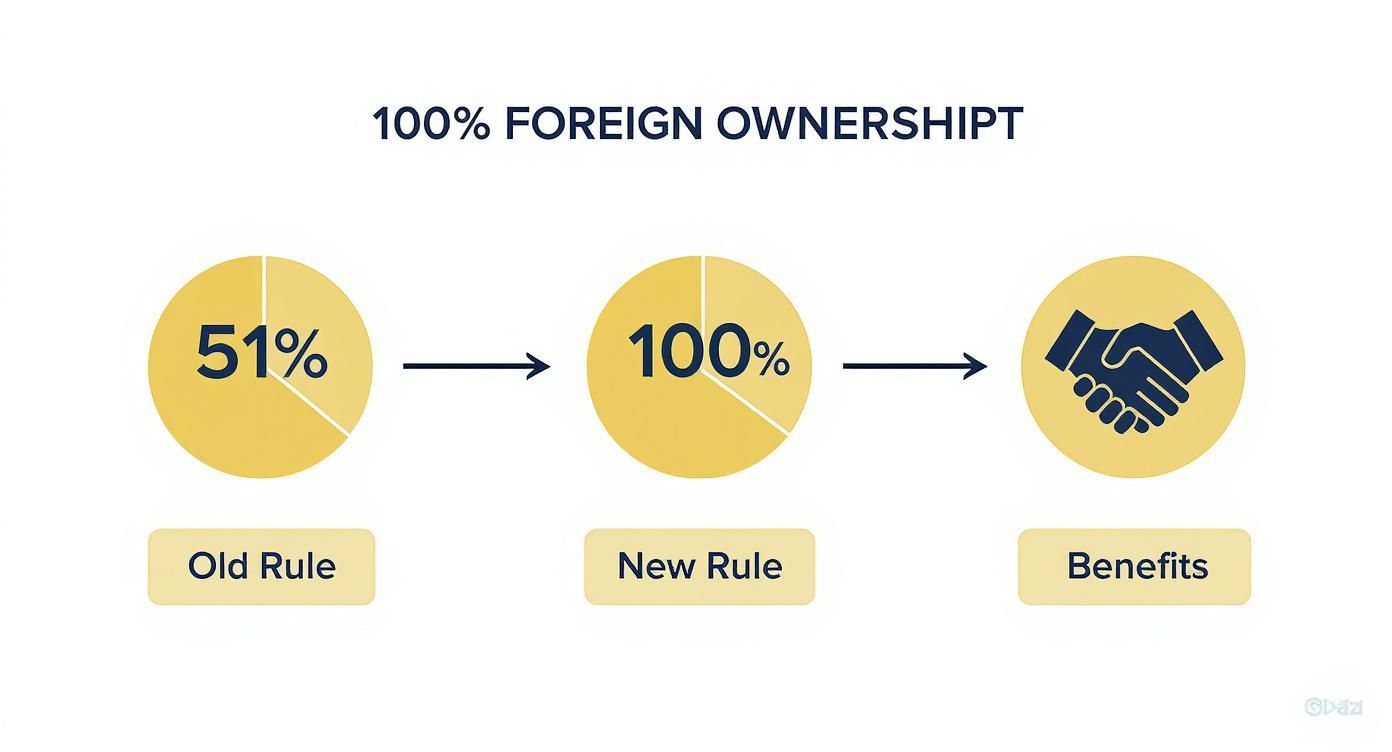
As you can see, the new regulations have completely empowered international investors, giving them the control and security over their mainland ventures that just wasn’t possible before.
Securing Your Identity and Initial Approval
With your activity and legal form decided, it’s time to give your company a name and get the initial green light from the authorities. This is where things start getting formal.
First up, you’ll reserve a trade name. This name must be unique and follow specific UAE naming conventions—that means no religious references or names of existing organisations. You can submit up to three options online, and approval usually comes through within a day. A common mistake I see is people choosing a name that’s too generic or already in use, which just causes unnecessary delays.
Next comes the Initial Approval. Think of this as a no-objection certificate from the DET saying they’re fine with you establishing your business. It confirms your proposed business activity and name are compliant, and you’ll need this piece of paper before you can move forward with things like signing an office lease. This approval is typically valid for six months, giving you plenty of time to sort out the next steps.
The Initial Approval is the foundational permit for your entire setup. Without it, you can’t draft your legal documents or secure an office, effectively putting your progress on hold. It’s the official starting gun for your company formation.
Drafting Legal Documents and Finding a Home
This phase is all about creating your company’s constitutional document and securing its physical address. Both are critical.
The Memorandum of Association (MOA) is the legal backbone of your company, especially for an LLC. This document outlines everything from the company’s purpose and shareholding structure to management responsibilities and profit distribution. Even with 100% foreign ownership, a meticulously drafted MOA is absolutely essential. It has to be written in both English and Arabic and then notarised before a public notary.
While that’s happening, you also need to secure a physical office space. A mainland company requires a real, tangible address with a tenancy contract registered with Ejari, Dubai’s online portal for lease registration. This is a non-negotiable requirement; a virtual office simply won’t cut it for a business setup in Dubai mainland.
Many startups and SMEs find a smart workaround by opting for a cost-effective desk or small office within a registered business centre. This satisfies the legal requirement without the massive overhead of a standalone office lease. The Ejari certificate you receive is a critical piece of the puzzle for your final license application.
The Final Submission and Key Registrations
You’re now at the finish line. With your Initial Approval, notarised MOA, and Ejari contract in hand, you’re ready to submit your final application to the DET for your trade license. This is the moment where all your paperwork comes together for the final review.
Once the DET approves your application and you pay the fees, your trade license is issued. That’s it—your company officially exists and is legally permitted to operate in Dubai.
But the journey doesn’t quite end there. As soon as you have that license, you must immediately register with two key government bodies:
- Ministry of Human Resources and Emiratisation (MOHRE): This registration is essential for hiring any employees and processing their visas and labour contracts.
- General Directorate of Residency and Foreigners Affairs (GDRFA): This registration allows your company to apply for visas—first for yourself as an investor, and then for any staff you bring on.
Managing all these steps, from choosing the right activity to getting those final registrations done, demands serious attention to detail. This is where partnering with a corporate service provider can be invaluable, ensuring each stage is completed accurately and on time. It frees you up to focus on your actual business goals, confident that the administrative foundation of your company is rock solid.
With your trade licence in hand, your company is officially a legal entity. But let’s be honest, it’s just a piece of paper until you can actually live and work here. The next big move is getting residency visas, which is what truly turns your registered business into an operational one. This is the process that allows you and your team to call the UAE home, and it all kicks off by registering your new company with the immigration authorities.
The very first document you’ll need to get this rolling is the company Establishment Card. Think of it as your company’s official file with the immigration department, linking your business to the General Directorate of Residency and Foreigners Affairs (GDRFA). It’s issued by the Ministry of Human Resources and Emiratisation (MOHRE), and you can’t do anything visa-related without it. No Establishment Card means no hiring staff, and you can’t even get your own investor visa.
Investor Visas vs. Employment Visas
It’s important to understand the two main types of visas you’ll be dealing with. While they both grant residency, they’re designed for different people within your company structure.
- Investor Visa (or Partner Visa): This one’s for you, the owner. It’s tied directly to your shares in the company and usually comes with a longer validity, often two years or more. It solidifies your status as an investor contributing to the local economy and is always the first visa you should secure for the business.
- Employment Visa: This is for everyone else you hire, from your general manager right down to your junior staff. The visa validity is linked to their employment contract, which is typically for two years. Sponsoring employees is a fantastic sign of growth and shows you’re creating jobs.
And businesses are definitely creating jobs. The Dubai Department of Economy and Tourism (DET) recently highlighted that mainland companies processed over 85,000 new employment visas—a testament to the bustling activity in this sector. You can dig into more of Dubai’s economic indicators on rascorporateadvisors.com to see the full picture.
From Entry Permit to Emirates ID
Once you have your Establishment Card, the path to residency is pretty well-defined. It’s a multi-stage journey where attention to detail is everything.
- Get the Entry Permit: First, you apply for a temporary visa that allows you or your employee to be in the UAE legally while the rest of the process unfolds. If the person is already in the country on a tourist visa, you’ll do what’s called a “change status” application instead.
- Complete the Medical Fitness Test: This is a mandatory health screening for all residency applicants. It’s a standard procedure to check for specific communicable diseases, ensuring public health and safety.
- Biometrics for Emirates ID: After a successful medical test, the applicant heads to an Emirates ID service centre. Here, they’ll provide their fingerprints and have a photo taken, which is essential for issuing the national ID card.
- Stamp the Visa: The final step! You submit the passport to immigration, and they affix the official residency visa sticker inside. Once that stamp is in, the residency is official.
Your Emirates ID will quickly become the most important card in your wallet. It’s your official proof of identity and you’ll need it for practically everything: opening a bank account, renting an apartment, and even setting up your home internet.
Bringing Your Family Over
One of the best perks of getting your own residency visa is the ability to sponsor your immediate family, like your spouse and children. The process is quite straightforward. As soon as your own visa is stamped and you have your Emirates ID, you can start their applications.
You’ll need to show attested documents, such as your marriage and birth certificates, along with proof you have a place to live (your registered tenancy contract, or Ejari) and meet a minimum salary requirement. This just gives the authorities confidence that you can comfortably support your family in Dubai.
Let’s be realistic—navigating all these applications, document requirements, and government touchpoints can be a real headache. It’s time-consuming and frankly, a distraction from running your business. This is where having professional PRO services in your corner becomes invaluable. A good team can handle the entire visa process for you, offering 24/7 support and ensuring every form is filled out perfectly, saving you from costly delays and letting you focus on what really matters: getting your new venture off the ground.
Getting a Handle on Costs and Compliance
Getting your trade license is a huge milestone, but it’s really just the beginning. The real test of a successful launch is having a solid grip on your finances and legal obligations right from the start. To build a stable business, you need to understand the full picture of what it costs to set up and run a business in Dubai mainland. Let’s walk through what you can expect to pay, both upfront and down the line.
Your Initial Setup Investment
First things first, let’s talk about the one-time government fees. Think of these as the essential costs to get your company legally on the map.
Your main upfront expenses are all tied to the licensing process itself. These are pretty standard, and any good consultant can give you a clear breakdown.
- Trade Name Reservation: A small fee to make sure your business name is unique and secured.
- Initial Approval Certificate: This is what you pay for the DED’s green light, a critical step that allows you to move forward.
- Trade License Issuance Fee: This is the big one. It’s the main government fee for your license, and the cost will depend on your specific business activity.
- Memorandum of Association (MOA) Notarisation: You’ll need to pay to have your company’s key founding document legally attested.
Getting these figures nailed down early on helps you build a realistic budget and avoids any nasty surprises just when you’re trying to get things moving.
Recurring Expenses and Annual Commitments
Once you’re up and running, your focus shifts to the ongoing costs needed to keep your business in good standing. These are the expenses that will be part of your annual budget.
The biggest recurring cost is almost always the annual trade license renewal. This is a non-negotiable fee you pay to the DED to keep your business active. Right alongside that is your office rent. For a mainland company, a physical office with a registered Ejari is a must, making this a fixed cost you’ll need to account for.
Don’t forget about visas for yourself and any staff. These come with application fees and mandatory health insurance premiums that renew every two to three years, depending on the visa’s term.
Budgeting for recurring costs is just as critical as planning for your initial setup fees. These expenses are what keep your company compliant and operational year after year.
Navigating the UAE’s Corporate Tax Framework
Staying compliant is about more than just renewing your license. As of June 2023, the UAE rolled out a federal Corporate Tax. While the 9% rate is incredibly competitive, it only kicks in for businesses with taxable profits over AED 375,000.
This is great news for many startups and SMEs who might not hit that threshold early on. However, registration with the Federal Tax Authority (FTA) is mandatory for all businesses, regardless of profit. This means proper bookkeeping is no longer just good practice—it’s the law. You’ll need to maintain accurate accounting records and be prepared to file an annual corporate tax return.
Essential Compliance You Cannot Ignore
Running a mainland business in Dubai means playing by the rules. The regulations here are designed to create a transparent and fair business environment. Two of the most important ones you need to know are UBO and ESR.
- Ultimate Beneficial Owner (UBO): You are legally required to keep a register of who ultimately owns or controls your company. This isn’t just internal paperwork; you have to submit this information to the authorities to ensure transparency.
- Economic Substance Regulations (ESR): If your business is involved in certain activities like banking, insurance, or investment management, you have to prove you have a real economic presence in the UAE. This usually involves filing an annual ESR notification and, if required, a more detailed report.
Getting this wrong can lead to hefty fines, so it’s something you absolutely need to get right from day one.
International entrepreneurs will find the financial environment here very welcoming. Mainland companies enjoy 100% repatriation of capital and profits, and with the new tax law, many effectively operate with a 0% corporate tax bill for now. Plus, there’s no mandatory minimum capital for most business activities, which really lowers the barrier to entry.
To thrive, you need to manage your money wisely. You can find some practical tips to improve business cash flow that can help you maintain financial health from the get-go. Working with a specialist who understands the landscape can ensure you not only launch smoothly but also stay on the right side of the law, freeing you up to focus on what you do best: growing your business.
Got Questions About Your Dubai Mainland Business? Let’s Get Them Answered
Setting up a business anywhere in the world comes with its fair share of questions, and Dubai is no different. Even with the clearest plan, you’ll run into little details that need clarification. This section is designed to tackle the most common queries I hear from entrepreneurs, giving you the practical, straightforward answers you need to keep moving forward.
It’s no surprise that questions are popping up more frequently. We’re seeing a huge influx of global entrepreneurs, with Dubai mainland company registrations jumping by 23% year-on-year. This boom is happening because old hurdles, like the requirement for a local sponsor, have been cleared away, cementing Dubai’s reputation as a top spot for international business. You can get a deeper look into this growth and understand why Dubai is a premier business hub on kgrnaudit.com.
Do I Still Need a Local Sponsor for My Mainland Company?
This is easily the most common question, and the answer is a game-changer: for most businesses, no.
The old rule requiring a local Emirati partner to hold 51% of your company’s shares is a thing of the past for most commercial and industrial activities. Recent reforms have opened the doors wide, allowing 100% foreign ownership for over 1,000 different business activities.
However, there’s a key distinction to make. If your business falls under a professional services licence—think consultancies, law firms, or auditing services—you’ll need what’s called a Local Service Agent (LSA).
An LSA is not a sponsor, and the difference is huge:
- No Shares: They have absolutely zero equity in your company.
- No Control: They have no input on your daily operations or big-picture decisions.
- Fixed Fee: You pay them a set annual fee for their services, which has no connection to your profits.
Think of them as a regulatory liaison. Their role is to satisfy a legal requirement without interfering with your autonomy. A few strategic sectors might still have local partner requirements, so it’s always a good idea to confirm with a setup specialist first.
What’s the Minimum Office Space I Need for a Mainland Company?
While the government has relaxed the old, rigid rules that tied your visa quota directly to your office’s square footage, a physical office address is still a must-have. You can’t get a mainland licence without it.
The Department of Economy and Tourism (DET) requires a registered physical address with a valid tenancy contract, known as an Ejari, to prove your business has a real presence in Dubai. Virtual offices just won’t cut it for a mainland setup. For most startups and smaller operations, a dedicated desk or a small private office in an approved business centre is a fantastic, cost-effective way to tick this box.
Your Ejari-registered tenancy contract is the one thing you can’t work around for a mainland trade licence. It’s the official proof of your physical address and the foundation of your application. Without it, you’re stopped in your tracks.
How Long Does the Whole Mainland Setup Process Take?
Everyone wants to know how quickly they can get up and running. While the timeline can shift depending on your specific business activity and how organised your paperwork is, a realistic timeframe is anywhere from one to four weeks.
The initial steps, like getting your trade name and Initial Approval, are usually quite fast—often sorted in just a few days. It’s the next phase, like finding the right office and getting your Memorandum of Association notarised, that can take a week or more.
Once all your documents are submitted correctly, the final trade licence is typically issued within a few working days. After that, you’ll move on to visa processing for yourself and any employees, which usually adds another two to three weeks to the clock.
Figuring out the ins and outs of your business setup in Dubai mainland doesn’t have to be a solo mission. The experts at 365 DAY PRO Corporate Service Provider LLC provide personalised, affordable solutions to manage every step, from licences and visas to making sure you stay compliant. With our 24/7 support, we are always here when you need us, so you can stay focused on your business launch while we handle the heavy lifting.
📞 Call Us Now: +971-52 923 1246
💬 WhatsApp Us Today for a Free Consultation
Start your UAE journey with confidence by visiting 365dayproservices.com today.