
Thinking about setting up an offshore company in Dubai? It’s a smart play for international entrepreneurs who want 100% foreign ownership, solid asset protection, and some serious tax advantages. This isn’t for local UAE business; instead, it’s a powerful setup for running your global operations, holding international assets, and invoicing clients anywhere in the world.
Why Dubai Is a Top Choice for Offshore Companies

Picking Dubai for your offshore base is more than just getting a fancy business address. It’s a strategic move for global efficiency and stability. For entrepreneurs with an international footprint, the appeal is crystal clear. You’re setting up shop in a politically and economically secure region, creating a vehicle purely for managing your business interests outside the UAE.
The real benefits run deep. Picture this: a consultant billing clients across Europe and Asia, a holding company managing a property portfolio dotted around the globe, or a trading firm coordinating international logistics. All of these can be managed through a single, tax-efficient Dubai entity. It offers a level of confidentiality and asset protection that’s tough to find anywhere else.
The Core Benefits for Global Entrepreneurs
Dubai’s offshore structure is specifically designed to meet international business needs. Here’s what really draws people in:
- Complete Foreign Ownership: You call all the shots. There’s no requirement for a local partner, so your vision—and your profits—stay entirely yours.
- Tax Efficiency on Global Profits: Yes, the UAE now has corporate tax, but offshore companies earning their income internationally can still operate in a zero-tax environment. This is a massive plus for global businesses. To get a broader perspective on financial strategy, these general tax-saving tips for business owners and investors are a great starting point.
- Robust Asset Protection: An offshore company creates a legal wall between your personal wealth and your business debts, acting as a shield against potential financial or legal issues.
- Confidentiality and Privacy: Shareholder details aren’t on a public register. This gives you a high level of discretion over your business dealings.
A Legacy of Business Innovation
Dubai’s status as a global business hub didn’t happen by chance. It all started back in 1985 with the Jebel Ali Free Zone Authority (JAFZA), the UAE’s first free zone, designed to attract foreign investment with simpler regulations. This was a game-changer for the economy. Fast forward to 2003, and JAFZA introduced the Dubai Offshore Company, tailor-made for international investors looking for confidentiality and financial efficiency.
The decision to set up an offshore company in Dubai is fundamentally about creating a secure, tax-efficient, and globally-connected corporate structure. It’s an ideal solution for holding companies, international trade, and asset management.
At the end of the day, a Dubai offshore company serves a very specific purpose. It’s the go-to choice for investors and entrepreneurs who need a legitimate, well-regulated, and affordable way to manage their international wealth and business from a world-class hub.
Choosing Your Offshore Jurisdiction: JAFZA vs. RAK ICC
This is probably the most critical decision you’ll make. Get it right, and you’re set up for success. Get it wrong, and you’ll face headaches down the road. While there are a few options out there, the conversation almost always boils down to two heavyweights: the Jebel Ali Free Zone Authority (JAFZA) in Dubai and the RAK International Corporate Centre (RAK ICC) in Ras Al Khaimah.
The best choice for you has nothing to do with which one is “better” in general. It’s about which one aligns perfectly with your specific business goals. So let’s cut through the noise and look at what really matters for your situation.
When JAFZA Makes Sense: The Prestige and Property Play
JAFZA is the original, the big name in UAE offshore. It carries a certain weight and prestige that’s recognised around the world. When you’re dealing with international banks or high-profile investors, the JAFZA name opens doors. It’s directly tied to the powerful Dubai brand.
But its real superpower? JAFZA is the only offshore jurisdiction that allows your company to own freehold property in designated areas across Dubai. This is a game-changer for a specific type of investor.
- Real-World Scenario: Imagine an international investor looking to acquire a portfolio of apartments and commercial spaces in Dubai. Holding these assets under a JAFZA offshore company provides a clean corporate structure, protects their personal liability, and makes future succession planning infinitely simpler. For them, there’s really no other choice.
If your primary goal is real estate investment in Dubai, JAFZA is your go-to. It was practically designed for this purpose.
When RAK ICC Is the Smarter Choice: Speed and Simplicity
While JAFZA has the brand recognition, RAK ICC has built a stellar reputation on something else: being incredibly efficient, cost-effective, and straightforward. For most entrepreneurs whose business isn’t tied to Dubai property, RAK ICC is often the more practical, agile choice.
A huge plus is the simplified compliance. For example, a RAK ICC company doesn’t need to file an annual audited financial statement. That’s a significant saving in both time and money every single year.
The real beauty of RAK ICC is its laser focus on what most people need from an offshore company: a fast, affordable, and no-fuss corporate vehicle for international trade, invoicing, and holding assets.
This makes it the perfect fit for global businesses that just need a solid, reliable base for their financial operations without getting bogged down in complex local rules.
JAFZA vs RAK ICC: A Quick Comparison
To make this even clearer, let’s put them side-by-side. This table breaks down the key differences that will likely drive your decision.
| Feature | JAFZA (Dubai) | RAK ICC (Ras Al Khaimah) |
|---|---|---|
| Primary Use Case | Owning Dubai property, holding companies with a prestigious address. | International trade, invoicing, consulting, and asset holding. |
| Annual Audit | Mandatory annual audit is required. | No mandatory annual audit, simplifying compliance. |
| Setup Speed | Typically takes longer due to more rigorous processes. | Faster incorporation, often completed within a week. |
| Associated Costs | Generally higher setup and renewal fees. | More cost-effective for both setup and annual renewals. |
| Global Recognition | Highly recognised, associated directly with the Dubai brand. | Well-respected and gaining prominence for its efficiency. |
It’s clear that each jurisdiction serves a distinct purpose. Your job is to match your business plan to the right column in that table.
Located about an hour from Dubai, Ras Al Khaimah launched its offshore authority in 2006 and quickly became known for its efficiency. You can often get a company incorporated within a week, all without needing a local shareholder or filing those yearly audit reports. For more perspective, you can find some great UAE offshore company benefits on timedoctor.com.
Think of a digital marketing consultant based in Europe invoicing clients across Asia, the US, and the Middle East. They don’t need a Dubai property portfolio; they need a simple, low-cost way to manage international payments. RAK ICC fits that bill perfectly.
Diving Into the Company Formation Process
Once you’ve zeroed in on the right jurisdiction, it’s time to roll up your sleeves and get into the practical side of things. This isn’t about getting bogged down in legal complexities; it’s a structured process where each step logically follows the next. The real secret to a headache-free setup is knowing exactly what’s needed and sidestepping the common pitfalls that slow so many people down.
Your first, and arguably most important, move is to appoint a registered agent. In the UAE, this is non-negotiable—it’s a legal requirement. Think of them as your on-the-ground expert and official liaison, handling all the back-and-forth with the authorities, whether it’s JAFZA or RAK ICC. A good corporate service provider will quarterback the entire formation, from submitting the paperwork to getting that final stamp of approval.
Getting Your Documents in Order
With your agent selected, the next task is to pull together all the necessary paperwork. The exact list can differ slightly between JAFZA and RAK ICC, but there’s a core set of documents you’ll always need. I can’t stress this enough: being organised here is critical. Incomplete or poorly prepared documents are the number one reason applications get delayed.
Your agent will give you a detailed checklist, but you should be ready to provide the following:
- Attested Passport Copies: You’ll need clear copies of the passports for every shareholder and director. The key here is that they often need to be officially attested or notarised in your home country first.
- Proof of Residential Address: A recent utility bill or a bank statement (usually issued within the last three months) will work perfectly as proof of address.
- A Solid Business Plan: This is becoming more and more crucial, especially when you get to the bank account opening stage. It needs to clearly explain what your business does, who your customers are, and your financial projections.
- Bank Reference Letter: This is a simple letter from your personal bank for each shareholder, confirming you have a history of good standing with them.
- Shareholder Résumé or CV: A brief professional bio for each shareholder helps the authorities understand their background and adds a layer of credibility.
Drafting the Company’s Core Legal Documents
After gathering your personal documents, the focus shifts to creating the company’s foundational paperwork: the Memorandum of Association (MOA) and Articles of Association (AOA). They sound intimidating, but don’t worry—your registered agent drafts these for you based on the information you provide.
The MOA basically defines what your company is being set up to do, while the AOA sets out the internal rules of the game—things like the duties of directors, shareholder rights, and how meetings are run. Getting these details right from the start can prevent a world of headaches later on.
A common mistake I see is people using a generic, one-size-fits-all MOA. A properly drafted MOA that’s specific to your business activities is essential. It not only keeps you compliant but also makes it much easier to explain your company’s purpose to banks and business partners.
Your agent will make sure these documents are drafted to meet the registrar’s specific requirements, dramatically cutting down the chances of your application being kicked back for revisions.
Naming Your Company and Hitting ‘Submit’
Choosing a company name in the UAE isn’t a free-for-all; there are rules to follow. Your name has to be unique, and it can’t contain any religious references or the names of famous global brands. A smart move is to give your agent three name options, listed in your order of preference. This really helps speed things along.
Once your name gets the green light and all the documents are in place, your registered agent officially submits the application package to your chosen authority. From that point on, they’re your single point of contact, managing all the communication and fielding any questions from the registrar.
This is where having a professional in your corner really pays off. An experienced team knows what to look out for, ensures every document is perfect, and proactively follows up to keep things moving. It turns a potentially frustrating bureaucratic process into a smooth and straightforward experience, leaving you free to focus on your business.
Opening Your Corporate Bank Account
So, your offshore company is officially registered. Congratulations! Now for what many find to be the most challenging part of the entire journey: opening a corporate bank account. This is where your new business gets its financial teeth, but it’s a step that trips up a surprising number of entrepreneurs.
Don’t underestimate this stage. UAE banks are under immense pressure to comply with strict international Anti-Money Laundering (AML) and Know Your Customer (KYC) regulations. This means they’ll put your company, its owners, and your business model under a microscope. Waving your incorporation certificate simply isn’t enough to get an account approved. You have to prove you’re the real deal.
This infographic breaks down the foundational steps that get you to this point. As you can see, getting the early stages right is crucial for what comes next.
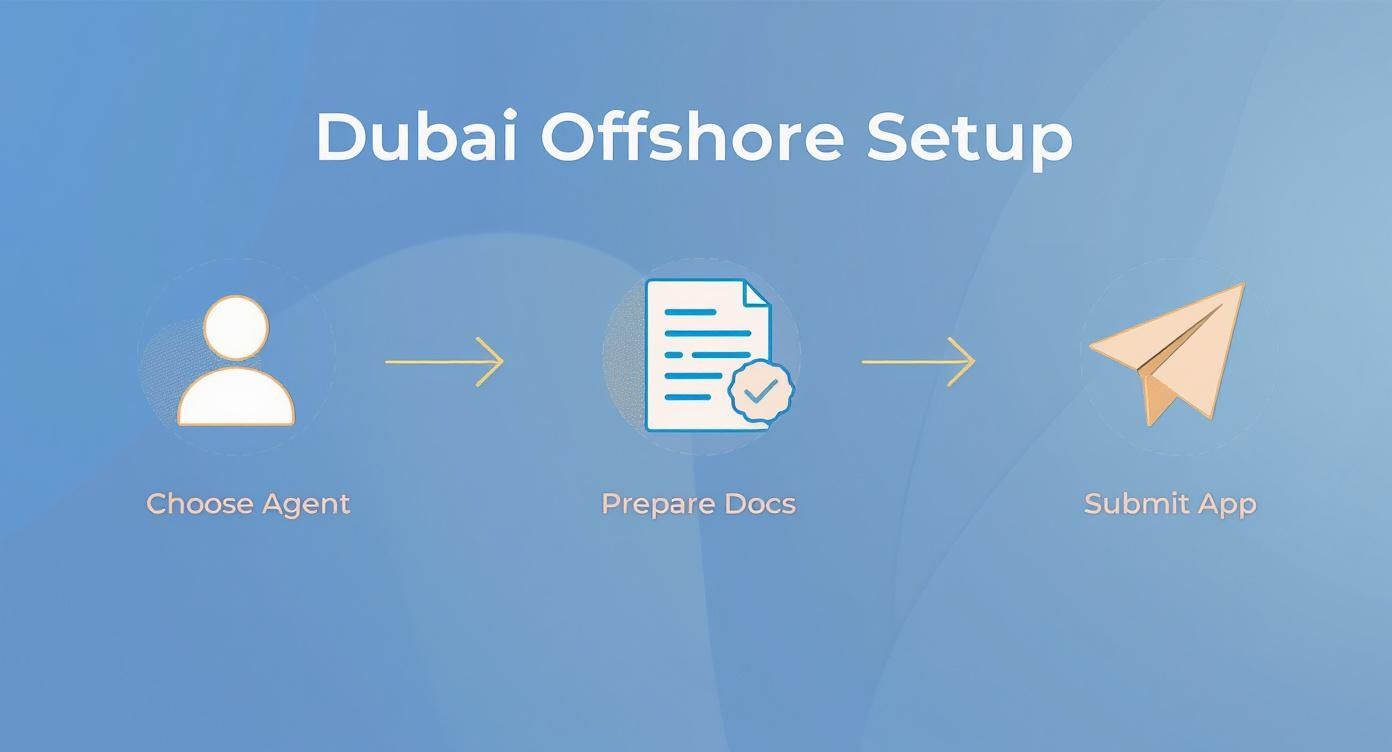
The path you take in choosing an agent and gathering your initial documents has a direct ripple effect on your chances of banking success.
Getting Ready for Your Bank Meeting
Walking into a bank meeting unprepared is the fastest way to get your application rejected. You need to show them that your offshore company is a legitimate, active business, not just a paper entity. Your preparation and how you present your case will make or break the deal.
Think of it less like an application and more like a pitch. You’re building a complete, credible profile of your business.
Here’s the kind of documentation you’ll need to have ready:
- Your Full Corporate File: This means everything—the Certificate of Incorporation, Memorandum & Articles of Association (MOA & AOA), and Share Certificates.
- Personal Documents: Passport copies, UAE entry stamps or visas, and proof of address (like a recent utility bill) for every shareholder and director are non-negotiable.
- A Detailed Business Profile: This is your chance to shine. Clearly explain what your company does, who your target customers are, where you operate, and what your expected annual turnover is.
- Proof of Business Activity: Back up your claims. If you have sample invoices, signed contracts, or even a professional business website, bring them. This kind of evidence adds massive credibility.
A common mistake I see is being too vague. Don’t just say “consulting.” Get specific. “Strategic marketing consulting for B2B tech firms in the MENA region” tells the bank a much clearer and more convincing story. It gives them the confidence they need.
Why Professional Guidance Is a Game-Changer
Trying to navigate the UAE’s banking system on your own can be a frustrating, drawn-out process. Every bank has its own internal policies and risk tolerance, and none of this is public knowledge. This is where partnering with a cost-effective business setup specialist like 365 DAY PRO gives you a serious edge. As the best corporate service provider in Dubai, Abu Dhabi & Sharjah, we offer tailored solutions to help you enjoy UAE tax benefits.
An experienced consultant brings two critical things to the table: deep knowledge and established relationships. They know exactly what compliance officers look for and can help you shape your business profile to tick all the right boxes. Crucially, they have connections at multiple banks and understand which ones are a good fit for your specific industry.
This insider insight can be the difference between getting your account open in weeks versus facing months of delays and rejections. With our 24/7 support service, you have a guide every step of the way.
To see how we can make this process smoother for you, 💬 WhatsApp Us Today for a Free Consultation.
Staying Compliant in a Shifting Regulatory World
Getting your offshore company registered is a fantastic first step, but the real work of maintaining its value and legal standing begins now. You need to keep your finger on the pulse of the UAE’s regulatory environment, which is constantly evolving. The country does an incredible job of staying pro-business while also meeting global standards for transparency, and for you, that means being proactive.
This isn’t about getting buried in red tape. It’s about understanding a few key duties that protect your company. Two of the most significant recent changes you need to know about are the Economic Substance Regulations (ESR) and the requirement to maintain a register of your Ultimate Beneficial Owners (UBO). Think of these not as hurdles, but as frameworks that prove your company’s legitimacy.
Understanding Your Core Responsibilities
So, what do these regulations actually mean for you?
The idea behind Economic Substance Regulations (ESR) is simple: it’s a test to ensure your company has real economic activity in the UAE and isn’t just a “shell” or “paper” company. If your business involves specific activities, like holding intellectual property or leasing, you’ll need to prove you have a genuine operational footprint. This could be as straightforward as documenting board meetings where strategic decisions were made within the UAE.
Likewise, keeping a UBO register is now a global standard. It’s a private list of every individual who ultimately owns or controls your company. It’s absolutely critical for preventing financial crime and is something your bank will require to keep your corporate account active.
These regulations are all about boosting transparency and credibility. A fully compliant company is one that banks, partners, and international clients trust, and that’s an invaluable asset.
A big part of managing this is knowing how to distribute information to regulatory authorities securely and efficiently, as this will make your reporting duties much smoother.
Your Registered Agent is Your Compliance Partner
Don’t think of your registered agent as just the person who helped you set up. They are your ongoing partner in compliance. I’ve seen firsthand how a good agent acts as a first line of defence, alerting you to legal shifts and managing the essential annual tasks that keep your company in good standing.
The annual renewal process is the most important part of this. It typically involves two key payments:
- The annual government licence renewal fee, paid to the registrar (either JAFZA or RAK ICC).
- The annual service fee for your registered agent, which covers their services as your official point of contact.
Miss these deadlines, and you could be looking at hefty fines, a frozen bank account, or even having your company struck off the register entirely. A professional corporate service provider takes this off your plate, ensuring every deadline is met. As specialists in Freezone company formation across the UAE, we manage these critical details so you can stay focused on what you do best: running your business.
Recent updates have definitely dialed up the transparency requirements. You may now need to submit financial statements and UBO information to meet international standards. This just shows how committed the UAE is to its global reputation. But even with these changes, the core benefits—like no currency controls and the freedom to repatriate all your profits—are here to stay.
To get expert guidance on keeping your company compliant, give us a call.
📞 Call Us Now: +971-52 923 1246.
Your Top Questions About Dubai Offshore Companies, Answered
Thinking about setting up an offshore company in Dubai is a big step, and it’s completely normal to have a long list of questions. It’s not just about paperwork; it’s a strategic move for your global business. I’ve worked with countless entrepreneurs on this journey, and a few key questions always come up.
Let’s cut through the noise. Here are the straight answers you need to get a clear picture and move forward with confidence.
Can an Offshore Company Own Property in the UAE?
Yes, it absolutely can. This is one of the biggest draws for international investors and a key reason people choose this structure. Using a corporate entity to hold real estate is a smart way to protect your assets and make future succession planning much simpler.
A JAFZA offshore company, for instance, is specifically designed to own freehold property in Dubai’s designated zones, making it the go-to choice for building a real estate portfolio here. Likewise, RAK ICC entities offer a similar advantage, providing a secure and tax-efficient way to hold property. Essentially, it creates a clean separation between your personal wealth and your property investments.
Do I Have to Be in Dubai for the Setup?
For the initial incorporation? Nope. That’s the beauty of it. The entire company registration can be managed remotely by a good registered agent. They’ll handle all the filings and legwork so you can focus on your business from wherever you are in the world.
But here’s the important part you can’t skip: you will need to plan a trip to the UAE to open the corporate bank account. Banks here have very strict “Know Your Customer” (KYC) rules and will require an in-person meeting with the company’s shareholders. So, while the company can be born from a distance, you’ll need to be here to give it financial life.
What Are the Typical Annual Costs?
One of the best things about a Dubai offshore company is how cost-effective it is to maintain, especially when you compare it to mainland or free zone setups. The ongoing costs are predictable and minimal, which makes budgeting a breeze.
Your main annual expenses boil down to just two things:
- Registrar Renewal Fees: This is the mandatory fee you pay to the authority (JAFZA or RAK ICC) to keep your company’s licence active.
- Registered Agent Fees: This covers the professional services of your agent, who acts as your official point of contact and handles your compliance admin.
The real savings come from what you don’t have to pay for. There are no mandatory office rent or employee visa costs, which are significant overheads for other types of UAE companies. Any reputable business setup specialist will give you a clear, itemised breakdown of these recurring fees right from the start.
How Confidential Is My Information?
A high degree of privacy is a core feature of a Dubai offshore company. The names and personal details of shareholders and directors are not published on any public register. This gives you a solid layer of confidentiality for your business affairs.
However, it’s crucial to understand that “private” doesn’t mean “secret” from the authorities. You are legally required to maintain an internal, private register of the company’s Ultimate Beneficial Owners (UBO). While this isn’t for public viewing, you must be ready to share it with banks or government bodies if they request it. This is standard global practice to fight money laundering and terrorism financing, and it ensures your company is seen as both private and credible on the world stage.
Getting these details right from the start is why working with a specialist is so important. They know how to navigate the nuances for you.
At 365 DAY PRO Corporate Service Provider LLC, we are specialists in Mainland Company Formation in Dubai & Abu Dhabi and Freezone company formation across the UAE. We deliver cost-effective business setup solutions tailored to your needs, helping you enjoy UAE tax benefits for international entrepreneurs. With our 24/7 support service, we’re always here when you need us.
📞 Call Us Now: +971-52 923 1246
💬 WhatsApp Us Today for a Free Consultation
Start your journey with a team dedicated to your success. Learn more about our services at https://365dayproservices.com.