
Opting for a mainland business setup in Dubai is the single best decision for any entrepreneur who wants full, unrestricted access to the entire UAE market. This structure gives you the freedom to trade directly with local customers, bid on government contracts, and set up your office anywhere you like. It’s about maximum operational freedom and true growth potential.
The Strategic Advantage of a Dubai Mainland Company
When you’re mapping out your business in the UAE, one of the first big decisions is whether to set up on the mainland or in a free zone. While free zones have their perks for specific industries, a mainland company gives you something far more valuable: complete market reach. Think of it as having an all-access pass to one of the world’s most vibrant economies.
A mainland licence, issued by Dubai’s Department of Economy and Tourism (DET), is your key to operating without any geographical handcuffs. You can open your office, shop, or clinic anywhere in the city, deal directly with the local market, and—crucially—go after lucrative government tenders. That last one is a big deal, as it’s an opportunity reserved exclusively for mainland businesses.
To help you see the difference clearly, let’s break down the core distinctions between the two most common setup types.
Mainland vs Free Zone Company At a Glance
| Feature | Mainland Company | Free Zone Company |
|---|---|---|
| Business Scope | Can trade anywhere in the UAE and internationally. | Restricted to trading within its specific free zone or internationally. |
| Ownership | 100% foreign ownership for most business activities. | 100% foreign ownership is standard. |
| Office Location | Can lease commercial space anywhere in Dubai. | Must operate from an office or facility within the designated free zone. |
| Government Contracts | Eligible to bid for and win government projects. | Generally not eligible to bid on mainland government tenders directly. |
| Visas | No limit on the number of employee visas (depends on office size). | Visa eligibility is often tied to the size of the office or facility leased. |
| Licensing Authority | Department of Economy and Tourism (DET) and other government bodies. | The specific free zone authority (e.g., DMCC, JAFZA). |
This table shows that while both have their advantages, the mainland setup is built for businesses aiming for deep integration and widespread growth within the UAE itself.
Freedom to Trade and Grow
The biggest draw of a mainland business setup in Dubai is the pure liberty it provides. You’re not boxed into a specific economic zone; you can serve clients and customers across all seven emirates. This is absolutely critical for businesses in retail, trading, and any professional service that needs direct access to a wide customer base.
Let’s look at a practical example. Imagine a general trading company wants to import European furniture and sell it across the UAE.
- With a free zone licence, they’d hit a roadblock. To sell on the mainland, they would have to partner with a local distributor, which adds costs, complexity, and eats into their profit margins.
- With a mainland licence, they can handle everything themselves. They can import the goods, open showrooms in Dubai Mall, Abu Dhabi, and Sharjah, and sell directly to any customer. It’s a far more direct, efficient, and profitable model.
The infographic below really drives home the key advantages that give mainland companies their competitive edge.
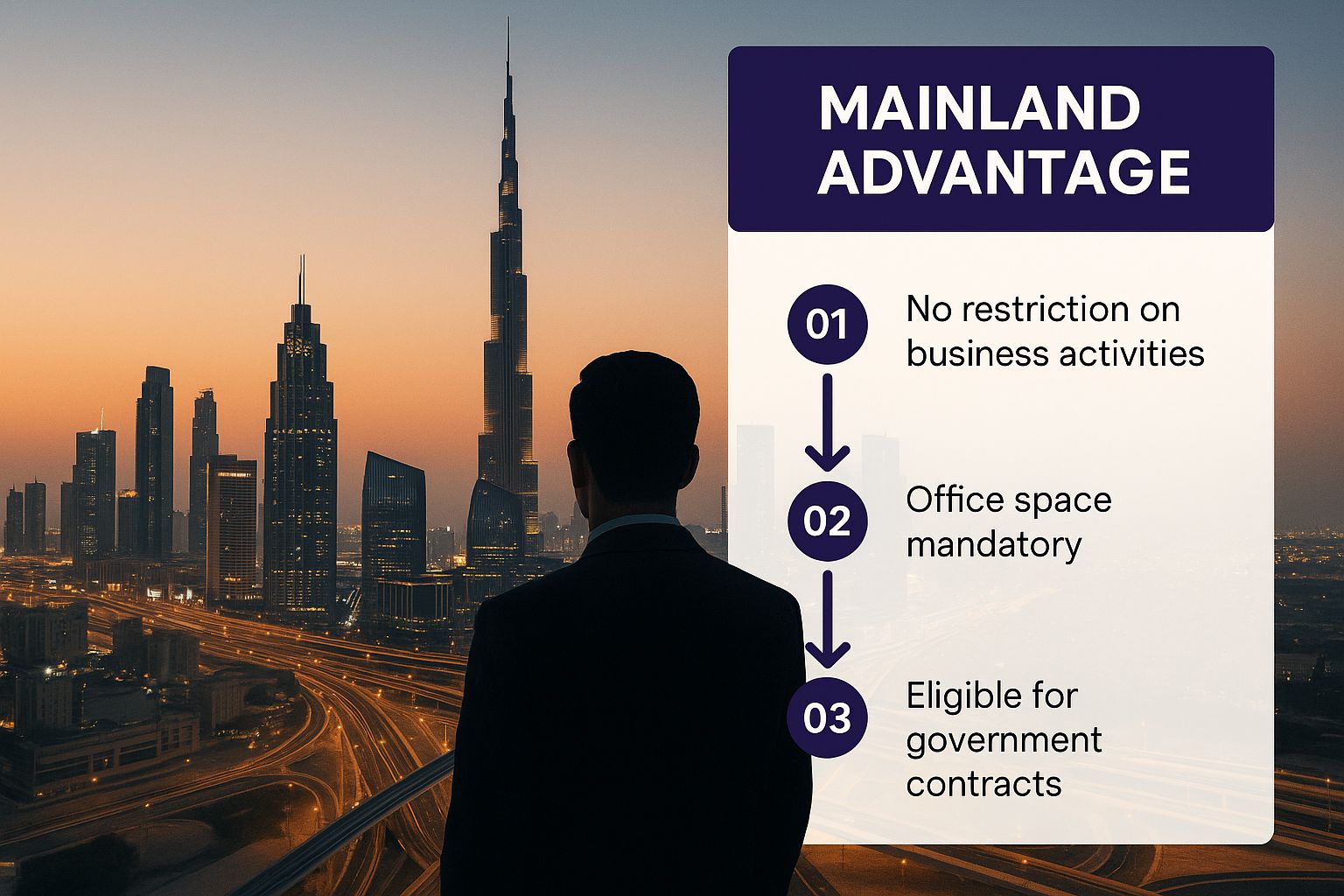
As you can see, direct market access and the ability to win government contracts are powerful reasons why so many entrepreneurs choose a mainland setup.
The Game-Changing Impact of 100% Foreign Ownership
For years, the biggest hurdle for foreign investors on the mainland was the requirement of an Emirati sponsor who held at least a 51% share. This often limited an entrepreneur’s direct control over their own company.
That all changed with the landmark reforms allowing 100% foreign ownership for most mainland companies. This was a complete game-changer. It instantly put Dubai on par with global business hubs and made it vastly more appealing for international entrepreneurs. This policy alone is expected to boost foreign direct investment, with some experts forecasting a 30-40% jump in new company registrations by non-Emiratis.
These reforms also had another welcome effect: they simplified the entire licensing process. What used to take several weeks can now be done in as little as 7-10 working days. You can learn more about the evolution of starting a company in Dubai mainland and its benefits here.
Key Takeaway: When you combine unrestricted trading, direct access to government projects, and complete foreign ownership, a mainland company becomes the most powerful vehicle for any entrepreneur serious about dominating the UAE market. It’s the structure built for long-term, sustainable growth.
Getting Your Business Licence: The Heart of Your Dubai Mainland Setup
Think of your trade licence as the official green light for your business in Dubai. It’s more than just a certificate; it’s the cornerstone of your entire operation, issued by the Department of Economy and Tourism (DET), that makes your company legal and ready to trade. I’ve seen many entrepreneurs get bogged down in this process, so let’s walk through it clearly to avoid the common headaches and costly delays.
The first thing you need to understand is that all licences are not the same. The specific licence you apply for is directly linked to what your business actually does. Nail this from the start, because your choice impacts everything—from your legal structure and what you can legally do, all the way to your long-term compliance obligations.
Choosing the Right Licence Type
The DET has three main licence categories, and you’ll need to fit your business into one of them. It’s best to think of them as specific pathways for different kinds of companies.
- Commercial Licence: This is your go-to for any business that involves trading goods. If you’re buying, selling, importing, or exporting physical products, this is the one you need. Think retail shops, e-commerce stores, or general trading companies. A classic example is a business importing electronics from Asia to distribute across the UAE—that’s a clear-cut Commercial Licence.
- Professional Licence: This licence is for businesses built on expertise and services. We’re talking about consultants, designers, accountants, marketers, IT specialists, and other professionals. A massive advantage here is the potential for 100% foreign ownership. However, you’ll need to appoint a Local Service Agent (LSA)—an Emirati national who serves as your company’s representative for government paperwork but holds no shares and has no say in your business decisions. A digital marketing agency is a perfect example of a business that would secure a Professional Licence.
- Industrial Licence: If you’re making something, this is your licence. It’s mandatory for any business involved in manufacturing, production, assembly, or any other industrial activity. Whether you’re turning raw materials into finished goods at a food processing plant or building custom furniture in a workshop, you’ll need an Industrial Licence.
Getting this wrong can cause major problems down the line, including fines and operational shutdowns. It’s absolutely critical to match your business activities to the right licence from day one.
The Core Steps to Secure Your Licence
Once you know which licence you need, the process follows a pretty logical sequence. Each step is a building block for the next, bringing you closer to launching your business.
It all starts with getting a unique trade name approved. Your chosen name has to follow DET rules—nothing offensive, nothing that violates public morals, and, of course, it can’t already be taken. With your name reserved, you’ll then apply for Initial Approval. This is essentially the DET giving you a preliminary nod, confirming they have no objections to your proposed business.
The Initial Approval is a huge milestone. It gives you the confidence to move forward with things like drafting legal documents or signing an office lease. But remember, it’s not the final licence to start trading.
With the Initial Approval in hand, your next big task is preparing the legal paperwork. For an LLC, this means drafting a Memorandum of Association (MOA); for a professional company, it’s a Local Service Agent (LSA) agreement. The MOA is a critical document that details the company’s shareholders, structure, and objectives. It needs to be drafted perfectly and attested by the right authorities.
Finally, once you have your attested MOA and a registered office lease (known as an Ejari), you can pull all your documents together for the final submission to the DET. They’ll issue a payment voucher, and once that’s settled, your trade licence is issued. You’re officially in business! Navigating this can be tricky, which is why many entrepreneurs use a corporate service provider. They handle the filings and follow-ups, turning a potentially complex journey into a much smoother path to getting your mainland business setup in Dubai off the ground.
Getting a Handle on Mainland Setup Costs
When you’re mapping out your budget for a mainland business in Dubai, you need a financial roadmap that goes beyond just the trade licence fee. That’s a common oversight I see—entrepreneurs focus on that one big number and forget about everything else that goes into it. A realistic budget is a mosaic of government fees, administrative charges, and operational costs that all add up to your real initial investment.
Laying out every potential expense from the get-go is the only way to avoid nasty surprises down the line. It’s not just about planning your finances; it gives you a much clearer, more honest picture of the entire journey. Skimping on this step can seriously strain your capital and put your launch date at risk.
The Core Expenses You Can’t Avoid
As you dive into the setup process, you’ll run into a series of mandatory fees. Each one is tied to a specific step in the licensing and registration journey, and they’re all non-negotiable if you want to be legally compliant.
Here’s a breakdown of what you should expect to pay for:
- Initial Approval Fee: This is a small but crucial charge you pay to the Department of Economy and Tourism (DET). It’s basically their nod of approval for your business idea and chosen name.
- Trade Name Registration: You have to pay to reserve your company’s name. The cost here can fluctuate—a standard name is cheaper, but one with special keywords might cost a bit more.
- MOA Attestation: Your Memorandum of Association isn’t just a document; it has to be legally attested. This involves notarisation fees to make it official and valid.
- Office Rent (Ejari): For a mainland company, a physical office is a must. Your annual rent, plus the fee to register the tenancy contract (known as Ejari), will be a major line item in your budget.
- Visa Processing Fees: Every investor and employee visa comes with its own string of costs—entry permits, medical tests, Emirates ID issuance, and the final visa stamping in the passport.
Historically, Dubai’s mainland companies have been the backbone of the UAE’s economy. The typical annual cost to get one off the ground—including all these fees, registrations, and that mandatory office lease—used to fall somewhere between AED 25,000 and AED 40,000. Of course, that figure moves up or down depending on your specific business activity and how big of an office you need.
One of the biggest draws, especially for SMEs, is the tax environment. Mainland companies are exempt from corporate tax as long as their annual taxable income stays below AED 375,000.
A Real-World Example: The Tech Startup
Let’s make this more concrete. Imagine a small tech startup with two co-founders who both need investor visas. They also plan on hiring one employee right away. Their business activity is software development, so they’ll need a Professional Licence.
Here’s what their budget would likely look like:
- Licensing & Registration: Around AED 15,000. This covers their trade name, initial approval, and the final licence issuance.
- Office Space: They decide on a small, flexible office in a business centre. That’s about AED 20,000 for the year, including the Ejari registration.
- Visa Costs: For three visas (two for the investors, one for the employee), the total comes out to roughly AED 18,000.
- Miscellaneous Fees: You’ve got to factor in MOA attestation, the establishment card, and other small administrative costs. Let’s add another AED 5,000 for those.
All in, this startup is looking at an initial setup cost of approximately AED 58,000. This example really shows how the final number is directly tied to how many visas you need and the kind of office you choose. A bigger team or a fancier office in a prime location would obviously push that figure higher.
My Advice From The Trenches: Never, ever underestimate the miscellaneous costs. I always tell my clients to add a contingency of 10-15% to their budget. It’s for all the little unexpected administrative fees or last-minute price changes. This bit of foresight saves a ton of financial stress when you’re in the thick of it.
Once you’re up and running, the game shifts to managing your ongoing expenses. To keep your business financially fit from the start, it’s worth exploring some proven strategies to reduce operational costs. By planning everything with this level of detail, you can walk into your mainland setup with total confidence, ready for every financial step.
Getting Your Office and Visas Sorted
With your trade licence approved, you’ve reached a major milestone. This is the point where your business plan starts to feel real, and you move from paperwork to a proper, physical operation. The next big steps are finding an office and getting visas for yourself and your team, which are essential for putting down roots in the UAE.
Unlike some free zones where you can get by with a virtual setup, a mainland company legally must have a physical address. This isn’t just a box to tick; it’s a hard requirement. Your tenancy contract is registered through a government system called Ejari, and this official address is crucial for almost everything that follows—from opening your corporate bank account to hiring employees.
Deciding on Your Office Space
Choosing an office is one of the most significant decisions you’ll make early on. It directly affects your budget, your company culture, and even how many people you can hire. Thankfully, Dubai’s real estate market is incredibly diverse, offering something for everyone, whether you’re a lean startup or a growing enterprise.
Here’s a breakdown of what’s on offer:
- Dedicated Office Space: The classic choice. You lease your own private, unfurnished office. This gives you complete control over branding, layout, and privacy. It’s the go-to option for established businesses or those with larger teams that need a custom-designed workspace.
- Business Centres: A fantastic plug-and-play solution. These offer fully furnished and serviced offices on flexible leases. You skip the headache and upfront costs of buying furniture and setting up utilities, letting you get to work almost immediately. It’s perfect if you want to be operational quickly without a hefty long-term commitment.
- Co-working Spaces: For maximum flexibility and a built-in community, co-working spaces are hard to beat. You can rent a desk or a small private office within a shared environment. You still get a valid Ejari for all your official needs but keep your overheads incredibly low. This is a favourite among consultants, freelancers, and tech startups.
It’s crucial to remember this: your office size directly impacts how many employee visas you can apply for. A bigger space means a larger visa quota. So, when you’re choosing your office, think about your hiring plans for the next year or two, not just your immediate needs.
Making Sense of the Visa Process
Once your office and Ejari are sorted, it’s time to tackle the visa applications for investors and employees. This is a multi-stage process that involves several different government bodies, so staying organised is key. Honestly, this is where having a professional partner can be a lifesaver. A good corporate services provider will manage the entire thing, offering 24/7 support and making sure no detail gets missed.
The path to residency generally follows these stages:
- Apply for an Establishment Card: First, you need to get an Establishment Card for your company from the immigration authorities. Think of it as your company’s pass to sponsor visas. Nothing can happen without it.
- Get the Entry Permit (Pink Visa): With the Establishment Card in hand, you can apply for an entry permit for each person. This is a temporary visa that allows them to be in the UAE legally while the rest of the paperwork is processed.
- Complete the Medical Fitness Test: Anyone over 18 has to do a mandatory medical screening at a government-approved health centre. It’s a standard check for certain communicable diseases.
- Provide Emirates ID Biometrics: Next, the applicant visits an Emirates ID service centre to give their fingerprints and have their photo taken.
- Get the Visa Stamped: Once the medical report is clear and the Emirates ID application is done, the final step is to submit the passport to get the residency visa stamped inside.
Completing this process officially makes an investor or employee a legal resident of the UAE, allowing them to open a personal bank account, rent a home, and more. It might sound like a lot, but a specialist in mainland company formation can offer cost-effective support tailored to your situation, ensuring a smooth run from start to finish.
Keeping Your Mainland Company in Good Standing
Getting your company off the ground is a huge milestone, but the real work starts now: keeping it legally and financially sound. A mainland business setup in Dubai isn’t a one-and-done deal; it comes with ongoing responsibilities that are critical for your company’s survival and growth. Getting these right from the beginning will save you from major headaches and penalties down the road.
One of the very first things you’ll need to do after you have that trade licence in hand is open a corporate bank account. This is absolutely essential. It keeps your business finances separate from your personal money, which is a cornerstone of financial transparency here in the UAE. Be prepared: banks will want to see your licence, shareholder documents, and probably a solid business plan. Having everything organised and ready to go will make the process much smoother.
Annual Renewals and Staying Compliant
Think of your Dubai mainland trade licence like a subscription—it needs to be renewed every single year with the Department of Economy and Tourism (DET). The renewal process isn’t just a simple payment; you’ll also have to renew your office tenancy contract (your Ejari) and secure any other approvals tied to your specific business activity.
If you miss that renewal deadline, the consequences can be severe. We’re talking hefty fines, your company getting blacklisted, and even having your business activities completely frozen. This is one date you absolutely cannot afford to forget.
Expert Insight: I always tell my clients to set a calendar reminder for at least two months before their licence is due to expire. That buffer gives you plenty of time to sort out your documents, like the updated Ejari, and handle any unexpected hiccups without the stress of a last-minute scramble.
Keeping proper books is another non-negotiable. UAE law requires every company to maintain accurate accounting records for a minimum of five years. This isn’t just good business sense—it’s the law, and it’s what your tax obligations and annual audits will be based on.
Understanding Taxes and Audits
With the introduction of UAE Corporate Tax, there’s a new layer of compliance to manage. The good news is there’s a 0% tax rate on annual net profits up to AED 375,000. The catch? Every single company must register for Corporate Tax with the Federal Tax Authority (FTA) and file an annual tax return, even if you don’t owe anything.
You also need to keep an eye on your revenue for Value Added Tax (VAT). If your annual turnover hits AED 375,000, you are legally required to register for VAT. From that point on, you’ll be responsible for filing regular VAT returns and making sure all your invoices are compliant.
The entire process of a mainland business setup in Dubai is woven into the UAE’s economic framework, which prioritises compliance and transparency. It’s no surprise that mainland businesses drive the local economy, making up about 70% of all commercial transactions in Dubai. While the UAE ranks high for its ease of doing business, this is supported by strict rules, including mandatory annual audits and following local labour laws. You can learn more about the business environment in the UAE and its regulations to get a fuller picture.
Getting Labour Laws Right
If you plan on hiring, you must get familiar with the UAE Labour Law. It governs everything from employment contracts and working hours to how you handle end-of-service benefits. A few key areas to focus on are:
- Wages Protection System (WPS): This is the official system for paying salaries. You have to use it, and you have to pay your staff on time.
- Leave Policies: Make sure you’re following all the rules for annual leave, sick days, and public holidays.
- Gratuity Calculations: When an employee leaves your company, you need to calculate and pay their end-of-service gratuity correctly.
Trying to figure all this out on your own, especially if you’re new to the region, can feel overwhelming. This is exactly why working with a specialist in mainland company formation is so valuable. With their expert help and a reliable 24/7 support service, you can hand off the compliance worries and focus your energy on what you do best: growing your business.
Let Us Handle the Heavy Lifting
Setting up a mainland company in Dubai is a major step, but you don’t have to navigate the complexities on your own. Having the right partner can make all the difference, turning a stressful process into a smooth and efficient launch.
✅ Best Corporate Service Provider in Dubai, Abu Dhabi & Sharjah
✅ Specialists in Mainland Company Formation in Dubai & Abu Dhabi
✅ Specialists in Freezone Company Formation across the UAE
✅ 24/7 Support Service – Always here when you need us
✅ Cost-Effective Business Setup Solutions tailored to your needs
✅ Enjoy UAE Tax Benefits for International Entrepreneurs
📞 Call Us Now: +971-52 923 1246
💬 WhatsApp Us Today for a Free Consultation
Your Mainland Business Setup Questions Answered
When you’re looking to set up a mainland company in Dubai, a lot of questions pop up. It’s completely normal. Getting clear, no-nonsense answers is the best way to move forward confidently and sidestep those common early-stage hurdles. Let’s dig into some of the things entrepreneurs ask us most often.
Do I Absolutely Need a Physical Office for a Mainland Licence?
Yes, this one is non-negotiable. To get a mainland trade licence in Dubai, you must have a physical office space registered with Ejari. This is a key difference from many free zone setups where you might get by with a virtual office package. Your registered address is what the government uses for all official mail and legal notices.
But don’t let that scare you into thinking you need a massive, expensive office right out of the gate. The rules are actually quite flexible. Your “office” can be anything from a dedicated unit to a simple flexi-desk in a registered co-working space, as long as it comes with a valid Ejari. This gives new businesses a smart way to manage costs while staying fully compliant.
What’s the Real Difference Between a Local Service Agent and a Sponsor?
It’s easy to get these two mixed up, but they play completely different roles, especially after the latest ownership reforms changed everything.
A Local Sponsor used to be a requirement for most commercial and industrial licences. This meant an Emirati partner had to hold 51% of your company’s shares. Thankfully, with the move to 100% foreign ownership for most business activities, this is now a thing of the past for the vast majority of entrepreneurs, giving you full control.
On the other hand, a Local Service Agent (LSA) is still required for professional licences—think consultancies, law firms, or IT services—where foreigners can own 100% of the business. An LSA is an Emirati national or a UAE-owned company whose job is purely administrative. They hold zero shares, have no say in your operations, and have no claim on your profits. They simply act as your official representative with government departments for a set annual fee.
How Long Does It Realistically Take to Set Up on the Mainland?
The whole process is much quicker than it used to be. While every setup has its own timeline, you can generally expect everything—from the initial application to holding your trade licence—to take somewhere between one and three weeks.
Some steps, like getting your trade name reserved, can be done in a day or two. What usually takes the most time is finalising the Memorandum of Association (MOA) and securing your office lease so you can get that all-important Ejari.
A Tip From Experience: Nearly every delay I’ve ever seen comes down to incorrect or incomplete paperwork. This is where working with a formation specialist really pays off. They know exactly what the authorities are looking for and make sure every document is submitted correctly the first time, cutting out weeks of potential back-and-forth.
Will I Have to Pay Corporate Tax on My Company’s Profits?
Yes, but the UAE’s tax system is incredibly friendly to small and medium-sized businesses. While there is a federal Corporate Tax, it comes with a very generous exemption. Any business with a net taxable profit of up to AED 375,000 per year pays a 0% tax rate.
Only the profits above that threshold are taxed at the standard rate of 9%. It’s important to remember, though, that regardless of how much you earn, every mainland company must register for Corporate Tax and file annual returns to stay in good standing. This is just part of doing business and enjoying the tax benefits the UAE offers.
Navigating the details of a mainland business setup in Dubai is much simpler when you have an expert in your corner. At 365 DAY PRO Corporate Service Provider LLC, we provide practical, cost-effective solutions designed for your specific needs, all with 24/7 support. Let our specialists handle the paperwork so you can focus on building your business.
Start your Dubai business journey with a free consultation today