If you’re looking to start a business in the UAE, you’ll quickly realise that everything hinges on one critical document: your business license. You can think of it as your official passport to doing business here. It’s the very first, and most important, step to getting your venture off the ground in this incredibly dynamic market.
Why a Business License Is Your Key to the UAE Market
A business license in the UAE is so much more than a piece of paper. It’s the legal foundation for your entire company. Without it, you simply can’t operate legally, open a corporate bank account, or even sponsor visas for your staff. It’s the government’s official stamp of approval, confirming that your business is legitimate and follows all the local rules.
This legal framework gives you stability and lets you operate with confidence. It clearly defines what your business is allowed to do, which is essential for building a sustainable company. More than that, having an official license is fundamental for building trust with customers, suppliers, and banks.
This infographic breaks down how a business license is your direct path to market entry, legal compliance, and a solid reputation.
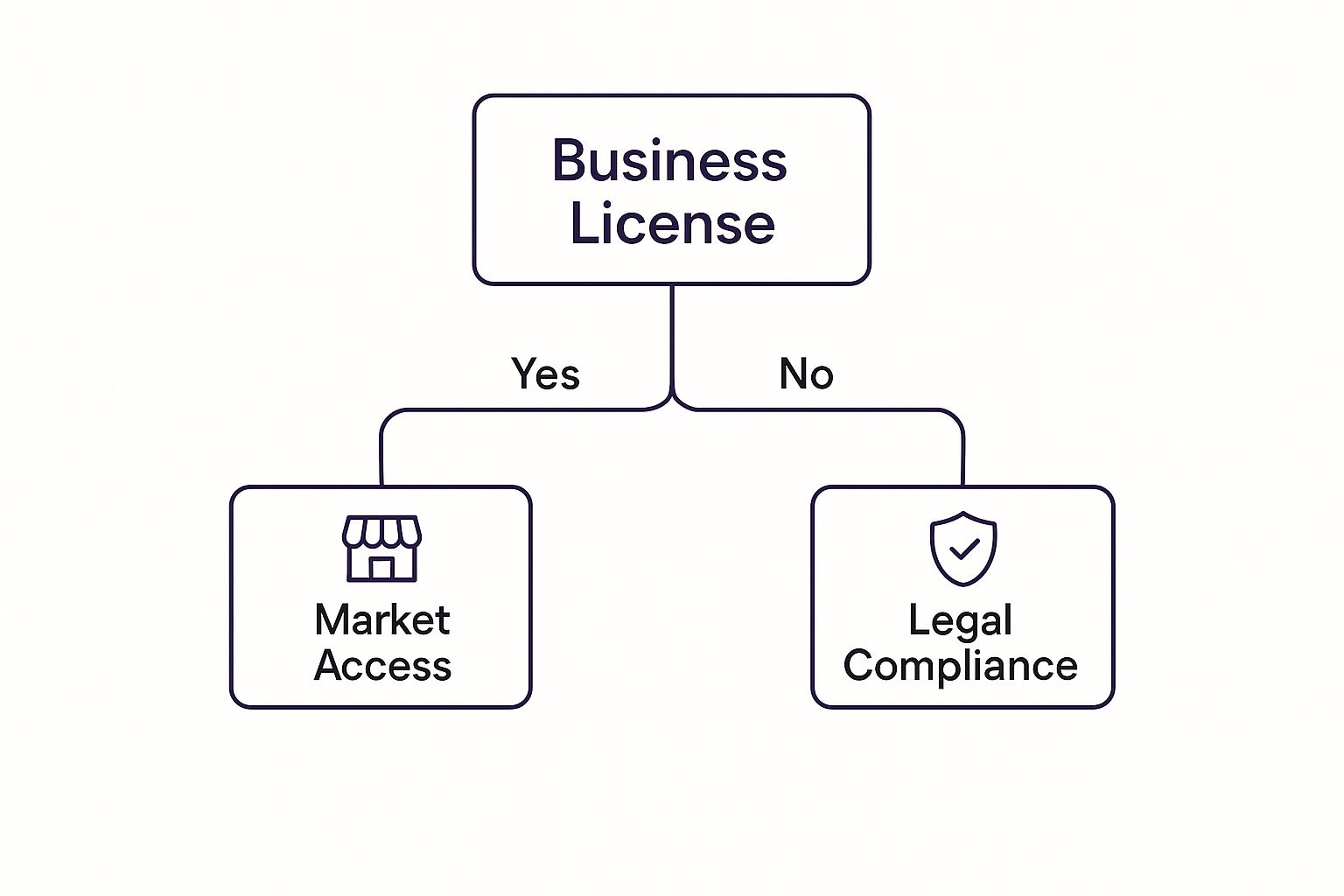
As you can see, getting licensed isn’t just about ticking a box for the authorities. It’s a strategic move that gives you real business advantages from day one.
The Foundation of Credibility and Growth
Holding a valid license immediately makes your company look credible. It shows partners and clients that you’re a serious, legitimate enterprise—and in a competitive market like the UAE, trust is everything. A licensed business can sign contracts, rent an office, and fully participate in the economy with its head held high.
The UAE’s business-friendly policies have fuelled some incredible growth. The country recently hit a major milestone, with over one million active business licenses on record. This 5% jump shows just how attractive the UAE is, especially with policies like 100% foreign ownership now available for many mainland companies. It’s a clear sign of a healthy, welcoming environment for new businesses.
Planning Your Entry into the Market
Before you jump into the licensing process, it’s smart to make sure your business idea is solid. A little homework upfront can save you a lot of time and money later. Before getting lost in the paperwork, it’s worth learning how to validate your business idea to be sure it has a real shot at success.
Ultimately, getting your business license sorted provides some huge benefits:
- Legal Protection: It keeps your operations compliant with UAE law, so you don’t have to worry about fines or penalties.
- Market Access: Your license is your ticket to the local market, and depending on your setup (Mainland or Free Zone), international markets too.
- Investor Confidence: It proves your business is stable and legitimate, making it far easier to attract investors and secure funding to grow.
Choosing Your Business Jurisdiction

When you decide to set up a company in the UAE, one of the first and most fundamental choices you’ll face is where to base it. This isn’t just about a physical address; it’s a strategic decision that will define your company’s legal structure, who you can do business with, and how you operate. The two main paths are setting up on the UAE Mainland or within one of the many specialised Free Zones.
Think of a Mainland company as opening a shop on a bustling city high street. You have the freedom to trade directly with any customer or business anywhere in the UAE, with zero restrictions. This is the go-to option for businesses that need to be fully integrated into the local economy—like retail stores, restaurants, construction firms, and local service providers.
A Free Zone, on the other hand, is more like a dedicated business park, often tailored to specific industries and geared towards international trade. These zones are incredibly popular with foreign entrepreneurs because they offer massive perks, including 100% foreign ownership and tax exemptions. It’s the perfect setup for import/export companies, global consultancies, and many e-commerce ventures.
Key Differences Between Mainland and Free Zone
The distinction between these two jurisdictions runs deep, affecting everything from your company’s ownership to its daily operations. This is where getting expert advice on Mainland and Free Zone company formation becomes invaluable, ensuring you pick the route that truly aligns with your business goals.
One of the biggest differences is the governing body. Mainland businesses are registered with the Department of Economic Development (DED) in their specific emirate, like Dubai or Abu Dhabi. Free Zones, however, operate under their own independent authorities, each with its own rulebook.
Choosing the correct jurisdiction isn’t just a logistical step; it’s a strategic move. The right choice can unlock growth by placing your business in the perfect legal and financial framework, while the wrong one can create frustrating roadblocks down the line.
This decision is more important than ever as the UAE’s business scene explodes. The country recently saw a massive influx of new companies, with around 200,000 new economic licenses issued nationwide. This boom is a direct result of government reforms and simplified digital processes that have made getting business licenses in the UAE easier than ever. You can discover more insights about the UAE’s business registration boom and what it means for entrepreneurs like you.
Mainland vs Free Zone Key Differences at a Glance
To make this choice clearer, let’s put the two options side-by-side. This table breaks down the core distinctions to help you see which one fits your needs best.
| Feature | Mainland License | Free Zone License |
|---|---|---|
| Business Scope | Can trade directly anywhere in the UAE and internationally. | Primarily restricted to trading within the Free Zone and internationally. Requires a local distributor for mainland sales. |
| Ownership | 100% foreign ownership is now available for most business activities. | 100% foreign ownership has always been a standard benefit. |
| Office Space | A physical office with an Ejari (lease registration) is mandatory. | Offers flexible office solutions, including virtual offices and flexi-desks. |
| Government Approvals | Requires approvals from multiple government bodies like DED and relevant ministries. | All approvals are managed through the single-window service of the specific Free Zone authority. |
| Visa Eligibility | Visa eligibility is generally linked to the size of the physical office space. | The number of visas is typically determined by the package chosen with the Free Zone. |
Ultimately, this comparison highlights the trade-offs. A Mainland setup offers complete market access within the UAE, while a Free Zone provides operational ease and cost-effective solutions, particularly for businesses with an international focus.
The Three Main Types of Business Licenses
Just as every business has a unique mission, the UAE’s licensing system is built to match. Picking the right license isn’t just a formality; it’s a critical decision that legally defines what your company can and cannot do. The authorities classify business activities into specific categories, and each one needs the correct license to operate legally and stay compliant.
Think of this as the first, most important piece of the puzzle. The three main types of business licenses in UAE are Commercial, Professional, and Industrial. Each one is tailored to a specific corner of the economy, whether you’re trading goods, offering your expertise, or actually making something new.
Commercial License for Trading Activities
If your business plan involves buying and selling physical goods, the Commercial License is your ticket to operate. This is by far the most common license you’ll see in the UAE, covering a massive range of trading activities. It’s the go-to for any business that functions as a retailer, wholesaler, or distributor.
A commercial license gives you the green light to import, export, and trade in all sorts of commodities. We’re talking about everything from electronics and fashion to food products and general goods.
So, what kind of businesses fall under this umbrella? Here are a few real-world examples:
- An e-commerce store selling products online.
- A retail shop in a bustling mall.
- A general trading company dealing in multiple product lines.
- A real estate brokerage helping clients buy and sell property.
For expatriates, the most popular legal structure for a commercial license is the Limited Liability Company (LLC). It’s a smart choice because it creates a legal wall between the business’s finances and your personal assets, giving you valuable protection.
Professional License for Service-Based Businesses
Now, if you’re an expert offering specialised, skill-based services, you’ll be looking at a Professional License. This license is granted based on your educational qualifications and professional expertise. It’s built for consultants, artisans, doctors, and other specialists who provide a service instead of selling a tangible product.
This is the perfect structure for anyone in fields like IT, marketing, management consultancy, or healthcare. It’s designed for individuals or teams of professionals who want to turn their expertise into a legitimate business.
A key advantage of a professional license is the ability for skilled individuals to have 100% ownership of their company, particularly with legal structures like a Sole Establishment or Civil Company. This makes it a very appealing option for consultants and service-focused entrepreneurs setting up in the UAE.
Common businesses that need a Professional License include:
- Management, marketing, or IT consultancies.
- Medical clinics and healthcare providers.
- Law firms and legal advisory services.
- Beauty salons and wellness centres.
- Art and design studios.
One of the biggest draws here is the potential for 100% foreign ownership on the mainland. If you set up a Sole Establishment or Civil Company, you’ll need to appoint a UAE national as a Local Service Agent (LSA). Don’t worry—they don’t hold any shares or have any say in the business; their role is simply to help with government paperwork.
Industrial License for Manufacturing and Production
The Industrial License is for the makers and producers. This license is specifically for any business involved in manufacturing, processing, or assembling goods from scratch. If you’re turning raw materials into finished products, this is the one you need. It’s a vital part of the UAE’s strategy to diversify its economy and build a strong industrial base.
To get this license, you must have a physical factory or workshop inside the UAE. The authorities, including the Ministry of Economy, have strict standards for safety, environmental impact, and quality control.
Examples of businesses requiring an Industrial License are:
- Food processing and packaging plants.
- Textile and clothing manufacturers.
- Furniture production workshops.
- Metal fabrication and assembly factories.
Be prepared for a more involved application process. Securing an industrial license often requires extra steps, like getting approvals for your factory layout, machinery, and production methods. It’s all to ensure that your industrial activities are safe, regulated, and a positive contribution to the national economy.
Your Step-by-Step Licence Application Roadmap

Getting your business licence in the UAE can feel like a mountain to climb, but it’s really just a series of well-defined steps. When you have a clear roadmap, what seems overwhelming becomes a straightforward, manageable plan. Following this process ensures you get all the legal and administrative details right from day one.
The very first thing you need to do is define your business activities. This decision is the cornerstone of your entire setup. It dictates what kind of licence you’ll need—Commercial, Professional, or Industrial—and helps you figure out whether a mainland or free zone jurisdiction is the right home for your company.
Once you’ve got that locked in, you can confidently move on to the next stage.
The Initial Setup Phase
Your journey officially starts with choosing and registering your company’s trade name. It’s not just about picking a name you like; it has to be unique and follow the UAE’s naming rules. This means no offensive language or religious references. You’ll submit your chosen name to the relevant Department of Economic Development (DED) or Free Zone authority and wait for their approval.
With your trade name reserved, the next checkpoint is getting your Initial Approval. Think of this as a preliminary green light from the authorities, confirming they have no objection to your proposed business. This approval is absolutely essential before you can proceed with drafting legal documents and other formalities.
This initial phase clears the way for the more detailed legal and logistical work ahead.
Finalising Legal and Logistical Requirements
After securing your Initial Approval, it’s time to prepare and sign your company’s Memorandum of Association (MoA). For some professional licences, you might need a Local Service Agent (LSA) agreement instead. The MoA is a critical legal document that spells out the ownership structure and the responsibilities of each partner.
The UAE government’s push for digital services has really simplified these procedures. Entrepreneurs no longer have to be physically present for every signature, which makes the whole process faster and much more convenient.
Another non-negotiable requirement is a physical address for your business. If you’re setting up on the mainland, you’ll need to lease an office space and register it through the Ejari system. This registered tenancy contract is a mandatory piece of the puzzle for your final application.
The shift towards digital business registration has brought incredible efficiency to the UAE. Thanks to innovations like Digital Memorandums of Association and e-signatures, company registration in leading free zones like RAKEZ and IFZA can now be wrapped up in just one to five working days. You can learn more about the swift changes in UAE business registration to see how much has evolved.
Finally, with all your paperwork in order—the approved trade name, initial approval, signed MoA, and tenancy contract—you can submit your application and receive your business licence. As specialists in company formation, we can guide you through every one of these steps, ensuring a smooth and successful launch.
What to Expect: Costs and Documents
Getting a clear picture of the money and paperwork involved is one of the most important steps to a smooth launch. When you start budgeting for your business license in UAE, it’s easy to focus on the final issuance fee, but the reality is that several smaller costs pop up along the way. Planning for these from the get-go means no nasty surprises later on.
The journey usually starts with paying to reserve your trade name and getting initial approval from the authorities. After that, you’ll face the main licence fee, which can vary wildly depending on where you set up shop – be it on the mainland in Dubai or Abu Dhabi, or within one of the UAE’s many specialised free zones.
But the government charges are only part of the story. You also need to account for the practical, day-to-day costs of getting your business off the ground.
Breaking Down the Key Expenses
If you’re setting up a mainland company, for instance, a physical office is non-negotiable. That means factoring in rent and the cost of registering your Ejari (the official tenancy contract). Then there’s the visa processing for yourself and any staff you plan to hire, which includes separate fees for the application, medical tests, and the final Emirates ID card.
Thinking about your budget isn’t just a numbers game; it’s about building a realistic timeline. When your funds and documents are ready to go, you can move from one step to the next without hitting pause, keeping your momentum going.
As specialists in both Mainland and Freezone Company Formation, we believe in making this process as straightforward as possible with clear, upfront pricing. Our goal is to make sure you understand every single dirham, from government duties to our own service fees, so you can manage your startup capital with confidence.
Essential Document Checklist for UAE Business License Application
One of the best ways to avoid delays is to get all your paperwork in order before you even start. While the exact list can change slightly from one jurisdiction to another, there’s a core set of documents you’ll almost certainly need.
Here’s a look at the fundamental paperwork to get you started.
| Document Type | Description & Key Considerations |
|---|---|
| Shareholder Passport Copies | You’ll need clear, colour copies of the passports for every partner and shareholder. Crucially, each passport must have at least six months of validity remaining. |
| Visa & Entry Stamp Pages | If any shareholders are already inside the UAE, you’ll need to provide copies of their current visa and the entry stamp page from their passport. |
| Proof of Address | This is for verification. A recent utility bill or another piece of official mail showing the home address of each shareholder usually does the trick. |
| Business Plan Summary | For some professional activities or within certain free zones, you’ll be asked for a brief business plan. This should cover your company’s goals, services, and target audience. |
| Application Forms | These are the official forms from the licensing authority, whether it’s the Department of Economy and Tourism (DET) for mainland or a specific free zone’s administration. |
Having these documents organised and ready to go will make the approval process so much faster. Our team is on hand with 24/7 support to help you pull everything together and double-check it for accuracy before it’s submitted.
Let the Experts Handle the Heavy Lifting
While the steps to getting a UAE business license are straightforward on paper, the reality on the ground can be a maze of specific requirements and subtle nuances. This is where having an experienced guide isn’t just a luxury—it’s essential for a smooth, efficient launch.
Think of it this way: you wouldn’t try to navigate a foreign city without a map. A business setup specialist is your map and your local guide, all in one.
As the Best Corporate Service Provider in Dubai, Abu Dhabi & Sharjah, we’ve been through this process countless times. We are specialists in both Mainland Company Formation in Dubai & Abu Dhabi and Freezone Company Formation across the UAE, so we know the common pitfalls, the regulatory quirks, and how to manage all the government paperwork so you don’t have to.
Our job is to take the bureaucratic headaches off your plate, freeing you up to concentrate on what really matters: getting your business off the ground. With our 24/7 support service, you’re never alone in this process—we’re always here when you need us.
To build a strong foundation for your new venture, it’s also smart to connect with other specialists who can help you grow. You can find a wide network of agency partners who offer services that complement your business needs.
Ready to start your UAE business journey and enjoy UAE tax benefits for international entrepreneurs? Get in touch. Our cost-effective business setup solutions are tailored to your needs. We’re here to make it happen.
Frequently Asked Questions
Setting up a business in the UAE can feel like a maze, and it’s natural to have questions. We’ve been there. Here are some of the most common things entrepreneurs ask us, with straight-to-the-point answers from our own experience.
Can I Get a UAE Business License Without Renting an Office?
Absolutely, you often can. Free zones are particularly flexible here, with many offering smart desk or virtual office solutions. These packages give you a legitimate business address without the expense of a full-time physical office.
For a mainland license, however, it’s a different story. You’ll almost certainly need a physical office space with a registered Ejari contract. It really comes down to where you want to operate and what your business actually does.
How Long Does It Take to Get a Business License in Dubai?
This is a classic “it depends” question, but here’s a realistic breakdown. In many of Dubai’s slicker free zones, you could be up and running in just a few working days. Their digital systems are incredibly efficient.
A mainland license usually takes a bit longer, typically anywhere from one to four weeks. The reason for the delay is the need for approvals from several different government departments. The single best thing you can do to speed things up? Have every single piece of paperwork ready and correct from day one.
Do I Still Need a Local Sponsor for My Business in the UAE?
Good news on this front. For most businesses on the mainland, the old requirement for an Emirati sponsor is gone. The law has changed to allow for 100% foreign ownership, which is a huge advantage for international founders.
That said, a few strategic industries still have specific ownership regulations, so it’s always wise to check. And if you’re in a free zone, it’s even simpler: you always get 100% foreign ownership—no local sponsor needed, period.
What’s the Real Difference Between a Trade License and a Business License?
In everyday conversation in the UAE, you’ll hear these terms used for the same thing. “Trade license” and “business license” both refer to the official document that legally permits your company to operate.
Think of it like this: “business license” is the general category, and the specific type you get (like Commercial, Professional, or Industrial) just details exactly what activities you’re allowed to do.
Getting through the setup process is always easier with someone who knows the ropes. As specialists in Mainland and Freezone company formation across Dubai, Abu Dhabi, and Sharjah, 365 DAY PRO Corporate Service Provider LLC provides practical, cost-effective solutions built around your goals. You’ll get the benefit of our 24/7 support and deep expertise to secure your license and start taking advantage of the UAE’s tax benefits.
📞 Call Us Now: +971-52 923 1246
💬 WhatsApp Us Today for a Free Consultation at https://365dayproservices.com