
Starting a company in Dubai isn’t just a business decision; it’s a strategic leap into one of the most dynamic economic centres on the planet. The process, which really boils down to choosing between a mainland or free zone setup and getting the right licence, has become surprisingly straightforward, especially if you have someone experienced to guide you. For entrepreneurs looking in from overseas, the big attractions are crystal clear: incredible tax benefits, the option for 100% foreign ownership, and a direct line to global markets.
Why Launch Your Business in Dubai?
Dubai is far more than its iconic skyline. It’s a genuine powerhouse for global commerce and a hotbed of innovation. Think about its location—it’s a natural bridge connecting East and West, giving businesses phenomenal access to markets across Europe, Asia, and Africa. For anyone with ambition, this isn’t just a geographical quirk; it translates into real-world opportunities for trade, logistics, and international partnerships.
The government here isn’t passive. They’ve intentionally created an environment where businesses are set up to succeed, not just to get by. The policies are designed to pull in foreign investment, slash red tape, and encourage growth across a huge range of industries. It’s this forward-thinking approach that has made Dubai such a stable and reliable place to build a company.
A Magnet for Global Entrepreneurs
The numbers speak for themselves. Dubai’s business scene exploded in the first half of 2025, with the Dubai Chamber of Commerce reporting a staggering 35,500 new companies registered. That’s almost 200 new businesses opening their doors every single day—a clear signal of the emirate’s powerful draw. On top of that, exports hit $47 billion in the same period, showing just how healthy the economic climate is. If you’re interested in the details, you can explore more data on Dubai’s economic momentum and read the full report.
The infographic below really paints a picture of the strategic opportunities waiting for new ventures here.
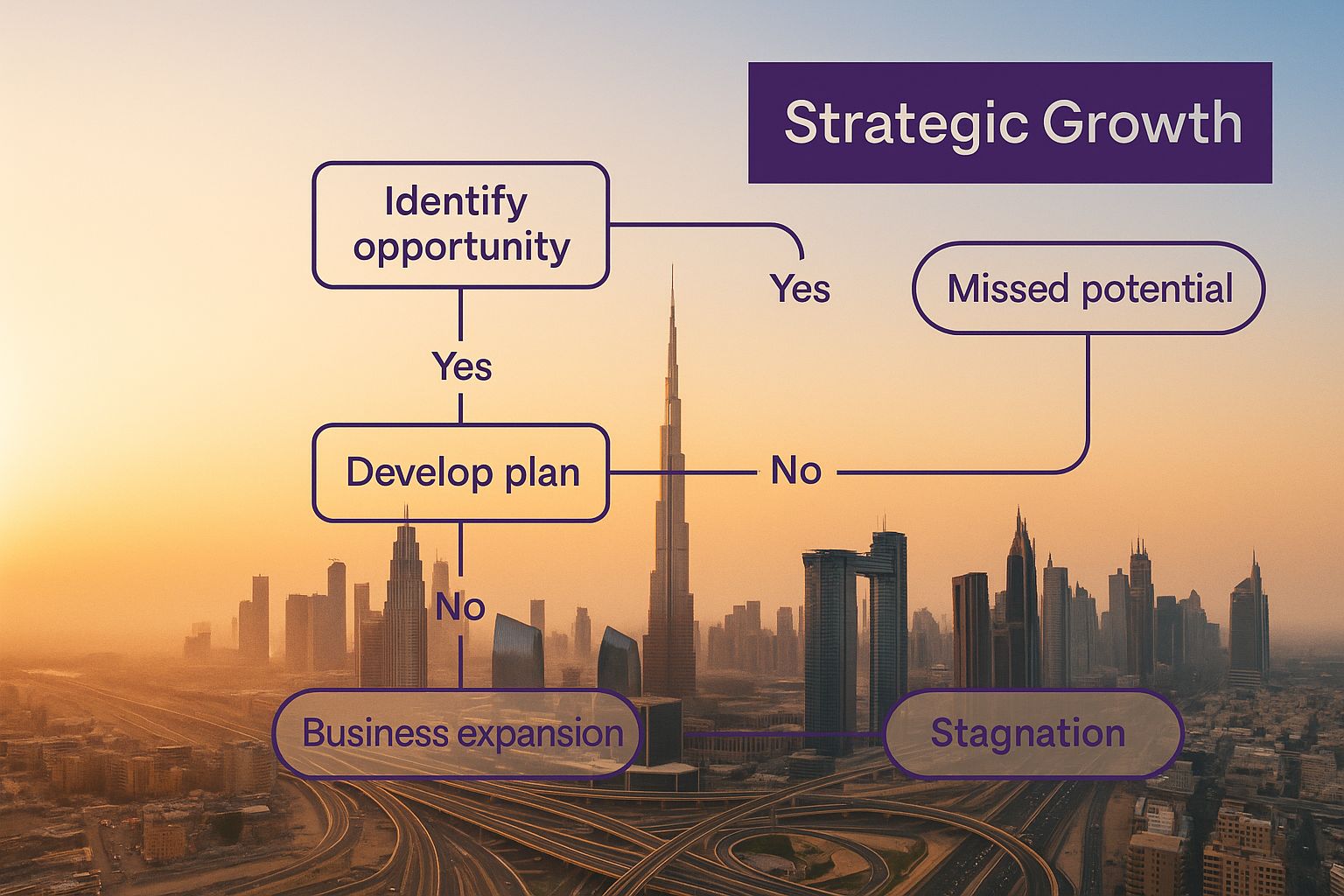
It’s this combination of world-class infrastructure and progressive policies that makes the ground so fertile for expansion. Your journey to a successful business setup in Dubai starts with grasping these fundamental advantages.
Key Advantages for Your New Venture
Setting up shop in Dubai unlocks a raft of benefits that can have a direct impact on your bottom line and how smoothly your business runs. Here are just a few of the standout reasons entrepreneurs are flocking to the UAE:
- Significant Tax Benefits: The tax environment is incredibly appealing. You’re looking at zero personal income tax and a very low corporate tax rate. This means more of your profits can be ploughed back into growing the business.
- World-Class Infrastructure: You’ll be operating with state-of-the-art ports, airports, and digital networks at your fingertips. It makes global trade and communication feel seamless.
- Diverse International Market: You gain immediate access to a multicultural customer base and a global talent pool. It’s the perfect place to test new products and scale your services internationally.
- Specialised Business Hubs: The UAE is famous for its industry-specific free zones. Whether you’re in tech (Dubai Internet City) or logistics (JAFZA), there’s a specialised hub with tailored facilities ready to support you.
Getting your business setup in Dubai right is about more than just paperwork. It’s about placing your company in an ecosystem designed for long-term growth, with a government that’s genuinely invested in your success. Partnering with a specialist who knows the ins and outs of company formation in Dubai and Abu Dhabi can help you navigate the entire process with confidence.
Choosing Your Business Jurisdiction
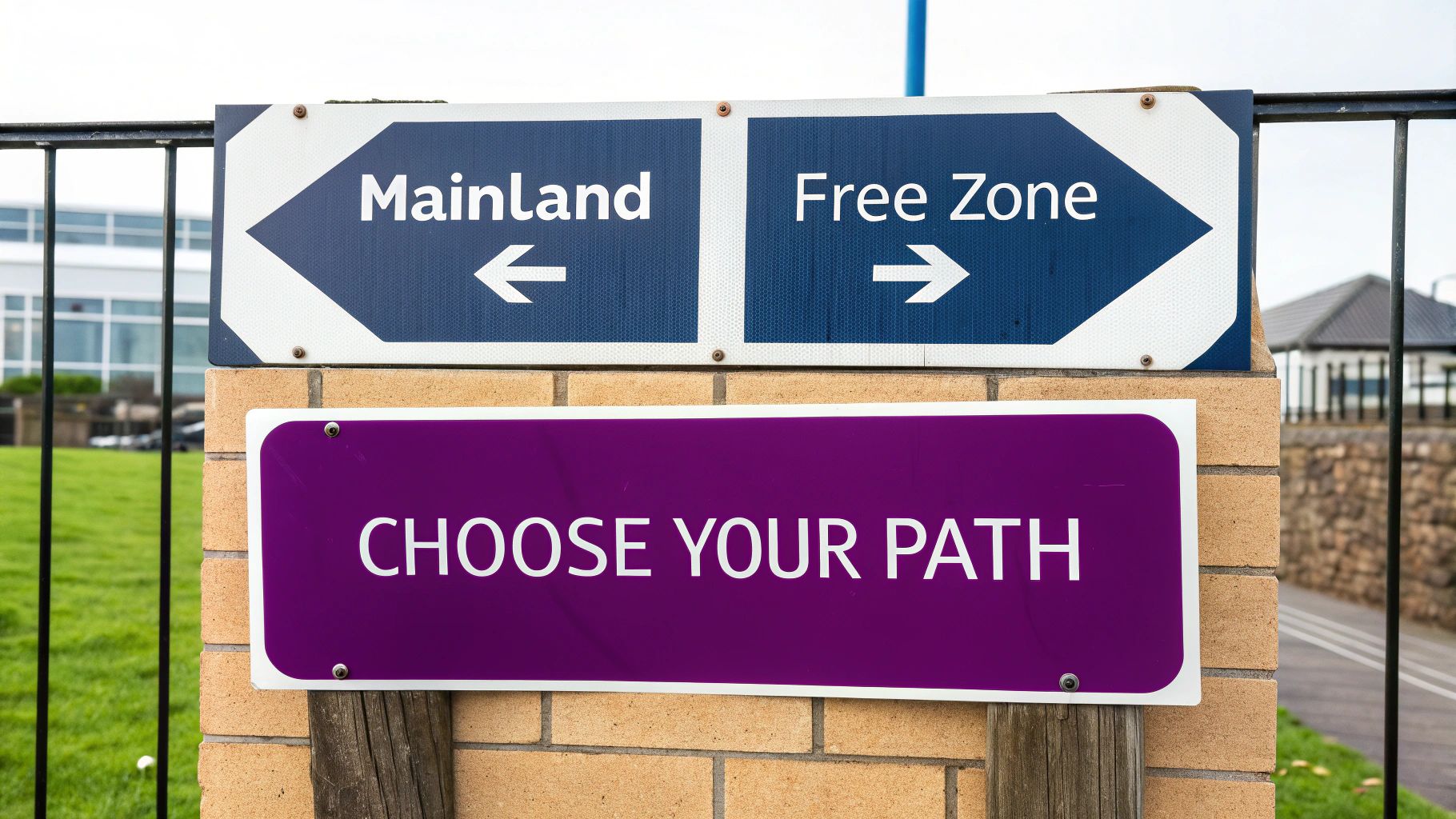
The very first—and arguably most critical—decision you’ll make on your journey to a successful business setup in Dubai is picking the right jurisdiction. This isn’t just about ticking a box on a form. It’s a choice that will fundamentally define your company’s future: who you can sell to, what your ownership looks like, and how you can grow.
Many entrepreneurs get bogged down here, but it usually comes down to one simple question: where are your customers? Answering that honestly is the key to deciding between a Mainland or a Free Zone company. Get this right from day one, and you’ll save yourself a world of hassle and expense later on.
Understanding Dubai Mainland
A Dubai Mainland company, registered directly with the Department of Economic Development (DED), gives you the ultimate freedom to operate. This is your all-access pass to the entire UAE market. If your business plan involves opening a cafe, a retail store, or offering services directly to local residents and businesses, then a Mainland licence isn’t just an option—it’s essential.
It’s also the only way to work with UAE governmental bodies. Want to bid on those lucrative government contracts? You absolutely need a Mainland setup. This structure offers unmatched flexibility, letting you rent an office anywhere in Dubai and open as many branches as you need across the Emirates.
One of the biggest game-changers recently has been the move toward 100% foreign ownership for most Mainland companies. Not long ago, you needed a local Emirati partner, but recent reforms have completely changed the game, making the Mainland proposition more appealing than ever for international investors. It’s worth understanding how these business setup trends are shaping the UAE in 2025.
Exploring UAE Free Zones
Scattered across the UAE are over 40 specialised Free Zones, each one a self-contained economic hub built to support specific industries. Think of them as dedicated ecosystems—places like Dubai Internet City for tech, Dubai Media City for creative agencies, or the DMCC for commodities trading.
These zones are a magnet for businesses focused on international trade and consulting. The benefits are hard to ignore:
- Complete Foreign Ownership: You maintain 100% control of your company, no local partner required.
- Tax Exemptions: This is the big one. Free Zones offer major tax advantages, including exemptions on corporate and personal income.
- Full Profit Repatriation: You are free to send 100% of your profits and capital back home without any restrictions.
- Easier Setup: The registration process is generally quicker and less bureaucratic than a Mainland setup.
So, what’s the catch? A Free Zone company is restricted from trading directly with the UAE Mainland market. To tap into the local economy, you’d need to work through a local distributor, which adds another layer of complexity and cost to your operations.
The choice between Mainland and Free Zone isn’t about which is “better,” but which is the right fit for your specific business model. A specialist in company formation across Dubai and Abu Dhabi can offer cost-effective solutions tailored to your unique goals, ensuring you benefit from the UAE’s favourable tax environment.
A Practical Comparison
To help you make a clear-headed decision, let’s put these two options side-by-side. The table below breaks down the key differences to help you see which jurisdiction aligns with your business goals.
Mainland vs Free Zone: A Quick Comparison
This table breaks down the key differences between Mainland and Free Zone jurisdictions to help you make an informed decision based on your business needs.
| Feature | Dubai Mainland | Dubai Free Zone |
|---|---|---|
| Market Access | Unrestricted access to the entire UAE market. | Limited to the Free Zone and international markets. |
| Government Contracts | Eligible to bid on and win lucrative government tenders. | Not eligible to work directly with government bodies. |
| Office Location | Can rent physical office space anywhere in Dubai. | Must operate from within the chosen Free Zone. |
| Visa Quota | Generally offers a more flexible and larger visa quota. | Visa eligibility is often tied to office size. |
| Ownership Structure | 100% foreign ownership available for most activities. | 100% foreign ownership is a standard feature. |
| Business Activities | A broad list of over 2,000 permitted activities. | Activities are typically specific to the Free Zone’s focus. |
Ultimately, this is a strategic decision. If your vision is to build a brand that’s woven into the fabric of the local UAE economy, the Mainland is your only real path. But if your clients are global and your focus is on international trade, a Free Zone offers a powerful, tax-efficient launchpad.
So, you’ve picked your battleground: Mainland or Free Zone. Now for the real work—getting the right trade licence. This isn’t just paperwork; it’s the legal backbone of your entire operation in Dubai. It dictates exactly what your business can and can’t do, and getting this part right from day one is non-negotiable for staying compliant and actually succeeding.
Think of this stage as drawing up the architectural plans for your company. You’ll be selecting your specific business activities, drafting legal documents, and getting the official nod from the authorities. If you rush this or make a guess, you’re setting yourself up for headaches, potential fines, and operational hurdles that could have been easily avoided.
Choosing the Right Licence Type
First things first, you need to understand the licence categories offered by Dubai’s Department of Economic Development (DED). They’re not interchangeable, and each is designed for a specific kind of business.
- Commercial Licence: This is your go-to for any kind of trading. If you’re buying and selling goods—whether that’s through a retail store, an e-commerce site, or a general trading firm—this is the licence for you.
- Professional Licence: This one’s for the experts. It covers service-based businesses like consultants, designers, artisans, doctors, and IT specialists. A huge advantage here is the potential for 100% foreign ownership, but you’ll typically need to appoint a Local Service Agent (LSA).
- Industrial Licence: If you’re making something, this is your ticket. It’s mandatory for any business involved in manufacturing, production, assembly, or any other industrial activity. Be prepared for a more rigorous approval process, as you’ll need sign-offs from bodies like the Ministry of Industry and Civil Defence to meet safety and environmental standards.
Picking the wrong one is a classic mistake. I’ve seen marketing consultants get a commercial licence, only to face penalties because their work is service-based, not trade-based. It pays to get this right.
Navigating the Key Registration Milestones
Once you’ve identified the right licence, the registration process officially kicks off. It’s a series of sequential steps, and paying close attention to the details here will make everything run much more smoothly.
Defining Your Business Activities
Your trade licence will list every single “business activity” your company is legally permitted to carry out. The DED has a comprehensive list of over 2,000 activities to choose from. It’s absolutely critical to select every relevant activity right at the start. Why? Because adding one later means formally amending your licence, which costs both time and money.
For example, a digital marketing agency isn’t just “marketing.” They’d likely need activities for “Web Design,” “Social Media Marketing Services,” and “Advertising,” all grouped under one professional licence. A general trading company, on the other hand, would have a far wider scope under its commercial licence.
Trade Name Reservation
Your company’s name needs to be unique and follow UAE naming rules. It can’t be offensive, use religious names, or be a carbon copy of an existing business. The DED has an online portal where you can check if your desired name is available and then reserve it. This is your first official step on the company registration ladder.
Here’s a piece of advice I always give international clients: think about the cultural context. A name that sounds great in English might land differently in Arabic. It’s always a good idea to choose something that’s professional, clear, and works for a global audience.
Obtaining Initial Approval
With your name reserved, the next move is to apply for an Initial Approval Certificate. This is basically the UAE government giving you a preliminary green light to start your business. You can’t move forward with things like drafting your legal documents or leasing an office until you have this in hand.
This step is a crucial checkpoint in the business setup Dubai journey. It confirms that your proposed business model and activities are all above board and comply with local regulations.
Finalising Your Legal Structure
With the initial approval secured, it’s time to make things official by formalising your company’s legal structure.
The Memorandum of Association (MOA) is the cornerstone document, especially for LLCs. It lays out everything from the shareholding percentages and partner responsibilities to the internal rules that will govern your company. This isn’t something to be taken lightly; it needs to be drafted with care, notarised, and submitted correctly.
For entrepreneurs coming from abroad, this can feel like a complex maze, particularly when dealing with the unique regulations of a free zone. As specialists in Freezone Company Formation across the UAE, we’ve guided countless clients through this with cost-effective and clear solutions. Our job is to ensure your legal framework is rock-solid and perfectly aligned with your business goals. You can learn more about how we assist international entrepreneurs with their setup needs.
Once your legal documents are finalised and all the government fees are paid, you’re on the home stretch. The final step is receiving your official trade licence, which marks the official birth of your Dubai company.
Establishing Your Physical and Financial Presence

With your trade licence in hand, your company is officially real on paper. The next crucial step is to give it a physical and financial home. This is where your business setup Dubai journey gets tangible, as you’ll be securing an office and opening a corporate bank account.
These aren’t just boxes to tick. They are the foundational pillars that allow you to operate legally, hire your team, and actually do business. Your office space, for instance, has a direct impact on how many visas you can apply for, while the bank account is the lifeblood of your entire operation.
Securing Your Operational Base
In Dubai, an office is more than just a place to put your desk—it’s a legal requirement tied directly to your trade licence. The kind of space you need will a depend on your jurisdiction (Mainland or Free Zone), your budget, and how you plan to operate.
If you’re setting up a Mainland company, a registered physical office is non-negotiable and must be documented with an Ejari, the official tenancy contract registration system. Free Zones also require a registered address within their territory, but they tend to offer more flexible solutions.
Here’s a breakdown of the most common options:
- Traditional Leased Offices: This is your classic route—renting a dedicated space that you can brand and make your own. It’s perfect for established businesses that need privacy and are planning to hire a decent-sized team.
- Serviced Offices: Think of these as move-in-ready spaces. They come fully equipped and are usually located in professional business centres. The contracts are often more flexible, making them a great middle-ground if you want a professional address without a long-term lease.
- Co-working Spaces: An excellent choice for startups, freelancers, and small teams. You get a legitimate business address and a collaborative environment full of networking opportunities. It’s often the most cost-effective way to meet the physical presence rule.
- Virtual Offices: Available in certain Free Zones, a virtual office gives you a registered address and mail-handling services, but no physical desk. While it’s the cheapest option, it usually comes with very limited or zero visa eligibility, so it only works for specific business models.
Your office choice has real-world consequences. For example, in many jurisdictions, your visa quota—the number of employees you can sponsor—is directly linked to your office’s square footage. A bigger space means more visas.
Navigating the Corporate Bank Account Opening Process
Ask anyone who has set up a business here, and they’ll likely tell you that opening a corporate bank account in the UAE can be one of the trickiest parts. Banks are held to very strict international compliance and anti-money laundering (AML) standards, which means their due diligence process is incredibly thorough.
You can’t just walk into a branch and expect to open an account the same day. It takes preparation, paperwork, and patience.
Preparing Your Documentation
Being over-prepared is the single best thing you can do to avoid delays. While the exact list varies a bit from bank to bank, you’ll need to pull together a comprehensive file with these documents:
- Corporate Documents: Your trade licence, Memorandum of Association (MOA), and all other official company formation certificates.
- Shareholder and Manager Details: Clear copies of passports, visa pages, and Emirates IDs for all partners and anyone who will be a signatory on the account.
- Proof of Address: A recent utility bill for each shareholder.
- Business Plan: A well-structured document that clearly explains what your business does, who your customers are, and your financial projections.
- Supplier and Client Information: Having a list of potential key suppliers and customers ready shows the bank you have a legitimate business plan.
The bank’s main goal is to understand your business inside and out. A clear, well-written business plan is absolutely critical. Be ready to answer detailed questions about your revenue model and operations.
Successfully getting through these steps is where professional help makes a difference. Our cost-effective business setup solutions are designed to give you 24/7 support from specialists in both Mainland and Free Zone formations, guiding you every step of the way.
Once your physical and financial foundations are solid, remember to establish your online presence. Learn How To Create & Set Up Google My Business so that customers can find you from the moment you launch.
Visas, Compliance, and Life After Your Licence
Getting your trade licence is a huge milestone, but let’s be clear: it’s the starting line, not the finish. Now the real work begins. The post-setup phase is all about two things: getting visas so you and your team can actually live and work in the UAE, and keeping your company in good standing with the authorities.
Think of it this way: you’ve just built the car. Now you need to get the keys (visas) and keep up with the maintenance (compliance) to make sure it runs smoothly for years to come. This is where you transition from a great idea on paper to a fully operational, compliant business.
Getting Your Residency Visas Sorted
One of the biggest draws of setting up a company here is the access to residency visas. As the owner, you can secure an investor or partner visa, which then becomes your ticket to sponsoring your employees and even your family. It’s a well-defined process, but one you need to follow carefully.
It all starts with getting an entry permit. Once that’s issued, you’ll head for a mandatory medical fitness test at a government-approved health centre. They screen for certain communicable diseases, which is a standard public health measure across the country.
With a clean bill of health, the next stop is the Emirates ID application. This little card is your lifeline in the UAE – you’ll need it for just about everything, from opening a personal bank account to renting an apartment. The final step is getting the visa stamped directly into your passport. That’s the moment it all becomes official; you’re now a UAE resident.
Staying on Top of Your Compliance Game
Running a business in Dubai isn’t a “set it and forget it” affair. The UAE has a clear and robust regulatory framework, and staying on the right side of it is crucial to avoid hefty fines and keep your licence active. Honestly, staying informed isn’t just a good idea—it’s non-negotiable.
Here are the big-ticket items you’ll need to manage:
- Corporate Tax: With the introduction of the federal Corporate Tax, you must register your business with the Federal Tax Authority (FTA). This means keeping clean accounting records and filing your tax returns annually. Getting this right from day one is essential.
- Economic Substance Regulations (ESR): If your business is in a specific sector—think banking, insurance, or fund management—you have to prove you have a real operational presence here. This involves filing an annual ESR notification and a detailed report showing you have the right amount of staff, physical office space, and expenditure in the UAE.
- Ultimate Beneficial Ownership (UBO): Transparency is key. Every company must keep a register of its Ultimate Beneficial Owners (the actual people who own or control it) and submit this to the authorities. It’s part of a global effort to prevent financial crime.
I always tell my clients that compliance isn’t just about ticking boxes to avoid penalties. It’s about building a reputation. When you manage your obligations proactively, you’re sending a powerful signal to banks, partners, and regulators that you’re a serious, credible player in the UAE market.
Your Path to Good Standing
Keeping everything in order requires a system. It’s an ongoing commitment, not a one-off task. You’ve got your annual trade licence renewal, meticulous bookkeeping, and the need to keep an ear to the ground for any changes in commercial law. For entrepreneurs new to the region, it can feel like a lot to juggle.
This is where bringing in a corporate service provider can be a game-changer. You can launch your venture with real confidence, ready to enjoy the tax benefits the UAE offers international entrepreneurs. When you have a team of specialists handling everything from the initial business setup in Dubai to visa processing and long-term compliance, you’re free to do what you came here to do: grow your business.
Your Top Questions About Setting Up a Business in Dubai
If you’re thinking about setting up a business in Dubai, you’re not alone. It’s an exciting prospect, but it naturally comes with a lot of questions. Over the years, I’ve heard them all. Here are the answers to the most common queries I get from entrepreneurs just like you.
What’s the Real Cost to Get Started?
This is usually the first question on everyone’s mind, and the honest answer is: it depends. There’s no single price tag. A basic free zone package can get you in the door for around AED 15,000, but think of that as a starting point, not the final number.
What really drives the cost is a handful of key decisions you’ll make:
- Your Location: Mainland setups tend to have higher upfront costs, largely because of mandatory office leases and different government fee structures. Free zones often offer more budget-friendly packages.
- Your Licence: A general trading licence on the mainland is a bigger investment than a specialised professional service licence in a free zone. The scope of your activities matters.
- How Many Visas?: Every residence visa adds to the bill. The size of your team from day one will directly impact your initial budget.
- Your Office: Will you need a full physical office, a simple flexi-desk, or just a virtual office address? The price difference between these options is significant.
The best approach is to get a detailed, itemised quote. Make sure it breaks down every single government fee and service charge so there are no surprises later on.
Can I Get a UAE Residence Visa by Opening a Company?
Yes, absolutely. In fact, for most entrepreneurs moving here from abroad, setting up a company is the clearest and most common route to securing a UAE residence visa.
Once your business is registered, you, as the owner, are eligible for an investor or partner visa. These are usually valid for two or three years and can be renewed as long as your business is active and in good standing. After your own visa is stamped, you can then sponsor your family and, of course, the employees you bring on board. Your company essentially becomes the foundation for your new life in the UAE.
Do I Still Need to Find a Local Emirati Partner?
For most businesses today, the answer is a firm no. This is one of the most welcome changes we’ve seen in UAE commercial law. The old rule requiring a local Emirati partner to hold 51% of a mainland company’s shares has been scrapped for the vast majority of business activities.
This is a game-changer. You can now have 100% foreign ownership of your mainland company, something that was previously only a benefit of setting up in a free zone. While a few very specific strategic sectors might still have some ownership restrictions, most international investors can now enjoy full control of their ventures.
How Long Does the Whole Setup Process Take?
The timeline can be anything from a few days to several weeks. A simple free zone company, where everything is straightforward, can be registered in less than a week.
Setting up on the mainland is a bit more involved as it requires approvals from several government departments, so you should budget for two to four weeks. Once you have that trade licence in hand, the next steps—opening your corporate bank account and getting your residency visa processed—will likely take another two to four weeks. If you’re building an online presence, you’ll also want to understand the steps to launching an e-commerce business as you get your company established.
A quick tip from experience: Working with a good corporate service provider can genuinely speed things up. They know how to prepare all the paperwork correctly the first time and how to navigate the system, which helps you sidestep the common mistakes and delays that can stall the process.
Ready to turn your Dubai business ambitions into reality? With us, you get:
✅ The Best Corporate Service Provider in Dubai, Abu Dhabi & Sharjah
✅ Specialists in Mainland Company Formation in Dubai & Abu Dhabi
✅ Specialists in Freezone Company Formation across the UAE
✅ 24/7 Support Service – Always here when you need us
✅ Cost-Effective Business Setup Solutions tailored to your needs
✅ The full UAE Tax Benefits for International Entrepreneurs
📞 Call Us Now: +971-52 923 1246
💬 WhatsApp Us Today for a Free Consultation: https://365dayproservices.com