If you’re an expatriate living and working in the UAE, you’ve probably thought about bringing your spouse over to join you. The UAE spouse visa is the official pathway to make that happen. It’s a residency permit that you, as a legal resident, sponsor for your husband or wife, allowing them to live with you long-term in the Emirates.
This isn’t just about getting an entry stamp; it’s about building a life together here. The process is designed for residents who have already established themselves and can prove they’re ready to support their family.
Bringing Your Partner to the UAE

Think of the UAE spouse visa as being tied directly to your own residency. It’s not an independent visa your partner can get on their own; their legal status in the country is linked to yours. This is what officially turns them from a visitor into a resident, giving them the ability to settle in, open a bank account, and truly be a part of the community.
For families looking to put down roots, this visa is the critical first step. It moves you past the limitations of temporary visit visas and into a more stable, long-term living arrangement.
The Three Core Requirements for Sponsorship
Before you get lost in the paperwork, it’s best to make sure you tick three essential boxes. The entire sponsorship process is built on these foundational requirements, which prove to the authorities that you’re in a position to support your spouse.
- You Must Be a Resident: First and foremost, you (the sponsor) need to have a valid UAE residency visa. This is non-negotiable.
- You Must Have a Stable Income: The government requires you to meet a minimum salary threshold to show you can financially support your partner.
- You Must Have a Place to Live: You need to provide a registered tenancy contract, known as an Ejari, as proof of suitable accommodation.
These requirements are in place to ensure that all sponsored family members are well-supported, which contributes to the UAE’s goal of creating a stable and thriving expatriate community.
Why These Rules Exist
The UAE government’s focus is on ensuring that all family sponsorships are legitimate and sustainable. With an expatriate population of over 9 million, the regulations are designed to verify marital status and confirm financial stability. After all, the cost of living can be high, and the authorities want to see that sponsors are prepared.
That’s why there’s a minimum salary requirement, typically around AED 3,000 to AED 4,000 per month plus accommodation provided by the employer, or AED 4,000 without. It’s a straightforward way for them to gauge your financial readiness.
At its heart, the UAE spouse visa is about family reunification. It’s the mechanism that allows legal residents to build a stable home life, ensuring the expatriate community can flourish both at work and at home.
The table below offers a quick checklist of the main eligibility points.
Sponsor Eligibility at a Glance
Use this checklist to quickly see if you meet the essential requirements to sponsor your spouse in the UAE.
| Requirement | Details |
|---|---|
| Valid UAE Residency | Your own residency visa must be valid and active. |
| Minimum Monthly Salary | Usually AED 4,000, or AED 3,000 if your employer provides housing. |
| Legal Marriage | You’ll need an attested marriage certificate to prove your relationship. |
| Suitable Accommodation | A valid tenancy contract (Ejari) in the sponsor’s name is required. |
Checking these points off early will make the entire application process much smoother.
Getting a handle on these basics is the first real step towards a successful application. For a deeper dive into the specifics, this complete guide to the UAE Spouse Visa process is another excellent resource to have on hand. Once you confirm your eligibility, you can move forward with confidence.
Who Can Sponsor a Spouse in the UAE?
Before you dive into the paperwork, it’s crucial to know if you even qualify to sponsor your spouse in the UAE. The authorities have a clear set of criteria to make sure you’re financially stable and have the legal status to support your partner. Think of it as a checklist they use to confirm you can take on this responsibility.
The core requirements are pretty straightforward, but the specifics can change depending on your job and personal circumstances. For instance, the rules for someone working in a government role can be slightly different from those for an employee in a mainland company or a free zone.
Let’s break down exactly what you (the sponsor) and your spouse need to have in place.
The Sponsor’s Salary Requirement: The Magic Number
This is the big one. The most critical piece of the puzzle is your monthly salary. The UAE government has set a minimum income level to ensure sponsors can comfortably provide for their family without financial trouble.
As a general rule, the minimum salary required is AED 4,000 per month. However, there’s a key exception: if your employer provides you with accommodation, this threshold drops to AED 3,000 per month. This makes sense, as a significant chunk of your living costs is already covered.
The salary threshold isn’t just an arbitrary figure. It’s the government’s primary way of confirming you have the financial means to maintain a good standard of living for your family here in the UAE.
It’s also important to remember that this isn’t just for salaried employees. Whether you own a business or are an investor, you’ll still need to prove a steady income that meets or goes above this minimum.
When the Rules Change: Special Cases and Higher Thresholds
While the AED 4,000 benchmark is standard for most male expats sponsoring their wives, some situations have different, often stricter, rules.
- Women Sponsoring Husbands: The criteria are tougher when a woman sponsors her husband. She usually needs to hold a specific professional role, like a doctor, engineer, or teacher. Her minimum salary requirement is also much higher, typically starting at AED 8,000 or AED 10,000 per month, depending on the emirate.
- Business Investors & Partners: If you’re an investor, you won’t have a standard labour contract. Instead, you’ll need to show your financial stability through documents like your company’s trade licence, memorandum of association, and often the last six months of your personal or corporate bank statements.
These differences show why it’s so important to check the specific rules that apply to you. The income requirements are enforced strictly. To sponsor a spouse or children, that AED 4,000 per month is the key figure. But if you plan to sponsor other relatives, like siblings, the required income doubles to AED 8,000. This system is all about making sure dependents are well-supported. Recent visa updates also require sponsors to show proof of adequate housing and provide a legally attested marriage certificate. You can find more details on the UAE’s family visa cost and regulations on terratern.com.
What About the Sponsored Spouse?
Your spouse also has a few non-negotiable requirements to meet. These are mainly to do with health and identity, ensuring they comply with the country’s public health and security standards.
Here’s what your spouse will need:
- Pass a Medical Fitness Test: This is mandatory. After arriving in the UAE (or when changing their visa status from within the country), your spouse must go for a medical screening at a government-approved health centre. The test checks for specific communicable diseases, and passing is essential for the visa to be issued.
- A Valid Passport: Their passport must be valid for at least six more months. It also needs at least two blank pages for the visa stamp.
- Passport-Sized Photos: You’ll need a few recent, clear, passport-style photos with a white background, matching the official immigration guidelines.
Getting these things in order for your spouse is just as vital as meeting your own sponsorship criteria. Ticking these boxes before you start the main application will save you a world of headaches and help the process go much more smoothly.
Your Essential Document Checklist
Let’s get down to the most critical part of the entire UAE spouse visa process: your paperwork. Honestly, this is where most applications either sail through smoothly or get stuck in frustrating delays.
Think of it as building a case for the immigration authorities. Each document is a piece of evidence. A single missing paper or an incorrect stamp can bring everything to a halt. To keep things simple and stress-free, I’ll break down exactly what you need.
H3: Complete UAE Spouse Visa Document Checklist
Here’s a clear table that lays out every single document you’ll need. It specifies who is responsible for providing each one and flags the really important details, like which papers need official attestation.
| Document Name | Provided By | Important Notes (e.g., Attestation, Translation) |
|---|---|---|
| Passport & Residency Visa Copy | Sponsor | Must have at least 6 months validity. |
| Emirates ID Copy | Sponsor | A clear, valid copy is essential. |
| Attested Labour Contract or Salary Certificate | Sponsor | Your official proof of employment and income. |
| Registered Tenancy Contract (Ejari) | Sponsor | Shows you have suitable housing in the UAE. |
| 3-Month Bank Statement | Sponsor | Required to prove salary has been credited. |
| Passport Copy (Colour) | Sponsored Spouse | Must have at least 6 months validity and blank pages. |
| Passport-Sized Photographs | Sponsored Spouse | Recent, high-quality photos with a white background. |
| Attested Marriage Certificate | Both (Shared) | Crucial. Must be attested in the home country & UAE. Needs legal translation if not in Arabic/English. |
| Medical Fitness Test Results | Sponsored Spouse | Completed inside the UAE after arrival. |
| Visa Application Form | Both | Typed and submitted through an approved typing centre. |
Having this checklist handy will make gathering everything feel much more manageable. Just tick them off one by one, and you’ll be in great shape.
H3: The Sponsor’s Responsibilities
As the sponsor, you carry the main responsibility. The government needs to see that you are legally resident here, financially stable, and have a proper home for your partner.
You’ll need to provide:
- Copies of your passport and UAE residency visa. Double-check that both are valid for at least another six months.
- A clear copy of your Emirates ID.
- Your labour contract (if you’re in the private sector) or an official salary certificate (for government employees).
- Your registered tenancy contract, known as an Ejari, to prove you have adequate accommodation.
Sometimes, they’ll also ask for bank records to back up your salary certificate. It pays to know in advance how to get your bank statement quickly to avoid any last-minute scrambling.
H3: Documents from Your Spouse
The documents for your spouse are mostly for identification and getting them ready for the residency process once they arrive. It’s a much shorter list, but just as important to get right.
Make sure you have:
- A colour copy of their passport. Again, ensure it has a minimum of six months validity and a few blank pages for the new visa stamp.
- Recent, passport-sized photographs with a crisp white background. Don’t use old photos; they have specific requirements.
My advice? Always have a few extra copies of these on hand. You never know when you might be asked for one during the process.
H3: The All-Important Shared Document: Your Marriage Certificate
Now for the centrepiece of your application: the marriage certificate. This single document legally proves your relationship, and it absolutely must go through a formal verification process called attestation.
Attestation is a non-negotiable process. It involves getting official stamps from various government departments to confirm that your marriage certificate is genuine and legally recognised by the UAE authorities. An unattested certificate is a guaranteed rejection.
This multi-step validation is where many people trip up. The UAE government needs to be certain that all sponsorships are based on legitimate family ties.
The attestation journey for your marriage certificate has a very specific order:
- Home Country Attestation: First, it must be stamped by the Ministry of Foreign Affairs (or equivalent) in the country where the marriage took place.
- UAE Embassy Attestation: Next, the UAE Embassy or Consulate in that same country needs to add its stamp.
- UAE MOFAIC Attestation: Finally, once you bring the document to the UAE, it must get a final stamp from the Ministry of Foreign Affairs and International Cooperation (MOFAIC).
Only after these three steps are complete is your certificate ready for the visa application. Getting this right from the start saves you time, money, and a massive headache. It’s the key to a successful application.
The Step-By-Step Application Process
Once you’ve got all your attested documents in order, it’s time to dive into the official application for the UAE spouse visa. I know it can look daunting, but the whole journey breaks down into a pretty logical sequence. The best way to think about it is as a roadmap with two different starting points, and which one you take depends on a single, simple question: where is your spouse right now?
The path you follow will change slightly if your spouse is already in the UAE on a visit visa, compared to if they’re still in their home country. Both routes get you to the same place—a valid residency visa—but the first few steps are different. Let’s walk through both scenarios so you have a clear, actionable plan.
Visualising the Core UAE Spouse Visa Workflow
To make things easier, this flowchart lays out the three main stages you’ll go through, from getting your paperwork ready to the final stamp of approval.
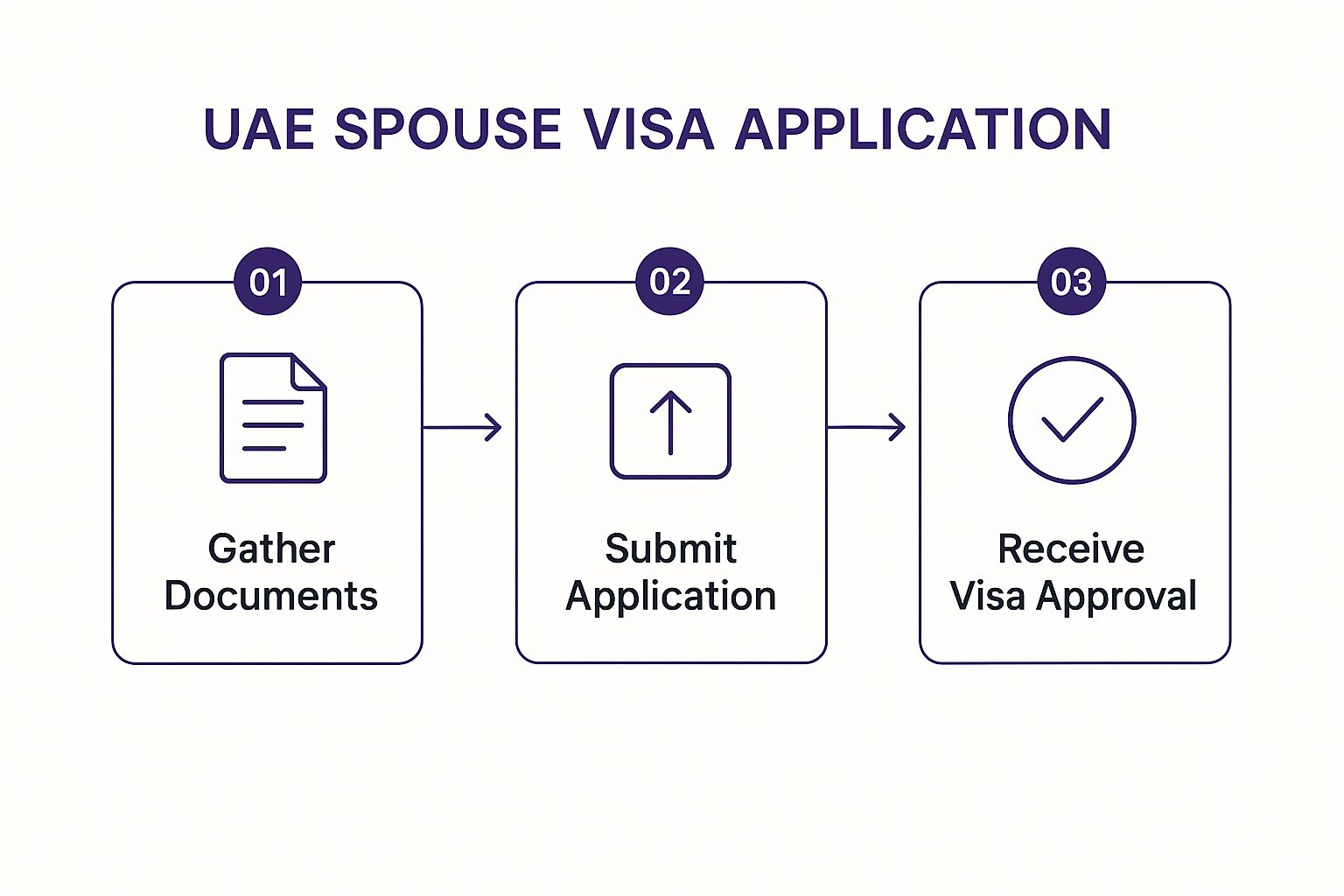
As you can see, it’s a step-by-step process. Each stage needs to be completed before you can move on to the next.
Path 1: Your Spouse is Already Inside the UAE
This is the route most couples prefer, and for good reason. It allows your partner to stay in the country while the visa is being processed, which avoids a lot of stress. If your spouse is here on a tourist or visit visa, you can apply for a “change of status” so they don’t have to fly out and back in again.
Here’s how it works, step-by-step:
- Apply for an Entry Permit: The first move is to apply for an entry permit (sometimes called a visa permit). You’ll do this through an approved typing centre like Amer in Dubai or a Tasheel centre elsewhere. Hand over all your documents, and once approved, this permit lets your spouse stay in the country legally while you sort out the rest.
- Complete the ‘Change Status’ Application: As soon as that entry permit is issued, you need to immediately apply for a “change of status”. This is what officially switches their status from a visitor to a soon-to-be resident. It comes with an extra fee, but it’s absolutely crucial for avoiding overstay fines.
This in-country status change is a game-changer. It means your spouse doesn’t have to leave the UAE and re-enter on the new permit, saving you a small fortune in flights and a mountain of logistical headaches.
- Medical Fitness Test: With the status changed, your spouse has to get a medical test at a government-approved health centre. This is a standard screening for certain communicable diseases, and passing it is non-negotiable for residency.
- Emirates ID and Biometrics: Next up, you’ll apply for your spouse’s Emirates ID card. This involves a trip to a Federal Authority for Identity and Citizenship (ICA) centre to give biometric data—basically, just fingerprints and a photo.
- Final Visa Stamping: The home stretch! You’ll submit your spouse’s passport to get the residency visa stamped inside. Once that’s done, their shiny new Emirates ID card will be printed and sent to you. Congratulations, your spouse is now officially a UAE resident!
Path 2: Your Spouse is Outside the UAE
If your spouse is still abroad, the process starts in a similar way, but they’ll need to travel to the UAE at a specific point. You’re essentially applying for an entry permit first, which they will use to enter the country for the purpose of getting their residency.
Here’s the timeline for this scenario:
- Apply for an Entry Permit: As the sponsor, you’ll kick things off by applying for the entry permit from inside the UAE. You’ll submit the exact same set of documents at a typing centre.
- Spouse Enters the UAE: Once the entry permit is approved, you’ll send a copy to your spouse. They need this document to travel to the UAE. Critically, this permit is usually valid for 60 days from its issue date, so they must enter the country within that two-month window.
- Complete In-Country Formalities: The moment your spouse lands, a new 60-day countdown begins. They have this timeframe to complete all the remaining steps inside the country. This includes:
- Getting the mandatory medical fitness test done.
- Applying for their Emirates ID and giving their biometrics.
- Submitting the passport for the final residency visa stamp.
Missing that 60-day deadline can lead to fines and serious complications, so it’s really important to get moving as soon as your spouse arrives. Whichever path you end up taking, staying organised and hitting your deadlines is the secret to a smooth and successful UAE spouse visa application.
What to Expect for Costs and Timelines
Let’s talk about the two things everyone asks about: money and time. Budgeting for your UAE spouse visa isn’t about one lump sum payment, and the process isn’t one long, endless wait. It’s a series of steps, each with its own cost and timeline. Knowing this upfront helps you plan properly and avoids any last-minute surprises.
The total cost is really a collection of individual fees you’ll pay along the way. Keep in mind that these can differ slightly from one emirate to another—Dubai’s service centre fees might not be exactly the same as Abu Dhabi’s, for instance. It also depends on whether you’re handling things yourself at a government service centre like Amer or Tasheel.
Breaking Down the Main Costs
So, where does the money actually go? It helps to see an itemised list so you can track your spending. The main expenses are tied directly to the mandatory steps in the process.
Here’s a rough breakdown of what you’ll be paying for:
- Entry Permit: This is your first major fee. It covers the permit that lets your spouse enter the UAE to start the residency process or, if they’re already here, to switch their visa status.
- Status Change (if applicable): If your spouse is in the UAE on a tourist or visit visa, this extra fee lets you change their status to a residence visa without them having to fly out and back in again. It’s a real convenience.
- Medical Screening: Everyone has to do it. This fee covers the mandatory medical fitness test and the official health certificate that comes with it.
- Emirates ID Application: This is for the application and printing of the Emirates ID card. It’s a non-negotiable part of becoming a resident, and the card is usually valid for one or two years, matching the visa.
- Visa Stamping: The final step. This fee is for getting that all-important residence visa sticker officially placed in your spouse’s passport.
These are just the core government fees. Don’t forget to budget for the extras, like getting your marriage certificate attested, legally translated if it isn’t in Arabic, and paying the service fees at the typing centre that prepares your application.
Setting Realistic Timeline Expectations
When it comes to the timeline, patience is your best friend. The system is pretty efficient, but each stage has its own processing window. Understanding this flow from the get-go will save you a lot of stress.
Think of the process not as a single long wait, but as a series of smaller waiting periods. Completing one step unlocks the next. It’s a sequence of milestones rather than one massive hurdle.
Generally, once you’ve submitted a complete and correct application, you can expect the whole journey—from the initial entry permit to the final visa stamp—to take around 10 to 15 working days. But remember, this is a solid estimate, not a guarantee.
Let’s look at how that time breaks down:
- Entry Permit Issuance: This is usually the fastest part. After your application is in, the entry permit often comes through within 2 to 5 working days.
- Medical Test and Emirates ID: The medical results are quick, typically ready in just 24 to 48 hours. You can book the Emirates ID biometrics appointment soon after, and that application runs in parallel with the visa stamping.
- Visa Stamping: Once the medical is cleared and the Emirates ID process is underway, the final stamping in the passport usually takes another 3 to 5 working days.
Things like public holidays, a sudden rush of applications, or if officials ask for extra documents can slow things down. It’s always a smart move to add a small buffer to your plans. My advice? Don’t book any non-refundable flights until that visa is officially stamped in the passport.
Renewing Your Spouse Visa and Dodging Common Pitfalls
Getting your UAE spouse visa is a fantastic feeling, but keeping that residency valid is the next chapter. The good news? Renewing the visa is a much simpler affair than the first time around. Think of it less like building a house from scratch and more like a fresh coat of paint.
Even so, there are a few common trip-ups that can cause headaches for both renewals and first-time applicants. Knowing what to look out for is half the battle won. Let’s walk through the renewal steps and shine a light on the frequent mistakes people make, so you can manage the whole process with confidence.
The Spouse Visa Renewal Process
As your spouse’s visa approaches its expiry date, you’ll want to kick off the renewal process. The ideal window is within 30 days of expiry. Thankfully, you won’t need to dig up every single document from your original application; the authorities already have your main file.
The renewal is really about confirming that you still meet all the original sponsorship requirements. For the most part, you’ll need to provide:
- Your Renewed Documents: This means a copy of your updated labour contract or salary certificate and your new Ejari (tenancy contract).
- Another Medical Test: Your spouse will have to complete another medical fitness test at an approved government health centre. This is just to confirm they still meet the UAE’s health standards for residents.
- Updated Forms: You’ll need a new, typed application form for the renewal, along with fresh passport photos for your spouse.
Once you’ve submitted everything, you’ll move on to renewing the Emirates ID and getting the new residence visa stamped in their passport. This is typically for another one, two, or three years, depending on your sponsorship type.
Common Mistakes That Cause Delays
The smartest way to ensure a smooth application is to learn from the mistakes others have made. You’d be surprised how many applications get delayed or rejected not because of ineligibility, but because of small, avoidable admin errors.
By far, the most common reason a spouse visa gets stuck is due to incomplete or improperly prepared documents. A single missing attestation stamp can bring the entire process to a screeching halt, sometimes forcing you to start from square one.
To keep your application moving forward, steer clear of these common slip-ups:
- Improper Document Attestation: This is a big one. Handing over a marriage certificate without the correct stamps from your home country’s Ministry of Foreign Affairs, the UAE Embassy in that country, and the UAE Ministry of Foreign Affairs (MOFAIC) is a guaranteed rejection.
- Missing Deadlines: Once your spouse enters the UAE on their entry permit, the clock starts ticking. They have a strict 60-day window to get their medical test done and the visa stamped in their passport. Missing this deadline means daily fines and a whole lot of extra hassle.
- Incomplete Application Forms: A form with blank fields or typos will often be sent straight back to you. Always double-check, and then triple-check, every single detail before you submit it.
- Mismatched Names: Make sure the sponsor’s name on the tenancy contract (Ejari) is an exact match to the name on their passport, labour contract, and Emirates ID. Even a small difference can cause a delay.
Getting ahead of these issues will save you an incredible amount of time, money, and stress. It turns what could be a frustrating process into a smooth and positive step on your journey in the UAE.
A Few Common Questions, Answered
Even with a clear roadmap, specific situations can pop up that leave you wondering what to do next. Here are quick answers to some of the most common questions we get from clients navigating the spouse visa process.
Can I Sponsor My Spouse If I Have an Investor Visa?
Absolutely. If you’re a business owner or an investor in the UAE, you can definitely sponsor your spouse. The process is just slightly different.
Instead of providing an employer’s salary certificate, you’ll need to prove your financial standing using your company’s documents. This usually involves submitting your official trade licence and, in some cases, a few months of personal or corporate bank statements to show stable income. The other core requirements—like your attested marriage certificate and a registered tenancy contract (Ejari)—are exactly the same.
What Happens If My Spouse Fails the Medical Test?
This is a critical, non-negotiable part of any UAE residency visa. The medical fitness test screens for specific communicable diseases, like HIV and active tuberculosis, to protect public health.
Unfortunately, if the test comes back positive for one of these conditions, the visa application will be rejected. The authorities are very strict on this, and the individual is typically required to leave the country. Appeals in these situations are almost never successful.
Can a Woman Sponsor Her Husband in the UAE?
Yes, a wife can sponsor her husband, but the rules are a bit stricter compared to when a man sponsors his wife. The authorities often require the sponsoring wife to work in a specific professional field, such as medicine, engineering, or education.
There’s also a higher minimum salary requirement. This usually falls somewhere between AED 8,000 and AED 10,000 per month, though the exact figure can vary by emirate and whether her employer provides accommodation.
Navigating the ins and outs of the UAE spouse visa can feel overwhelming, but you don’t have to figure it all out on your own. For professional assistance with visa services or business setup, consider reaching out to a corporate service provider.
✅ Best Corporate Service Provider in Dubai, Abu Dhabi & Sharjah
✅ Specialists in Mainland Company Formation in Dubai & Abu Dhabi
✅ Specialists in Freezone Company Formation across the UAE
✅ 24/7 Support Service – Always here when you need us
✅ Cost-Effective Business Setup Solutions tailored to your needs
✅ Enjoy UAE Tax Benefits for International Entrepreneurs
📞 Call Us Now: +971-52 923 1246
💬 WhatsApp Us Today for a Free Consultation at https://365dayproservices.com