
Before you even think about filling out a single form, the very first step is to figure out if your business actually needs to register for corporate tax in the UAE. It’s a common question I hear, and the simple answer is: almost every business does. But whether you actually pay tax often comes down to your annual revenue and the specific nature of your business activities.
Do You Need to Register for Corporate Tax?

Let’s get this straight: your corporate tax journey in the UAE doesn’t start with the registration portal. It starts with a clear understanding of your obligations. The Federal Tax Authority (FTA) has cast a wide net with its definition of a ‘Taxable Person’, so don’t assume this only applies to massive corporations. If you’re running an LLC, a sole proprietorship, or even just earning business income as an individual, you need to take a close look at where you stand.
For individuals earning income from a business or freelance work, there’s a clear benchmark. The requirement to register for corporate tax kicks in once your total business turnover crosses AED 1 million within a single calendar year. Think of this as the definitive line that separates your personal earnings from what the FTA considers taxable business income.
Who Exactly is a “Taxable Person”?
Knowing your classification is crucial, whether you’re operating a mainland company in Dubai or a tech startup in a Sharjah free zone. As specialists in both Mainland and Freezone Company Formation across the UAE, we can confirm the rules are broad, but there are important nuances depending on your setup.
Here’s a practical breakdown:
- Mainland and Offshore Companies: If your business falls into this category, registration is mandatory. It doesn’t matter what your income level is—all resident juridical persons are required to register and prepare to file returns.
- Individuals with Business Income: This is where the threshold matters. If you’re a freelancer, consultant, or sole proprietor, you only have to register if your annual business-related revenue hits that AED 1 million mark. Your personal salary, rental income from real estate, and gains from personal investments don’t count towards this total.
- Free Zone Companies: Businesses set up in a free zone must also register for corporate tax. No exceptions. However, you might be eligible to become a ‘Qualifying Free Zone Person’, which unlocks some very attractive tax benefits, including a 0% rate on qualifying income.
To give you a clearer picture of what this means for your bottom line, here’s a quick summary of the tax rates.
Corporate Tax Rates and Thresholds at a Glance
The UAE’s corporate tax system is intentionally designed to be straightforward and supportive of small businesses and startups. This table breaks down the tiers so you can quickly see how your business might be affected.
| Annual Taxable Income (AED) | Corporate Tax Rate |
|---|---|
| From AED 0 to AED 375,000 | 0% |
| Above AED 375,000 | 9% |
As you can see, the 0% tax rate on the first AED 375,000 of taxable income provides significant breathing room for new and growing businesses. Only the profits above this amount are subject to the standard 9% rate, which remains one of the most competitive in the region.
The UAE’s corporate tax structure is a strategic move to support business growth while solidifying its position as a global economic hub. The tiered system—0% on profits up to AED 375,000 and a standard 9% rate above that—is a huge relief for SMEs. Free zone entities that meet specific substance and activity requirements can also benefit from this 0% rate, creating a powerful incentive for investment. This approach showcases how you can maintain a pro-business environment while meeting international tax standards. For more details, you can explore the UAE’s tax benefits for entrepreneurs.
Whether you’re an international entrepreneur looking to set up here or an established local business, getting this initial assessment right is absolutely critical. Correctly identifying your status from day one is the key to avoiding compliance headaches down the road and setting your business on the right path.
Getting Your Paperwork in Order for a Flawless Registration

Before you even think about logging into the EmaraTax portal, the real work begins with gathering your documents. Trust me, a smooth registration hinges entirely on being prepared. Having every piece of paper scanned, clear, and ready to go will save you a world of frustration and prevent those dreaded application rejections.
I always tell my clients to think of it like preparing ingredients before you start cooking. It just makes the whole process faster and a lot less stressful.
Whether you’re an international entrepreneur with a new free zone entity or a seasoned local business owner, the document list can shift slightly based on your company’s setup. The core requirements are pretty consistent, but the specifics for a mainland LLC in Dubai versus a free zone company in Sharjah will differ. Taking a moment now to get organised will pay off massively once you’re in the middle of the online form.
The Must-Have Documents for Every Business
No matter what kind of company you run, there are a few documents you absolutely cannot proceed without. Make sure these are current, clearly scanned (PDF or JPG works best), and saved somewhere you can easily find them.
- A Valid Trade Licence: This is your golden ticket. Double-check that your licence is active and not expired. An out-of-date licence is an instant roadblock.
- Passport and Emirates ID Copies: Get crystal-clear copies of the passports and Emirates IDs for every single owner, partner, and shareholder. I can’t tell you how many applications I’ve seen delayed simply because of a blurry or cut-off scan.
- Proof of Authorisation: The person filling out the application needs to prove they have the right to do so. This typically means having a Power of Attorney (POA) or a formal board resolution that explicitly names them as the authorised signatory for tax matters.
Other Documents You’ll Likely Need
Depending on your business structure, you might get asked for a few more things. It’s always better to have them ready just in case, so you don’t have to scramble for them mid-application.
One of the most common requests is for the Memorandum of Association (MOA) or Articles of Association (AOA). This is the legal blueprint of your company, showing its structure and who owns what. The Federal Tax Authority (FTA) will definitely want to review it.
Let’s take a real-world example: a mainland LLC in Dubai. For this setup, you’d need the DED-issued trade licence, passport copies for all partners, the authorised manager’s Emirates ID, the company’s MOA, and a clear contact number and P.O. Box. A free zone company would need the same types of documents, but they would be issued by their specific free zone authority instead.
As we moved through 2024 and look towards 2025, the UAE government has solidified the requirement for businesses to register for corporate tax with the FTA. The major trigger for this mandatory registration is if your annual business turnover climbs above AED 1 million. For any business hitting this number, meeting the registration deadline is crucial to dodge a hefty AED 10,000 penalty for being late.
While the process is similar for most, there are nuances. Legal entities must provide that proof of authorisation for the signatory, a step an individual might not have to worry about. You can find more details about the deadlines and what to expect by checking out the latest updates on the corporate tax registration deadline for 2025.
Diving into the EmaraTax Online Registration
Alright, with your documents in order, it’s time to tackle the online registration itself. The entire process takes place on the Federal Tax Authority’s official portal, EmaraTax. Get comfortable with this platform; it’s where all your tax affairs will be managed from now on.
First things first, you’ll need to create a user account. It’s a simple sign-up using your email and a secure password. Once that’s done and you’ve verified your account, you can log in and see the main dashboard.
Here’s a look at the EmaraTax portal homepage. This is your gateway to all tax services in the UAE.
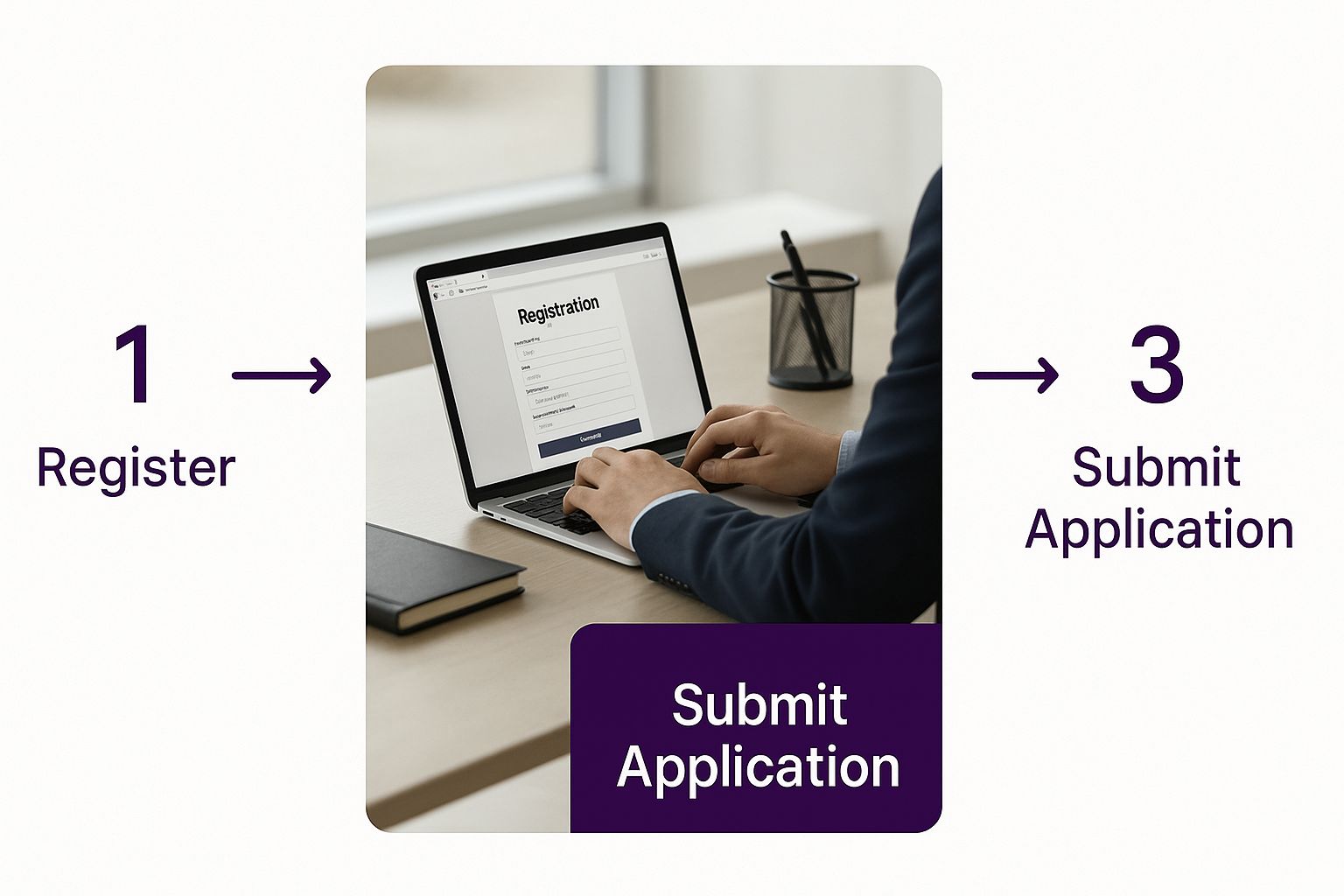
The portal is designed to be user-friendly, and you should easily spot the Corporate Tax registration option. This is where you’ll kick off the application to get your business formally recognised by the FTA.
Filling Out the Registration Form
Once you start the application, you’ll be guided through an electronic form broken into several sections. The key here is patience and precision. Keep your prepared documents handy to ensure every detail you enter is spot-on.
You’ll be asked to provide several key pieces of information:
- Business Details: This covers your company’s legal name, trade licence number, and its issue and expiry dates.
- Contact Information: A valid UAE phone number, P.O. Box, and the registered physical address of your business are required.
- Business Activities: You’ll need to select the activities that align with your trade licence. This is a crucial step, particularly if you’re a free zone entity aiming for Qualifying Free Zone Person status.
- Ownership Structure: Be prepared to list all owners, partners, and shareholders, along with their respective ownership percentages.
I’ve seen many applications get delayed because of small, avoidable mistakes. A classic one is rushing and entering inconsistent information. For example, your business name must be an exact match to what’s on the trade licence. A tiny difference, like typing “Ltd.” instead of “Limited,” can trigger a manual review and add weeks to your timeline.
After filling in the details, you’ll move on to uploading your documents. The portal has specific upload fields for your trade licence, MOA, passport copies, and other required files. Make sure you’re uploading clear, legible scans in the correct format (usually PDF or JPG) to prevent them from being rejected.
Declaring Financials and Hitting Submit
Near the end of the form, you’ll need to declare your company’s financial year-end and confirm whether your turnover exceeds certain thresholds. This data helps the FTA establish your tax period and other compliance obligations. For instance, any business with an annual turnover of over AED 50 million must maintain audited financial statements.
After a final review of all your entries, you’ll hit that all-important submit button. This is the moment your careful preparation pays off.
Once you submit, you’ll receive a confirmation, and your application will go to the FTA for review. If everything is correct, they will issue your unique Tax Registration Number (TRN).
While you can certainly navigate this process yourself, getting it right the first time is critical, especially with more complex business structures in Dubai, Abu Dhabi, or Sharjah. As the Best Corporate Service Provider in Dubai, Abu Dhabi & Sharjah, we ensure a smooth, error-free submission.
Understanding Your Deadline to Avoid Costly Penalties
When it comes to the UAE’s new corporate tax system, the single most common question I hear from clients is, “When exactly do I need to register?” It’s a valid concern because getting this wrong isn’t just a minor slip-up—it comes with a hefty, immediate fine. Let’s walk through how this works so you can stay on the right side of the Federal Tax Authority (FTA).
Forget about a single, universal tax deadline for everyone. The FTA has been quite practical here. They’ve tied your specific corporate tax registration deadline directly to the month your business licence was issued, regardless of the year. This clever approach creates a staggered system, preventing a massive bottleneck and giving everyone a clear, predictable timeframe.
For example, businesses whose licences were issued in January or February (of any year) had a firm deadline of 31st May 2024. This same logic applies throughout the year, whether your company is on the mainland or in a free zone.
How to Pinpoint Your Exact Deadline
To avoid any nasty surprises, you need to find your company’s specific registration window. The FTA has laid this out very clearly, so there’s no room for ambiguity. It all comes down to the month printed on your trade licence.
Here’s the official breakdown to help you find your deadline:
- Licence Issued in March or April: Your deadline is 30th June.
- Licence Issued in May: Your deadline is 31st July.
- Licence Issued in June: Your deadline is 31st August.
- Licence Issued in July: Your deadline is 30th September.
The pattern continues logically for the rest of the year. What if you don’t have a licence? For those entities, the deadline is three months from the date they started conducting business activities.
The Real Cost of Missing Your Deadline
Let’s be blunt: failing to register on time triggers an administrative penalty of AED 10,000. This isn’t a slap on the wrist or a warning letter; it’s an immediate financial consequence for non-compliance. Given how clearly the deadlines have been communicated, the FTA’s tolerance for delays is understandably low.
I’ve seen firsthand how seriously the FTA is taking enforcement. They’ve been very clear, but they also understand the adjustment period businesses are going through. My best advice? Be proactive. Registering early is your only guaranteed way to sidestep penalties.
The uptake has been massive. By mid-2024, the Federal Tax Authority reported a surge in registrations, with around 576,000 businesses already in the system. In a nod to the initial challenges, the FTA even introduced a Late Registration Penalty waiver. This initiative gives businesses a chance to avoid the AED 10,000 fine if they meet certain conditions. You can get the full story directly from the FTA about this important initiative.
While a waiver might sound like a good fallback, relying on it is a gamble. The safest and smartest strategy is to identify your deadline now and get your application submitted well in advance. If you’re feeling unsure, our specialists are available 24/7. We are always here when you need us and can jump on a free consultation to make sure you navigate every requirement without the stress.
Alright, you’ve successfully registered for corporate tax and have your Tax Registration Number (TRN) in hand. That’s a huge step, but what comes next?
Think of your TRN not as the end of the process, but as the official beginning of your company’s life within the UAE tax system. This unique number is now your official identifier for everything tax-related—from filing your annual returns to making payments. You’ll be using it constantly.
The Golden Rule: Meticulous Record-Keeping
Now that you’re registered, your most important ongoing task is keeping flawless financial records. This isn’t just good business practice; it’s the law.
The Federal Tax Authority (FTA) requires you to keep all your books of accounts and supporting documents for a minimum of seven years after the end of each tax period. And believe me, they can and do perform audits.
Your records need to be detailed enough to back up every single number on your tax return. This means having everything organised and accessible, including:
- Financial Statements: Properly prepared according to IFRS or IFRS for SMEs.
- Invoices and Receipts: A complete trail of all your income and expenses.
- Bank Statements: Every business-related transaction needs to be accounted for.
- Contracts and Agreements: Any legal paperwork that underpins your financial activities.
From my experience, poor record-keeping is the fastest way to get into trouble with the tax authorities. If you’re audited and can’t produce the documents to justify your tax filing, you could be looking at some serious penalties. It’s absolutely vital to have a solid accounting system in place from the very start.
Getting Ready for Your First Tax Return
With your records in order, your next major milestone is filing your first corporate tax return. You have nine months from the end of your company’s financial year to both file the return and pay any tax you owe.
That might sound like a lot of time, but it flies by. Don’t wait until the last minute. The process involves more than just submitting your profit-and-loss statement; you’ll need to calculate your taxable income by making specific adjustments to your accounting profit, as laid out in the law.
Once you’re registered, managing these ongoing tasks effectively is key. It’s a great time to look into efficient business process optimization to get your financial workflows in order. A proactive approach here makes record-keeping simpler and filing your return a much less stressful experience, keeping you compliant and prepared.
Feeling a bit overwhelmed by the UAE’s company formation rules or the corporate tax registration process? You’re not alone. It can feel like a maze, especially when you’re trying to get a new venture off the ground. That’s where bringing in a specialist can make all the difference.
Whether you’re setting up on the Mainland or in a Freezone across Dubai, Abu Dhabi, or Sharjah, getting expert advice is more than just a convenience—it’s a strategic move. We focus on providing cost-effective business setup solutions tailored to your needs. Our goal is simple: let us handle the paperwork and administrative headaches so you can focus on what you do best, all while ensuring you enjoy UAE tax benefits for international entrepreneurs.
One thing we’ve learned over the years is that questions don’t just come up between 9 and 5. That’s why we offer a dedicated 24/7 support service. It’s about giving you peace of mind and clarity right from the very beginning. Knowing you have an expert in your corner can be a real game-changer.
If you’d rather have someone guide you through the process to make sure every detail is spot on, let’s talk. A quick, free consultation can clear things up and get you started on the right foot.
📞 Call Us Now: +971-52 923 1246
💬 WhatsApp Us Today for a Free Consultation
Common Questions About UAE Corporate Tax
Getting your head around corporate tax in the UAE can be tricky, especially when you’re busy running your business. We get a lot of questions from entrepreneurs in Dubai, Abu Dhabi, and across the Emirates, so we’ve put together some straight-to-the-point answers to the most common ones.
Do I Still Need to Register if My Business Is in a Free Zone?
Yes, you absolutely do. This is a common point of confusion. Every single business in the UAE, including all free zone entities, must register for Corporate Tax. There are no exceptions to the registration requirement.
The real advantage of being in a free zone comes down to your tax liability. If your company meets the criteria for a ‘Qualifying Free Zone Person’—which involves conducting specific ‘Qualifying Activities’ and having real substance in the UAE—you can benefit from a 0% tax rate. But even if you’re certain you’ll owe zero tax, you still have to register to get your Tax Registration Number (TRN) and meet your legal obligations with the Federal Tax Authority (FTA).
What’s the Penalty if I Miss My Registration Deadline?
Missing your deadline is a serious and expensive oversight. The Federal Tax Authority (FTA) doesn’t issue warnings for this; they impose an immediate administrative penalty of AED 10,000 for failing to register on time.
Your deadline isn’t random—it’s tied to the month your trade licence was issued. It’s critical to know this date and get your application in well beforehand. While there have been rare instances of penalty waivers, you can’t bank on that. The only sure way to avoid the fine is to register on time.
Understanding the small but crucial differences between mainland and free zone rules, or the real-world impact of a missed deadline, is where expert advice really pays off. It’s about securing your compliance and your peace of mind.
Should I Register for Corporate Tax Myself or Hire a Consultant?
You can definitely handle the corporate tax registration on your own using the FTA’s EmaraTax portal. If your business is very simple and you’re comfortable with the process, it’s a manageable task.
However, for most businesses, getting professional help is a smart move. This is particularly true if your company has a complex ownership structure, you’re an international founder, or you’re a free zone entity trying to lock in that 0% tax rate.
A good tax specialist will:
- Make sure your application is filled out perfectly, with no mistakes.
- Correctly classify your business activities, which is vital for free zone companies.
- Catch common errors that can cause delays, rejections, or even future compliance problems.
While DIY is an option, working with a specialist in Mainland and Freezone company formation ensures everything is done right the first time. It saves you stress and protects you from costly mistakes down the road. Our 24/7 support service is always available to help clear up any confusion.
Navigating corporate tax registration and setting up a business in Dubai, Abu Dhabi, or Sharjah doesn’t have to be overwhelming. For practical, expert solutions that fit your budget, get in touch with 365 DAY PRO Corporate Service Provider LLC. Let our team make sure you take full advantage of all the UAE tax benefits on offer.
Explore our business setup services at https://365dayproservices.com.