
What Is a Memorandum of Association? Your Company's Blueprint

When you start a business, you're essentially building something from the ground up. Before any architect lays the first brick, they need a detailed blueprint. This plan dictates the building’s purpose, its physical limits, and its core specifications. For your company, the Memorandum of Association (MoA) is that exact blueprint.
It’s the foundational charter document that officially establishes your company’s existence and sets the rules for how it engages with the outside world. This isn't just a piece of administrative paperwork; it's a non-negotiable legal requirement for forming a company anywhere in the UAE.
Defining Your Company's Public Identity
At its heart, the MoA is a public declaration. It’s the document that tells regulators, banks, partners, and customers who you are, where you're located, and what you do. It formally separates the company from its owners, establishing it as its own distinct legal entity. This is a critical concept, as it’s the basis for limited liability, which protects the personal assets of shareholders.
A well-crafted MoA provides absolute clarity on a few core elements:
- Company Objectives: It spells out the specific business activities your company is legally allowed to pursue. Anything outside this scope is considered ultra vires, or beyond your legal powers.
- Shareholder Liability: It clearly states the financial responsibility of each shareholder, which is typically limited to the amount invested in their shares.
- Capital Structure: The document details the total authorised share capital of the company and how it's distributed among the founders.
A Quick Look at the MoA's Key Functions
To get a clearer picture, let's break down the primary roles of the Memorandum of Association. The table below summarises its most important functions, giving you a quick reference for why this document is so vital to your business setup.
Key Functions of a Memorandum of Association at a Glance
| Function | Description |
|---|---|
| Defines Existence | Legally establishes the company as a separate entity from its owners. |
| Sets Objectives | Outlines the specific business activities the company is authorized to conduct. |
| Establishes Liability | Clarifies the financial liability of shareholders, typically limiting it to their investment. |
| Outlines Capital | Details the company's total authorized share capital and its initial structure. |
| Public Declaration | Serves as a public record for stakeholders like investors, banks, and authorities. |
| Foundation for Governance | Sets the external framework within which the company must operate. |
This summary highlights how the MoA acts as the constitutional bedrock for your enterprise, providing structure and legal certainty from day one.
A Cornerstone of UAE Business Registration
The UAE government has worked hard to make company formation more straightforward. A clear and standardized MoA is central to this effort, whether you're setting up on the UAE mainland or in a free zone. In fact, digital reforms related to the MoA and other registration steps have helped cut the time needed to register a business by approximately 30%, according to World Bank analysis. This commitment to efficiency underscores just how important it is to get this foundational document right.
Ultimately, the MoA isn't just a hurdle to clear. It’s the very DNA of your company’s legal identity and operational authority. It’s the document that gives your business the right to exist and operate within the law.
How the MoA Has Evolved with UAE Company Law
To really get a handle on the modern Memorandum of Association, you can't see it as some static, dusty document. It’s alive, and it has grown and changed right alongside the UAE's incredible economic journey. Think of the MoA's evolution as a mirror reflecting the country's transformation into a global business hub. The legal framework has been constantly sharpened to attract investment and build a transparent corporate environment, all in response to what international entrepreneurs and investors actually need.
It wasn't always this way. If you look back at older frameworks, like the 1984 Commercial Companies Law, the approach was a bit more relaxed. Companies could often get by with broader, more generalized clauses about what they planned to do. That world is long gone.
From General to Granular: The Shift to Precision
Today's legal landscape demands absolute clarity. UAE authorities now review every single clause with a fine-toothed comb, paying special attention to the Objects Clause—the part that defines your company’s permitted activities. Vague or sweeping descriptions simply won't fly anymore. Your MoA must list specific, approved business activities that match your trade license, one-to-one.
This move toward precision wasn't just for a bit of extra paperwork. It serves a few critical purposes:
- Tighter Regulatory Oversight: When activities are specific, it's far easier for authorities to monitor businesses and ensure they’re playing by the rules.
- Investor Protection: Clear objectives give shareholders and partners peace of mind, knowing their investment is being used for its stated purpose and not for some unexpected venture.
- Fewer Legal Headaches: A precise MoA leaves little room for interpretation, which significantly cuts down the risk of future arguments over what the company is and isn't allowed to do.
This shift toward granularity makes sure every company operates within a well-defined legal and commercial box, strengthening the integrity of the entire market.
Aligning with Global Corporate Governance
The UAE’s legal updates are all about bringing the nation's corporate practices in line with top international standards. You can see this commitment reflected in what’s now required in a memorandum of association. A huge step was the introduction of the 2020 Companies Law, which made it mandatory to include detailed capital structures and shareholder agreements directly within the MoA. Suddenly, the document became much more comprehensive. This newfound legal clarity helped supercharge investor confidence, which coincided with foreign direct investment inflows doubling to $19 billion annually by 2022. It's powerful proof of what clear corporate rules can do. You can dig deeper into these trends in the World Bank's regional reports.
A modern UAE MoA is more than just a registration document; it's a declaration of compliance, transparency, and a company's readiness to do business on a global stage. Its precision directly reflects the country's commitment to creating a secure and predictable investment climate.
At the end of the day, the MoA's journey from a simple charter to a detailed constitutional document is a story of smart, strategic progress. For any entrepreneur setting up in Dubai, Abu Dhabi, or Sharjah, it means that while the goalposts have moved and the requirements are stricter, the legal foundation you build for your business is stronger and more resilient than ever. We are the Best Corporate Service Provider in Dubai, Abu Dhabi & Sharjah, and our specialists in Mainland and Freezone company formation are here to make sure your MoA meets these exacting standards right from the start.
Anatomy of an MoA: Key Clauses Explained

To really get a feel for what a memorandum of association does, we need to look under the hood. It’s less like a stuffy legal tome and more like your company's official birth certificate and passport rolled into one. Every section, or 'clause', pins down a vital piece of information that defines your company’s identity and what it's allowed to do.
These clauses aren’t just suggestions; they’re the non-negotiable building blocks that give your business its legal form. Getting one wrong or leaving any ambiguity can cause serious headaches later on. Let’s walk through the essential clauses one by one.
The Name Clause
This one’s straightforward but absolutely foundational. It states the official, legal name of your company. This name has to be unique and get the green light from the relevant economic department here in the UAE. From contracts to letterheads, this is the name you'll use for everything, marking the very first step in carving out your company's legal identity.
The Registered Office Clause
This clause formally records your company's legal address in the UAE. It’s much more than just a P.O. box; this is the official spot where all legal notices and correspondence will be sent. For mainland companies especially, this is crucial because it establishes your legal jurisdiction and proves you have a physical presence, which is a must-have for many business activities.
The Objects Clause
This is arguably the most important part of your entire MoA. The Objects Clause lays out, in detail, the purpose of your business and the full range of activities it's legally authorised to carry out.
Think of it as the defined boundaries of your company's playground. Inside those boundaries, you're free to operate. But if you conduct business outside of them, you’re acting ultra vires (a legal term for "beyond your powers"). Such actions can be nullified, exposing your company to significant legal risks. As Specialists in Mainland Company Formation in Dubai & Abu Dhabi, we excel at helping you frame these activities precisely.
A well-crafted Objects Clause is your first line of defense in any future legal disputes. It ensures your business operations are perfectly aligned with your trade license, making every move you make legally sound from the get-go.
The Liability Clause
This clause is your personal financial shield. The Liability Clause confirms that the liability of each shareholder is limited to the value of their shares in the company. It's the very principle that makes a Limited Liability Company (LLC) so attractive, as it separates your personal assets—like your house or car—from the company's finances, protecting them from creditors if the business runs into trouble.
The Capital Clause
Here, you'll find the details of the company's financial backbone. The Capital Clause outlines the authorised share capital—the total amount of capital the company is permitted to raise by issuing shares—as well as the initial capital paid by the founders. It also breaks down how this capital is divided into shares of a set value and who holds them.
The Subscription Clause
Finally, we have the Subscription Clause. This is where the founding shareholders, or subscribers, formally declare their intention to create the company and commit to taking the number of shares listed next to their names. It acts as the official sign-off page. With witnessed signatures, the founders bind themselves to the memorandum's terms, legally bringing the company to life.
MoA vs AoA: What's the Difference?
When you're setting up a business, it's easy to get tangled up in the paperwork. Two documents that often cause confusion are the Memorandum of Association (MoA) and the Articles of Association (AoA). While they're a package deal, they play very different roles.
Let's try a simple analogy. Think of your company as a country. The MoA is its constitution. It sets out the country's name, its borders (what business it can do), and its relationship with the rest of the world. The AoA, on the other hand, is the set of laws that govern how things work inside those borders—how leaders are elected, how decisions are made, and the rights of its citizens (shareholders).
The MoA is your company's foundational charter. It’s the document that tells banks, investors, and government bodies who you are and what you're here to do. It answers the big-picture questions. The AoA gets into the nitty-gritty of daily operations, defining the internal mechanics of your company.
The Charter vs. The Rulebook
So, the MoA defines the playground, and the AoA sets the rules for the games played within it. The MoA establishes the company's legal identity and powers, while the AoA manages its internal affairs.
Here’s how that plays out in the real world:
- The MoA will state that your company is authorised to engage in "e-commerce and retail" activities.
- The AoA will detail the process for appointing a new CEO, the procedures for holding an Annual General Meeting, or how shares can be transferred between owners.
This infographic breaks down some of the key elements that go into creating the MoA.
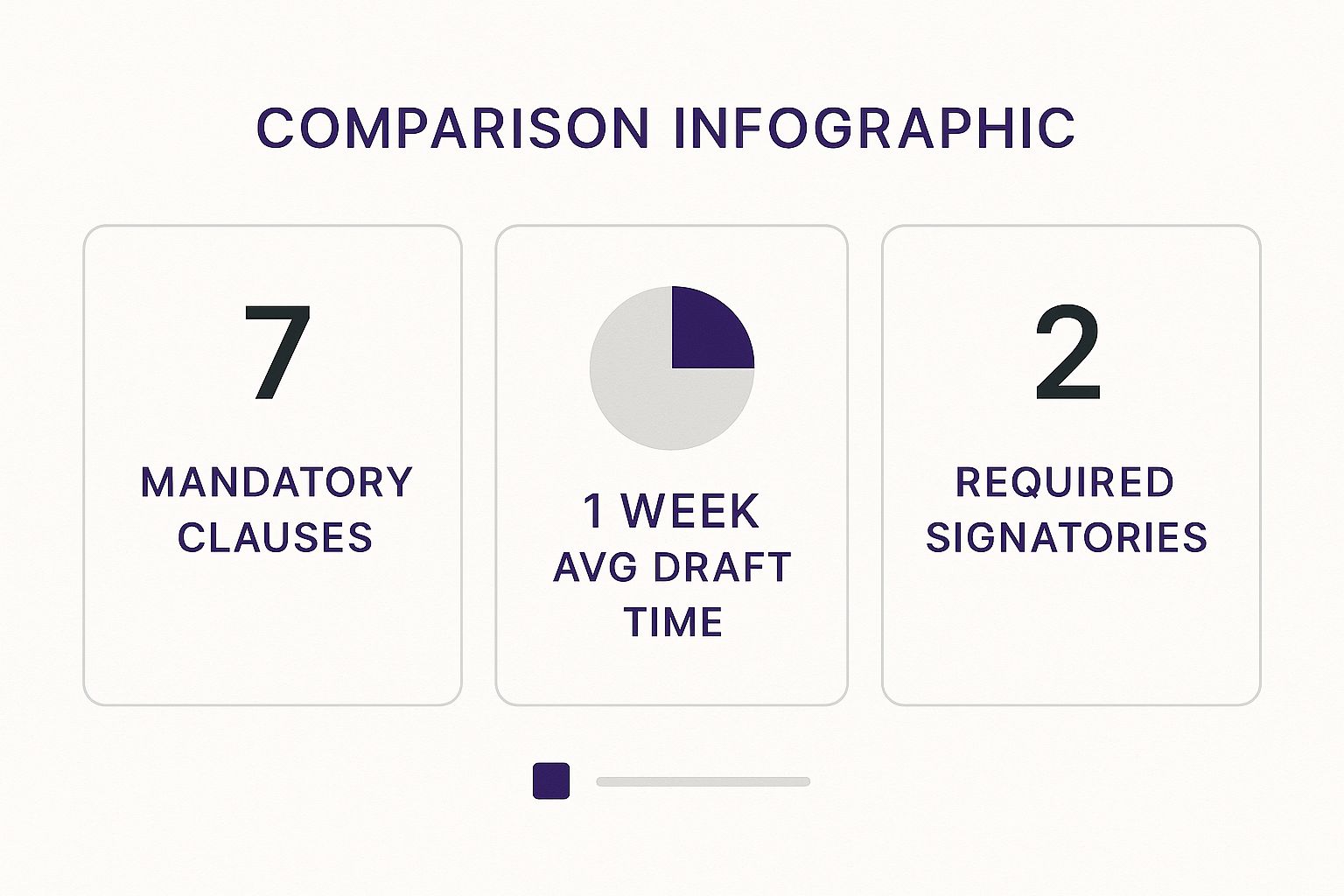
As you can see, a standard MoA typically includes 7 mandatory clauses, needs at least 2 signatories, and usually takes about a week to get just right.
A Clear Comparison
To make the distinction crystal clear, let's break it down side-by-side. This table highlights the core differences between the two essential documents.
| Aspect | Memorandum of Association (MoA) | Articles of Association (AoA) |
|---|---|---|
| Primary Purpose | Defines the company's charter, objectives, and scope. It's the company's constitution. | Outlines the internal rules, regulations, and procedures for company management. It's the company's by-laws. |
| Relationship | Governs the company's relationship with the outside world (creditors, investors, the public). | Governs the internal relationship between the company and its members (shareholders, directors). |
| Scope | Sets the boundaries within which the company can operate. Any action outside this is invalid. | Provides the framework for operating within the boundaries set by the MoA. |
| Content | Includes mandatory clauses: Name, Registered Office, Objects, Liability, Capital, and Association. | Includes rules for share capital, meetings, director appointments, voting rights, and profit distribution. |
| Alteration | Difficult to change. Requires a special resolution and often government approval. | Easier to change. Typically requires a special resolution passed by shareholders. |
| Legal Hierarchy | The supreme document. It overrides the AoA in case of any conflict. | Subordinate to the MoA. Cannot contain any clause that contradicts the MoA. |
Understanding this table is key. The MoA is your company's bedrock, while the AoA is the operational framework built upon it. Both must be drafted with care to work in harmony.
Which Document Holds More Power?
There's no contest here: the Memorandum of Association is the superior document.
If a conflict ever arises between a rule in your AoA and a clause in your MoA, the MoA always wins. Full stop. The Articles of Association simply cannot contain a provision that contradicts or goes beyond the scope defined in the Memorandum.
Think of it this way: The MoA is the supreme law of your corporate land. The AoA consists of the statutes passed under that law. Any statute that violates the supreme law is automatically void. The same principle applies here.
Getting this hierarchy right is crucial. You could follow your internal rulebook (the AoA) to the letter, but if the action you take steps outside the boundaries set by your MoA, it could be deemed legally invalid. This is precisely where professional guidance on mainland and freezone company formation proves its worth—we ensure your constitutional and legal documents are perfectly aligned from day one.
Drafting Your MoA for UAE Business Setup
Alright, so you’ve got the theory down. Now comes the exciting part: actually creating the Memorandum of Association for your new venture. This is where the rubber meets the road, and it’s a process that demands attention to detail, a bit of foresight, and a solid grasp of the rules in your chosen jurisdiction—whether that’s on the UAE mainland or in a free zone.
While both paths get you to a valid trade license, the journey to a finalized MoA looks a little different for each. Mainland companies in Dubai or Abu Dhabi, for instance, typically follow a fairly standardized process through the Department of Economic Development (DED). Free zones, on the other hand, each have their own specific templates and online portals. No matter where you set up, the end goal is the same: to create a rock-solid legal document that perfectly captures your company's identity and what it’s allowed to do.
Our specialists in Mainland and Freezone Company Formation live and breathe these different pathways. We're here to walk you through every step, making sure each detail is spot-on with local regulations. With our 24/7 Support Service, you're never navigating this critical phase alone.
Key Steps in the Drafting Process
Getting to a finished MoA involves hitting several important milestones. Thankfully, the introduction of the e-MoA system has made things much faster and more straightforward. In fact, data from the UAE's Ministry of Economy reveals that over 95% of new companies registered between 2018 and 2023 submitted their MoA electronically. This digital shift even helped drive a 20% year-over-year increase in new company registrations in 2019 and 2020. You can dig deeper into how these government initiatives have shaped the UAE’s economic landscape.
So, what does the process actually look like? Here’s the general workflow:
- Defining Business Activities: First, you’ll work closely with a corporate service provider to nail down the exact, approved business activities that will go into your Objects Clause. This has to be precise.
- Drafting the Document: Your consultant will then draft the MoA, carefully weaving in all the mandatory clauses and shareholder information.
- Shareholder Review: This is a crucial gut-check. All founding partners need to review the draft to ensure it perfectly matches their shared vision and agreement.
- Notarization: Once everyone agrees, the MoA must be signed by all shareholders in front of a public notary here in the UAE. This is the step that makes it official and legally binding.
- Submission: Finally, the notarized MoA is submitted to the relevant authority (like the DED for mainland or the specific free zone authority) as a key part of your trade license application.
Aligning Your MoA with Your Legal Structure
It’s absolutely critical that your MoA matches your chosen legal structure. The content and specific requirements for a Limited Liability Company (LLC) are quite different from those for other business types.
Think of it this way: an LLC's MoA must clearly state that the partners' liability is limited and spell out exactly how the shares are divided. A Sole Establishment, which is a one-person show, doesn't need a multi-shareholder MoA at all but will have its own foundational documents outlining its business scope.
Getting this alignment wrong can bring your entire application to a screeching halt. As specialists in creating Cost-Effective Business Setup Solutions tailored to your needs, we make sure your MoA is not just a generic template. It’s tailored to your specific business activities and your chosen legal form, clearing the path for a smooth and successful registration.
Ready to Launch Your UAE Business? We Can Help.
As we've seen, a thoughtfully drafted Memorandum of Association is more than just a legal requirement—it’s the very foundation of your company. Getting every detail right from the beginning is crucial for staying compliant and paving the way for future growth here in the UAE.
While it's possible to go it alone, the small details can have big consequences. A flawless MoA from day one can save you a world of time, money, and legal hassles later on.
So, why try to navigate this complex legal landscape by yourself? We are the Best Corporate Service Provider in Dubai, Abu Dhabi & Sharjah. Our specialists in Mainland and Freezone Company Formation across the UAE live and breathe this stuff. We provide practical, Cost-Effective Business Setup Solutions tailored to your specific business goals, handling all the intricacies of the MoA so you can get back to what you do best: building your business.
Your Partner From Day One
Setting up a new company should be an exciting moment, not one bogged down by paperwork and confusion. Our goal is simple: to make the entire process smooth and straightforward for you. With our 24/7 Support Service, we’re always here when you need us, making sure every step of your company formation is handled with care and precision.
Partnering with us means you can confidently Enjoy UAE Tax Benefits for International Entrepreneurs. Let our experts handle the heavy lifting of your business setup, giving you a clear and efficient path to launching your company.
Ready to take the first step in your UAE business journey?
✅ Specialists in Mainland Company Formation in Dubai & Abu Dhabi
✅ Specialists in Freezone Company Formation across the UAE
✅ Cost-Effective Business Setup Solutions tailored to your needs
✅ Enjoy UAE Tax Benefits for International Entrepreneurs
✅ 24/7 Support Service – Always here when you need us
📞 Call Us Now: +971-52 923 1246
💬 WhatsApp Us Today for a Free Consultation
Frequently Asked Questions
When you're setting up a business in the UAE, especially for the first time, you're bound to have questions about the Memorandum of Association. Getting straight answers is crucial for moving forward with confidence. Here are some of the most common queries we hear from entrepreneurs just like you.
Can I Amend the Memorandum of Association After Registration?
Absolutely, but it's a formal process, not a simple edit. Once your company is registered, changing your MoA requires you to follow specific legal steps. Think of it as amending your company's constitution—it needs proper procedure and approval.
Typically, you'll need to pass a special resolution that all shareholders agree on. From there, you submit the changes to the relevant authority, like the Department of Economy and Tourism (DET), for their stamp of approval. Whether you're changing your business activities, company name, or capital structure, the update must be officially recorded to be legally binding.
Is an MoA Required for a Sole Proprietorship?
It depends. For a sole proprietorship owned by one person, you won't need a traditional MoA designed for multiple shareholders. That just wouldn't make sense.
However, you still need a founding document. The licensing authority usually issues a document that serves a similar purpose, defining the business's legal name, its activities, and official status. But here's a key distinction: if a company owns the sole proprietorship, then an MoA is generally required.
When a company does something that isn't covered in the 'Objects Clause' of its MoA, that action is considered 'ultra vires'—a Latin term meaning 'beyond the powers'. This can render the act legally void and create serious trouble for the business and its directors.
What Happens If My Company Acts Outside Its MoA Scope?
Stepping outside the activities defined in your MoA is a serious matter with real legal consequences. Your Objects Clause isn't just a suggestion; it's a hard boundary for your company's legal operations.
Any business deal or contract your company enters into that falls outside these defined powers is deemed ultra vires. This can make the entire transaction legally void, as if it never happened. This not only opens your company up to lawsuits but can also attract penalties from regulatory bodies. It’s a powerful reminder of why getting your business activities right from day one is so important for your company's stability.
Navigating the details of a flawless Memorandum of Association is what we do best. The experts at 365 DAY PRO Corporate Service Provider LLC make sure your company’s foundational documents are perfectly drafted and fully compliant with UAE law, setting you up for a smooth business launch. Let us handle the legal heavy lifting so you can focus on what you do best: growing your business.
Find out more about our business setup solutions and get started today.