
So, you're looking to make the UAE your new home? Fantastic. The first and most crucial step is figuring out which residence visa pathway is the right fit for you. Think of it as choosing the right key for the right door.
Most people find their route to residency through employment, property investment, or by setting up their own business. While each path has its own set of rules and requirements, they all lead to the same destination: legal residency in one of the world's most exciting countries.
Understanding Your UAE Residence Visa Options
Getting your head around the different visa options is the foundation of the whole process. It might look a bit complicated from the outside, but it's actually quite logical. The system is built around your primary reason for being here—whether you're coming for a job, to invest, or to join your family.
The UAE’s approach to residency is shaped by its incredibly diverse population. With expatriates making up over 88.5% of the country's residents, a clear and structured visa system isn't just helpful; it's essential. This massive international community, with large groups from India, Pakistan, and other parts of Asia, is what makes the UAE so vibrant.
The Main Pathways to Residency
For the vast majority of people, the journey to a UAE residence visa boils down to one of three main routes. Your job is to figure out which one aligns with your plans.
-
Employment Visa: This is by far the most common way in. A company in the UAE offers you a job and then acts as your sponsor, handling the heavy lifting of the visa application for you.
-
Investor or Entrepreneur Visa: If you've got a business idea or are looking to invest, this is your ticket. You can secure residency by setting up a company—either on the Mainland or in a Free Zone—or by purchasing a property that meets the minimum investment value.
-
Family Sponsorship: Already a resident? Great. You can sponsor your immediate family, like your spouse and children, to come and live with you. It’s a straightforward way to bring your loved ones over.
No matter which path you take, one thing is non-negotiable: health insurance. Every resident needs it. To get a better handle on what's required, it’s worth reading up on Health Insurance for Expatriates in the United Arab Emirates.
To help you see how these options stack up, here’s a quick comparison of the most common visa types.
UAE Residence Visa Pathways at a Glance
This table breaks down the main visa routes, giving you a clear snapshot of what each involves and who it’s best for.
| Visa Type | Primary Eligibility | Typical Validity | Best For |
|---|---|---|---|
| Employment Visa | A valid employment contract with a UAE-based company. | 1-2 years (renewable) | Professionals and skilled workers with a job offer. |
| Investor Visa | Significant investment in property or a UAE business. | 2-10 years (renewable) | High-net-worth individuals and real estate investors. |
| Entrepreneur Visa | Founding or owning a business in the UAE (Mainland or Free Zone). | 2-5 years (renewable) | Business owners and startup founders. |
| Family Visa | Sponsored by a relative who is a legal UAE resident. | 1-3 years (tied to sponsor's visa) | Spouses, children, and dependent parents of residents. |
Hopefully, this gives you a clearer idea of where you might fit in. Choosing the right path from the start saves a lot of time and potential headaches down the line.
Choosing the right corporate service provider can make a significant difference. As the Best Corporate Service Provider in Dubai, Abu Dhabi & Sharjah, we offer tailored, cost-effective business setup solutions and 24/7 support to ensure your visa process is seamless.
The Employment Visa: A Practical Walkthrough
For most professionals eyeing a move to the UAE, the path to residency starts with a single, crucial document: a job offer. The employment visa is by far the most common route, and while your new company will do most of the heavy lifting, it’s smart to understand the journey ahead. Let's break down what your employer handles versus what you’ll need to do yourself.
Landing a job is, of course, the very first hurdle. You can't even begin the visa process without an official offer in hand. If you're still in the search phase, here's some great advice on how to effectively use LinkedIn to find job opportunities that can lead to that all-important contract. Once you've signed on the dotted line, your employer kicks things off.
Getting Your Foot in the Door: The Entry Permit
First up is the entry permit, which you might also hear called an e-visa. This isn't something you apply for; your employer takes care of it through the official immigration portals. Think of it as your official invitation to enter the UAE for work.
Once issued, you typically have 60 days to travel to the UAE. The moment you land, another clock starts—you then have another 60 days to complete the rest of the process and convert this temporary permit into your full residence visa.
This infographic gives you a clear picture of the essential documents you’ll need as you move from the initial entry permit to becoming a full resident.
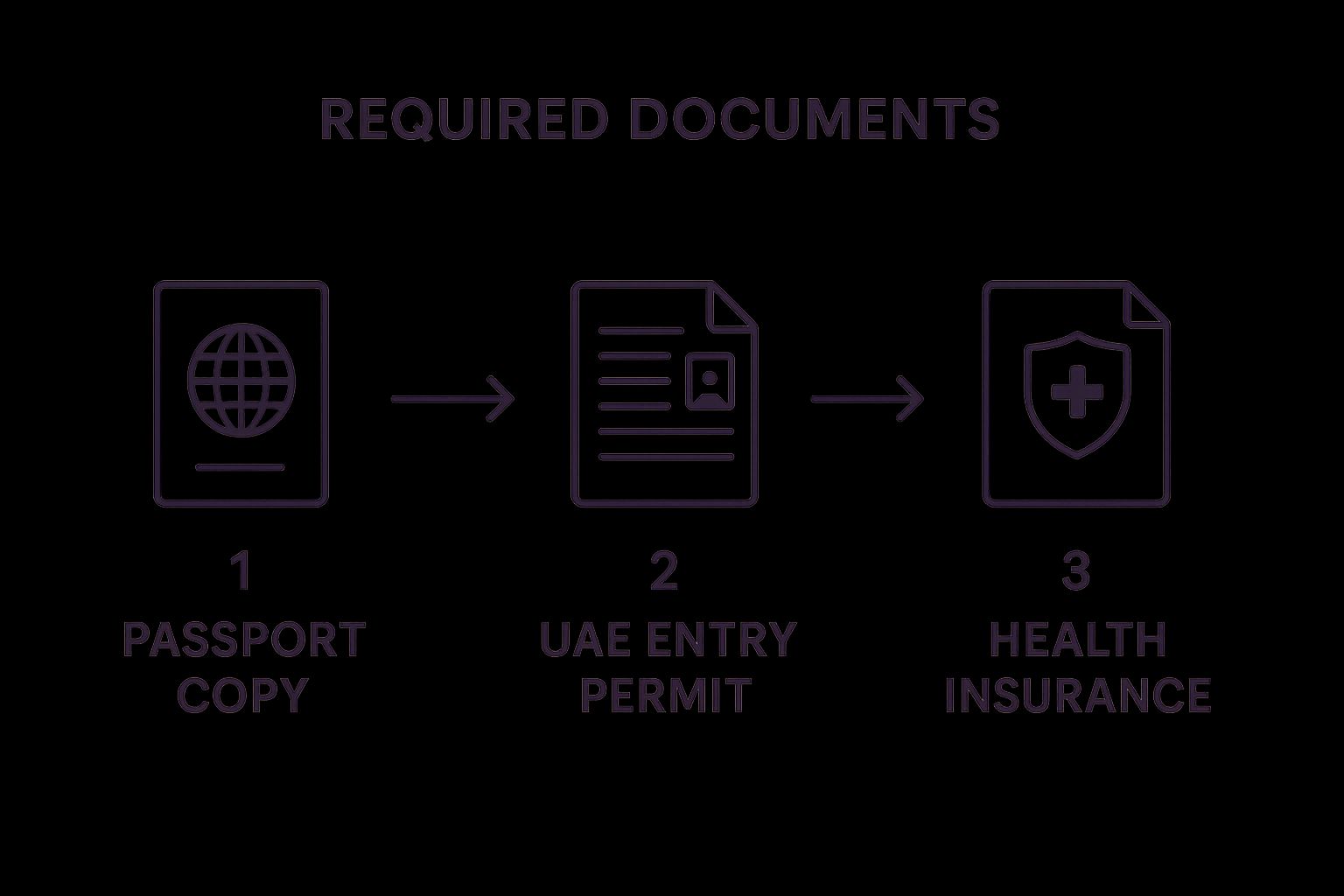
As you can see, your passport, the entry permit from your employer, and a valid health insurance policy are the cornerstones of the whole process.
Medicals and Biometrics: The In-Country Steps
After arriving in the UAE, you have a couple of important appointments to get through: the medical fitness test and your Emirates ID biometrics. Your company's PRO (Public Relations Officer) will usually point you in the right direction, but it's up to you to show up and get them done.
The medical test is standard procedure for anyone over 18 applying for residency. It's a straightforward screening that includes a blood test and a chest X-ray to check for certain communicable diseases. The results are sent directly to the immigration authorities, usually within 24-48 hours.
At the same time, you'll visit a designated centre to apply for your Emirates ID. This is where you’ll provide your fingerprints and have your photo taken. Don't lose the application receipt—it's a critical piece of paper you'll need for the final visa stamping.
Even though your employer is your sponsor, juggling these appointments and paperwork can be a real headache. This is where a corporate service provider can be a lifesaver, coordinating schedules and double-checking every document to avoid frustrating delays. Our 24/7 Support Service means we’re always here when you need us.
The Final Step: Getting the Visa Stamped
This is the moment it all becomes official. With your medical results cleared and biometrics completed, your employer submits the final package to the immigration authorities. This bundle of documents includes:
- Your original passport
- The entry permit
- Your medical fitness certificate
- The Emirates ID application receipt
- A copy of the company's trade licence and immigration card
The authorities then place the residence visa sticker directly into your passport. That stamp is your proof of legal residency in the UAE, typically valid for one to two years and renewable. With that done, you're officially a resident, and your physical Emirates ID card will arrive in the mail shortly after.
From landing in the UAE to getting the visa stamped in your passport, the whole process usually takes between two and four weeks. The real key to a smooth run is preparation. Having all your personal documents, especially properly attested educational certificates, ready to go before you travel can save you from major delays. One small mistake can set you back weeks.
Working with a specialist can make all the difference. For a free consultation on how we can make your journey to UAE residency seamless, WhatsApp Us Today for a Free Consultation or give us a call at +971-52 923 1246.
Investor and Entrepreneur Paths to Residency
For many, the dream of living in the UAE isn't about finding a job—it's about building one. The country has rolled out the red carpet for entrepreneurs and investors, creating clear, structured pathways to residency for anyone ready to contribute to its booming economy.
Whether you're launching a new venture or buying property, using your assets is a powerful way to secure your place here. This approach gives you far more control than a typical employment visa, putting you firmly in charge of your own residency status. It all starts, however, with one critical decision that will define your entire business journey in the UAE.

The First Big Choice: Mainland vs Free Zone
Before you even think about the visa application, you have to decide where your business will call home. This choice between setting up on the Mainland or in a Free Zone is fundamental. It impacts everything—your market access, ownership rules, and ultimately, your visa eligibility. Getting this right from the start is non-negotiable for long-term success.
Deciding between a mainland and a free zone setup is one of the most important choices you'll make when establishing your business in the UAE. Each has distinct advantages and limitations that directly affect your operations and growth potential. Here's a straightforward comparison to help you understand the core differences.
Mainland vs Free Zone Company Setup
| Feature | Mainland Company | Free Zone Company |
|---|---|---|
| Ownership | Now allows 100% foreign ownership for most activities, though some strategic sectors may still require a local partner. | 100% foreign ownership is standard across all free zones, offering complete control to the investor. |
| Business Scope | Unrestricted access to trade directly within the entire UAE local market and internationally. Ideal for client-facing businesses. | Operations are generally restricted to the specific free zone and international markets. Trading within the UAE mainland requires a local distributor. |
| Office Space | Requires a physical office space registered with the authorities. Office location is flexible across the emirate. | Can often start with a flexi-desk or virtual office, making it a more cost-effective option for startups. Physical office is optional but available. |
| Visa Quota | Visa eligibility is tied to the size of the physical office space. More space generally means a larger visa quota for employees. | The number of visas is typically determined by the business package chosen, not necessarily the office size. |
Understanding these nuances is key. A mainland company gives you the freedom to operate anywhere, which is crucial for retail or direct service businesses. On the other hand, a free zone offers a more controlled, often lower-cost environment perfect for export-focused companies or those who don't need a physical presence across the UAE.
Securing Residency Through Real Estate
Another well-trodden path to residency is through property investment. The UAE's thriving real estate market offers a direct route to a long-term visa, as long as your investment hits a certain mark. This is a fantastic option for anyone who wants to plant roots in the country without the day-to-day demands of running a business.
To qualify for a residence visa through property, you need to invest a minimum of AED 2 million (around $545,000 USD) in a freehold property. A crucial point: the property must be completed and ready to live in, not an off-plan purchase. The visa you get for this is typically a Golden Visa, which gives you long-term residency for up to 10 years.
The process kicks off once the property is officially registered in your name. You'll work with the Dubai Land Department (DLD) to get the necessary documents, including the title deed. This document is the core proof of your investment when you submit your visa application to the immigration authorities.
The Prestigious Golden Visa Explained
The Golden Visa is the UAE's premier long-term residence permit. It was specifically created to attract and keep global talent, high-net-worth investors, and pioneering entrepreneurs in the country. It grants residency for 5 or 10 years without needing a national sponsor, offering a level of stability and freedom that is second to none.
But it’s not just for property investors. The programme is open to a wide range of talented individuals:
- Entrepreneurs with a successful start-up or a game-changing business idea.
- Top Executives with high salaries and impressive professional track records.
- Exceptional Talents in fields like science, art, culture, and sports.
- Scientists and Researchers who have made significant contributions in their area of expertise.
The programme's popularity has absolutely exploded. Launched in 2019, the Golden Visa initiative saw incredible growth. After issuing around 47,150 visas in 2021, the number shot up to 79,617 in 2022 and then soared to a massive 158,000 in 2023. Real estate investment has been a major factor, especially after the government removed the minimum down payment requirement for property investors, making it even more accessible. You can read more about these trends and the Golden Visa's impact on the UAE economy.
Navigating the investor and entrepreneur pathways requires careful planning and a bit of insider knowledge. From picking the right business jurisdiction to putting together a perfect Golden Visa application, every single step matters. For a free, no-obligation chat about getting your UAE residence visa through investment, give us a call.
Call Us Now: +971-52 923 1246 or WhatsApp Us Today for a Free Consultation.
Bringing Your Family Over to the UAE
Once you've got that UAE residence visa stamped in your passport, the next big thought for many of us is, "How do I bring my family over?" It's a huge step, turning a solo work stint into a real family life abroad. Thankfully, the process is pretty clear-cut, but it all boils down to meeting the right criteria, especially when it comes to your salary and profession.
The UAE government has these rules in place for a good reason – to make sure anyone sponsoring family can actually support them properly. It's all about maintaining the quality of life the country is known for. If you've got a valid residence visa and your salary hits the minimum mark, you're well on your way to sponsoring your immediate family.
Who Can I Sponsor?
As a resident, you can generally sponsor your spouse and kids. The rules get quite specific, so it’s worth knowing exactly who qualifies before you get started. No one likes surprises halfway through an application.
Here’s a quick rundown of who you can usually bring over:
- Your Spouse: You can sponsor your husband or wife. You'll need an officially attested marriage certificate to prove your relationship.
- Your Daughters: You can sponsor unmarried daughters, regardless of their age.
- Your Sons: Sons can be sponsored up to the age of 25. Once they pass that milestone, they'll need to find their own visa, usually through a job.
- Your Parents: Bringing your parents over is also an option, but the bar is higher. The salary requirement is much steeper, and you'll need to prove you're their sole financial support.
These guidelines are designed to help keep families together while you build your life and career in the UAE.
Getting to Grips with Salary Requirements
This is the big one. Your ability to sponsor your family is directly linked to how much you earn each month. The government sets these minimum salary levels to make sure you have the financial means to provide for everyone.
Typically, the minimum salary required starts at AED 4,000 per month, or AED 3,000 if your company provides accommodation. Just be aware, these figures aren't set in stone; they can shift depending on which emirate you're in and your specific job title. For sponsoring parents, you're looking at a much higher threshold, often around AED 20,000 per month. It's always a good idea to double-check the very latest requirements with the immigration authorities directly.
Sponsorship rules can feel like a moving target. We offer a free consultation to give you the most current information, so you know you're on the right track before you even start. WhatsApp Us Today for a Free Consultation for some clear, straightforward advice from our experts.
The Paperwork: Your Sponsorship Document Checklist
Honestly, getting your documents in order is half the battle. If you're well-prepared, the whole process will be so much smoother. A single missing document or an incorrect attestation can stop your application in its tracks and cause some serious delays.
Think of it as building a case file for your family's application. While the list might vary slightly here and there, these are the core documents you'll almost certainly need.
Here’s what you'll need to gather:
- Attested Marriage Certificate: This is non-negotiable. It needs to be attested by the UAE embassy in your home country and then again by the Ministry of Foreign Affairs (MOFA) here in the UAE.
- Attested Birth Certificates: Same deal for your children's birth certificates. They need to go through the same two-step attestation process.
- Proof of a Place to Live: You'll need a registered tenancy contract (known as Ejari in Dubai) to show you have a suitable home for your family.
- Your Labour Contract: Your official employment contract is key, as it states your salary and profession.
- Bank Statements: You'll likely need to provide three to six months of bank statements showing your salary being deposited.
- Passport Copies: Good, clear copies of your passport and the passports of every family member you're sponsoring.
I can't stress the importance of the attestation process enough. Any official document issued outside the UAE has to be certified back home first, then counter-attested by MOFA here. It's how they legalise your papers for use in the country. This part often takes the most time, so my advice is to get started on it as early as possible.
This is where working with a team that does this day in, and day out can save you a world of headaches. As Specialists in Mainland Company Formation in Dubai & Abu Dhabi and across the UAE, we handle all the nitty-gritty of document attestation and submission, making the whole family sponsorship journey feel effortless. For complete, end-to-end support, Call Us Now: +971-52 923 1246.
Avoiding Common Visa Application Mistakes
Getting a UAE residence visa is a process that demands attention to detail. While the steps themselves are logical, the system has plenty of small tripwires that can cause frustrating delays if you’re not careful. Getting it right the first time isn’t just about being efficient; it’s about avoiding the stress and extra costs that come with a rejected application.
Think of it this way: one missing signature or a document that hasn't been properly stamped can bring the whole process to a screeching halt. The good news is, with a bit of foresight, most of these mistakes are completely avoidable.
The Make-or-Break Step: Document Attestation
Before you even start thinking about medical tests or booking appointments, your entire focus needs to be on your documents. This is, hands down, the biggest hurdle for most applicants. Any official paper from outside the UAE—think university degrees, marriage certificates, or birth certificates—is essentially worthless here until it has been properly attested.
And this isn't just getting a simple stamp. It's a specific, multi-stage legalisation process.
- First, the document needs to be certified by the right government department in your home country (like the Ministry of Foreign Affairs).
- Next, the UAE Embassy or Consulate in that same country has to stamp it.
- Finally, once you're in the UAE, it gets a final attestation from the Ministry of Foreign Affairs (MOFA).
This chain of verification is non-negotiable. Submitting something that's missing even one of these stamps is a surefire way to get your application rejected, forcing you to start all over again.
So many people underestimate how long attestation can take—we're talking weeks, sometimes even months. My advice? Start this the second you get a job offer or decide to move forward with your business. It's the single best thing you can do to keep your application on track.
Getting Through Medicals and Biometrics
Once your entry permit is issued and you're in the UAE, you have two key appointments to tackle: the medical fitness test and the biometrics for your Emirates ID. They're both pretty straightforward, but you need to be prepared. The medical involves a blood test and a chest X-ray to screen for certain communicable diseases, and the results are usually sent directly to the immigration authorities within 48 hours.
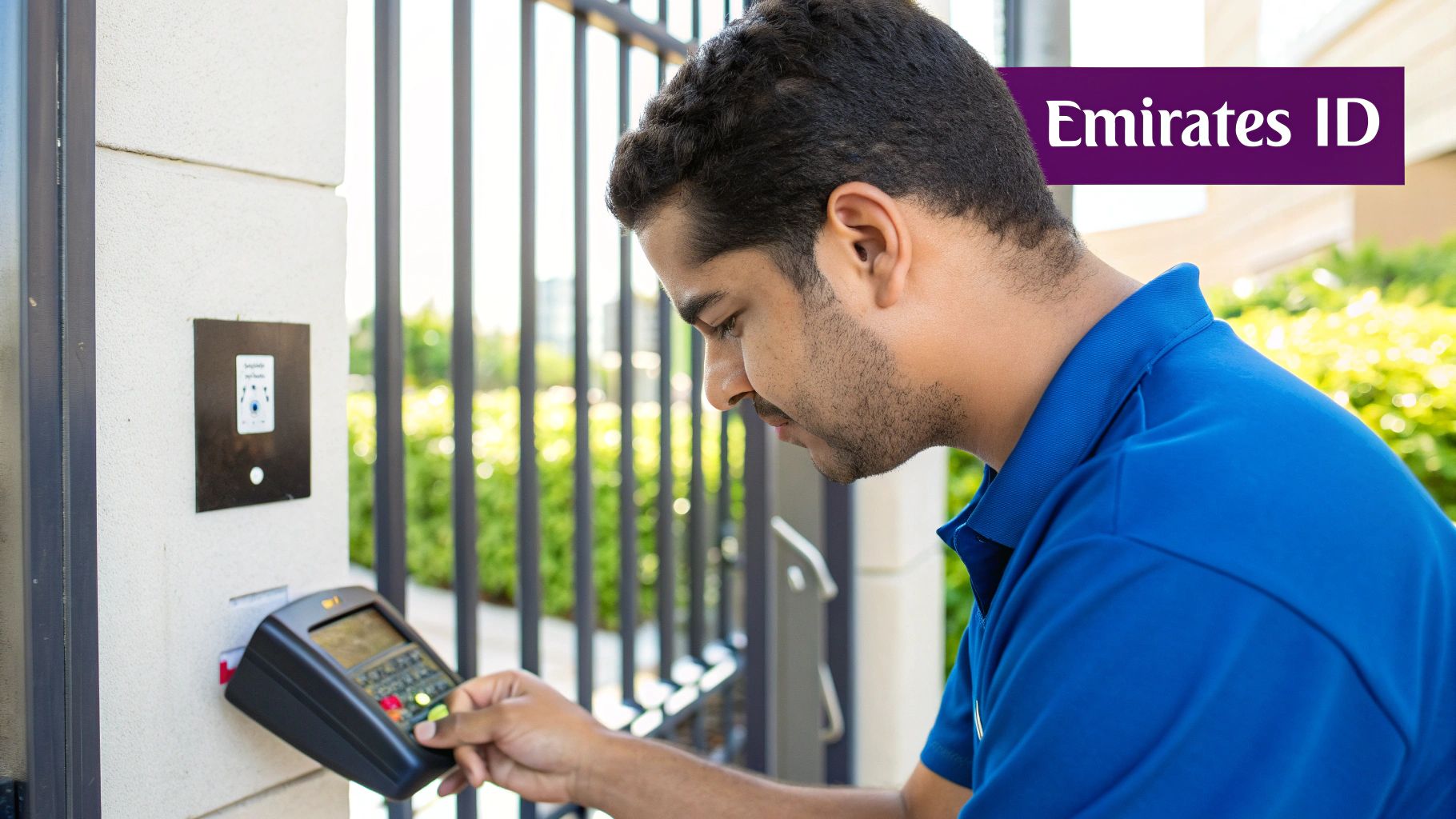
For the Emirates ID biometrics, you'll head to an approved centre to give your fingerprints and have your photo taken. It’s a quick appointment, but always book it in advance to avoid long queues, especially during busy periods. Hold on to the application receipt you get—it’s crucial for the final visa stamping step.
How to Keep Tabs on Your Application
The waiting game can be the hardest part, but thankfully, you don't have to be in the dark. The UAE government has official online portals where you can track your application's progress, so you're not just relying on updates from your sponsor or PRO.
You can check your status on the Federal Authority for Identity, Citizenship, Customs and Port Security (ICP) website, or if you're in Dubai, the General Directorate of Residency and Foreigners Affairs (GDRFA) portal. You’ll just need your application number and a few personal details. It gives you a clear view of where things stand.
The Real Cost of Overstaying and Violations
I can't stress this enough: you must respect the UAE's visa laws. The consequences for not doing so are serious and they are enforced. Overstaying your visa, even by one day, means you start racking up daily fines. More significant violations, like working on a tourist visa, can land you in much bigger trouble.
These aren't empty threats. Enforcement is strict. For example, between January and June 2025, authorities took action against over 32,000 people for visa violations, with about 70% facing deportation. The ICP is very clear that these rules are in place to ensure everyone complies with the law. You can read more about the importance of adhering to UAE visa regulations and recent enforcement actions.
Breaking the rules can lead to:
- Heavy Fines: Overstay fines add up fast and can become a huge financial burden.
- Deportation: For serious offences, you will be sent back to your home country.
- Re-entry Bans: A ban could prevent you from ever returning to the UAE, sometimes for life.
Always be proactive. The best approach is to start your renewal process at least 30 days before your current visa expires.
Navigating these steps takes diligence. As Specialists in Freezone Company Formation across the UAE and visa services, we handle these complexities daily. For a seamless experience that lets you focus on your new life or business, WhatsApp Us Today for a Free Consultation.
Answering Your Top UAE Residence Visa Questions
Even with the best preparation, you're bound to have questions pop up as you go through the visa process. It's completely normal. In fact, after years of helping people navigate this, we've seen just about every question there is.
Let's tackle some of the most common queries we hear day in and day out. This should help clear up any lingering doubts and give you the confidence to move forward.
How Long Does The Entire UAE Residence Visa Process Take?
This is the big one, isn't it? The honest answer is: it depends on your specific visa.
For a typical employment visa, once you're on the ground in the UAE, the process is surprisingly quick. You should plan for about two to four weeks. This timeframe covers the essential in-country steps: your medical fitness test, giving biometrics for your Emirates ID, and finally, getting that all-important visa sticker in your passport.
Now, if you're going for an investor or property visa, the timeline can stretch out a bit. That's because you need to get approvals for your company or property purchase first, before the actual residency part even kicks off.
The single biggest delay we see? Simple paperwork errors. Getting every document correctly prepared and attested before you even start is the secret to a fast, hassle-free experience.
"The difference between a smooth four-week process and a frustrating four-month ordeal often comes down to paperwork. Partnering with a corporate service provider ensures every document is correct from day one, effectively eliminating the most common cause of delays."
What Happens If My Visa Application Is Rejected?
Getting a rejection notice is tough, especially since the authorities don't usually hand you a detailed reason. It can feel like hitting a wall. However, it's almost always down to a few common culprits: a flag on a security background check, a simple mistake on the application form, or not quite meeting one of the eligibility criteria.
Don't panic. Your sponsor, whether it's your employer or your own company, can make an enquiry at the immigration department to get a better sense of the issue. A rejection isn't always a final 'no'. More often than not, if you can fix the problem, you can reapply.
This is where professional advice is crucial. Before you rush to resubmit, have a specialist review your entire file. They've seen it all before and can pinpoint the likely cause of the rejection, helping you build a much stronger case for the second attempt.
Can I Work In The UAE On A Tourist Visa While Waiting For My Residence Visa?
Let me be crystal clear on this: absolutely not. It is strictly illegal to do any kind of work in the UAE while you're on a tourist or visit visa. You have to wait until your official employment entry permit is issued and you've started the formal residency steps.
The consequences for breaking this rule are severe, both for you and the company that hires you. You could be facing:
- Heavy fines, often running into thousands of dirhams.
- Immediate deportation.
- A potential ban that stops you from re-entering the UAE in the future.
It's just not worth the risk. Be patient and wait for the proper legal status before you start working.
How Long Can I Stay Outside The UAE Without My Residence Visa Being Cancelled?
This is a critical rule to remember. For most standard residence visas, like those for employment or family sponsorship, you cannot be outside the UAE for more than 180 consecutive days. That’s roughly six months. If you stay out longer than that, the immigration system automatically cancels your visa.
There are some key exceptions, though. Holders of the prestigious Golden Visa, for example, have the freedom to stay abroad for much longer without jeopardizing their residency. It's vital to know the specific rules for your visa category to avoid a very unwelcome surprise at the airport.
Navigating the complexities of how to get a UAE residence visa is our specialty. At 365 DAY PRO Corporate Service Provider LLC, we are the Best Corporate Service Provider in Dubai, Abu Dhabi & Sharjah, offering Cost-Effective Business Setup Solutions tailored to your needs. With our 24/7 Support Service, we ensure your journey to residency is seamless, allowing you to Enjoy UAE Tax Benefits for International Entrepreneurs.
📞 Call Us Now: +971-52 923 1246
💬 WhatsApp Us Today for a Free Consultation at https://365dayproservices.com.