So, you’re looking to make Dubai your home base. Fantastic choice. Getting a residence visa is your ticket to living and working in this incredible city, and it’s more straightforward than you might think.
The usual path involves getting sponsored, either by an employer if you’ve landed a job, or by setting up your own company. Once you have a sponsor, it’s a matter of gathering your documents, completing a local medical test, and providing your biometric data. For entrepreneurs, forming a company in a mainland or freezone is often the quickest and most direct route to residency.
Your Path to Living and Working in Dubai

Dubai’s appeal to entrepreneurs, professionals, and investors from around the globe is undeniable. A residence visa is the key that unlocks all the professional and lifestyle perks the city has to offer. My goal here is to cut through the noise and break down the entire application journey into clear, simple steps.
I’m skipping the generic fluff to give you practical advice based on years of experience helping people make the move. Whether you’re an entrepreneur planning a mainland company formation in Dubai, an investor looking at a freezone setup, or a professional starting a new job, this guide has you covered.
Understanding the Visa Landscape
The UAE government has been working hard to make getting a residence visa in Dubai easier, especially for expats who want to stay long-term. Just look at the numbers. As of 2025, Dubai’s population has topped 3.9 million, and a staggering 92% of those residents are expatriates. That’s about 3.5 million people living and working here on various visas.
The system is designed for this kind of volume. In 2023 alone, the General Directorate of Residency and Foreigners Affairs (GDRFA) handled over 19 million transactions. It’s a well-oiled machine. You can read up on the latest UAE visa reforms and their impact on foreign ownership from Valustrat to see how things are continuously improving.
I often hear people worry that the visa process will take months. The reality is, a standard employment visa is usually turned around in just 7 to 15 days. It’s a testament to how efficient the UAE’s immigration system really is.
Let’s start with a high-level look at the main ways to get residency. This should help you figure out which path is the right one for you.
To give you a clearer picture, here’s a quick breakdown of the most common visa routes.
Dubai Residence Visa Pathways at a Glance
| Visa Pathway | Typical Sponsor | Estimated Processing Time |
|---|---|---|
| Employment Visa | A UAE-based company (mainland or freezone) | 7 – 15 business days |
| Investor/Partner Visa | Your own newly formed company | 10 – 20 business days |
| Family Visa | A resident family member (spouse or parent) | 10 – 15 business days |
| Golden Visa | Self-sponsored (based on specific criteria) | 2 – 4 weeks |
As you can see, the timelines are quite reasonable. The key is choosing the right pathway from the start to avoid any unnecessary delays.
Why Expert Guidance Matters
While the process is efficient, each visa type has its own set of specific requirements, and the details matter. This is exactly where the Best Corporate Service Provider in Dubai, Abu Dhabi & Sharjah becomes your most valuable asset.
We have Specialists in Mainland Company Formation in Dubai & Abu Dhabi and Specialists in Freezone Company Formation across the UAE, so we can put together Cost-Effective Business Setup Solutions tailored to your needs. We handle the paperwork, deal with the government authorities, and give you the support you need with our 24/7 Support Service – Always here when you need us. That leaves you free to focus on your business goals and Enjoy UAE Tax Benefits for International Entrepreneurs.
Finding Your Ideal Visa Pathway
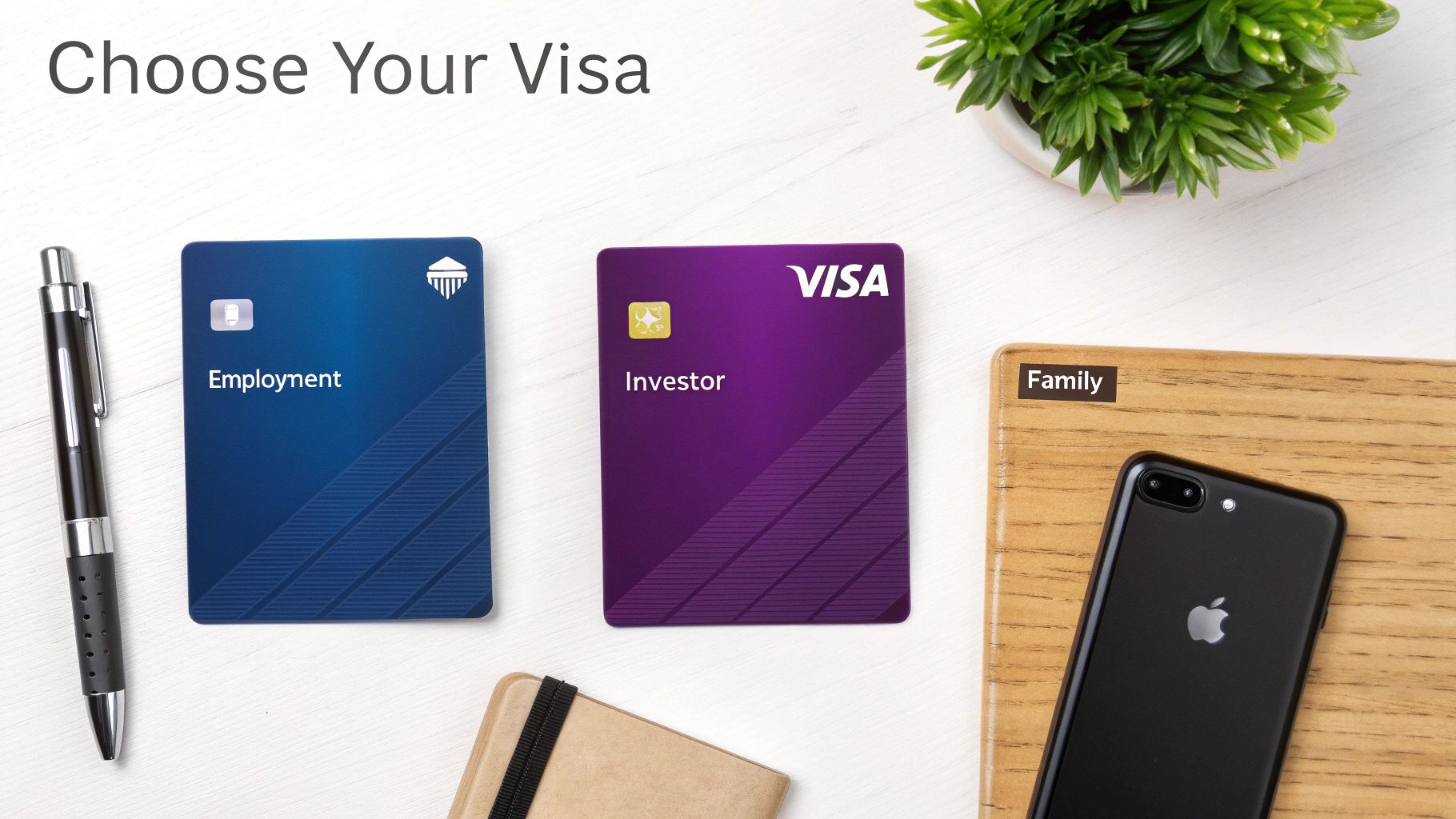
Choosing the right visa isn’t just a box-ticking exercise; it’s the foundation for your entire life in Dubai. The path you take will depend on what brings you here—whether you’ve landed a job, are launching your own business, or plan to invest in the city’s dynamic future.
Let’s get into the main routes to residency. I’ll cut through the official jargon to give you a clear, practical picture of what each option really means for you.
The Employment Visa: The Most Common Route
For most people, the journey to becoming a Dubai resident starts with a job offer. The Employment Visa is by far the most travelled path, and for good reason: your employer sponsors you directly. This makes the process much simpler on your end, as the company’s HR team or their PRO (Public Relations Officer) will handle the bulk of the paperwork.
Your main job is to supply the required documents—your passport, photos, and attested educational certificates. From there, your employer takes the lead, managing the application with the Ministry of Human Resources and Emiratisation (MoHRE) and the immigration authorities. They are legally on the hook for getting your work permit and residence visa sorted.
- Who it’s for: Professionals with a job offer from a company in Dubai, whether it’s on the mainland or in a freezone.
- Sponsor: Your employer.
- Typical Validity: 2 years, and it’s renewable.
Once you arrive in Dubai, your company will guide you through the final local steps, which include the medical fitness test and giving your biometrics for your Emirates ID.
The Investor Visa: For Entrepreneurs and Business Owners
If you’re an entrepreneur ready to build your own company, the Investor Visa, often called a Partner Visa, is your ticket. This route lets you sponsor yourself through your business, giving you a great deal of independence. The specifics change a bit depending on where you decide to set up shop.
Mainland Company Formation
Setting up on the Dubai mainland gives you unrestricted access to trade within the entire UAE market. As the owner of a mainland company, you can secure an investor visa for yourself, and then go on to sponsor your family and any staff you hire. We are Specialists in Mainland Company Formation in Dubai & Abu Dhabi and can walk you through every step.
Freezone Company Formation
Creating your company in one of Dubai’s many freezones is a hugely popular choice, offering perks like 100% foreign ownership and major tax advantages. Your Investor Visa is tied to your company within that specific zone, making it a brilliant, cost-effective option for consultants, service providers, and traders working with international clients.
The most important thing to understand here is that your business is your sponsor. This puts you in control of your residency status, linking it directly to your company’s success and good standing.
Sponsoring Your Loved Ones: The Family Visa
Once you’ve secured your own residence visa, you can bring your family over to join you. The Family Visa is the mechanism for sponsoring your spouse and children, and in some circumstances, your parents. The main hurdle is meeting a minimum salary requirement, which proves you can support them financially.
The current salary threshold is usually AED 4,000 per month (or AED 3,000 if your employer provides accommodation). If you plan to sponsor your parents, the requirement is much higher, typically around AED 20,000 per month. You’ll need to provide your attested marriage certificate for your spouse and attested birth certificates for your kids.
Specialised Pathways: Golden and Retirement Visas
Dubai has also created some excellent long-term residency options for certain individuals, offering more stability than the standard two-year visa.
- The Golden Visa: This is a prestigious 10-year visa designed for significant investors, entrepreneurs, and people with exceptional talents in fields like science, the arts, and sports. For real estate investors, putting a minimum of AED 2 million into property can make you eligible for this coveted visa.
- Retirement Visa: If you’re over 55, this renewable 5-year visa lets you enjoy your retirement years in Dubai. To qualify, you need to meet one of several financial criteria, like owning a property worth at least AED 1 million or having significant savings.
For anyone looking at property as a way to secure residency, this comprehensive guide for property investors is a great resource to understand the process in detail.
The sheer volume of applications shows just how attractive Dubai is. The General Directorate of Residency and Foreigners Affairs (GDRFA) handled over 19 million transactions in 2023 alone. This level of efficiency is vital as the city’s population is expected to hit 7.4 million by 2040, fuelling a constant demand for visas from professionals and investors worldwide.
In-Country Steps: From Entry Permit to Visa Stamp
You’ve got your entry permit in hand—great! That means the clock has officially started on the final leg of your journey to becoming a Dubai resident. This next phase happens entirely within the UAE and involves a few key appointments. It might sound like a bit of a bureaucratic marathon, but if you know the steps, it’s actually a pretty smooth sprint to the finish line.
Essentially, this is all about completing three mandatory local requirements: the medical fitness test, the Emirates ID biometrics appointment, and the final visa stamping in your passport. Think of it as the UAE’s way of doing its final checks before officially welcoming you.
First Up: The Medical Fitness Test
Your first major stop is the medical fitness test. This is a mandatory requirement for every residence visa applicant over 18 years old, designed to safeguard public health in the UAE by screening for specific communicable diseases.
The test itself is straightforward and has two parts:
- A blood test to screen for illnesses like HIV and Hepatitis B.
- A chest X-ray to check for any signs of tuberculosis.
You’ll need to visit a government-approved medical fitness centre for this. Dubai has plenty of them, often run by the Dubai Health Authority (DHA). Depending on how quickly you need the results, you can choose from standard, 24-hour, or even 4-hour VIP services.
Here’s a piece of advice from experience: try to get to the centre early on a weekday morning. They are usually far less crowded, and you can often be in and out—from registration to the final X-ray—in less than an hour.
Next: Your Emirates ID Biometrics
Once your medical results are out (they’re usually sent electronically straight to the immigration authorities), it’s time to move on to your Emirates ID. While your sponsor handles the initial online application, you personally need to visit a Federal Authority for Identity and Citizenship (ICA) centre to provide your biometric data.
This appointment is quick and painless. They’ll just take your fingerprints and a photo. The real trick is getting a convenient appointment slot. Your sponsor, or a corporate service provider like us, can book this for you, which helps avoid any unnecessary waiting around.
Just make sure you bring your original passport and entry permit to the appointment. The Emirates ID is arguably the most important document you’ll carry in the UAE—you’ll need it for everything from opening a bank account to getting a phone plan—so getting this step done right is crucial. As the Best Corporate Service Provider in Dubai, Abu Dhabi & Sharjah, we take care of the booking and double-check all your paperwork, so you can walk in without any stress. Our 24/7 Support Service – Always here when you need us is on standby if you have any last-minute questions.
The Final Hurdle: Visa Stamping
This is the moment it all becomes real—getting that physical residence visa sticker placed inside your passport. After your medical results are cleared and your biometrics are in the system, your sponsor will submit your passport to the immigration authorities for the final stamp.
This last part is surprisingly fast, often taking just a couple of business days. The visa stamp in your passport will show its validity (typically two years for an employment visa) and your official profession.
Here’s a realistic look at how the timeline usually breaks down:
| Stage | Estimated Timeframe | What You’ll Do |
|---|---|---|
| Medical Fitness Test | 1-2 business days | Visit an approved centre for your blood test and X-ray. |
| Emirates ID Biometrics | 1-3 business days | Attend your scheduled appointment at an ICA service centre. |
| Visa Stamping | 2-5 business days | Your sponsor submits your passport for the final visa sticker. |
All in all, you can expect this entire in-country process—from your medical test to getting your passport back with the visa inside—to be wrapped up in about 7 to 10 working days. A smooth run really comes down to good timing and coordination. This is where our Cost-Effective Business Setup Solutions tailored to your needs make a world of difference, ensuring every step is ticked off without delay so you can start settling into your new life in Dubai.
Your Essential Document Preparation Checklist
Let’s be honest: getting your paperwork right is the single most critical part of the entire visa process. I’ve seen countless applications get stalled—or worse, rejected—over a missing signature or an incorrect document. A small mistake here can bring everything to a grinding halt.
Think of this stage as laying the groundwork for your new life in Dubai. If you get this foundation solid, everything that follows becomes dramatically simpler. We’ll walk through the absolute must-haves for everyone, then get into the nitty-gritty of what’s needed for specific visa types. Most importantly, we’ll clear up the confusion around document attestation and translation.
Core Documents for All Applicants
No matter why you’re moving to Dubai, a few key documents are non-negotiable. These are the items every single applicant needs to have ready.
- Valid Passport: This is obvious, but check the details. Your passport needs at least six months of validity left from your date of entry, plus a minimum of two blank pages for the visa stamp.
- Passport-Sized Photographs: Don’t just use any old photo. They must be recent and meet strict UAE government standards—think white background and specific dimensions. It’s best to get them done at a studio here in the UAE.
- Entry Permit: This is your initial green light. It’s the document that allows you to enter the UAE for the specific purpose of processing your residency.
Once you’re in the country, you’ll also need the receipt from your Emirates ID application and your medical fitness test results to proceed, but the three items above are what get you through the door.
This flow chart below illustrates the main in-country steps you’ll take after arriving with your entry permit—the medical test, biometrics appointment, and the final visa stamping.
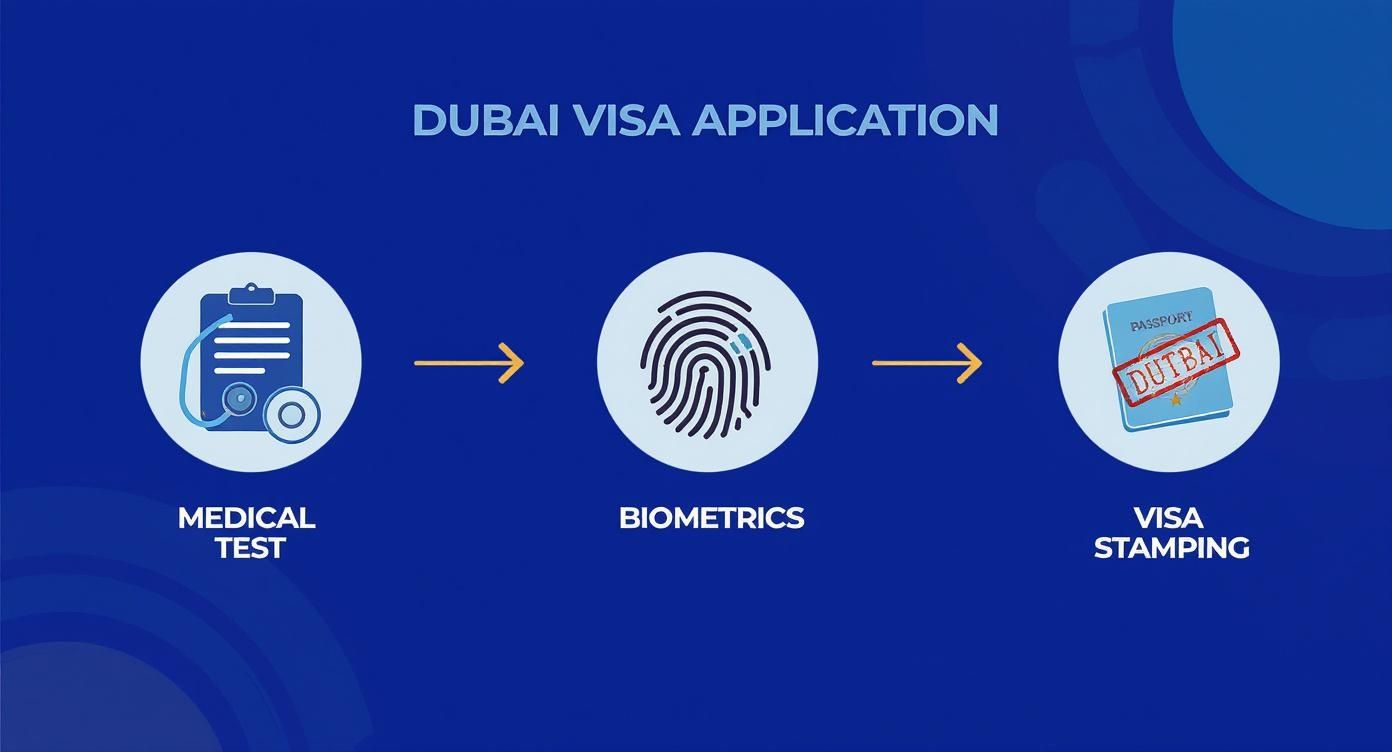
As you can see, it’s a clear, sequential process. Each step is a government checkpoint that has to be cleared before you can move on to the next one.
The Critical Role of Attestation and Translation
This is, without a doubt, where most people get tripped up. Any official document issued outside the UAE—like your university degree, marriage certificate, or your children’s birth certificates—isn’t automatically accepted by the authorities here. They need to be officially “attested.”
Attestation is a formal, multi-step verification process. To give you a real-world example, here’s what a university degree typically goes through:
- First, it’s verified by the Ministry of Foreign Affairs in your home country.
- Next, it gets stamped by the UAE Embassy in that same country.
- Finally, it receives a concluding attestation from the Ministry of Foreign Affairs (MOFA) here in the UAE.
On top of that, if any of these crucial documents aren’t in English or Arabic, they must be legally translated by a certified translator based in the UAE. Trying to submit something that hasn’t been properly attested or translated is a surefire way to get your application sent right back to you.
A mistake I see all the time is people thinking a simple notary stamp from back home will suffice. The UAE’s attestation protocol is far more thorough and involves multiple government departments. Getting this wrong can easily set you back by several weeks.
Document Checklist by Visa Type
To help you get organised, here’s a handy checklist that breaks down the required documents for the most common visa categories. Having the right paperwork from the start saves an incredible amount of time and stress.
Comparison Table: Document Checklist by Visa Type
| Document | Employment Visa | Investor Visa | Family Visa |
|---|---|---|---|
| Signed Offer Letter/Labour Contract | Required | Not Applicable | Not Applicable |
| Attested Educational Degree | Required (for many professions) | Not Applicable | Not Applicable |
| Company Trade Licence | Not Applicable | Required | Not Applicable |
| Memorandum of Association (MOA) | Not Applicable | Required | Not Applicable |
| Attested Marriage Certificate | Not Applicable | Not Applicable | Required (for spouse) |
| Attested Birth Certificate(s) | Not Applicable | Not Applicable | Required (for children) |
This table makes it clear how the document requirements change based on your reason for residency. For an employment visa, it’s all about your professional qualifications. For an investor visa, your company’s legal documents are the priority. And for a family visa, the focus is on legally proving your relationships.
This is where working with a professional team makes all the difference. As Specialists in Mainland Company Formation in Dubai & Abu Dhabi and Specialists in Freezone Company Formation across the UAE, we live and breathe these checklists. Our job is to make sure every single document is prepared, attested, and submitted correctly the first time. Our Cost-Effective Business Setup Solutions tailored to your needs are built to manage this complexity for you, with our 24/7 Support Service – Always here when you need us ready to help at every stage.
Common Mistakes and How to Avoid Them
Learning from others’ missteps can save you an incredible amount of time, money, and stress when you’re figuring out how to get a residence visa in Dubai. After guiding countless entrepreneurs and professionals through this journey, I’ve seen the same handful of preventable errors derail applications. These aren’t complex legal hurdles; they’re simple oversights that are easy to avoid with a bit of foresight.
From submitting non-attested certificates to discovering a name mismatch at the last minute, these issues can bring your plans to a grinding halt. The good news is that for every common pitfall, there’s a straightforward, proactive solution.
Forgetting Document Attestation
One of the most frequent and frustrating mistakes I see is people submitting official documents without the proper attestation. Your degree or marriage certificate from back home holds no legal weight in the UAE until it’s been through a specific, multi-step verification process.
Simply put, the UAE government needs to be certain your documents are legitimate. Submitting a non-attested certificate is like showing up to an exam without your ID—the process just can’t move forward.
- The Consequence: Your application will be immediately rejected or put on hold, causing serious delays. You’ll then have to courier the documents back to your home country to start the attestation process, which can take weeks, sometimes even months.
- The Proactive Solution: Get the attestation process started for all your educational and personal certificates before you even travel to the UAE. This is where a corporate service provider can be a lifesaver, as they can navigate this complex chain of verifications for you.
Failing the Medical Fitness Test
The mandatory medical test is a non-negotiable step. A “fail” result will stop your visa application dead in its tracks. The test screens for specific communicable diseases, and if any are detected, residency will be denied on public health grounds.
This can be a devastating blow, especially if you’ve already quit your job and moved your life here. The financial and emotional cost is huge.
The smartest move you can make is to get a pre-travel medical check-up in your home country that screens for the same conditions as the UAE test. This simple step provides peace of mind and lets you address any potential issues before you invest in the move.
Overlooking Name Discrepancies
This one sounds minor, but believe me, it causes major headaches. Your name must be written exactly the same across every single official document—passport, visa application, degree certificate, and offer letter. A tiny variation, like a missing middle name or a slightly different spelling, can get flagged by the immigration system and lead to rejection.
For example, if your passport says “John Michael Smith” but your degree certificate just says “John Smith,” the system may not recognise them as the same person.
To avoid this, do a thorough audit of all your documents before you submit anything. Make sure your name is 100% consistent everywhere. If you spot a discrepancy, get it officially amended before you start the visa process.
Post-Visa Compliance Missteps
Getting that visa stamp in your passport is a huge milestone, but your responsibilities don’t end there. A critical rule that new residents often miss is the requirement to not stay outside the UAE for more than 180 consecutive days (six months). If you go over this limit, your residence visa will be automatically cancelled.
This rule is strictly enforced. It’s crucial for keeping your residency legal and avoiding fines or nasty surprises when you try to re-enter the country.
The UAE government’s stance on legal compliance has become increasingly firm. Enforcement of residency laws has tightened, with authorities actively identifying people who violate visa rules. In the first half of 2025 alone, over 32,000 individuals were flagged for violations, with a significant number facing deportation. You can find more details about these UAE visa rule enforcements on economictimes.com. This really underscores why staying informed and compliant is absolutely essential.
Your Dubai Residence Visa Questions Answered
Going through the visa process in Dubai often brings up a handful of specific questions. It’s completely normal. To wrap things up, I want to tackle some of the most common queries I hear from clients. Getting these details straight will help you move forward with confidence, knowing exactly what to expect.
How Long Is a Dubai Residence Visa Typically Valid For?
This is a great question, and the answer really depends on your specific situation – mainly, your visa type and your sponsor. It’s definitely not a one-size-fits-all deal.
For most professionals holding a standard Employment Visa, you’re typically looking at a two-year validity period. That’s the most common timeframe you’ll see. But for investors and entrepreneurs, the horizon can be much longer. An Investor Visa tied to a mainland or freezone company often starts at two years, while big-ticket programmes like the Golden Visa can grant you residency for five or even ten years. My advice? Always double-check the exact validity for your category and pop a renewal reminder in your calendar way ahead of time.
Can I Apply for a Residence Visa While Inside the UAE on a Tourist Visa?
Absolutely, and honestly, it’s the most convenient way to do it. This is a very common procedure officially called an “in-country status change.” It allows you to switch from a tourist visa to a residence visa without ever having to leave the UAE.
Gone are the days of needing to do a “border run” or book a flight just to re-enter the country. While there’s an extra government fee for this convenience, it saves you a ton of hassle, not to mention the cost of flights and travel. Working with the Best Corporate Service Provider in Dubai, Abu Dhabi & Sharjah makes this even smoother, as they handle all the paperwork and ensure the transition is seamless.
The real beauty of an in-country status change is that you can carry on with setting up your life in Dubai while the visa is processed in the background. It completely removes the stress of dealing with airport immigration or worrying about overstaying.
What Happens if My Residence Visa Application Is Rejected?
First off, don’t panic. A rejection can feel like a major setback, but it’s often not the final word. The most important thing to do is to get the official reason for the denial directly from the immigration authorities.
From my experience, rejections usually boil down to a few common issues:
- Paperwork problems, like missing documents or incorrect attestations.
- Security flags that might pop up during routine background checks.
- Failing the medical fitness test.
Depending on the reason, the fix could be straightforward. If a document was missing, you can simply provide it and re-apply. For anything more complicated, it’s really best to bring in a specialist who knows how to navigate an appeal or prepare a new, stronger application.
What Is the Minimum Salary to Sponsor My Family in Dubai?
For many expats, bringing family over is the ultimate goal. To make that happen, you need to show you can support them financially.
As a general rule, a male resident looking to sponsor his wife and children needs a minimum monthly salary of AED 4,000, or AED 3,000 if the company provides accommodation. Just keep in mind that these figures can be updated, and the criteria can be different if you’re sponsoring your parents, or if a female resident is sponsoring her family. It’s always smart to check the latest requirements with the GDRFA or a trusted consultant before starting the process.
Navigating the ins and outs of how to get a residence visa in Dubai is far less daunting when you have an expert in your corner. As the Best Corporate Service Provider in Dubai, Abu Dhabi & Sharjah, we live and breathe mainland and freezone company formation, visa processing, and document attestation. We offer Cost-Effective Business Setup Solutions tailored to your needs. With our 24/7 Support Service – Always here when you need us, we’re here to help you Enjoy UAE Tax Benefits for International Entrepreneurs.
📞 Call Us Now: +971-52 923 1246 or start your free consultation on WhatsApp today. We are Specialists in Mainland Company Formation in Dubai & Abu Dhabi and Specialists in Freezone Company Formation across the UAE, ready to assist you.