
So, you're thinking about setting up shop in the UAE? Smart move. But getting started here isn't just about filing paperwork; it's about understanding the unique landscape and making the right strategic moves from day one. The UAE has worked hard to become a launchpad for global businesses, and that's not by accident. It's the result of a deliberate, forward-thinking vision that has built a genuinely supportive ecosystem for entrepreneurs.
This isn't just talk. The results speak for themselves. The government's proactive approach has catapulted the UAE up the global business rankings.
The United Arab Emirates has firmly established itself as a premier destination for startups, climbing from 43rd position globally in 2020 to an anticipated 21st in 2025 on the Global Startup Ecosystem Index. This rapid advancement highlights the country's effective strategies involving investment, regulatory reforms, and public-private collaborations. You can read more about the UAE's thriving startup ecosystem and its global performance.
This momentum creates real, tangible opportunities. As a founder, your journey starts with a single, critical decision that will define your company's future.
Mainland, Free Zone, or Offshore? Choosing Your Playground
Your first big decision is where to set up your business—your jurisdiction. This choice dictates who you can trade with, your ownership structure, and the rules you'll operate by. It's the foundation for everything that comes next, so it pays to get it right.
To help you get a clear picture, here’s a quick comparison of the three main options.
UAE Business Jurisdictions at a Glance
| Feature | Mainland | Free Zone | Offshore |
|---|---|---|---|
| Market Access | Full access to the entire UAE local market and government tenders. | Can trade internationally and within its own Free Zone. Limited access to the Mainland market, often via a local distributor. | No trading permitted within the UAE. |
| Ownership | Up to 100% foreign ownership for most business activities. | 100% foreign ownership is a standard benefit. | 100% foreign ownership. |
| Office Space | Physical office space is mandatory. | Flexible options, from physical offices to flexi-desks or virtual offices. | No physical office required. A registered agent’s address is used. |
| Visas | Visa eligibility is generally tied to the size of your office space. | Visa packages are often included with the licence, with options to add more. | No visas are issued. |
| Taxation | Subject to 9% corporate tax on profits over AED 375,000. | 0% corporate tax for qualifying income. | Generally 0% tax. |
| Best For | Retail, restaurants, clinics, local service providers, construction. | International trade, consulting, tech startups, media companies. | Holding companies, asset protection, international invoicing. |
Each of these jurisdictions serves a very different purpose. Let's break down what that means for your business in practice.
A Mainland company is your ticket to the entire UAE domestic market. If you want to open a cafe in Dubai, a retail store in Abu Dhabi, or bid on lucrative government contracts, this is the path for you. It gives you the freedom to trade directly with any customer or business across all seven Emirates.
On the other hand, a Free Zone company is perfect for businesses focused on international trade or services. Think of them as dedicated economic hubs—there are over 40 of them, many specializing in industries like tech, media, or finance. They offer fantastic benefits like 100% foreign ownership and tax exemptions, making them ideal for a global consultancy or an e-commerce business serving customers outside the UAE.
Finally, an Offshore company is a different beast altogether. This is a non-resident entity, mainly used for things like holding international assets, protecting investments, or managing global transactions. It's a powerful tool for tax planning and corporate structuring, but it doesn't allow you to trade within the UAE at all.
Getting this choice right from the start is crucial. It’s where partnering with a good corporate services provider becomes your biggest asset. An experienced advisor can look at your specific business model, understand your long-term goals, and guide you to the jurisdiction that makes the most sense—turning a complex decision into a clear, confident first step.
Choosing Your Jurisdiction: Mainland vs. Free Zone
This is it. The single most important decision you'll make when setting up your business in the UAE is picking your jurisdiction. It's a choice that ripples through everything—your market access, ownership rules, and how easily you can grow. Get this wrong, and you could be looking at costly changes down the road. It’s not about generic definitions; it’s about matching your exact business model to the right legal framework.
Let’s think about this practically. Say you’re launching a consultancy and want to land government contracts or work directly with clients across the Emirates. In that case, a Mainland setup isn't just an option; it's a necessity. It gives you a license to operate freely across the entire local market, with no middlemen required.
Understanding Mainland Company Formation
A Mainland company, licensed by the Department of Economic Development (DED) in your chosen emirate, is your all-access pass to the local economy. It’s the go-to structure for any business with a physical footprint—think retail shops, restaurants, professional service firms, or trading companies selling directly to consumers and other UAE businesses.
For years, this route meant needing a local sponsor, but recent reforms have completely changed the game. Today, for over a thousand business activities, international entrepreneurs can have 100% foreign ownership on the Mainland. This is a massive shift that has made the Mainland an incredibly attractive option for anyone serious about building a strong local presence. Working with the best corporate service provider in Dubai & Abu Dhabi, Mainland UAE, can help you navigate these new rules with clear, cost-effective solutions.
Exploring the World of Free Zones
Now, let's flip the coin. If you're a tech start-up with clients scattered across the globe, a specialised Free Zone presents a very compelling alternative. Free Zones are self-contained economic areas—there are over 40 of them across the UAE—each with its own rules and often designed for specific industries like technology, media, finance, or commodities.
The advantages here are pretty clear:
- 100% Foreign Ownership: This is standard across all Free Zones, giving you complete control.
- Tax Benefits: Free Zone companies typically enjoy exemptions from corporate and personal income taxes—a huge incentive for international founders focused on financial efficiency.
- Simplified Setup: The registration process is generally faster and more straightforward than a Mainland setup.
This structure is ideal for businesses that aren’t primarily chasing the local UAE market. For example, an e-commerce store shipping goods internationally or a digital marketing agency serving clients in Europe and Asia would find a Free Zone to be a perfect, cost-effective launchpad.
This simple decision tree shows how your business's core function naturally points you towards the right jurisdiction and licence.
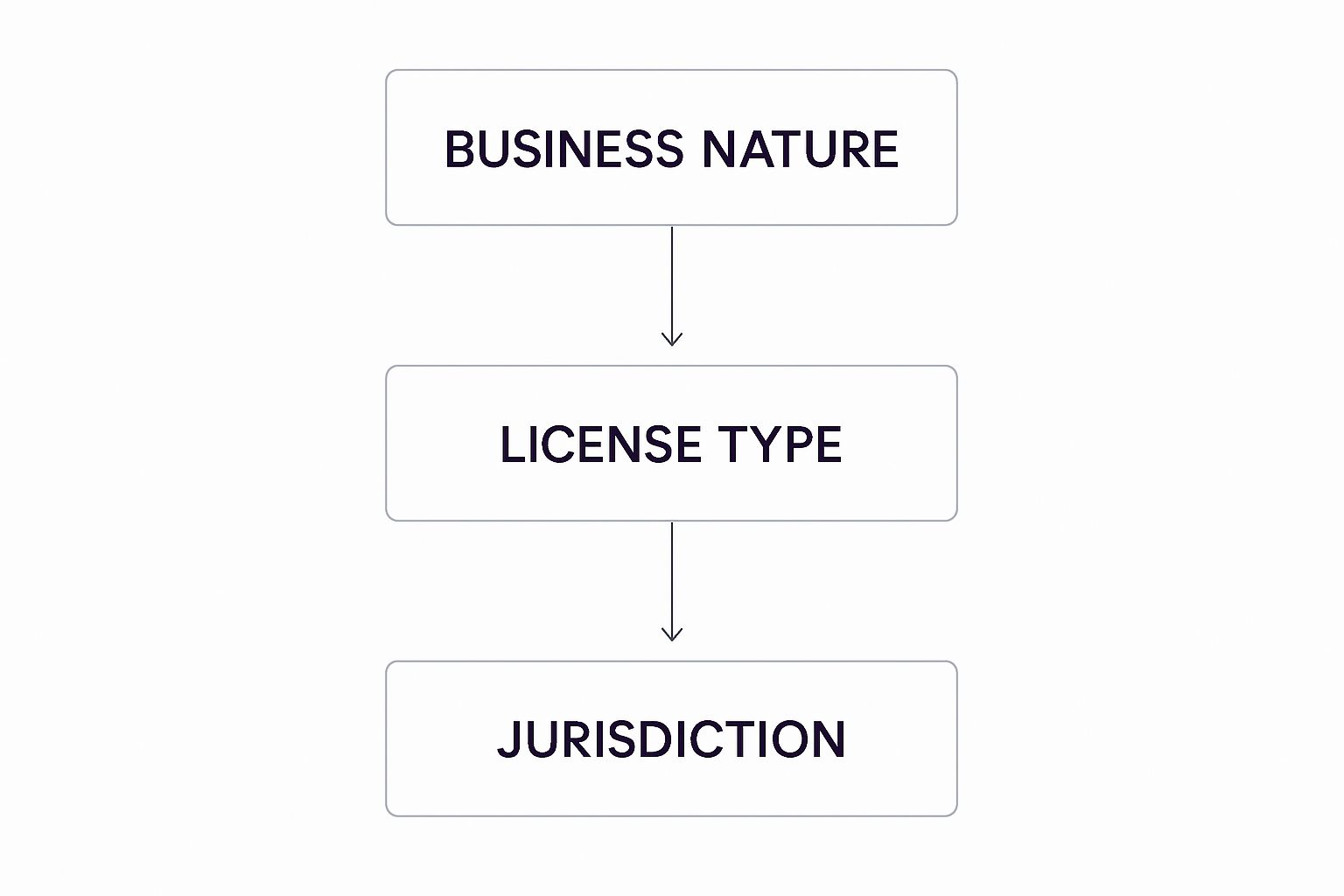
The key takeaway from this visual is that the process is logical. Once you're clear on your business model, the choice of jurisdiction becomes much simpler.
Key Differences to Consider
Choosing between Mainland and a Free Zone is about more than just who you can sell to. It's a strategic trade-off across several critical areas. Making the right call is fundamental to successfully navigating how to start a business in the UAE.
Expert Tip: Don't just think about what you need today. Where do you see your business in five years? Will you need to hire a large local team? Do you dream of opening a physical shop one day? A Free Zone might be cheaper now, but a Mainland licence could be a much smarter long-term investment if local expansion is on your horizon.
Let's break down the differences head-to-head.
| Feature | Mainland Company | Free Zone Company |
|---|---|---|
| Business Scope | Can trade anywhere in the UAE and internationally. Eligible for government contracts. | Can trade internationally and within its specific Free Zone. Access to Mainland requires a local agent or distributor. |
| Office Requirements | A physical office space registered with Ejari is mandatory. | Offers flexible options, including flexi-desks and virtual offices, reducing initial setup costs. |
| Visa Quotas | Visa eligibility is typically determined by the size of your physical office space. | Visa packages are often included with the license, with options to purchase more as needed. |
| Approvals | Requires approvals from multiple government bodies, including the DED and municipality. | All approvals are managed by the respective Free Zone authority, creating a single point of contact. |
Ultimately, there's no single "best" choice—only the one that perfectly fits your business. For a free consultation to map your needs to the ideal jurisdiction, Call Us Now at +971-52 923 1246 or W/a us today. Our team offers 24/7 support to ensure you get it right from the very start.
Choosing the Right Business Licence and Legal Structure
Once you've decided between a Mainland or Free Zone setup, your next big hurdle is getting the right licence and legal structure. This isn't just a box-ticking exercise. This is the legal DNA of your company—it defines what you can do, who owns what, and where your personal liability begins and ends. Get this part right, and you're building on solid ground.
First things first, you need to understand the main licence categories. The government is very specific about this: your business activities must perfectly match the licence you hold. There's no grey area here.

What Are the Main Licence Types?
In the UAE, your business will fall into one of three buckets. Picking the correct one from the start saves you a world of headaches down the line.
- Commercial Licence: This is your ticket if you're in the business of buying and selling things. Think e-commerce stores, retail shops, or general trading companies that import and export goods. If physical products are your game, you need a Commercial Licence.
- Professional Licence: Are you selling your skills or expertise? This one's for you. It's designed for consultants, marketing agencies, IT specialists, designers, and other service-based professionals. Essentially, your knowledge is the product.
- Industrial Licence: If you make stuff, you need an Industrial Licence. This covers everything from manufacturing and production to assembling components or processing raw materials into finished goods.
The choice is usually quite clear. A marketing consultant selling strategy needs a Professional Licence. A business selling electronics online absolutely needs a Commercial Licence.
Selecting Your Legal Structure
Hand-in-hand with your licence is your company's legal structure. This decision directly impacts your liability and ownership rules. For most new entrepreneurs, the choice boils down to two popular options: the Limited Liability Company (LLC) and the Sole Establishment.
A Limited Liability Company (LLC) is a favourite for a reason. It creates a legal wall between your personal assets and your business's finances. If the company runs into debt, your personal savings, car, and home are shielded. An LLC can be set up by two or more shareholders and works well for both Mainland and Free Zone companies.
A Sole Establishment, on the other hand, is owned by just one person. Here, you and the business are one and the same in the eyes of the law. This means you are personally on the hook for all company debts. While it's often simpler and faster to set up, especially for professionals, it comes with that added risk.
The most important thing to remember is that your legal structure directly dictates your financial risk. An LLC offers a protective corporate shield, whereas a Sole Establishment ties your personal finances directly to the business.
This is where working with the best corporate service provider for Freezone in UAE can be a real game-changer. An expert will make sure your chosen activities, licence, and legal structure are all perfectly aligned, preventing costly compliance problems later. They handle all the paperwork, so you can be confident your business is built correctly from day one. For a Free Consultation to explore your options, W/a us today.
Navigating these choices can get tricky, as rules can vary between jurisdictions. Some Free Zones, for instance, offer unique company structures designed for their specific industries. An advisor can find cost-effective solutions by pinpointing the most efficient setup for what you want to achieve. For personalised advice, Call Us Now at +971-52 923 1246. Our team is here with 24/7 support service to help you make the right call.
Getting Your Visas Sorted and a Bank Account Opened
You’ve got the licence and your company is officially registered—congratulations! That’s a huge milestone. Now it’s time to move from paperwork to a fully operational business. This next stage is all about building the physical and financial foundation: getting residency for yourself and your team, and setting up a corporate bank account.
While these might seem like procedural steps, they’re packed with their own little challenges. Getting them right is crucial to avoid delays that can stall your launch.

This is a critical part of learning how to start a business in the UAE because it’s where your presence in the country becomes official. The two big tasks here—visas and banking—are closely connected and need to be handled in the right order.
What the Residency Visa Process Really Looks Like
For most entrepreneurs coming from abroad, getting that UAE residency visa is the main event. It’s far more than just a stamp in your passport; it’s your ticket to actually living and working here. With it, you can rent an apartment, get utilities connected, and truly build a life in the Emirates.
The process follows a pretty clear path, but you need to tick every box along the way.
Here’s a breakdown of the typical journey to getting your residency:
- The Entry Permit: Once your company's immigration card is ready, the first real step is applying for an entry permit. Think of this as your invitation to enter the UAE specifically to get your visa sorted.
- The Medical Fitness Test: After you’ve arrived, you’ll need to complete a mandatory medical test at a government-approved health centre. It’s a standard screening for certain communicable diseases.
- Your Emirates ID Application: Next up is a trip to an Emirates ID service centre to provide your biometrics—that means fingerprints and a photo. The Emirates ID is a non-negotiable ID card for every resident.
- The Final Visa Stamping: The last step is getting the residency visa sticker placed in your passport. Once that's done, your Emirates ID card will be printed and issued, and the process is complete.
Expert Tip: A massive time-saver I always recommend is getting your personal and educational documents attested in your home country and by the UAE Embassy there before you even start. This bit of foresight can easily shave weeks off your timeline.
This same process applies to you as the business owner and to any staff you bring on board. Working with a corporate services partner can be a lifesaver here, as they manage the entire flow, making sure every form is perfect. It’s a huge weight off your shoulders when you're trying to get a business off the ground.
Navigating the Corporate Bank Account Challenge
Here’s something that catches many entrepreneurs by surprise: opening a corporate bank account in the UAE can be tough. It’s often much harder than people expect. Thanks to strict international compliance and anti-money laundering (AML) rules, UAE banks perform some serious due diligence on new businesses.
Just showing up with a trade licence isn’t going to cut it.
The banks need to understand your business—and I mean really understand it. You'll need a solid business plan that clearly explains your services, who you’re selling to, and how you expect to make money. Be ready to provide a mountain of information about the company's shareholders, where their initial funds came from, and your day-to-day operational model.
How you present your new company is everything. Banks are looking for substance. While a virtual office might be fine for getting your licence, some banks will want to see a physical office, especially for mainland setups. Your success often hinges on how well you can explain your vision and how quickly you can provide every document they ask for.
The back-and-forth and the sheer volume of paperwork can feel overwhelming. This is where having a partner offering 24/7 support service makes a real difference. When a bank comes back with a question at an odd hour, getting an instant, expert answer keeps things moving. Finding cost-effective solutions that include this kind of hands-on banking support is genuinely invaluable.
For a free consultation on getting your documents ready and navigating the bank account opening maze, W/a us today or Call Us Now at +971-52 923 1246. We can help you put your best foot forward with the banks.
Getting to Grips with the UAE's Financial Landscape
So, what really makes the UAE such a magnet for entrepreneurs from all corners of the globe? While the quick and easy setup process gets a lot of attention, it’s the country's savvy, pro-business financial policies that truly set the stage for long-term success. If you're serious about starting a business here, getting your head around this is non-negotiable.
The big picture is pretty simple. The appeal really boils down to two things: a highly attractive tax system and an investment scene that’s buzzing with activity. For most international founders I speak with, the UAE tax benefits for international entrepreneurs are often the first thing that catches their eye, giving them a serious competitive advantage from day one.
The Lowdown on UAE Corporate Tax
The introduction of a federal corporate tax was a game-changer, marking a new level of maturity for the UAE's economy. But don't let the headline figure of 9% on profits spook you. The system is much more nuanced and cleverly designed to give small businesses a leg up.
At its core is a very generous exemption. Your business pays 0% tax on profits up to AED 375,000. Think about that for a moment. This means a huge number of startups and SMEs won't pay a dirham in corporate tax during their crucial early years. That's more cash you can plough straight back into growing the business.
The corporate tax system isn't just a revenue tool; it's a strategic move to nurture startups. That 0% tax bracket for profits under AED 375,000 is a powerful lifeline, making the UAE one of the most financially forgiving places to get a new venture off the ground.
And it gets even better if you're set up in a Free Zone. Businesses there can often qualify for a 0% corporate tax rate on their "qualifying income." This usually applies to income you earn from clients outside the UAE, or from dealing with other companies located in any of the country's Free Zones. For any business with international ambitions, this is a massive plus.
Plugging into a Thriving Investment Scene
Beyond the tax advantages, you’ll find yourself in a place where money is actively looking for a home. The UAE’s investment ecosystem is not just growing; it's robust and full of confidence. Serious capital is flowing into promising new companies, especially in today's high-growth sectors.
You just have to look at the recent numbers to see the momentum. Take April and May 2025, for example. In just those two months, UAE-based startups raked in US$62 million in funding across nine separate deals. This kind of consistent investment flow proves the market is healthy and packed with potential. You can dive deeper into the latest MENA startup funding trends and insights to see for yourself.
What does this mean for you as a founder? It means you’re not just shouting into the void. You’re entering a market where investors are actively hunting for the next big thing.
So, where’s the smart money going? A few sectors are particularly hot right now:
- FinTech: Anything from digital payments to wealth management platforms.
- B2B Software (SaaS): Tools that make other businesses run smoother and smarter.
- E-commerce and Logistics: The backbone of the region’s booming online retail market.
- HealthTech: Tech solutions that are changing how healthcare is managed and delivered.
Of course, landing that investment takes more than just a brilliant idea. You’ll need a rock-solid business plan that shows you understand the local market and have a clear path to scaling up. Investors here want to see a vision for market domination, not just a launch. The good news is, in the UAE, ambitious visions can genuinely find the capital they need to become reality.
For a free consultation on structuring your business to make the most of these financial advantages, W/a us today. Our team can help you build a setup that is not only compliant but also highly efficient. Call Us Now at +971-52 923 1246 to get started.
Your UAE Business Setup Questions Answered

Starting a business in a new country always kicks up a lot of questions. It's completely normal. While the UAE’s setup process is known for its efficiency, it has its own distinct set of rules that can feel a bit overwhelming at first glance. To give you some clarity and confidence, we’ve put together answers to the most common queries we get from entrepreneurs just like you.
Think of this as a quick-fire round to tackle those lingering concerns and help you sidestep some common hurdles on your journey.
What Is the Most Cost-Effective Way to Start a Business in the UAE?
This is the big one, isn't it? The most honest answer I can give is that it really depends on your specific business model. The most cost-effective solution isn't about finding the absolute lowest price tag; it's about securing the best long-term value for what you actually need.
For example, a Free Zone licence often has a lower initial cost. It’s a fantastic choice if your client base is mostly international and you don’t need to trade directly with the local UAE market. This route comes with some serious perks, including significant UAE tax benefits for international entrepreneurs.
On the other hand, if your business plan involves direct trade within the Emirates—say, opening a coffee shop or a local marketing agency—a Mainland licence is your only direct path. The initial investment might seem higher, but it's far more economical in the long run than trying to manage complex dual-licence structures or relying on third-party distributors.
The smartest move is to look at the total cost of ownership over time, not just the initial licence fee. A free consultation with someone who's been through this dozens of times can map out the genuine costs for your specific scenario, making sure your first financial decision is your best one.
Can I Get a UAE Residency Visa Without Renting an Office?
Yes, absolutely. This is a game-changer for modern entrepreneurs, especially if you're a consultant, freelancer, or tech founder. Many Free Zones now offer specialised packages that grant you visa eligibility without locking you into a lease for a physical office.
These packages typically provide access to a "flexi-desk" or a shared business centre, which ticks the box for the legal requirement of having a presence. This approach massively cuts down your initial setup costs and keeps your monthly overheads low.
One thing to keep in mind, though: your visa allocation is often linked to your office setup. A flexi-desk might get you one or two visas, but if you're planning to build a larger team on the ground, you'll eventually need to lease a proper physical office.
How Long Does the Entire Business Setup Process Take?
The timeline for getting your business up and running can vary quite a bit. It all comes down to the jurisdiction you pick, the complexity of your business activities, and how organised you are with your paperwork.
Here’s a realistic breakdown:
- Free Zone Setup: This is usually the fastest option. You can have your initial licence issued in just a few working days because a single authority handles all the approvals.
- Mainland Setup: A Mainland company can take a little longer, often a few weeks. This is because it needs green lights from several government departments, like the Department of Economic Development and the local municipality.
- Visas and Bank Account: Once your licence is in hand, you should factor in another 2-4 weeks for the residency visa process and for getting your corporate bank account fully operational.
Working with a corporate service provider who knows the system inside and out can seriously speed things up. Their experience helps you dodge the common delays that pop up from incorrect filings or missed steps.
The entire ecosystem here is built for growth. The Middle Eastern startup scene, with the UAE at its heart, saw incredible expansion through 2024 and 2025. Since 2022, the region pulled in a staggering US$3.94 billion in startup funding, and the UAE was a primary destination for that capital. This momentum is backed by government policies focused on simplifying company formation, which has been key to making the UAE a top market for new ventures. You can dig into these Middle Eastern startup statistics to see the trends for yourself.
Do I Need a Local Sponsor for a Mainland Company?
For most businesses, not anymore! This is one of the most welcome reforms in recent years for anyone learning how to start business in UAE. The government now allows 100% foreign ownership for over a thousand commercial and industrial activities on the Mainland.
This change has made the Mainland a much more straightforward and appealing option for international investors who want direct access to the local market without giving up equity.
However, a local UAE national partner is still required for a handful of strategic sectors, usually related to national security or specific regulated industries. A quick chat with a business setup consultant will instantly clarify the ownership rules for your specific business activity, ensuring you're compliant right from the start.
Embarking on your UAE business journey is an exciting step, and you don’t have to do it alone. With the right partner, every part of the process becomes clearer and much more manageable. At 365 DAY PRO Corporate Service Provider LLC, we provide the expert guidance and practical, hands-on support you need to bring your vision to life.
For a Free Consultation to talk through your unique business plan, W/a us today or Call Us Now at +971-52 923 1246. Our team is ready with 24/7 support service to help you launch successfully.