

Securing a business bank account in Dubai is far more than just a bureaucratic step. Think of it as plugging your company directly into the UAE's vibrant economy. Your choice of banking partner is absolutely critical for handling everything from local payments and staff salaries to VAT compliance. For any business serious about long-term growth here, whether on the Mainland or in a Free Zone, it’s a non-negotiable asset.
✅ Best Corporate Service Provider in Dubai, Abu Dhabi & Sharjah
✅ Specialists in Mainland Company Formation in Dubai & Abu Dhabi
✅ Specialists in Freezone Company Formation across the UAE
✅ 24/7 Support Service – Always here when you need us
✅ Cost-Effective Business Setup Solutions tailored to your needs
✅ Enjoy UAE Tax Benefits for International Entrepreneurs
📞 Call Us Now: +971-52 923 1246
💬 WhatsApp Us Today for a Free Consultation
Why Your Dubai Venture Needs a Local Bank Account
Don't mistake opening a corporate bank account in Dubai for just another item on your setup checklist. This is a strategic move. It tells clients, suppliers, and government agencies that you're credible and here to stay. Trying to run a business without one? You’re creating unnecessary friction from day one, making simple tasks like renewing your trade licence or getting paid by local customers a real headache.
Simply put, a UAE bank account is your financial command centre. It enables you to manage core business functions that would otherwise be clunky and expensive to run through an international account.
Streamlining Core Business Operations
With a proper Dubai business account, your day-to-day financial tasks become a breeze. You can manage your team's payroll through the UAE's mandatory Wages Protection System (WPS) without any fuss. Paying your Value Added Tax (VAT) to the Federal Tax Authority (FTA) is also much more direct, letting you stay compliant while avoiding the pain of international transfers and currency conversions.
This local financial footprint builds trust, too. When you send an invoice with an IBAN from a well-known UAE bank, it carries more weight than one from an overseas account. This small detail can often mean getting paid faster and building stronger commercial ties.
Building Financial Credibility in the UAE
Your relationship with a local bank is your first step in building a financial history in the UAE. This track record becomes incredibly important down the line when you need to apply for business loans, trade finance, or other credit facilities to scale your operations. Banks will look closely at your transaction history and how you manage your account to gauge your creditworthiness.
A solid banking history within the UAE is powerful proof of your business's financial health and stability. It’s the foundation you'll need for future financing and investment opportunities.
The UAE banking sector's health is a great barometer for the region's economic pulse. Corporate deposits have seen incredible growth, which points to booming business activity. The Central Bank of the UAE reported that total deposits have soared to nearly AED 2.85 trillion, with corporate deposits making up over AED 1 trillion of that. This highlights the massive financial currents that businesses here are tapping into. You can dive deeper into these figures in the Central Bank's January 2025 statistical bulletin.
Choosing the Right Bank for Your Business
Picking a bank in Dubai isn’t just a transaction; it's the start of a critical business partnership. It’s easy to get bogged down comparing monthly fees, but the right choice goes much deeper. You need a financial institution that actually gets your business model and is set up to help you grow. Let's move beyond the generic bank lists and get practical about finding the perfect fit for your business bank account in Dubai.
The banking scene here is a mix of old and new. You’ve got the local heavyweights like Emirates NBD and Abu Dhabi Commercial Bank (ADCB), global players like HSBC, and the more agile, digital-first banks such as Mashreq NeoBiz. Each one serves a different kind of entrepreneur. What works for a massive mainland trading company is almost certainly the wrong choice for a tech startup in a Free Zone.
Key Criteria for Your Decision
Before you start looking at flashy promotional offers, you need to filter your options based on what truly matters to your day-to-day operations. Get the fundamentals right, and your banking will be a breeze; get them wrong, and it can become a constant headache.
Here are the non-negotiables to consider:
- Minimum Balance Requirements: This is usually the first hurdle. Banks insist you keep a minimum average balance each month, and if you dip below it, you'll face penalties. This can be anything from a manageable AED 10,000 to a much steeper AED 200,000 or more.
- Online Banking Platform: Let's be honest, a clunky online portal is a deal-breaker. You need to assess its real-world usability. How easy is it to make international transfers? Can you process bulk payments for payroll without wanting to pull your hair out? Does it integrate with your accounting software? A poorly designed platform can easily cost you hours every month.
- Access to Credit and Trade Finance: Think long-term. Does this bank have a good track record of supporting SMEs with loans, letters of credit, or other trade finance facilities? It’s a smart move to build a relationship now with a bank that can fund your expansion down the line.
- Multi-Currency Accounts: If you're dealing with international clients or suppliers, a multi-currency account isn't a luxury—it's essential. It lets you hold, receive, and pay in currencies like USD, EUR, or GBP, which can save you a small fortune in conversion fees and protect you from volatile exchange rates.
This image highlights just how intertwined your banking choice is with your overall business strategy.

It’s a clear reminder that picking a bank affects everything from your daily efficiency to your financial stability in the years to come.
Comparing Top Business Bank Accounts in Dubai
To help you get a clearer picture, this table compares some popular business bank accounts. It's designed to help you quickly identify a good starting point based on your company's size, industry, and financial situation.
| Bank Name | Account Type | Target Business | Minimum Average Balance (AED) | Monthly Fee (AED) |
|---|---|---|---|---|
| Emirates NBD | Business Account | General SMEs, Trading | 50,000 | 250 |
| Mashreq Bank | Business First | Tech Startups, SMEs | 25,000 | 200 |
| ADIB | Business Elite | Halal-compliant, SMEs | 20,000 | 150 |
| Emirates Islamic | Business Banking | Halal-compliant, SMEs | 10,000 | 100 |
| Mashreq NeoBiz | Digital Account | Freelancers, Startups | 0 | 0 (Varies) |
Keep in mind that these figures are a snapshot. Always confirm the latest details directly with the bank, as requirements and fees can change. This comparison should, however, give you a solid framework for your initial research.
Matching Bank Types to Business Models
Let's make this more concrete with a couple of real-world scenarios. Each one calls for a completely different banking strategy.
Scenario 1: The Free Zone Tech Startup
You're launching a new SaaS company out of a tech-focused Free Zone. Your starting capital is tight, the team is lean, and your revenue will mostly come from international clients in USD. Your top priorities are a low minimum balance, a brilliant digital banking experience, and easy multi-currency management.
For this kind of agile business, a digital-first account like Mashreq NeoBiz or a specialised SME package from a larger bank would be a great fit. They're built for flexibility, with lower financial barriers and powerful online tools.
Scenario 2: The Mainland Trading Company
Now, picture a general trading company on the Dubai Mainland. They’re importing goods, dealing with multiple international suppliers, and need letters of credit. Their monthly turnover is substantial, and their banking needs are more traditional and complex.
This business needs the muscle of a major local bank like Emirates NBD or an international giant like HSBC. These banks have robust trade finance departments, provide dedicated relationship managers, and can handle high-volume, complex transactions. The higher minimum balance is less of an issue because their cash flow supports it.
Your business's jurisdiction—Mainland or Free Zone—directly influences your banking needs. Mainland businesses often require more traditional trade finance tools, while Free Zone startups prioritise digital flexibility and lower entry barriers.
As a corporate service provider, we've seen it time and time again: the right bank can genuinely accelerate a company's success. With our 24/7 support, we help entrepreneurs cut through the noise and find a partner that truly matches their ambition. Our hands-on experience in both Mainland and Freezone company formation means we can provide practical, cost-effective solutions that let you take full advantage of UAE tax benefits. For a deeper dive, you can find out more about UAE business banking options.
Getting Your Paperwork in Order for a Smooth Application
Think of opening a business bank account in Dubai less like a simple application and more like building a case for your business. Every single document is a piece of evidence. If one piece is missing, out of date, or doesn't quite match the others, the entire process can grind to a halt. Success here hinges on meticulous preparation.
You’re not just gathering papers; you’re telling the story of your business in a way that satisfies the bank's strict due diligence. Banks here are incredibly thorough, and even a minor inconsistency can trigger red flags, leading to frustrating delays or even an outright rejection.
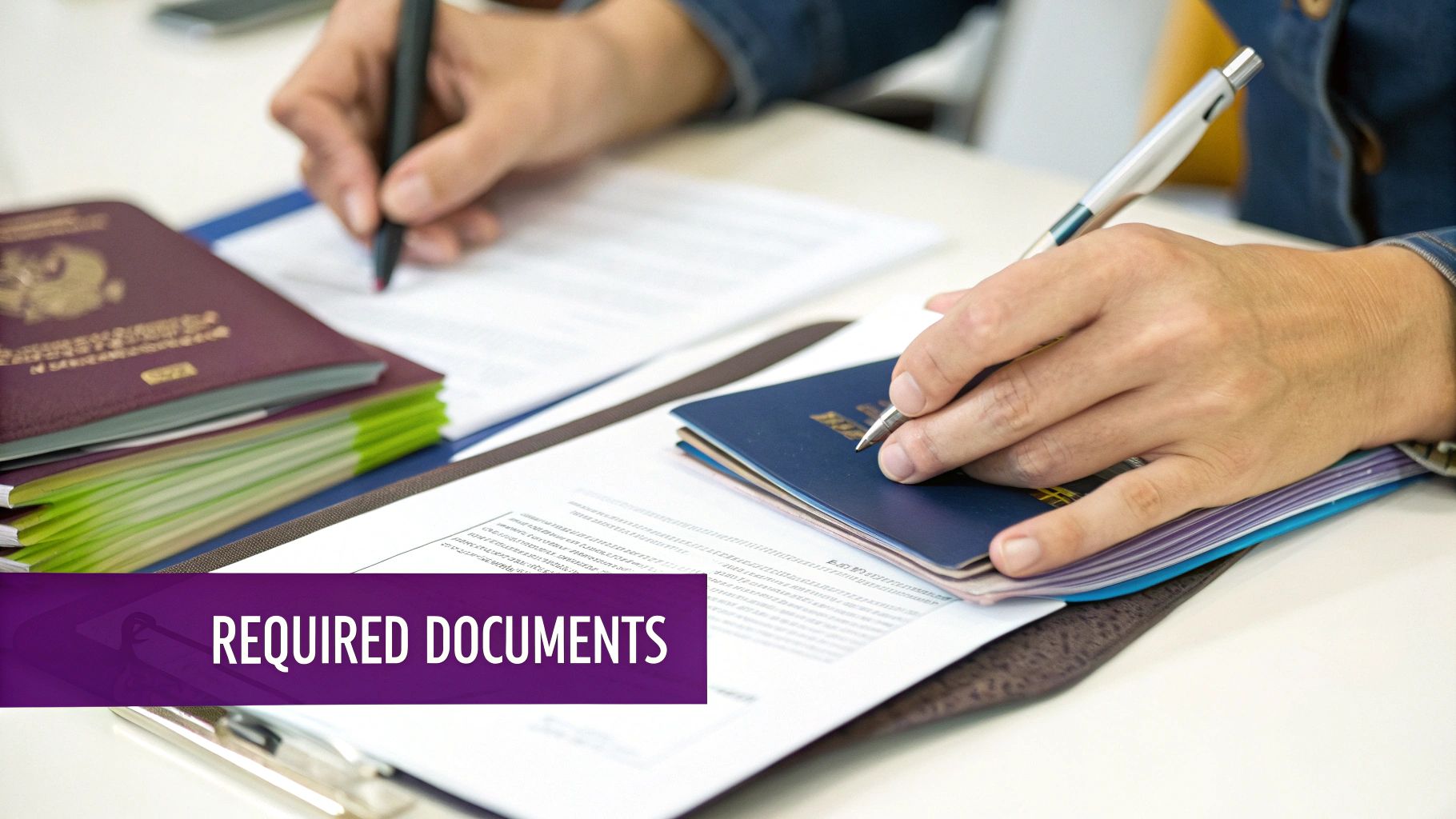
This is your chance to prove your company is legitimate, viable, and a good risk. Your goal is simple: make the banker's decision to say "yes" as easy as possible by leaving no room for questions.
Your Core Company Documents
First things first, let's pull together the foundational paperwork that proves your business is a legally recognised entity in the UAE. These are the non-negotiables, and they absolutely must be current. An expired trade licence, for example, is an instant deal-breaker.
Here’s the essential list:
- Valid Trade Licence: This is your primary proof of operation. It doesn't matter if it's from a Mainland authority like the DED or a Free Zone—it must be valid.
- Memorandum of Association (MOA): For LLCs and similar structures, this is your company's rulebook. It lays out the shareholders, their ownership stakes, and how the business will be run.
- Certificate of Incorporation/Registration: The official document confirming your company is registered with the relevant authority.
- Share Certificates: These formally identify each shareholder and specify the number of shares they own.
Pro Tip: Look closely at the business activities listed on your Trade Licence. They need to be specific and accurately reflect what your company actually does. Vague descriptions like "General Trading" can make a bank's compliance team suspicious and slow everything down while they ask for more details.
Essential Stakeholder Identification
Next up, the bank needs to verify the identity of every single person connected to the business. This means all shareholders, directors, and anyone who will have the authority to sign on the account. They will dig deep here.
Each key person needs to provide:
- Passport Copies: You'll need clear, high-quality copies for every shareholder and signatory. Don't be surprised if the bank asks for these to be attested or notarised, especially for partners based overseas.
- UAE Residence Visa and Emirates ID Copies: This is mandatory for any partner or signatory who lives in the UAE. It’s a crucial link proving their connection to the country.
- Proof of Address: A recent utility bill (DEWA) or a registered tenancy contract (Ejari) is the standard requirement to confirm where each signatory lives.
This entire stage is about transparency. The bank needs to know exactly who they’re doing business with to meet their anti-money laundering (AML) and Know Your Customer (KYC) obligations.
The Business Case: Your Financial Story
Beyond the legal documents, you have to paint a compelling picture of your business's purpose and financial standing. This is where you shift from proving you can operate to showing how you'll operate successfully.
Be ready to present the following:
- A Detailed Business Plan: Don’t just download a generic template. Your plan needs to clearly outline your business model, target customers, realistic revenue projections, and even key suppliers or clients you've already lined up. A well-researched plan screams professionalism.
- CVs of the Signatories: Banks want to see that the people running the account have relevant experience and a credible professional background. It adds another layer of confidence.
- Company Profile: A short, punchy document summarising what your business does, its mission, and who the key players are.
- Source of Funds Declaration: This is a big one. You must be prepared to clearly explain and prove where the initial capital for the business came from.
For international entrepreneurs, this can all feel like a maze. As a premier corporate service provider, we live and breathe this stuff. We help entrepreneurs from all over the world leverage the full range of UAE tax benefits by getting their company formation and banking set up correctly from day one.
We make sure your documentation tells the right story—one that aligns perfectly with local regulations and what the banks need to see. Working with our specialists gives you 24/7 support and a cost-effective business setup solution that’s built for your specific goals.
What to Expect During the Bank Application and Interview
Once you’ve handed over your neatly compiled document package, the real work of securing your business bank account in Dubai begins. This isn't just about getting a rubber stamp on your paperwork. It's an in-depth due diligence process where the bank needs to get comfortable with you and your business.
Be prepared for a wait. The timeline is notoriously unpredictable, often stretching from a few weeks to several months. The best thing you can do is set realistic expectations right from the start. During this time, the bank's compliance team is in full swing, meticulously verifying every single detail—from the validity of your trade licence to the professional history of every signatory on the account. Any small inconsistency can cause a major delay, which is exactly why that initial, perfectly prepared file is your biggest advantage.
Getting Ready for the Banker Meeting
The meeting with the relationship manager—whether it's in person or over a video call—is the most critical part of this entire journey. Think of it less as a formality and more as an interview. This is where the bank assesses the legitimacy and potential of your business. Your primary job is to build trust and prove that you're a professional, transparent, and low-risk client.
Treat this meeting as seriously as you would a pitch to an investor. The banker is trained to sniff out red flags, and your confidence, clarity, and preparation will make all the difference. A vague or poorly explained business plan is one of the quickest routes to a rejection.
Common Questions and How to Nail the Answers
Bankers in Dubai will ask direct questions to get a clear picture of your operations, how you generate revenue, and what your financial future looks like. Having solid, confident answers ready is non-negotiable.
You can almost guarantee they'll ask things like:
- "Walk me through your business model." Get ready to explain exactly how your company makes money. Skip the buzzwords and be specific about your products or services.
- "Who are your main suppliers and customers?" Give them real examples. If you can name specific companies you plan to work with, it shows you've really thought this through.
- "What are your financial forecasts for the first year?" You need realistic, well-supported figures for revenue, costs, and profit. Be ready to explain the logic behind your numbers.
- "Why did you choose Dubai for your business?" Connect your answer back to tangible benefits like market access, logistical advantages, or the local talent pool.
At the end of the day, the banker’s main job is to assess risk. The most convincing thing you can do is clearly explain your business's cash flow—where the money comes from and where it goes.
Building Credibility and Proving You're a Good Bet
It's not just about what you say, but how you say it. Present yourself as an organised, serious entrepreneur. It’s a great idea to have copies of your key documents with you, even though you’ve already submitted them. It shows you’re on top of things and respect their time.
Above all, be completely transparent about who owns the company and where your startup capital came from. Banks have zero tolerance for grey areas here due to strict anti-money laundering (AML) rules. Trying to hide or obscure these details is a surefire way to get your application denied.
The whole process can feel a bit overwhelming, especially with the different demands of each bank. Our specialists provide 24/7 support through every stage, from company formation to opening your bank account, so you always have an expert to guide you. You can see how we provide tailored and cost-effective business setup solutions for international entrepreneurs. Ultimately, proving your business is a credible and viable venture is the key to getting that new business bank account in Dubai.
Navigating Common Hurdles and Rejection Reasons
Even with the most organised application, trying to open a business bank account in Dubai can feel like hitting a wall. It’s crucial to understand why banks say "no" so you can prepare for it. The reality is that banks in the UAE have a very low appetite for risk. They're often looking for reasons to decline an application, not approve it.
Don't take it personally; it's all about their internal procedures. A rejection often comes down to the bank's own risk profile flagging certain nationalities, business activities, or complicated ownership structures. The trick is to see these potential roadblocks coming and tackle them head-on in your application.
What to Do If You're Flagged as "High-Risk"
Some factors will automatically put your application into a "high-risk" bucket, which means you're in for some serious scrutiny. This doesn’t mean your business is shady—it just means it falls outside what the bank considers a standard, straightforward case.
Here are a few common red flags I see all the time:
- Nationality Roadblocks: If any signatories or shareholders are from countries on international sanctions lists or the Financial Action Task Force (FATF) grey list, it's often an immediate dead end. The compliance risk is simply too high for most banks to consider.
- Complicated Company Structures: Banks get nervous when they can't easily see who's in charge. If your company is owned by another offshore firm or has several layers of corporate ownership, it obscures the Ultimate Beneficial Owner (UBO).
- Sensitive Business Activities: Certain industries are automatically viewed as high-risk because of their potential for money laundering. Think cryptocurrency, general trading without a clear product focus, or businesses dealing in precious metals.
So, how do you handle this? Honesty and clarity are your best friends. If you have a complex ownership setup, draw up a simple, clear chart that maps out the entire structure and points directly to every UBO. If nationality is a potential issue, build a stronger local case by showing you have a physical office, resident employees, or even signed contracts with local clients.
Proving You're a Viable Startup
New businesses face a classic chicken-and-egg problem. Banks want to see proof that you're an operational, viable business, but you need the bank account to become operational. It's frustrating.
This is where your business plan has to do the heavy lifting. A generic, boilerplate plan won't cut it. It needs to be a robust document that proves your company's potential.
A meticulously detailed business plan is your startup’s most powerful tool. It should clearly outline your revenue model, target market, and include letters of intent from potential clients or signed supplier agreements to demonstrate concrete business activity.
This kind of documentation turns your application from just an idea on paper into a real business with a believable path to making money. We specialise in both Mainland and Freezone company formation across Dubai and Abu Dhabi, and a big part of what we do is help new ventures build the strongest possible case for the banks.
Managing the Minimum Balance Requirement
For many startups and SMEs, the minimum balance requirement is a major hurdle. When cash flow is everything, being asked to lock up a large sum of money can be tough. Some of the more premium accounts require balances of over AED 100,000, and the monthly penalties for dipping below that can be severe.
Dropping below the minimum isn't just a financial hit; it can also prompt the bank to close your account, which is a black mark on your company's record.
Here are a few practical ways to manage this:
- Start Small: Don't go for the fancy account with all the bells and whistles right away. Choose a bank or a basic account with a lower, more realistic minimum balance. You can always upgrade later once the money is flowing.
- Try to Negotiate: This doesn't always work, but if you have a great business plan and build a good rapport with your relationship manager, you might be able to negotiate a temporary waiver or a lower starting balance.
- Plan Your Cash Flow: Before you even apply, make sure your initial funding is enough to comfortably cover the minimum balance for at least six months. This gives you a buffer while you work on bringing in revenue.
Getting through these challenges takes a bit of foresight and a smart approach. By understanding what the banks are looking for and being ready to address their concerns, you can flip a potential rejection into a successful approval for your business bank account in Dubai.
Your Dubai Business Banking Questions Answered
When you're setting up a business in Dubai, the banking process is bound to stir up some questions. It's one of those things where even with a perfect plan, you hit a few specific hurdles that can feel a bit confusing. Let's tackle some of the most common queries we hear from entrepreneurs.
Can I Open a Business Bank Account in Dubai Remotely?
The simple, direct answer? It's highly unlikely.
While the idea of getting everything done from your home country is tempting, the reality of opening a corporate account here almost always requires you to be physically present at some point. UAE banks operate under very strict Know Your Customer (KYC) rules. This means at least one account signatory needs to meet a bank representative face-to-face to sign the final documents.
But that doesn't mean the whole process has to be a slog. By working with a business setup consultant, you can get all the groundwork done before you even book a flight. We're talking document gathering, pre-checking the application, and handling the initial back-and-forth with the bank. This makes your trip to the UAE short and sweet—just a quick visit for the final signing.
How Long Does It Take to Open a Corporate Account?
This is the big one, and honestly, the timeline can be all over the place. You need to be patient. I’ve seen accounts opened in as little as two weeks, but I’ve also seen complex cases drag on for three months or more.
A simple, straightforward application—say, for a mainland LLC with one resident shareholder—could very well be approved in 2-4 weeks.
But if your company has foreign corporate shareholders, a complex ownership tree, or operates in what's considered a high-risk sector, the bank will kick off an enhanced due diligence process. This deeper dive can easily stretch the timeline to 2-3 months. The best way to speed things up? Submit a perfect application from day one with every single document in order. Don't give them a reason to come back with questions.
What Should I Do If My Bank Account Application Is Rejected?
First off, don't panic. A rejection feels like a huge blow, but it’s definitely not the end of your journey.
Your first move should be to politely ask the bank for the reason. They won't always give you a detailed breakdown, but common culprits are a business plan that didn't quite convince them, an unclear source of funds, or a business activity that just doesn't fit their risk profile.
A "no" from one bank doesn't mean you'll get a "no" from all of them. Every bank in the UAE has its own risk appetite and internal criteria. What one bank sees as too risky, another might see as a great opportunity.
Once you have an idea of the problem, you can either fix it and try again or, the smarter move, take your application to a different bank. This is where having an expert on your side really pays off. A good corporate service provider knows the ins and outs of multiple banks and can match your business profile to the right institution, turning that initial rejection into an approval.
For an even deeper dive into the nuances and requirements, check out our comprehensive guide to opening a business bank account in Dubai for more practical advice.
Navigating the complexities of company formation and bank account opening in Dubai requires expert local knowledge. At 365 DAY PRO Corporate Service Provider LLC, our specialists offer cost-effective, tailored solutions for both Mainland and Freezone setups, complete with 24/7 support. We ensure you can fully enjoy UAE tax benefits while we handle the intricate details. Contact us today to get started.