Starting a business in Dubai isn't just about finding an office space; it's about plugging into a global hub of commerce. You're literally at the crossroads of the Middle East, Asia, and Europe, with access to some of the world's fastest-growing markets. This guide is designed to cut through the noise and give you a clear, practical roadmap for getting started, whether you're looking at a Mainland or Free Zone setup.
Why Dubai Should Be Your Next Business Destination
Choosing Dubai is a strategic move. It's a deliberate decision to place your company in an incredibly dynamic economic environment. The city is built for business, with world-class infrastructure, forward-thinking government policies, and a tax system that’s hard to beat. It’s this combination that creates such fertile ground for both startups and established corporations.
The UAE government is serious about attracting foreign investment, and they've created real advantages to make the process appealing. For international entrepreneurs, the benefits are clear: significant tax advantages and access to a diverse, highly skilled, and multicultural workforce. This supportive ecosystem is precisely why so many global players have made Dubai their home base.
A Hub of Economic Growth and Opportunity
The city's economic energy is more than just a feeling—the numbers back it up. In the first half of 2025 alone, Dubai saw a massive surge in new businesses, with an incredible 35,500 new companies registered. That data, coming from the Dubai Chamber of Commerce, paints a clear picture of a city that's not just growing but booming.

This kind of rapid growth creates real opportunities across countless sectors, from tech and e-commerce to logistics and professional services. The constant flow of new ventures creates a competitive but collaborative environment that's perfect for innovation.
"Dubai’s appeal lies in its unique blend of strategic location, forward-thinking governance, and a commitment to creating a seamless experience for business owners. It’s a place where ambition meets opportunity."
The Right Setup For Your Business Model
Navigating the setup process is much simpler when you have the right support. As the Best Corporate Service Provider in Dubai, Abu Dhabi & Sharjah, we create cost-effective, practical solutions that match your specific goals. Our team has been through this process countless times, and we cover every critical detail to make sure your journey from idea to launch is a smooth one.
We focus on the two main routes for company formation:
- Mainland Company Formation: This is your best bet if you want unrestricted access to the local UAE market or plan to work directly with government bodies.
- Freezone Company Formation: Ideal for international trade, this option gives you 100% foreign ownership, tax exemptions, and simplified import-export processes.
While you're handling the legal and logistical side of things, don't forget the importance of developing your company's branding right from day one. A strong brand is crucial for making your mark here. And with our 24/7 support, we’re always on hand to help, letting you focus on what you do best—growing your business.
Deciding Between a Mainland and Free Zone Setup
When you decide to set up a company in Dubai, one of the first forks in the road you'll encounter is the choice between a Mainland and a Free Zone licence. This isn't just a bit of paperwork; it’s a strategic decision that will shape your entire business. It determines who you can sell to, your ownership structure, and how you can grow within the UAE and internationally.
Getting this right from the start comes down to one simple question: where are your customers? If you're targeting the local UAE market directly, your path is likely different than if your focus is purely on international trade.
The All-Access Pass: The Mainland Advantage
A Mainland company, licensed directly by the Dubai Department of Economy and Tourism (DET), gives you the freedom to operate anywhere in the UAE. Think of it as the ultimate pass to the local economy. You can trade with any other business, work directly with government bodies, and even bid on major public sector contracts.
This makes a Mainland setup the only real choice for businesses that need a physical presence and want to engage with customers on the ground.
- Retail and Hospitality: If you're dreaming of opening a shop, a café, or a restaurant, a Mainland licence is a must.
- Local Service Providers: For consultancies, law firms, and other professional services aiming to serve UAE-based clients, a Mainland licence is essential for unrestricted operation.
- Construction and Real Estate: Any company involved in local property development or infrastructure projects needs to be on the Mainland.
As Specialists in Mainland Company Formation in Dubai & Abu Dhabi, we’ve guided countless businesses through this process. The ability to set up an office anywhere, hire staff without restrictions, and fully integrate into the local business community is why this structure is so powerful.
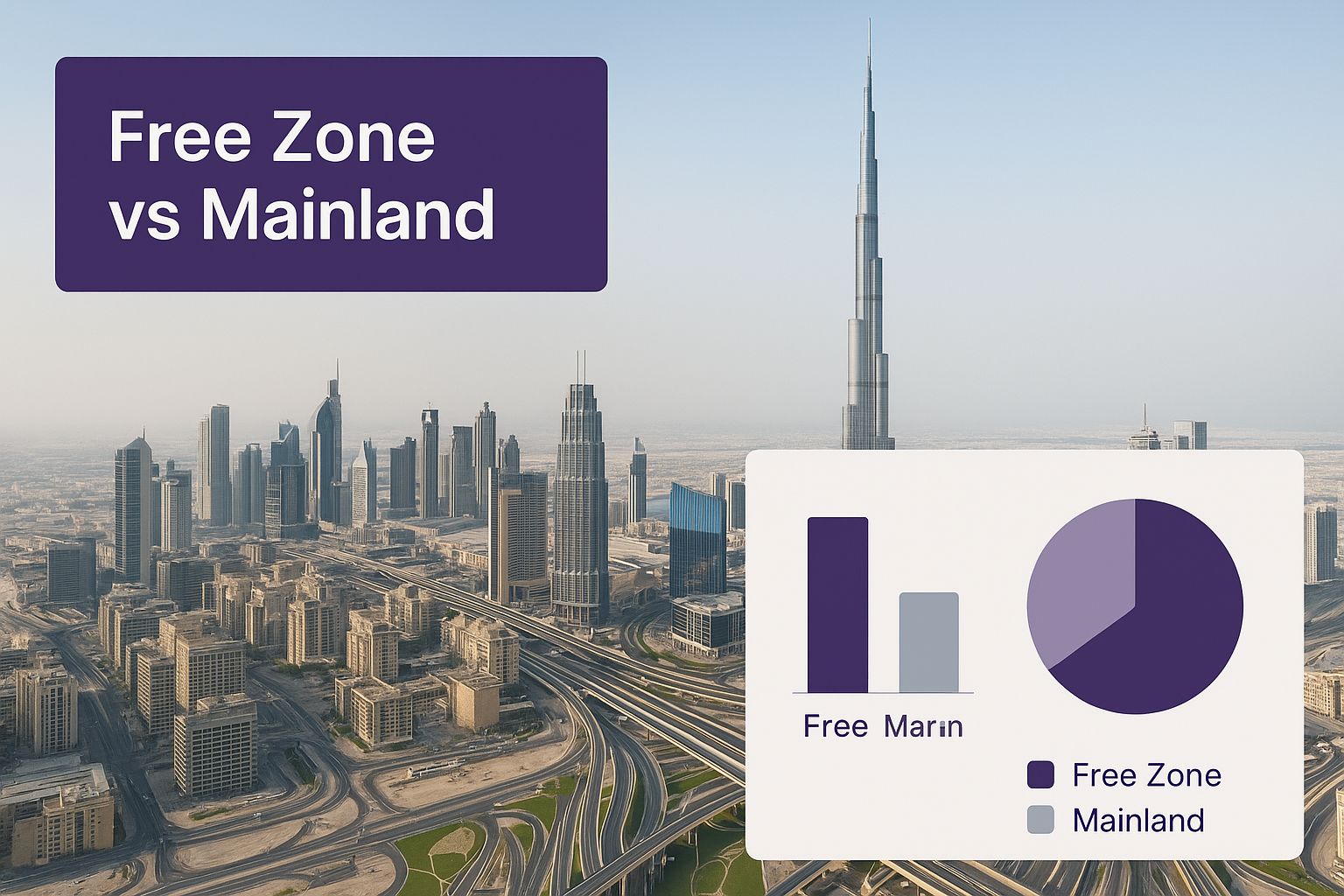
This visual gives you a quick snapshot of the key differences, showing the operational freedom a Mainland company provides compared to the more focused, internationally-oriented Free Zone environment.
A Global Hub: Exploring the Power of Free Zones
On the other side of the coin, you have the Free Zones. These are special economic zones designed to attract foreign investment with a compelling package of benefits. With over 40 Free Zones scattered across the UAE, many are built around specific industries, creating vibrant ecosystems for tech, media, finance, and logistics.
The big draw for most international entrepreneurs? The financial and ownership perks.
One of the standout benefits is 100% foreign ownership. You don’t need a local Emirati partner, which means you maintain complete control over your company. For global founders, this is often the deal-maker.
Beyond ownership, Free Zone companies typically enjoy 100% repatriation of capital and profits and exemptions from import and export duties. This financial freedom is precisely why so many international trading and service-based companies flock to them.
Real-World Example: A Tech Startup
Imagine a software company from Europe wanting to tap into the Middle East market. Setting up in Dubai Internet City (a tech-focused Free Zone) lets them keep 100% ownership, plug into a network of innovators, and manage their regional operations with serious tax advantages.
Real-World Example: An E-commerce Brand
A global online retailer needs a distribution hub for the region. By establishing themselves in Jebel Ali Free Zone (JAFZA), they get direct access to one of the world's biggest seaports, fast-tracked customs, and zero import/export taxes—a perfect recipe for efficient international logistics.
As Specialists in Freezone Company Formation across the UAE, our job is to match your business activity with the one Free Zone that feels like it was built just for you.
Mainland vs Free Zone Company At a Glance
So, how do you make the final call? It really comes down to your business model. To simplify things, I've put together a table that breaks down the key differences.
| Feature | Mainland Company | Free Zone Company |
|---|---|---|
| Market Access | Unrestricted access to the entire UAE market. | Primarily for trade within the Free Zone and internationally. |
| Ownership | 100% foreign ownership is now available for most activities. | 100% foreign ownership is guaranteed. |
| Office Location | You can rent an office anywhere in Dubai. | You must operate from an office within the specific Free Zone. |
| Government Contracts | Eligible to bid on government projects and tenders. | Generally not eligible for government contracts. |
| Visas | Visa eligibility is often tied to the size of your office space. | The number of visas is usually included in pre-set packages. |
| Tax Benefits | Subject to 9% corporate tax on profits over AED 375,000. | Can often qualify for 0% corporate tax on qualifying income. |
Choosing the right jurisdiction is about building a foundation that supports your ambitions, not just for today but for the long run. Whether you need the local access of a Mainland licence or the global-facing efficiency of a Free Zone, we provide Cost-Effective Business Setup Solutions to get you there. And with our 24/7 Support Service, you’ll have a guide every step of the way.
The Company Formation Process Unpacked
Once you've made the call between a Mainland and Free Zone setup, the next phase is all about bringing your business to life. This is where you move from strategy to a real, registered company, and it involves a series of specific approvals and a whole lot of paperwork. Getting these details right from the get-go is the key to a smooth launch.
This is the point where your business idea starts to take on a legal identity. You’ll begin by defining exactly what your company will do, give it a name, move through the legal paperwork, secure a physical address, and finally, get that all-important licence that lets you start trading.

Defining Your Business Activity and Trade Name
First things first, you need to be crystal clear about your business activities. The Dubai authorities offer a list of over 2,000 approved activities, and your choice here dictates whether you get a commercial, professional, or industrial trade licence. This is a foundational decision that sets the legal framework for your entire operation.
Next up is reserving your trade name. This isn't just about branding; it's a regulated step. Your chosen name has to be unique and follow some pretty strict rules. For example, it can't contain any religious references or offensive language and must genuinely reflect what your business does. It's always a good idea to have a few options ready, just in case your first choice is already taken.
Navigating Initial Approvals and Legal Documentation
With your activity and name sorted, you’ll move on to securing the Initial Approval Certificate. You'll get this from the Department of Economy and Tourism (DET) for a Mainland company, or the relevant authority if you're in a Free Zone. Think of this document as a green light from the authorities, confirming they have no objection to you starting the business.
From there, it’s time to draft and sign your company’s core legal documents. The main one is the Memorandum of Association (MoA), which lays out the company’s structure, who the shareholders are, and how it will operate. This needs to be drafted with care and attested by a notary public to make it legally binding.
For many entrepreneurs, this is where the value of a trusted corporate service provider becomes clear. Handling government paperwork and legal attestations requires precision. A single mistake can lead to significant delays, which is why our PRO services are designed to manage this entire process flawlessly, saving you both time and stress.
Securing a Physical Address
Every company in Dubai, whether it's on the Mainland or in a Free Zone, is legally required to have a registered physical address. This is non-negotiable. For a Mainland setup, you'll need to sign a tenancy contract for office space and register it with Ejari, Dubai’s online tenancy registration system.
Free Zones often provide more flexible options, such as co-working spaces, flexi-desks, or dedicated offices right within the zone. What you choose will really depend on your budget, team size, and the rules of your specific Free Zone. When you're setting up, especially for an online venture, it’s vital to be clear on understanding the legal setup for ecommerce businesses to ensure you’re ticking all the right boxes, both digital and physical.
Obtaining Your Final Trade Licence
Once all your documents are submitted and your office lease is in place, you can finally apply for your trade licence. This is the official permit that legally allows your business to start operating. You’ll need to submit the whole bundle of paperwork you’ve gathered so far, including:
- The signed Memorandum of Association (MoA)
- The attested office tenancy contract (Ejari)
- Passport copies for all shareholders and managers
- The Initial Approval Certificate
After the authorities review and approve your application, you’ll be issued a payment voucher. Pay the licence fees, and the official trade licence is yours. The whole process is a sequence of steps, with each one depending on the last. While the typical timeline is a speedy 2 to 4 weeks, making Dubai great for getting to market fast, it's also smart to be prepared for costs beyond the initial setup package. Think about office rent, visa renewals, and ongoing compliance fees down the line.
With the trade licence in your hands, your company is officially established. The next moves are to get residency visas sorted for yourself and any employees, and to open a corporate bank account to start managing your finances.
Getting Your Visas and Bank Account Sorted
You’ve got the trade licence in hand – congratulations, your company officially exists on paper. But let's be real, the two biggest practical challenges are still ahead: sorting out your UAE residency visa and opening a corporate bank account. Getting these right is what actually lets you live here and do business.
These aren't just administrative boxes to tick. A tiny mistake on a visa application can set you back weeks, and walking into a bank unprepared is a surefire way to get your account application rejected. This is where a bit of inside knowledge and careful preparation really pay off.
Securing UAE Residency for You and Your Team
Your UAE residence visa is your ticket to everything. It’s not just a stamp in your passport; it's what allows you to legally live and work in Dubai. The process has several distinct stages, and you have to follow them to the letter.
It all starts with getting an entry permit, which lets you into the country specifically to take up your role as an investor or employee. Once you're here, you'll need to do a mandatory medical fitness test (a screening for specific communicable diseases). After you get the all-clear, it's on to biometrics and registering for your Emirates ID. That little card is your lifeline here—you'll need it for everything from renting a flat to setting up your phone plan.
This whole process doesn't just apply to you. It's the same for any staff you hire and can be extended to sponsor your family, too. As your corporate service provider, we handle this entire sequence from start to finish. We make sure every form is filled out perfectly and every appointment is booked, so your move to Dubai is as smooth as possible for you, your family, and your team.
The Hurdle of Opening a Corporate Bank Account
For many new entrepreneurs, this is often the toughest part of the whole setup. UAE banks are incredibly thorough, thanks to strict global anti-money laundering (AML) and know-your-customer (KYC) rules. They need to see a legitimate, well-documented business with a clear purpose before they'll even consider you.
A classic mistake is thinking a trade licence is all you need. It’s not. The banks want to see a solid business plan that clearly explains what you do, who your customers are, and how you'll make money. They're looking for proof of a real, active business, not just a name on a licence.
If there's one thing we've learned over the years, it's that the strength of your application is everything. The bank will dig into the background of your shareholders, the nature of your business, and where your funding comes from. A vague or incomplete application is a guaranteed "no".
To give yourself the best shot, you need to put together a comprehensive file. We walk our clients through assembling all the right documents to present a professional, credible profile that the bank will take seriously.
Here's a look at what you'll typically need to have ready:
- Complete Company Documents: Your trade licence, Memorandum of Association (MoA), and any share certificates.
- Shareholder and Manager Information: Clear copies of passports, visa pages, and Emirates IDs for all partners and account signatories.
- Proof of Address: A utility bill or tenancy contract for the main signatories.
- A Robust Business Plan: This needs to clearly lay out your business model, revenue projections, and financial forecasts.
- Supplier and Client Details: Naming potential clients or showing invoices from suppliers can add a huge amount of credibility.
How a Specialist Can Fast-Track the Process
This is where having someone who knows the system and has relationships with the banks makes a world of difference. We know exactly what each bank's compliance team is looking for and help you build an application that ticks all their boxes from the start. We essentially act as your advocate, presenting your business case and chasing up on your behalf.
As specialists in both Mainland Company Formation in Dubai & Abu Dhabi and Freezone Company Formation across the UAE, we've opened accounts for hundreds of businesses just like yours. We know the process inside and out, which means we can spot potential red flags and fix them before they become a problem.
Choosing the right partner for this final, crucial stage can be the difference between being up and running in a few weeks or being stuck in bureaucratic limbo for months. And with our 24/7 Support Service, you'll always have someone to call for an update or to answer a question, so you're never left wondering what's happening during this critical time.
Budgeting for Your Dubai Business Setup
Let's talk numbers. A solid financial plan is the bedrock of any successful launch in Dubai, and the last thing you want are hidden costs derailing your momentum. To budget properly, you need a clear picture of everything involved—not just the initial licence fee, but all the recurring expenses that keep your business running.
The initial investment is more than just a single price tag. It's a collection of one-time fees for your registration, government approvals, and visa processing. These upfront costs can look very different depending on whether you go for a mainland or free zone setup.
Mainland vs. Free Zone: What to Expect Upfront in 2025
Setting up a business in Dubai in 2025 means stepping into a well-oiled machine built for entrepreneurs. As a general guide, a mainland company setup typically starts around AED 25,999, a figure that usually gets you the essential business licence and your first investor visa.
If you’re leaning towards a free zone, the barrier to entry can be lower. Many packages start from AED 10,000, but this number can swing dramatically depending on which of the 40+ free zones you choose and the specific licence you need. To get a feel for how these compare, it's worth reading a detailed breakdown of business setup costs in Dubai.
Of course, these are just starting points. Your final bill will be influenced by a few key variables:
- Your Business Activity: Certain professional services or trading activities need extra approvals from government ministries, and each one comes with its own fee.
- Visa Requirements: The more visas you need for yourself, your partners, or future employees, the more you'll need to budget upfront.
- Office Space: A flexi-desk is a fantastic, low-cost starting point. But if you need a dedicated physical office from day one, that will naturally increase your initial outlay.
Beyond Day One: Planning for Ongoing Expenses
Here’s where many new entrepreneurs get caught out. They focus so intently on the initial setup cost that they forget about the annual expenses required to keep the lights on and the licence active.
Your first year's budget is just the beginning. Long-term success in Dubai requires a clear understanding of your annual financial commitments, from licence renewals to office rent and potential corporate service retainers.
To build a sustainable business, you absolutely must factor these recurring costs into your financial forecast:
- Annual Licence Renewal: This is your non-negotiable yearly fee to the authorities to keep your trade licence valid.
- Office Rent: Whether it’s a minimal charge for a shared desk or a full lease for a mainland office, this will be a significant part of your annual budget.
- PRO Service Retainers: Many businesses find it invaluable to keep a corporate service provider on retainer. This ensures all your visa renewals, licence amendments, and compliance tasks are handled smoothly without you having to navigate the system yourself.
- Corporate Tax Compliance: Since the introduction of corporate tax, you'll likely need to budget for professional accounting and auditing services to ensure you're filing correctly and staying compliant.
As Specialists in Mainland and Freezone Company Formation, our job is to give you a transparent, all-inclusive cost breakdown from the very beginning. We map out every potential fee so you can plan with confidence, enjoy UAE tax benefits for international entrepreneurs, and build your new venture on a truly solid financial foundation.
Common Questions About Dubai Company Setup
Jumping into the world of Dubai business setup always brings up a handful of critical questions. It's completely normal. You're navigating everything from ownership laws to long-term compliance, and getting clear, straightforward answers is what helps you move forward with confidence.
Let's tackle some of the most common queries we hear from entrepreneurs who are exactly where you are right now. Think of this as a quick-fire round to clear up any confusion, based on our real-world experience as one of the Best Corporate Service Providers in Dubai, Abu Dhabi & Sharjah.
Can a Foreigner Actually Own 100% of a Company?
Yes, they can! This is probably one of the biggest and most welcome changes to UAE business law in recent memory. For the vast majority of business activities, 100% foreign ownership is now the standard for both mainland and free zone companies.
It wasn't always this way. In the past, a mainland company usually meant bringing on a local Emirati sponsor who held a majority stake. That hurdle is now gone for most commercial and professional licences, giving international founders like you full command of their operations from day one.
How Many Visas Can I Get for My Company?
This is a great question, but there's no single magic number. Your visa eligibility is tied directly to your company's physical footprint and structure.
- Mainland Companies: It’s all about your office space. The authorities link your visa quota directly to the size of your registered office. The bigger the space, the more visas you're allocated.
- Free Zone Companies: Here, visas are usually bundled into packages. You might start with a setup that includes one or two visas, and as your team expands, you simply upgrade your package.
As Specialists in Mainland Company Formation in Dubai & Abu Dhabi, a big part of our job is helping you figure out your needs upfront. We ensure you secure the right setup for your team's size, both now and for your future growth.
Is a Physical Office Mandatory in Dubai?
The short answer is yes—every registered company in the UAE needs a physical, registered address. But "physical office" has a very flexible definition, especially when you're just starting out.
You don't need to be locked into a traditional, expensive office lease. For most new businesses and freelancers, a flexi-desk or a spot in a co-working space is a fantastic and Cost-Effective Business Setup Solution. This ticks the legal box for an address without draining your startup capital on overheads.
The non-negotiable document here is a valid tenancy contract (known as an Ejari for mainland setups) registered under your company’s name. This is one of the final pieces of the puzzle before your licence is issued.
What Are the Ongoing Compliance Requirements?
Getting your trade licence is a huge milestone, but it's not the finish line. Staying in good legal standing means keeping up with a few key annual tasks.
- Licence Renewal: Your trade licence has to be renewed every year with the DED or your specific free zone authority.
- Corporate Tax: You'll need to register for corporate tax and file your annual returns. This applies even if your profits fall below the AED 375,000 taxable threshold.
- Ultimate Beneficial Owner (UBO) Register: Keeping a record of your company's ultimate beneficial owners and ensuring it's up-to-date is a must.
- Audited Financials: Depending on your jurisdiction and business activity, you may need to submit audited financial statements annually.
The good news is that the business environment here is incredibly supportive. According to Mastercard’s SME Confidence Index, a remarkable 91% of UAE SMEs are optimistic about their growth prospects. This confidence is built on a stable economy and government policies that make compliance manageable. You can discover more insights about SME optimism in the UAE on tme-services.com.
Our 24/7 Support Service is designed to take the stress out of compliance, making sure you hit every deadline so your business can continue to thrive without interruption.
Ready to make your Dubai business a reality? Let 365 DAY PRO Corporate Service Provider LLC guide you through the process. We provide clear, expert support at every turn.
📞 Call Us Now: +971-52 923 1246
💬 WhatsApp Us Today for a Free Consultation at https://365dayproservices.com