
Not long ago, the UAE's manufacturing sector was a supporting act in an economy dominated by oil. Today, it’s taken centre stage, becoming a central pillar of the nation's economic strategy. This is a story of ambitious vision and incredible growth, one that's quickly turning the country into a formidable global industrial player.
The UAE's Rise as a Global Manufacturing Hub
Think of an economy rapidly swapping its foundations from oil to innovation. That's exactly what's happening in the United Arab Emirates. The manufacturing sector is now a primary engine for sustainable, long-term growth.
This strategic pivot isn't just about weaning the economy off hydrocarbons. It’s about building a diversified, knowledge-based economy that's resilient enough to compete and thrive on the world stage.
The UAE government’s commitment is the real engine behind this change. Through bold national strategies, it has cultivated an exceptionally welcoming environment for industrial investors. This has lit a fire under the sector, sparking a decade of explosive growth and pulling in entrepreneurs from home and abroad.
A Decade of Remarkable Growth
The numbers speak for themselves. The past ten years have seen a massive expansion in the UAE's industrial capabilities. This isn't just incremental progress; it's a quantum leap forward.
Here's a quick look at how far the sector has come in just a decade:
UAE Manufacturing Sector Growth Highlights
A summary of key metrics showcasing the impressive growth of the UAE's manufacturing industry over the past decade, highlighting its increased contribution to the national economy.
| Metric | 2013 Status | 2023 Status | Growth |
|---|---|---|---|
| H1 Sector Output | USD 13.6 billion | USD 25.9 billion | +91.1% |
| Contribution to National GDP | 7.9% | 11.2% | +3.3% |
These figures clearly show a sector that is not just growing, but accelerating. This rapid ascent is supported by a robust financial ecosystem, underscored by the UAE's emergence as a supply chain finance powerhouse, which is vital for keeping the gears of industry turning smoothly.
"The UAE’s long-term commitment to becoming a competitive destination for foreign manufacturing investments is clear. These policies, combined with an advantageous geographical location and excellent infrastructure, make the UAE a unique destination for manufacturers seeking growth and long-term stability."
This impressive expansion is no accident. It's the direct result of carefully planned government initiatives designed to build a world-class industrial ecosystem from the ground up.
Operation 300bn: The Strategic Blueprint
At the heart of this industrial ambition is 'Operation 300bn', a national strategy launched to cement the UAE's position as a global manufacturing hub. The core goal is clear and ambitious: more than double the industrial sector's contribution to the GDP to AED 300 billion by 2031.
But this initiative is so much more than just a number. It's a comprehensive roadmap with several key components working in tandem:
- Financial Fuel: The Emirates Development Bank (EDB) has earmarked AED 30 billion to finance priority industrial sectors. Think low-interest loans and generous grace periods designed to get projects off the ground.
- Talent and Tech Magnet: The programme actively works to pull in top talent and encourages the adoption of advanced technology and Industry 4.0 solutions, pushing for greater efficiency and innovation.
- Homegrown Champions: The complementary 'Make it in the Emirates' campaign champions locally manufactured goods. This builds a strong domestic market while simultaneously boosting export potential.
These strategic efforts paint a clear picture of why the manufacturing industry in the UAE is one of the most dynamic and attractive investment landscapes anywhere in the world today.
Exploring High-Growth Manufacturing Sectors
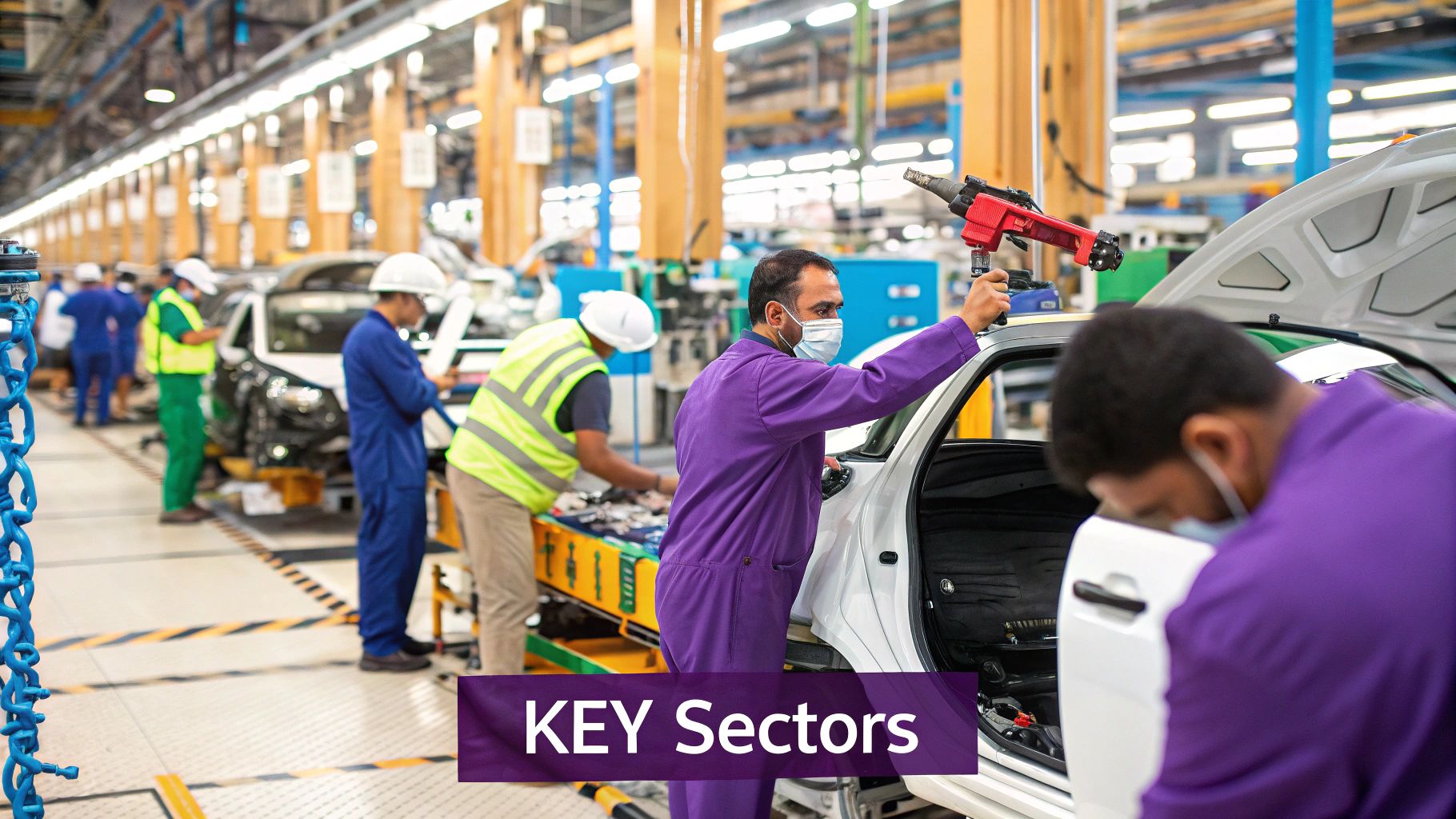
To really get a feel for the opportunity in the manufacturing industry in UAE, you have to look past the headlines and dig into the specific sectors powering its growth. The country's industrial strategy isn't a broad, one-size-fits-all plan. It’s a carefully managed ecosystem where certain industries are specifically nurtured to become global leaders. This targeted approach funnels resources, infrastructure, and investment right where they’ll make the biggest splash.
Think of the UAE's manufacturing landscape as a high-performance engine. Every component, from petrochemicals to food production, is precision-engineered to boost the national economy's overall power and efficiency. This is a core idea behind the 'Operation 300bn' initiative—making sure every industry plays its part in hitting the country's ambitious economic targets.
The UAE's manufacturing sector is defined by its focus on powerhouse industries like chemicals, rubber, plastics, metals, and food manufacturing. Each one plays a crucial role. For instance, the nation taps into its vast petrochemical capacity, making chemicals, rubber, and plastics major contributors to manufacturing value. Likewise, the UAE is a world leader in aluminium production, a testament to the strength of its metals manufacturing subsector, which just keeps growing. For a deeper dive, you can explore this detailed overview of the UAE manufacturing sector on emiratesnbdresearch.com.
The Industrial Heavyweights
At the heart of the UAE's industrial strength are its traditional heavyweights. These are the mature, globally competitive sectors that form the very foundation of the country's manufacturing output and export muscle.
- Petrochemicals, Plastics, and Rubber: By making the most of its rich hydrocarbon resources, the UAE has built a world-class petrochemicals industry. This sector is the source of essential raw materials for countless products, from industrial plastics to everyday consumer goods, feeding supply chains both at home and abroad.
- Base Metals (Especially Aluminium): The UAE is one of the top aluminium producers in the world. Companies like Emirates Global Aluminium (EGA) aren’t just smelters; they are innovation hubs, supplying high-quality metal to the automotive, construction, and aerospace industries all over the globe.
These sectors are the established giants, giving the economy a stable footing from which it can branch out into new, high-tech fields. They also create a powerful ripple effect, supporting a huge network of smaller businesses in processing, fabrication, and logistics.
Emerging and Future-Focused Industries
While the heavyweights provide a solid base, the UAE is aggressively pushing into next-generation industries. This is where the vision for a diverse, knowledge-based economy really starts to take shape. The focus here is on sustainability, advanced technology, and becoming more self-sufficient.
The UAE’s long-term commitment to becoming a competitive destination for foreign manufacturing investments is clear. These policies, combined with an advantageous geographical location and excellent infrastructure, make the UAE a unique destination for manufacturers seeking growth and long-term stability.
This commitment is pulling investors into several high-potential areas:
- Food and Beverage (F&B): With a national push for food security, the F&B sector has seen explosive growth. This covers everything from massive food processing plants to clever agritech startups figuring out how to farm sustainably in the desert. The aim is to rely less on imports and turn the UAE into a regional F&B powerhouse.
- Pharmaceuticals and Medical Equipment: Driven by a goal of healthcare self-sufficiency, this sector is a national priority. The government is actively encouraging local production of medicines and medical devices, which is opening up massive opportunities for specialised manufacturers.
- Advanced Technology and Machinery: As a key part of 'Operation 300bn', there's a huge drive to adopt Industry 4.0 technologies. This has created a booming market for businesses that produce robotics, automation systems, and advanced industrial machinery.
What’s more, each Emirate often develops its own speciality, creating focused industrial hubs. For instance, Dubai Industrial City is a major centre for a wide range of manufacturing, while KIZAD in Abu Dhabi is a powerhouse for large-scale industrial projects. This regional specialisation creates centres of excellence that concentrate talent, infrastructure, and supply chains—all to the benefit of businesses in that cluster. It's this kind of strategic thinking that is making the manufacturing industry in UAE so competitive on the world stage.
How Government Initiatives Are Fuelling Industrial Success in the UAE
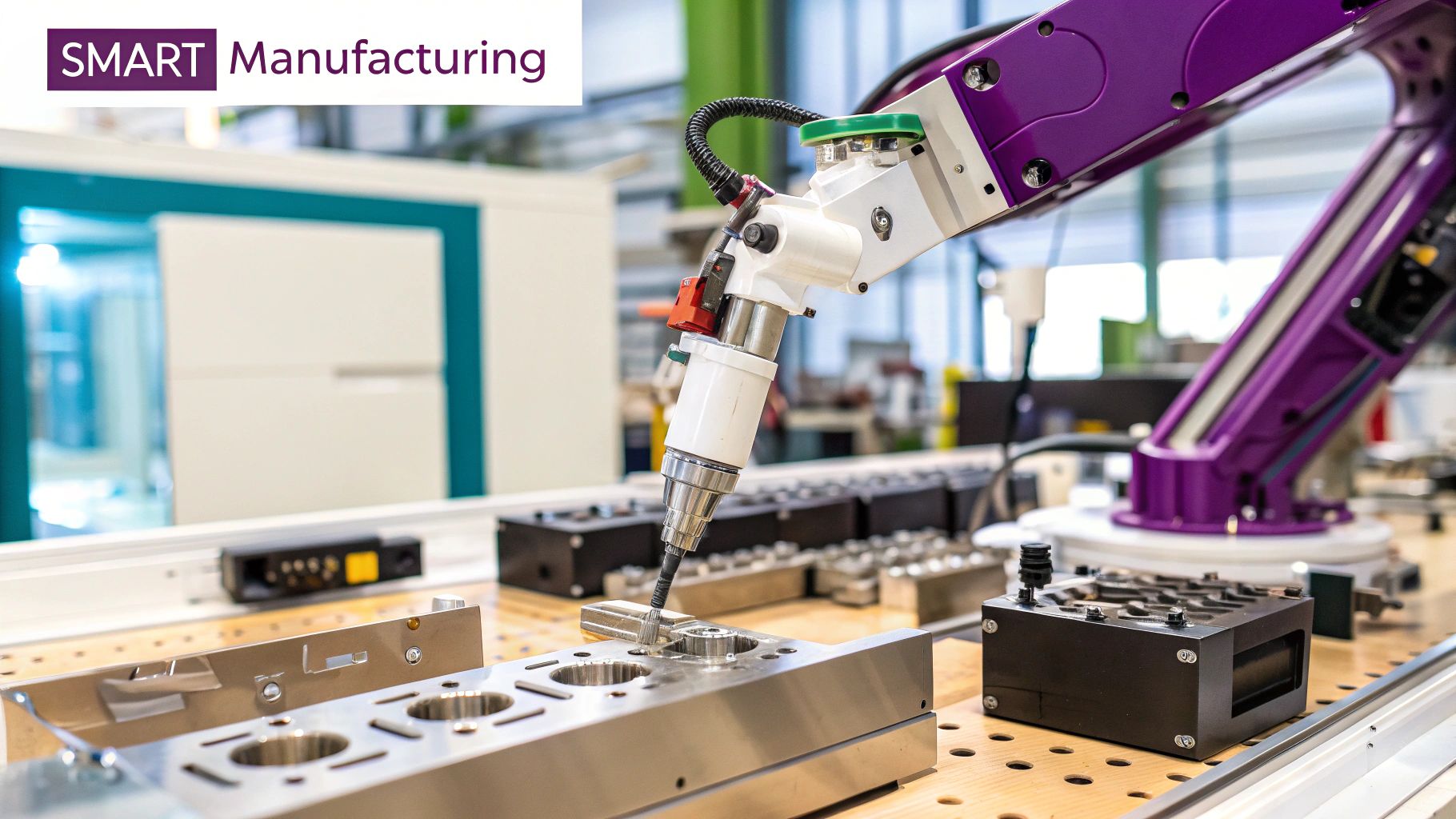
The incredible momentum you see in the manufacturing industry in UAE isn’t a happy accident. It’s the direct outcome of a powerful, long-term vision from the country's leadership. They aren't just giving the sector a nod of approval; they are actively engineering a supportive ecosystem designed to pull in investment and ensure businesses flourish.
You could almost think of the UAE government as a strategic partner in your manufacturing venture. It lays out the roadmap, provides critical tools, and offers the financial backing to turn ambition into reality. This deep commitment transforms high-level national goals into real, tangible advantages for entrepreneurs on the ground.
Two initiatives, in particular, are the engines powering this industrial renaissance: 'Operation 300bn' and the 'Make it in the Emirates' campaign. Working in tandem, they create a comprehensive support system that significantly lowers investment risks while fuelling sustainable growth.
The Power of Operation 300bn
'Operation 300bn' is the strategic heart of the UAE’s industrial future. Its headline goal is to boost the sector's contribution to the national GDP to AED 300 billion by 2031, but it's so much more than just a number. It's a detailed action plan for building a globally competitive, tech-forward industrial base.
For anyone looking to set up shop, this initiative unlocks a treasure trove of practical support. The Emirates Development Bank (EDB) is a key player here, earmarking a massive AED 30 billion (USD 8.2 billion) to finance priority industrial sectors. This isn't just about creating a friendly business climate; it's about injecting direct financial fuel to get projects off the ground and help them scale.
The message from the UAE is crystal clear: it is committed to being a top-tier destination for foreign manufacturing investment. When you combine these policies with a prime geographical location and world-class infrastructure, you get a unique proposition for manufacturers chasing growth and stability.
This financial backing is far from a one-size-fits-all loan. The EDB has structured a diverse range of financing solutions, each tailored to the specific needs of an industrial project.
- Capital Expenditure Financing: Need to buy new machinery or build a facility? You can secure financing for up to 80% of your capital expenditures, dramatically lowering the upfront investment hurdle.
- Project Financing: Whether you're starting from scratch (a greenfield project) or expanding an existing site (brownfield), you can access financing to cover up to 70% of the total project cost.
- Technology and Green Financing: To drive modernisation and sustainability, the EDB offers up to 90% financing for adopting advanced technology and up to 100% for projects focused on renewable energy and efficiency.
What’s more, these packages often come with very favourable terms, including two-year grace periods and low-interest rates, which can make a huge difference to your cash flow and the long-term health of your project.
Championing Local Production with 'Make it in the Emirates'
Working hand-in-glove with the financial might of 'Operation 300bn' is the 'Make it in the Emirates' campaign. Think of this as the public face and marketing arm of the UAE's industrial strategy. Its mission is to champion the quality and value of locally made goods, fostering national pride while creating an irresistible pull for international investors.
The campaign acts as a powerful magnet, drawing innovators and entrepreneurs to establish their manufacturing operations right here in the Emirates. It’s a connector, linking investors with local opportunities, simplifying the setup process, and spotlighting the competitive edge that comes with producing goods in the UAE.
A highlight of this initiative is the annual 'Make it in the Emirates' forum. This isn’t your typical conference; it’s a crucial networking hub where manufacturers get direct access to major procurement contracts with the nation's leading companies. To give you a sense of its impact, at one recent forum, national banks pledged over AED 40 billion (USD 10.9 billion) in competitive financing for industrial SMEs. That’s the kind of tangible support that turns plans into factories.
By cultivating a strong domestic market and relentlessly promoting UAE-made products on the global stage, this campaign ensures manufacturers have a solid foundation for both local sales and export growth. This dual focus is precisely what makes the manufacturing industry in UAE such a remarkably stable and profitable environment for investors.
Your Roadmap to Setting Up a Manufacturing Business
So, you're looking to start a manufacturing business in the UAE. It’s a fantastic prospect, but transforming that idea into a buzzing factory floor needs a solid plan. Think of this section as your step-by-step guide, breaking down everything from the initial legal paperwork to getting the final green light to operate.
Your very first decision is a big one: where will your business be registered? The choice between setting up on the Mainland or in a Freezone will shape almost everything about your company – from who can own it to where you can sell your products.
Choosing Your Foundation: Mainland vs. Freezone
Let’s break down the two main options. A Mainland company is registered directly with the Department of Economic Development (DED) in an emirate like Dubai or Abu Dhabi. The biggest advantage here is freedom. You can trade directly with any customer across the entire UAE and bid for those valuable government contracts. It gives you maximum reach within the country's borders.
On the other hand, a Freezone company is based within a specific, designated economic area. These zones are often built around certain industries (like tech or media) and come with some tempting perks, including 100% foreign ownership and tax exemptions. The catch? To sell your products directly into the UAE mainland market, you'll usually need to partner with a local distributor.
To make the choice clearer, it's helpful to see them side-by-side.
Comparing Mainland and Freezone Manufacturing Setups
Here’s a quick comparison to help you weigh the pros and cons of each setup based on what matters most for your manufacturing business.
| Feature | Mainland Company | Freezone Company |
|---|---|---|
| Market Access | Unrestricted access to the entire UAE domestic market. | Primarily for international trade; requires a local agent for Mainland sales. |
| Ownership | Now allows 100% foreign ownership for most activities. | Always offers 100% foreign ownership. |
| Government Tenders | Eligible to bid on government projects and contracts. | Generally not eligible to bid on government contracts. |
| Office Location | Can rent or own physical premises anywhere in the specific Emirate. | Must operate from within the designated Freezone's boundaries. |
| Approvals | Requires approvals from DED, Municipality, and other relevant ministries. | Approvals are managed by the specific Freezone authority, often simpler. |
Ultimately, the right choice really boils down to your business model. Are you focused on serving the local UAE market, or is your primary goal to export goods internationally? Answering that question will point you in the right direction.
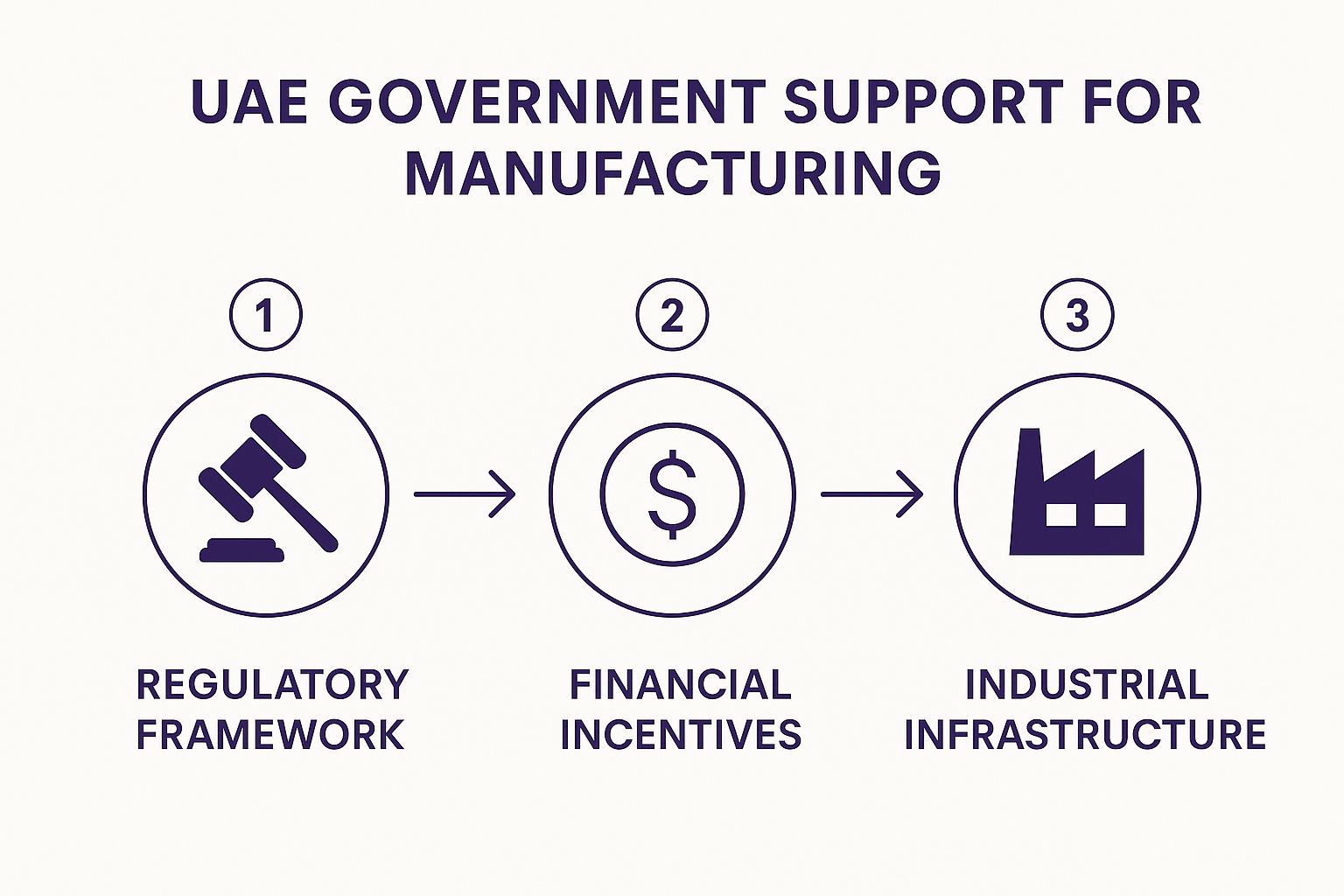
This image paints a clear picture of the government’s approach. It's a cohesive system designed to make industrial growth as smooth as possible, flowing from a strong regulatory framework right through to financial support and world-class infrastructure.
The Essential Steps to Launch
Once you've decided on your company's legal structure, the setup process follows a fairly logical path. Getting through these stages efficiently is the key to firing up your production lines without hitting frustrating roadblocks.
-
Secure Your Industrial Licence: This is your golden ticket. The industrial licence, issued by the DED for Mainland companies or the Freezone authority, is the official document that allows you to manufacture goods. It will clearly state what kind of products you are legally permitted to produce.
-
Find a Suitable Facility: Your factory or warehouse isn't just a building; it has to meet specific standards. It must comply with requirements from Civil Defence and other authorities covering safety, space, and equipment. For some industries, looking into specialised zones like Dubai Industrial City or KIZAD is a smart move, as they offer infrastructure that's already kitted out for manufacturing.
-
Obtain Necessary Approvals: Beyond the licence, you'll need a handful of other approvals. This typically involves the local Municipality, the Chamber of Commerce, and the Ministry of Industry and Advanced Technology (MoIAT), which is the main body overseeing the entire industrial sector. Don't overlook safety—implementing strong safety protocols from day one is non-negotiable. Using tools like practical Job Safety Analysis examples can help you spot and manage workplace hazards before they become a problem.
A smooth setup in the UAE's manufacturing sector hinges on diligent preparation and a deep understanding of the regulatory landscape. Partnering with a corporate service provider who specialises in Mainland and Freezone formation can make all the difference, transforming bureaucratic hurdles into simple milestones.
With the right guidance, this journey becomes much more straightforward. As specialists in Mainland Company Formation in Dubai & Abu Dhabi and Freezone Company Formation across the UAE, we can handle the complex paperwork and liaise with government bodies for you, ensuring everything is done correctly and cost-effectively. This frees you up to focus on what you do best: building a successful manufacturing business.
Why Investors Are Choosing the UAE for Manufacturing
Global investors have a world of options when deciding where to set up a manufacturing plant. So, what makes the UAE stand out? It’s more than just favourable tax rates. The real appeal lies in a powerful mix of logistical dominance, solid political stability, and a legal framework that genuinely welcomes business. It’s this combination that creates a secure and forward-looking environment for any industrial venture.
Choosing the UAE isn't just about finding a new address for your business; it's about plugging into an entire ecosystem built for growth. The country has deliberately engineered an environment where manufacturers can thrive, free from the red tape and uncertainty that plague so many other global hubs.
A True Gateway to Global Markets
Let's start with one of the UAE's biggest draws: its logistics. Positioned at the crossroads of Europe, Asia, and Africa, the country is a natural hub connecting you to billions of consumers. Its top-tier ports, like Jebel Ali in Dubai, and its major international airports aren't just stops along the way—they are vital arteries in the global supply chain.
What does this mean for a manufacturer on the ground? Pure efficiency.
- Faster Shipping: You can drastically shorten delivery times to major markets across three continents.
- Lower Logistics Costs: The sheer volume and competition within the UAE's logistics sector help keep your costs down.
- Effortless Connectivity: Your products have access to a massive network of air and sea routes, ensuring they get to customers quickly and reliably.
This geographical sweet spot gives your business incredible agility. You can react faster to market changes and fine-tune your supply chain for better profitability.
The UAE’s formula is simple but powerful: a great tax system, unshakable political stability, and world-class infrastructure. This creates a secure and profitable climate for investment, setting the stage for long-term industrial success.
A Business Environment That's Hard to Beat
Beyond its ports and airports, the UAE offers a regulatory and financial setup that’s second to none. The government’s forward-thinking policies are designed to do one thing: attract and keep foreign investment. This creates a level of security and operational freedom that’s hard to find elsewhere in the region.
Think about how these benefits directly impact your business:
- A Favourable Tax System: While there's a 9% corporate tax, the lack of personal income tax or capital gains tax means international entrepreneurs keep more of what they earn. You can learn how to Enjoy UAE Tax Benefits for International Entrepreneurs by setting up your operations smartly.
- 100% Foreign Ownership: This is a huge one. Recent legal changes now allow complete foreign ownership for most businesses on the mainland—a perk that used to be reserved for free zones. It means you have full control over your company.
- Political and Economic Stability: The UAE is known for being a beacon of stability. Its steady political climate and strong economy give you a predictable foundation to build your long-term plans on.
This trio of advantages takes a lot of the risk out of the equation. It lets you focus on what really matters—innovation and growth—instead of getting bogged down in bureaucracy.
Your Partner for a Smooth Entry
Making the most of these advantages takes a bit of local know-how. Choosing between a mainland or free zone setup, getting the right licenses, and making sure you’re compliant can feel overwhelming. This is where getting expert help can turn a complicated process into a straightforward one.
As the Best Corporate Service Provider in Dubai, Abu Dhabi & Sharjah, we act as your guide on the ground, making sure you tap into every benefit the UAE offers from day one. With our 24/7 Support Service, you have a team to back you up. Whether you're looking at Mainland Company Formation in Dubai & Abu Dhabi or exploring Freezone Company Formation across the UAE, the right support ensures your setup is correct, cost-effective, and perfectly matched to your business goals.
Ready to see how it could work for you? WhatsApp Us Today for a Free Consultation or Call Us Now: +971-52 923 1246 to speak with a specialist.
Have Questions About UAE Manufacturing? Let's Get Them Answered.
Stepping into a new industrial landscape always brings up a lot of questions. To help you get a clearer picture, I've gathered the most common queries we hear from investors looking at the manufacturing industry in UAE. These are the straightforward, practical answers you need to clear up any doubts and move forward with confidence.
What's the Real Minimum Investment to Get Started?
This is usually the first question on everyone's mind, and the honest answer is: there’s no magic number. The "minimum investment" to launch a manufacturing company in the UAE can vary wildly.
Think of it like building a house—the final price tag depends on the size, location, and the quality of the materials you pick. It's the same for your business. The startup costs are shaped by your specific industry, the scale of your operation, and whether you choose to set up on the Mainland or in a Freezone.
Here’s a breakdown of the main costs you’ll need to factor into your budget:
- Licensing and Registration Fees: These are the initial government charges to make your company official.
- Facility Costs: This could mean anything from renting a small warehouse to purchasing a large factory, and the price changes dramatically depending on where you are.
- Machinery and Equipment: This cost is tied directly to what you're making.
- Operational Capital: This is the money you need in the bank to cover things like initial payroll, raw material orders, and utilities before the revenue starts flowing.
The best way to get an accurate estimate is to build a detailed and realistic business plan. Our team specialises in creating Cost-Effective Business Setup Solutions tailored to your needs, helping you map out a precise budget before you commit a single dirham.
Can a Foreigner Actually Own 100% of the Business?
Yes, absolutely. This has been one of the most game-changing updates to UAE business law in recent years. Thanks to major legal reforms, foreign investors can now hold 100% ownership of their manufacturing companies in most sectors, even on the UAE Mainland.
This is a huge shift from the old days, when full foreign ownership was mostly limited to businesses operating inside a Freezone. This change has made the UAE massively more attractive for international entrepreneurs who want total control over their business and its future. It simply removes a major hurdle and makes the whole ownership structure much simpler for global investors.
Which Freezone Is the Best for Manufacturing?
It's a common misconception that there's a single "best" Freezone. The truth is, the right Freezone for your business depends entirely on what you do and what you need. Each Freezone is its own specialised ecosystem, with unique infrastructure, rules, and industry focus.
Choosing the right one is like picking the right tool for a job—you have to match the tool's strengths to your project's demands.
Let me give you a few concrete examples:
- Jebel Ali Free Zone (JAFZA): Sitting right next to the enormous Jebel Ali Port, JAFZA is a global powerhouse. It's the perfect choice for heavy industry, logistics firms, or any business that relies on sea freight to bring in materials or ship out finished goods.
- Dubai Industrial City (DIC): Just as the name suggests, this zone is custom-built for manufacturing and logistics. It provides ready-to-go infrastructure and has specific zones for different activities, whether you’re in food and beverage or heavy machinery.
- Khalifa Industrial Zone Abu Dhabi (KIZAD): As one of the largest industrial hubs in the region, KIZAD is geared towards large-scale projects, especially in sectors like aluminium, plastics, and automotive.
We are specialists in Freezone Company Formation across the UAE. We can help you dig into the unique benefits, costs, and logistical perks of each option to find the absolute perfect home for your new venture.
The UAE’s tax system is fundamentally designed to help businesses grow and attract the world’s best talent. With a low corporate tax rate and zero personal income tax, the country ensures that entrepreneurs and companies can reinvest more of their earnings into innovation and expansion.
What Tax Benefits Can My Company Really Expect?
The UAE is famous for having one of the world's most business-friendly tax environments, and this is a massive pull for the manufacturing industry in UAE. While a 9% corporate tax was recently introduced on profits over AED 375,000, the overall system is still incredibly favourable.
Here are the key benefits you’ll enjoy:
- No Personal Income Tax: You and your employees keep 100% of your salaries.
- No Capital Gains Tax or Withholding Tax: This makes financial transactions cleaner and boosts your investment returns.
- 0% Corporate Tax in Freezones: Many Freezones still offer a 0% corporate tax rate on qualifying income, often guaranteed for decades—sometimes up to 50 years.
These advantages create a powerful financial incentive that can dramatically improve your profitability and cash flow. When you Enjoy UAE Tax Benefits for International Entrepreneurs, you're setting your manufacturing business up for greater financial success and a more sustainable future.
Getting the setup right is the first critical step to launching a successful manufacturing operation in the UAE. At 365 DAY PRO Corporate Service Provider LLC, we live and breathe both Mainland and Freezone company formation. With our 24/7 Support Service – always here when you need us – and deep expertise, we handle all the complexities of licensing, approvals, and legal paperwork, freeing you up to focus on what you do best—building your business.
📞 Call Us Now: +971-52 923 1246
💬 WhatsApp Us Today for a Free Consultation at https://365dayproservices.com