Protecting your brand is one of the smartest moves you can make for your business, and figuring out how to register a trademark in the UAE is the first step. The whole point is to file an application with the Ministry of Economy, which gives you the exclusive legal right to your brand's name, logo, or even a slogan. Once it's registered, no one else can legally use it. This protection lasts for a solid 10 years and is a genuinely powerful asset for any business here in the Emirates.
Your Guide to Trademark Registration in the UAE

Getting a trademark isn't just a legal hoop to jump through; it’s a core business strategy that protects the identity and reputation you’ve worked so hard to build. In a market as dynamic as the UAE's, a registered trademark is your defence against copycats and counterfeiters. It gives your customers the confidence that they're getting the real deal, whether they're in Dubai or Abu Dhabi. The Ministry of Economy is the governing body here, and they’ve laid out a clear path for both local businesses and international companies to secure their intellectual property.
The Power of a Registered Trademark
When you register your brand, you're turning its name from just a word into a valuable, legally protected asset. This official stamp of approval gives you some serious advantages that can directly affect your market standing and, frankly, your profits.
Think about what you really get:
- Exclusive Rights: It’s yours and yours alone. You get the sole legal right to use, sell, or even license your trademark in the UAE for the specific goods and services you listed in your application.
- Brand Protection: This is the big one. It gives you the legal firepower to stop a competitor from using a mark that's confusingly similar to yours. This prevents them from piggybacking on your good name and stops customers from getting mixed up.
- Increased Asset Value: A registered trademark is a tangible asset on your company's balance sheet. It adds real value, which is something investors and potential buyers look for.
- Enhanced Credibility: Having that ® symbol next to your name just looks professional. It tells customers, partners, and even your competition that you are serious about your brand and in it for the long haul.
For anyone looking to do business here from abroad, the UAE's strong IP laws and friendly tax environment make it an ideal hub to build and protect a global brand. Getting your trademark officially registered here is the foundation of that security.
As experts in setting up businesses on the Mainland and in Freezones across the UAE, we’ve walked countless clients through this exact process. We focus on straightforward, cost-effective solutions with support available 24/7, making sure your path to securing a trademark is as smooth as possible. That way, you can get back to what you do best: growing your business.
Getting Your UAE Trademark Application Ready

Before you even think about the online application portal, you need to lay the groundwork. Think of this preparation phase as building the foundation for your brand’s legal fortress in the UAE. Getting these initial steps right is non-negotiable; it saves you a world of time, money, and frustration down the road.
The very first thing to do is make sure your proposed mark is actually eligible for registration. The UAE's trademark law, Federal Decree-Law No. 36 of 2021, has some very specific rules about what can and can't be protected. Your mark has to be distinctive—it needs to be capable of setting your goods or services apart from everyone else's.
It’s clear that local businesses are catching on. The number of trademark applications filed by UAE residents has been climbing steadily, which tells you a lot about how seriously entrepreneurs are taking brand protection. In fact, World Bank data shows that resident applications hit 8,281 in 2021. That figure really highlights the dynamism of the domestic economy and the growing drive to secure exclusive rights. You can explore more data on these trends over at tradingeconomics.com.
Is Your Trademark Eligible?
So, what makes a trademark strong enough to pass the Ministry of Economy's scrutiny? It all boils down to one word: distinctiveness. A completely invented name or a highly stylised logo has a far better chance of being approved than something generic or descriptive.
Here’s a look at what generally gets the green light:
- Unique Names and Words: Think of brand names that are made up or don't directly describe what you sell.
- Logos and Graphics: A well-designed visual is a powerful, registrable asset.
- Signatures and Letters: A specific signature or a unique combination of letters can also qualify.
- Patterns and Seals: Distinctive patterns or official-looking seals used in your branding are often eligible.
On the flip side, the Ministry is very clear about what it will reject. Knowing these no-go areas from the start can save you from an immediate refusal.
Your mark will likely be rejected if it is:
- Descriptive: Words that just describe the product, its quality, or where it’s from (e.g., trying to trademark "Dubai Coffee" for coffee made in Dubai).
- Against Public Morals: Any mark that clashes with the UAE's public morals or social order is a non-starter.
- An Official Emblem: This includes flags, logos of organisations like the Red Crescent, or anything that mimics official state symbols.
- Purely Religious: Marks that are exclusively religious in character are not permitted.
Run a Comprehensive Trademark Search
Once you've settled on a strong, eligible mark, the next critical step is to make sure no one else has beaten you to it. Filing for a mark that's confusingly similar to an existing one is one of the most common—and avoidable—reasons for rejection. This is where a proper search is absolutely invaluable.
You can start with a basic search on the Ministry of Economy’s online database. But a professional, comprehensive search digs much deeper. It looks for phonetic similarities (how words sound), visual similarities in logos, and marks in related classes of goods or services. For example, if you want to register "QuickServe" for a food delivery app, you must check if someone already has "KwikServ" registered for restaurant services. The similar sound and related industry could easily cause a conflict.
A preliminary search is your first line of defence against future legal battles. It doesn't just save you the application fee for a mark that's doomed to fail; it prevents the nightmare scenario of having to rebrand later because someone challenged your registration.
Get Your Documents in Order
With a clear and eligible trademark in hand, the final piece of prep work is gathering your documents. Having everything organised and ready to go before you log in to the portal makes the actual filing process a breeze.
The exact documents needed can differ slightly depending on whether you're applying as an individual or a company. As specialists in both Mainland and Freezone company formation across the UAE, we can help ensure your paperwork is perfectly aligned with your specific business structure.
Here’s a checklist of the essentials you'll almost certainly need:
- Trademark Specimen: A high-resolution digital image of your mark (logo, word, etc.).
- Applicant Details: Your full name, address, and nationality.
- List of Goods and Services: A very precise list of what your trademark will cover, categorised using the international Nice Classification system.
- Power of Attorney: If you're using a trademark agent or a service provider like us, a notarised and legalised Power of Attorney is required.
- For Companies: You'll need a copy of your company's trade licence or certificate of incorporation.
- For Individuals: A copy of your passport or Emirates ID will do.
Having these items ready means you can move through the application with confidence, knowing you have everything the Ministry of Economy requires.
Diving Into the Online Registration Portal
Once you've done your homework and gathered all your documents, it's time to get down to business on the Ministry of Economy's online portal. This is where your application officially kicks off. While the platform is fairly intuitive, knowing your way around its specific sections is the key to a hassle-free submission.
The journey from a well-prepared file to a successfully lodged application involves a few critical digital steps. Think of it as a clear path with distinct milestones, as shown in the overview below.
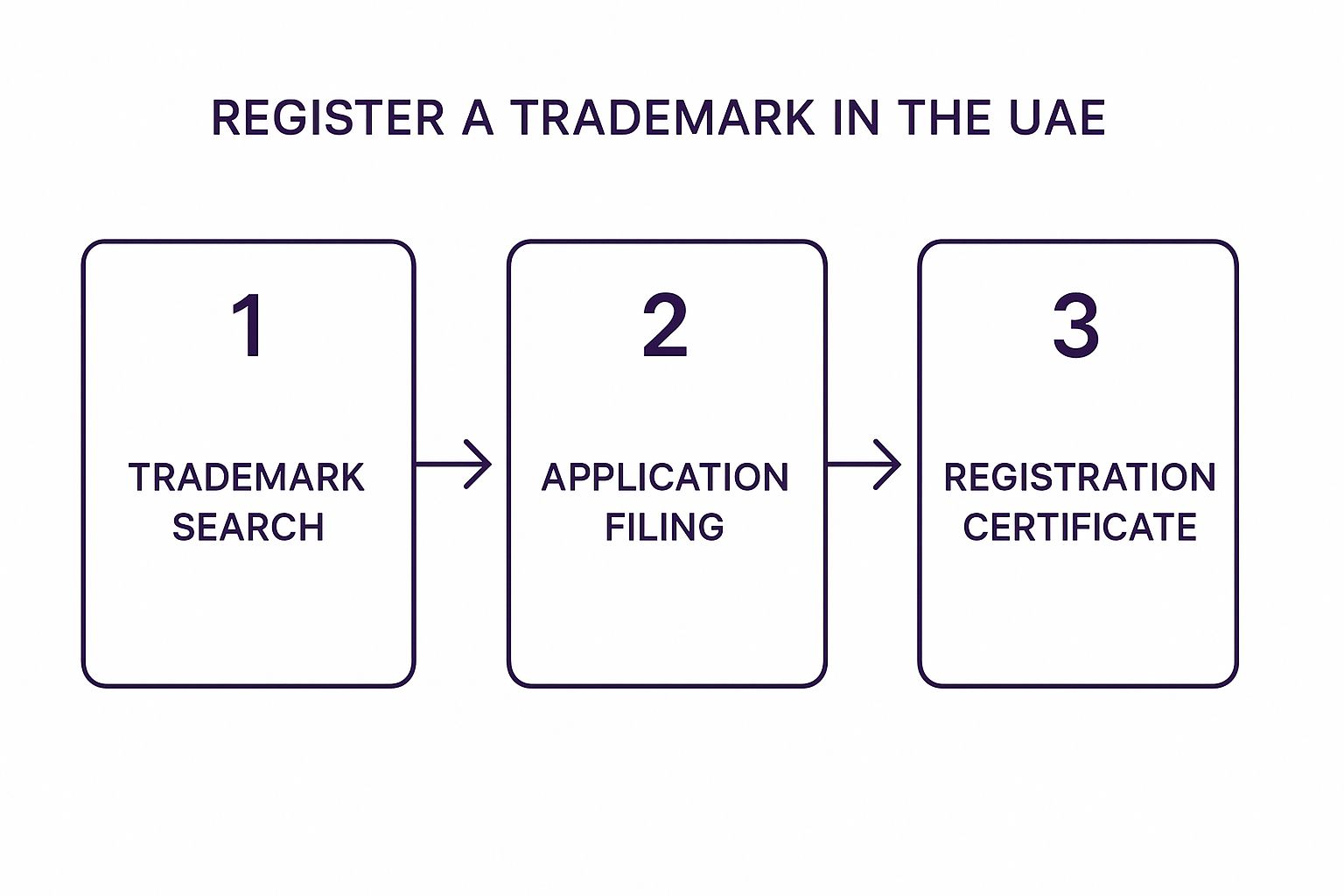
As you can see, filing the application is the central action, bridging your initial due diligence with the formal examination process. The entire system is built to be sequential, and mastering the online portal is your ticket to moving forward.
Creating Your Account and Entering Applicant Details
First things first, you'll need to create a user account. It’s a straightforward setup, but precision is everything. The details you enter here will form the official record of your registration, so double-check every entry. A tiny mismatch between your account details and your trade licence, for example, can bring the whole process to a halt.
With your account active, you can start a new trademark application. The system will guide you through entering the applicant's information. Whether you're a mainland company in Dubai, a freezone business in Sharjah, or an international applicant, the details must be perfect. This means your full legal name, address, and contact information. For companies, make sure the name is an exact match to what’s on your certificate of incorporation.
Uploading Your Trademark Specimen
Next up, you'll upload a digital version of your trademark, known as the specimen. This is the exact word, logo, or design you want to protect. The portal has specific technical requirements for the file, usually related to format (like JPG or PNG) and resolution, so pay close attention.
A common pitfall I see is people uploading a poor-quality or slightly incorrect version of their mark. Remember, what you upload is what the examiner sees and, if approved, what gets registered. Your file should be a clean, high-resolution image that clearly shows the mark without any extra clutter—unless that "clutter" is part of the mark itself.
Selecting Your Classes of Goods and Services
This is where strategy really comes into play. You need to classify your trademark under the right categories of goods or services using the internationally accepted Nice Classification system. The system is broken down into 45 classes (34 for goods, 11 for services), and your legal protection is limited only to the classes you select and pay for.
Choosing the right classes is absolutely vital. You need to think not just about what your business does today, but where it might be headed tomorrow.
-
Real-World Example 1: A New Dubai Restaurant
A new fine-dining spot opening on the Dubai mainland would definitely need Class 43 ("Services for providing food and drink"). But what if they also plan to sell branded olive oil or aprons? In that case, they should also consider Class 35 to cover "Retail services." -
Real-World Example 2: An Abu Dhabi Tech Startup
An Abu Dhabi startup launching new project management software would file under Class 9 for the "Downloadable software" itself and Class 42 for the "Software as a service (SaaS)" platform. This dual-class strategy protects both the product and the online service.
Selecting the wrong class—or worse, missing a relevant one—can leave a huge gap in your brand’s armour. It’s a costly error that can seriously limit the scope of your legal protection down the line.
Completing the Payment and Final Submission
The last step on the portal is paying the application fees. The UAE system is structured on a pay-per-class model, so your total cost is directly tied to how many classes you’ve selected. The portal calculates the total for you, so there’s no guesswork involved.
Here is a general overview of the official government fees you'll encounter during the process. Keep in mind that these don't include any professional service fees.
Breakdown of UAE Trademark Registration Fees
| Service Stage | Fee (AED) | Description |
|---|---|---|
| Application Filing Fee (per class) | 1,000 | This is the initial fee paid upon submitting your application for each class you've selected. |
| Publication Fee | 1,000 | Once your trademark is approved, this fee is required for its publication in the Official Gazette. |
| Final Registration Fee | 10,000 | This is the final payment to receive your official registration certificate after the opposition period closes. |
After your payment goes through, your application is officially in the hands of the Ministry of Economy. You’ll be given a filing number, which is your key to tracking the application's progress right there on the portal.
What Happens During the Examination and Publication Process?
So, you’ve navigated the portal and your application is officially submitted. Now, your part is done for a little while. Your trademark application moves into the formal examination phase at the Ministry of Economy, where an official examiner puts it under the microscope to make sure it ticks all the legal boxes required by UAE law.
This stage is a waiting game, but knowing what's happening behind the scenes can definitely make it less stressful. The thoroughness of this process is a direct reflection of the UAE's commitment to protecting intellectual property, which is why we see such a high volume of applicants.
Just how active is it? Well, in the first nine months of one recent year, the UAE saw 18,175 new trademarks registered—a massive 39% jump from the year before. During that same period, the Ministry handled a staggering 24,258 applications. These figures, which you can read more about in the Ministry of Economy's intellectual property trends report, really underscore why a meticulously prepared application is so crucial to standing out.
The Two Pillars of Examination
The examiner's review is broken down into two main stages, each with a very specific job to do.
First up is the formal examination. Think of this as a detailed administrative check. The examiner confirms that you've submitted all the right documents, paid the fees, and that every bit of information is filled out correctly. It's all about making sure the application is complete and properly filed.
Next is the substantive examination. This is where the real deep dive happens. The examiner analyses the heart of your trademark, assessing whether it’s truly distinctive and, most importantly, whether it clashes with any existing registered marks.
How to Handle a Potential Refusal
If the examiner flags an issue during the substantive review, you’ll receive an "office action," which is essentially a preliminary refusal. Don't panic. This isn't a final 'no,' but rather a heads-up that there's a problem you need to address.
What are the usual culprits for a refusal?
- Likelihood of Confusion: Your proposed mark is just too similar to one that's already registered in a related class.
- Descriptiveness: The mark is seen as too generic or simply describes the product or service it's meant for (e.g., trying to trademark "Cold and Sweet" for an ice cream brand).
- Violation of Public Morals: The mark contains something considered offensive or inappropriate under UAE law and cultural standards.
You generally have a 30-day window to respond to an office action. A strong, well-reasoned legal argument is vital here, explaining exactly why your mark should be approved despite the examiner’s initial concerns. Honestly, this is where having a professional on your side can make all the difference in crafting a persuasive response.
An examiner's refusal can feel like a major setback, but it's often a solvable challenge. The key is a timely and strategic response that directly addresses the legal points raised by the Ministry.
The Publication and Opposition Period
Once your application gets the green light from the examiner, it's conditionally approved. The next step is publishing it in the Official Gazette. This isn't just a formality; it's a critical transparency measure.
The publication acts as a public announcement, giving any third party a chance to object to your trademark before it becomes final. This is known as the opposition period, and it lasts for 30 days from the publication date.
Anyone who feels your trademark would infringe on their own pre-existing rights can file an opposition. For instance, a local business that has been using a similar (but unregistered) mark for years might see your application and decide to challenge it. If an opposition is filed, it kicks off a separate legal process where both sides make their case.
But if that 30-day clock runs out with no challenges, you’re in the clear. You’ll get a notification to pay the final registration fees, and soon after, your official trademark registration certificate will be issued, confirming your exclusive rights.
You’ve made it through the examination and the 30-day opposition period—congratulations! This is a massive step, but don’t pop the champagne just yet. There are a few final hurdles to clear before you can shift your focus from getting the trademark to keeping it.
Once that opposition window closes and no one has challenged your mark, you’ll get a notification to pay the final registration fees. This is the last official payment to the Ministry of Economy. Once that’s settled, they’ll issue your official Trademark Registration Certificate. This is the piece of paper that proves your exclusive ownership rights in the UAE.
Your Responsibilities as a Trademark Owner
Getting the certificate in your hands feels like the finish line, but it’s really the starting line for a new set of responsibilities. A registered trademark is a valuable business asset, but only if you actively manage it.
Your trademark registration is valid for 10 years from the date you first filed the application. That’s a good long run, but you need to be mindful of the expiry date. To keep your rights locked in, you have to renew your registration on time.
The Trademark Renewal Process
Thankfully, renewing is much simpler than the initial application. You can apply for renewal anytime within the final year of your 10-year term. If you miss that window, the UAE offers a six-month grace period after expiry, but it comes with penalty fees. It’s always cheaper and less stressful to be on time.
My best advice? Set a calendar reminder for a full year before your trademark is due to expire. This gives you plenty of breathing room to get the paperwork and fees sorted without any last-minute panic. If you let it lapse, your registration can be cancelled, leaving your brand completely exposed.
Why You Have to Actually Use Your Trademark
Here’s something many business owners overlook: registration gives you rights, but those rights are conditional. The UAE has a "use it or lose it" rule. If you don't use your trademark for five consecutive years, a third party can challenge it and have it cancelled.
This rule exists to stop people from squatting on trademarks they have no real intention of using. You need to show that your mark is genuinely active in the UAE marketplace for the goods or services you registered it for. This includes:
- Putting the mark on your products and packaging.
- Featuring it in your UAE-based advertising and marketing.
- Using it on your website and social media channels that target customers in the UAE.
Pro Tip: Keep meticulous records of your trademark in action. Save copies of invoices, marketing materials, and product photos. This evidence is your best defence if you ever face a cancellation claim for non-use.
Keeping an Eye Out for Infringement
Finally, it’s up to you to police your own trademark. The Ministry of Economy won't be scouting the market for copycats on your behalf. You have to be the one watching for anyone using your mark—or one that's confusingly similar—without permission.
Your registered trademark is a core part of your brand’s defence. Understanding broader strategies for intellectual property protection is vital for keeping your brand’s reputation intact. If you spot an infringer, the first step is usually a cease-and-desist letter, but you can escalate to legal action if needed. Being proactive is the only way to protect the value and exclusivity you’ve worked so hard to build.
And this vigilance is more important than ever. In the first quarter of a recent year, new trademark registrations in the UAE jumped by a staggering 64%, with about 4,600 new marks filed. This trend highlights a huge increase in entrepreneurial spirit and a growing awareness of just how critical IP rights are.
Your UAE Trademark Questions, Answered
Getting a trademark registered in the UAE is a big step, but it often comes with a lot of questions. Whether you're just starting to think about it or you're already deep in the process, a few things tend to pop up again and again. Let's clear up some of the most common queries we hear from business owners just like you.
How Long Does the Entire Registration Process Take?
This is usually the first question on everyone's mind. Realistically, you should plan for the entire trademark registration to take somewhere between six and twelve months. That's assuming everything goes smoothly from the moment you file to when you have the certificate in hand.
The first part of the wait involves the Ministry of Economy's internal review, which can take a few months. Once your application passes their initial checks, it's published in the Official Gazette. This kicks off a mandatory 30-day opposition period where anyone can raise an objection to your mark.
If that 30-day window closes without any issues, you're on the home stretch. You just need to pay the final registration fees to get your certificate. Of course, any hitches—like an incomplete application, questions from the examiner, or a formal opposition from another company—will add time to the process.
Can a Non-Resident Register a Trademark?
Yes, absolutely. You don’t need to live in the UAE or have a local company to secure a trademark here. The UAE’s intellectual property laws are open to foreign individuals and international businesses looking to protect their brand in the region.
There is one key requirement, however. If you're applying from outside the country, you must appoint a UAE-based trademark agent or law firm to represent you. This agent will be your official point of contact, handling all the paperwork and communication with the Ministry of Economy to ensure everything is done by the book.
Think of it as having a local expert on your team. A registered agent, like a corporate service provider, not only files the application but also knows how to navigate any official queries or challenges that might arise. It makes the whole experience far more straightforward for international brand owners.
As specialists in both Mainland and Freezone company formation across the UAE, we are perfectly positioned to act as your representative. We provide cost-effective business setup solutions and are always here when you need us with 24/7 support.
What Happens If an Application Is Rejected?
Seeing a rejection notice can feel like a major setback, but it's not necessarily the end of your application. The Ministry will provide an official notification explaining exactly why your trademark was refused. The most important thing is to act fast.
You have the right to appeal the decision, but there's a tight deadline. A grievance must be filed with the Trademarks Committee within 30 days of receiving the notice. This is where professional guidance becomes crucial. You’ll need to build a compelling legal argument, supported by evidence, that directly counters the examiner's objections and proves why your mark should be registered.
Understanding the Nice Classification System
When you file a trademark application, you can't just protect your brand for "everything." You have to specify the exact goods or services it applies to using the Nice Classification system. This is an international standard that organises everything into 45 distinct classes—34 for goods and 11 for services.
Getting this right is fundamental because your trademark protection is only valid for the classes you select. For example, if you register your brand in Class 25 (for clothing), you're protected against someone else selling t-shirts under a similar name. But that registration won't stop them from opening a restaurant (Class 43) with the same name.
You need to think carefully about what your business offers now and what it might offer in the near future. Each class you add strengthens your brand's legal shield, but keep in mind that you'll have to pay a separate application fee for every single class you include.
Navigating the complexities of trademark registration is just one part of establishing a strong business presence in the UAE. At 365 DAY PRO Corporate Service Provider LLC, we offer end-to-end support for mainland and freezone company formation, visa services, and all your corporate needs. Our team of specialists ensures a smooth, cost-effective setup, letting you focus on what matters most—growing your business.
Ready to protect your brand? Here’s how we can help:
✅ Best Corporate Service Provider in Dubai, Abu Dhabi & Sharjah
✅ Specialists in Mainland Company Formation in Dubai & Abu Dhabi
✅ Specialists in Freezone Company Formation across the UAE
✅ 24/7 Support Service – Always here when you need us
✅ Cost-Effective Business Setup Solutions tailored to your needs
✅ Enjoy UAE Tax Benefits for International Entrepreneurs
📞 Call Us Now: +971-52 923 1246
💬 WhatsApp Us Today for a Free Consultation: https://365dayproservices.com