So, you’ve landed a job in Dubai. Congratulations! Now comes the part that can feel a bit daunting: getting your work permit sorted. The good news is that it’s a very structured, employer-driven process. You won’t be navigating this alone.
Your new company takes the lead from the moment you accept the offer. They’ll kick things off by applying for your entry permit and employment contract through the official channels. Once you land in Dubai, you’ll go through a few final hoops—a medical fitness test and giving your biometrics for your Emirates ID—before getting the all-important residence visa stamped in your passport.
✅ Best Corporate Service Provider in Dubai, Abu Dhabi & Sharjah
✅ Specialists in Mainland Company Formation in Dubai & Abu Dhabi
✅ Specialists in Freezone Company Formation across the UAE
✅ 24/7 Support Service – Always here when you need us
✅ Cost-Effective Business Setup Solutions tailored to your needs
✅ Enjoy UAE Tax Benefits for International Entrepreneurs
📞 Call Us Now: +971-52 923 1246
💬 WhatsApp Us Today for a Free Consultation
A Closer Look at the Dubai Work Permit Process
Many people use the term 'work permit' to describe the whole package that makes you a legal resident employee in Dubai. It's not just one document but a series of interconnected approvals. Getting your head around this from the start really helps clarify what you need to do versus what your employer handles.
At its core, the system is built on sponsorship. For most people, your employer is your sponsor. They are the ones who will interact with government bodies like the Ministry of Human Resources and Emiratisation (MoHRE) and the immigration authorities to get the ball rolling. Think of them as your guide through the entire application maze.
The Main Milestones on Your Application Journey
The journey from job offer to legal resident follows a clear path, starting even before you set foot in the UAE.
Here’s what a typical timeline looks like:
- The Offer and Contract: It all begins when you accept a formal job offer. Your employer then registers this official offer letter with the authorities to make it legally binding.
- The Entry Permit (often called the 'Pink Visa'): With the contract in place, your employer applies for this temporary visa. It’s your ticket into the UAE specifically for work purposes.
- On-the-Ground Formalities: Once you arrive, the clock starts ticking. You generally have 60 days to complete the mandatory medical tests, provide fingerprints and a photo for your Emirates ID, and get your health insurance sorted.
- The Final Visa Stamp: After all the checks are passed and approvals are granted, your passport gets the final residence visa stamp. This is the moment you officially have the right to live and work in Dubai for the term of your visa.
Pro Tip: From start to finish, the entire process usually takes about 4 to 6 weeks. While some steps are very quick, the total time can be affected by how quickly documents are provided, appointment availability for medicals, and any public holidays.
To give you a clearer picture, here’s a breakdown of who does what and when.
Dubai Work Permit Timeline Overview
| Stage | Responsible Party | Estimated Timeline |
|---|---|---|
| Employment Offer Letter & Contract | Employer & Employee | 1-3 business days |
| Entry Permit (Employment Visa) Issuance | Employer / PRO | 3-7 business days |
| Employee's Arrival in UAE | Employee | N/A |
| Medical Test & Biometrics | Employee (with employer guidance) | 1-3 business days |
| Emirates ID & Labour Card Application | Employer / PRO | 2-5 business days |
| Residence Visa Stamping in Passport | Employer / PRO | 3-7 business days |
This table shows a standard flow, but remember that timelines can vary based on individual circumstances and the efficiency of the processes involved.
More Than One Way to Get a Permit
While having an employer sponsor you is by far the most common route, it’s certainly not the only one. Depending on your career path, other options might be a much better fit.
For the entrepreneurial-minded, you can actually sponsor yourself by setting up a company in a free zone or on the mainland. If you're a specialist in a field like marketing, design, or IT, securing a freelance licence is another fantastic way to gain residency and work for multiple clients. A good corporate service provider can walk you through the pros and cons of each, helping you decide whether a mainland business setup or a specific free zone in the UAE aligns best with your goals.
Choosing Your Pathway to Work in Dubai
Figuring out how to get a work permit in Dubai isn't a one-size-fits-all process. The right route for you really hinges on your career goals, whether you've already landed a job, or if you're planning to start your own business. Your choice dictates everything that follows, from who sponsors you to where you can legally work.
The most travelled road is, without a doubt, the employer-sponsored visa. This is the classic setup: a company in Dubai hires you and handles the entire visa process. For the employee, it’s a fairly straightforward and hands-off experience, making it the go-to option for professionals moving for a specific job.
But the way people work in Dubai is evolving. We're seeing more and more professionals opt for self-sponsorship, which gives them far more control and flexibility over their careers. This path is perfect for entrepreneurs, freelancers, and investors looking to make their mark in the UAE's vibrant economy.
Mainland vs. Free Zone Sponsorship
If you're taking the traditional employment route, where your company is located is a huge deal. It's either a mainland company or a free zone company, and this one detail significantly shapes your work life.
-
Mainland Company: This is a business registered directly with the Dubai Department of Economy and Tourism (DET). The biggest perk of working for a mainland company is the freedom to work anywhere in the UAE and deal directly with the local market. It’s the standard for many sectors, from retail to local professional services.
-
Free Zone Company: These businesses are based in one of Dubai's over 40 specialised economic hubs, like Dubai Media City or the Dubai International Financial Centre (DIFC). Typically, if a free zone company sponsors you, your work is confined to that zone and its clients, though recent rule changes have brought in more flexibility.
Here's what you really need to know: the rules are different. Mainland companies fall under the UAE Labour Law, but each free zone has its own independent authority and regulations. This can change everything from your contract terms to how disputes are handled, so it’s smart to know exactly which jurisdiction a potential employer operates in.
The Rise of Self-Sponsorship and Freelancing
For anyone who doesn't want to be tied down to a single employer, self-sponsorship is a fantastic alternative. This route has exploded in popularity as the UAE actively courts global talent and entrepreneurs. It puts you in the driver's seat—you become your own boss and your own sponsor.
One of the most popular ways to do this is with a freelance permit. It's ideal for independent professionals in creative, tech, media, and education sectors. Several free zones offer these permits, which give you a residence visa and the legal standing to work on projects for multiple clients. It's the ultimate ticket to freedom as a sole practitioner.
Investing in Your Future with an Investor Visa
If your ambitions go beyond freelancing, the investor visa is a powerful pathway. By setting up your own company, you can sponsor yourself and your family for residency. This is the ultimate form of self-sponsorship and the cornerstone for building a lasting business presence in the UAE.
Whether you go for a nimble free zone setup or a more expansive mainland company, the end result is the same: you control your own future. This option not only secures your work permit but also unlocks the UAE's significant tax advantages for international business owners. If you're looking at the bigger picture of relocating, this step-by-step guide on how to move abroad offers a great overview of the entire process.
Trying to decide between all these options can feel overwhelming. This is where a good corporate service provider comes in. They can look at your specific business idea or professional profile and pinpoint the best fit, handling everything from trade name registration to getting your investor visa stamped. That kind of expert advice is invaluable when you're making such a critical move.
Getting Down to Brass Tacks: The Application Process
So, you’ve figured out your path to working in Dubai. Now for the practical part: turning that job offer or business plan into a reality. This is where the paperwork really gets rolling, and it's a sequence of well-defined steps, usually handled by your employer or a corporate services provider like us.
Let's be clear: getting your documents in order before you start is the single best thing you can do. One of the most common hiccups we see is people starting the process without their educational degrees properly attested. Attestation is a mandatory verification of your qualifications, and sorting it out early can literally save you weeks of frustrating delays down the line.
The First Green Light: Approval and Entry Permit
Your journey officially kicks off when your employer applies for your work permit and employment contract through the Ministry of Human Resources and Emiratisation (MoHRE). They’ll submit your passport copy and the signed offer letter online. Once MoHRE gives the thumbs up, they issue an initial work permit, which is the official go-ahead to proceed.
With that approval secured, your employer then applies for your entry permit. You might hear this called an employment visa or, more colloquially, the 'pink visa' because of its colour. This is the crucial document that lets you legally fly into the UAE to start your job. It’s typically valid for 60 days, giving you a comfortable window to land in Dubai and sort out the rest of the formalities.
The infographic below shows the main ways people get set up to work here, whether it's through a traditional employer, as a freelancer, or by investing.
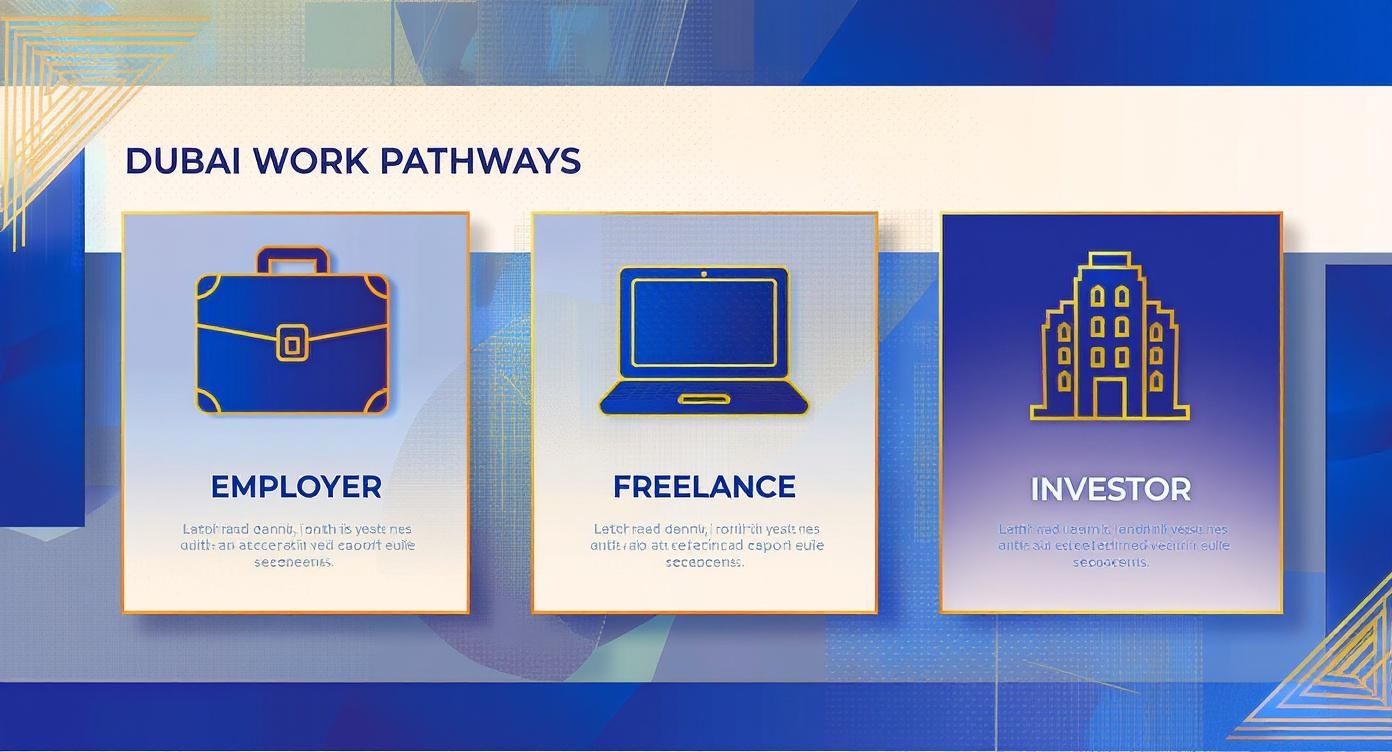
As you can see, the end goal is always legal residency, but how you get there at the start really depends on your sponsorship route.
Boots on the Ground: Medicals and Biometrics
Once you’ve arrived in Dubai with your entry permit in hand, it's time for a couple of mandatory appointments. First up is the medical fitness test. This is a standard procedure for every new resident, designed to protect public health. It’s nothing to worry about.
The test itself is straightforward and involves:
- A blood test to check for conditions like HIV and Hepatitis B.
- A chest X-ray to screen for tuberculosis.
You can go the standard route or pay a bit extra for a VIP service to get your results much faster, sometimes in just a few hours. After the medical, you'll need to visit a designated service centre for your biometrics appointment to get your Emirates ID card processed. They'll take your fingerprints and a digital photo.
This in-country stage is where you can really see the UAE's push for efficiency. What used to be a long-winded process with up to 15 steps and 16 documents has been completely overhauled. The government's new Work Bundle platform has streamlined this to just 5 steps and 5 required documents. In-person visits have been slashed from 7 to only 2, and the whole thing can be wrapped up in as little as 5 working days if everything is in order. You can learn more about this updated visa process to see just how much simpler it is now.
The Final Stretch: Visa Stamping and Your Emirates ID
Once you’ve passed the medical and your biometrics are in the system, your employer submits the final batch of documents to the immigration authorities. This package includes your medical certificate, Emirates ID application, and that all-important attested degree.
This is the home stretch. The process concludes with the residence visa stamping inside your passport. This sticker is your official proof that you can legally live and work in the UAE, usually for two years in most employment cases. A short while later, your physical Emirates ID card will arrive, which is your go-to identification for almost everything in the country, from opening a bank account to getting a phone plan.
Getting through these steps smoothly is all about knowing the procedures and having every piece of paper in perfect order. It's precisely why so many companies and individuals lean on professional PRO services. An expert can quarterback the entire process for you—from submissions to booking appointments—making sure it’s all done right the first time, turning a potentially stressful experience into a predictable and straightforward one.
Your Essential Document and Cost Checklist
Getting your Dubai work permit application right comes down to one thing: preparation. Knowing exactly what documents to gather and what costs to expect can turn a confusing bureaucratic maze into a clear, manageable process. Honestly, getting your paperwork in order from the get-go is the secret to avoiding frustrating delays down the line.
Think of it this way: you wouldn't start building a house on a shaky foundation. Your documents are that foundation. While your employer or a corporate services provider will handle the heavy lifting of the application itself, having your personal file ready to go makes everything move much faster.
Your Core Document Checklist
Your sponsoring company is going to need a specific set of documents from you to get the ball rolling. My advice? Start gathering these the moment you accept the job offer.
-
Valid Passport: This is non-negotiable. Your passport must have at least six months of validity left on it and a few blank pages for the new visa stamp. A clear colour copy of the main info page is what they'll ask for.
-
Passport-Sized Photographs: These have strict rules. You'll need photos with a plain white background, usually sized at 4.3 cm x 5.5 cm. It’s always smart to get a dozen printed so you have plenty on hand.
-
Signed Offer Letter or Employment Contract: This is the official proof of your employment, forming the legal basis for the entire visa application.
-
Attested Educational Certificates: For most professional jobs, your highest degree (like a Bachelor's or Master's) needs to be officially attested. This is a multi-step verification that starts in your home country and concludes at the UAE Embassy there before you even bring it to Dubai.
A Word of Warning: Degree attestation is a classic bottleneck. It’s the one thing that catches most people out because it takes so long. If you're serious about moving, I'd recommend starting this process even before you have a finalised job offer. It can save you weeks of waiting.
Understanding the Costs Involved
While UAE labour law requires your employer to pay for your work permit and visa, it’s still incredibly helpful to understand the breakdown of fees. It gives you a clear picture of the investment your new company is making in you and helps you follow the process.
The total cost can vary quite a bit depending on things like the company's classification and whether you opt for a standard or VIP medical test. Generally, you're looking at electronic permits costing anywhere from AED 300 to AED 5,000, Emirates ID fees around AED 100 for each year of your visa, medicals between AED 250 and AED 750, and the final visa stamping costing from AED 300 to AED 800.
Here’s a rough breakdown of the main expenses:
| Fee Component | Typical Cost Range (AED) | Notes |
|---|---|---|
| Initial Work Permit | 300 – 5,000 | Varies based on company size and your job's skill level. |
| Medical Fitness Test | 250 – 750 | You can choose from standard, 48-hour, and 4-hour VIP services. |
| Emirates ID Card | 270 – 370 | This is the typical cost for a standard two-year visa. |
| Visa Stamping | 300 – 800 | This is the final step, placing the residence visa in your passport. |
Keep in mind, an essential part of living and working in the UAE is having the right health coverage. It's a good idea to look into your options for United Arab Emirates Travel Health Insurance to ensure you're covered from day one.
Juggling all these documents and costs can feel overwhelming, especially if it’s your first time. This is where getting an expert involved really pays off. With 24/7 support, a PRO service can manage this entire checklist for you, making sure every document is correct and every fee is paid on time. Give us a call at +971-52 923 1246 to get clear, practical guidance that takes the guesswork out of the entire process.
Stepping Around the Common Hurdles in Your Application
Getting a work permit in Dubai can feel straightforward on paper, but it’s the small, overlooked details that often trip people up. A tiny mistake in your paperwork can easily stall the whole process, pushing back your start date and adding a layer of stress you just don't need.
One of the biggest culprits? Incomplete or incorrect documents. It sounds simple, but this is where most delays happen. We’re talking about anything from a slightly blurry passport copy to a photo where the background isn't a perfect, crisp white. Every single detail is scrutinised, and one missing signature or uncertified document can send you right back to the beginning.
The medical fitness test is another common sticking point. The test itself is standard, but many people don't realise the nuances. For instance, did you know you can often pay for a faster VIP service if you're racing against the clock? Not knowing this can create a bottleneck, which then delays your visa stamping and Emirates ID appointment.
How to Overcome Application Roadblocks
You might also face unexpected security checks or requests for additional verification. These are usually just routine, but they can add days—or sometimes weeks—to the timeline. This is where being prepared and knowing what to expect really pays off.
Here’s how you can stay ahead of these common setbacks:
- Triple-check your paperwork. Before you submit anything, go over every document with a fine-tooth comb. Make sure your passport has at least six months of validity left and that your name is spelled identically on every single form.
- Keep an eye on the clock. The entire process has a cumulative timeline. Your entry permit is valid for 60 days, so don't put off your medical test or biometrics until the last week. Plan ahead.
- Stay in touch. Keep the lines of communication open with your employer or your Public Relations Officer (PRO). They’re your eyes and ears on the ground and can often spot a potential issue before it becomes a real problem.
Here’s a classic example we see all the time: An IT professional was all set to start his new job. The problem? His university degree wasn't attested in his home country before he flew to Dubai. This one oversight delayed his visa by over four weeks while he frantically couriered documents back and forth. An expert would have flagged this on day one, saving him a month of stress and waiting.
Why Professional Guidance Makes All the Difference
This is exactly why working with a professional makes such a huge difference. At 365 DAY PRO, we’re not just paper-pushers; we specialise in both Mainland and Freezone company formation across the UAE, so we navigate these rules every single day. We've seen it all, which means we can anticipate roadblocks before they even appear.
We provide practical, cost-effective business setup solutions and handle the entire work permit journey for you, from the first application to the final visa stamp in your passport. And with our 24/7 support service, you'll never be left wondering what's next.
For a smooth transition, WhatsApp us today for a free consultation. Let us manage the red tape so you can focus on starting your new life in Dubai.
Your Dubai Work Permit Questions, Answered
Getting everything straight before moving to Dubai for work can feel a bit overwhelming. There are lots of moving parts, and it's natural to have questions. I've been helping people and businesses navigate this process for years, so let's clear up some of the most common queries I hear.
How Long Does It Really Take to Get a Work Permit in Dubai?
Let's be realistic: from start to finish, you should plan for about 4 to 6 weeks. That's the typical timeframe from the moment your employer hits 'submit' on the initial application to when you have the final residence visa sticker in your passport.
While the initial approval from the Ministry can come through surprisingly fast—sometimes in just 5 working days—that’s only the first step. After that, you've got the medical fitness test, the biometrics appointment for your Emirates ID, and then the final processing.
What can slow things down? A few usual suspects:
- Company Type: Things can move at a slightly different pace depending on whether your employer is on the mainland or in a free zone.
- Your Paperwork: This is the big one. Any delay in getting your educational degrees properly attested is the number one reason I see timelines stretch out.
- Public Holidays: Don't forget to account for official holidays, which can put a temporary pause on all government services.
Can I Bring My Family to Dubai on My Work Permit?
Absolutely. This is one of the best parts about working in Dubai. Once your own residence visa is sorted, you can start the process to sponsor your immediate family, like your spouse and children.
The main requirement from your side is meeting a minimum salary, which usually sits around AED 4,000 per month. The process for them will feel familiar: you'll apply for their entry permits, and once they're in the UAE, anyone over 18 will do their own medical test. Everyone, including the kids, will also get an Emirates ID. Just be prepared with officially attested documents like your marriage and birth certificates to prove your relationships.
What Happens if I Change Jobs in Dubai?
Switching jobs here is a very structured and common process. When you resign and work your notice period, your current employer is required to cancel your work permit and residence visa. This has to happen before the new company can even start applying for your new one.
The good news is that the application with your new employer is essentially the same as the one you went through the first time. Thanks to recent updates in UAE labour law, you're usually given a grace period after your visa is cancelled—sometimes up to six months. This gives you a comfortable window to either get the new visa finalised or, if your plans change, to arrange your affairs to leave the country.
A smooth job transition all comes down to good communication between you, your old boss, and your new one. Getting that cancellation processed quickly is the key to avoiding any frustrating delays with your new application.
What’s the Difference Between a Work Permit and a Residence Visa Anyway?
This question comes up all the time, and it's easy to get them mixed up. The best way to think about it is that they are two sides of the same coin—you can't have one without the other for employment.
- The Work Permit (or Labour Card): This comes from the Ministry of Human Resources and Emiratisation (MoHRE). It’s the official government permission slip that says you are legally allowed to work for a specific company.
- The Residence Visa: This is the sticker that goes into your passport, issued by the immigration authorities (GDRFA). This is what makes you a legal resident of the UAE, allowing you to live here for a set period, usually two years.
Simply put, you need the work permit to get the residence visa. These two, along with your Emirates ID, make up the complete legal package for living and working in Dubai. It’s a connected system designed to ensure everyone working here is properly documented.
Whether you’re dealing with mainland nuances, free zone regulations, or just want to ensure your documents are perfect the first time, that's where we come in. As 365 DAY PRO Corporate Service Provider LLC, we specialise in making business setup and visa processes straightforward and affordable, helping you make the most of opportunities like UAE tax benefits.
📞 Call Us Now: +971-52 923 1246
💬 WhatsApp Us Today for a Free Consultation at https://365dayproservices.com