Getting your hands on a UAE Police Clearance Certificate, which you'll often hear called a Good Conduct Certificate, is a pretty straightforward process these days. Everything is handled through official channels like the Ministry of Interior (MOI) app or your local police force's website.
The real trick is making sure you have all your documents in order before you start. What you'll need depends on your status: are you a current resident, a former resident, or just visiting the UAE?
What Exactly Is a UAE Police Clearance Certificate?
A Police Clearance Certificate (PCC) is an official document from the UAE police that confirms whether you have a criminal record in the country. It’s far more than just a piece of paper; it's a critical document that opens doors for some of life's biggest milestones.
Think of it as your official stamp of good character. It's often non-negotiable whether you're an entrepreneur setting up a mainland company in Dubai, an expat starting a new job, or a family applying for residency visas.
Why This Document Matters So Much
The need for a PCC pops up in all sorts of situations, underscoring the UAE's strong focus on maintaining a safe and secure community.
Here are a few common scenarios where you'll almost certainly be asked for one:
- New Jobs: Many employers, particularly in government or finance, require a PCC as a standard part of their background checks.
- Visas and Immigration: It’s a must-have for new residency visas, golden visa applications, or if you're planning to immigrate to countries like Canada or Australia.
- University Applications: Some universities ask for a PCC to maintain a safe campus for their students and staff.
- Professional Licences: If you're in a field that requires a licence to practise, you'll likely need to provide a PCC.
For example, in Abu Dhabi, a Police Clearance Certificate is vital for anyone looking to work, study, or even travel abroad. It’s also required for things like getting married or sponsoring family visas, which really shows how integrated it is into daily life. For more on the specifics there, you can look into the police clearance process in Abu Dhabi.
This certificate is just one example of the official paperwork needed for international movement. To get a better feel for how different documents work, it's worth understanding what a travel authorization entails and the role it plays.
To simplify, let's break down the basics of applying for a UAE Police Clearance Certificate.
PCC Application Quick Facts
| Who Can Apply? | Primary Application Methods | Common Uses |
|---|---|---|
| Current UAE residents (with a valid Emirates ID) | MOI UAE App, Dubai Police App, or local police websites. | Employment, new visa applications, university enrolment. |
| Former UAE residents (living abroad) | Online via MOI/police websites, or through a UAE Embassy. | Immigration to another country, foreign employment verification. |
| Visitors/Tourists (currently in the UAE) | In-person at a police service centre. | Local job applications, specific legal requirements. |
This table gives you a quick snapshot, but the key takeaway is that the process is accessible whether you're in the UAE or not—as long as you follow the correct channel.
Your Guide to Applying Online
Without a doubt, the easiest and most popular way to get your Police Clearance Certificate is to apply online. The UAE government has done a fantastic job of making the process accessible, meaning you can handle the entire application right from your laptop or phone.
You have a couple of main options here. The go-to platforms are the Ministry of Interior (MOI) UAE app and the dedicated websites or apps for each emirate, like the Dubai Police app. They're all designed to be pretty intuitive, walking you through everything step-by-step.
Generally, the process is the same no matter which platform you choose. The main difference is which one you'll use. For instance, if you're living in Dubai, it just makes sense to go straight to the Dubai Police app—it's the most direct route.
Navigating the Digital Application Process
First things first, you'll need to log in. This is usually done by creating an account or, even better, using your UAE Pass, which is your national digital ID. Once you’re in, look for a section called "Certificates" or "Services" and find the option for a Police Clearance Certificate (sometimes called a Good Conduct Certificate).
From there, you'll be taken to an online form. This is where you need to be really careful with the details. You'll enter your personal information, Emirates ID number (if you have one), and explain why you need the certificate.
The system is smart and will often adjust the requirements based on your answer. For example, a project manager in Dubai applying for a new job in the finance sector would select "employment" as the purpose. But a former resident now in Australia would choose "immigration" and specify Australia as the destination.
The process is designed to be accessible to a wide range of people—from current residents and citizens to former residents and even visitors. For a closer look at how Dubai has opened up this digital application process, you can find more details on how the Dubai Police have made this process accessible.
Uploading Documents and Making Payments
After you’ve filled out the form, it's time to upload your documents. The exact files you'll need depend on your situation:
- Current Residents: A clear scan of your valid Emirates ID is usually all you need.
- Former Residents: You’ll likely need to provide a copy of your passport and your last UAE residence visa.
- UAE Nationals: Just a copy of your Emirates ID will do.
Make sure your scans or photos are high-quality and easy to read—a blurry document is a common reason for delays. The system typically accepts standard formats like PDF or JPG.
Pro Tip: Before you even start, gather all your documents and save them in one folder on your device. It sounds simple, but it saves you from scrambling to find files in the middle of the application.
The final step is payment. The online portals are secure and accept all major credit and debit cards. Once the payment goes through, you'll get an immediate confirmation via email or SMS, which will include a crucial piece of information: your reference number.
Hang on to that number! It's how you'll track your application's status. Most platforms have a tracking feature where you can pop in the number and see live updates, from "In Process" to "Issued." It gives you peace of mind knowing exactly where things stand.
Gathering Your Documents and Understanding Costs
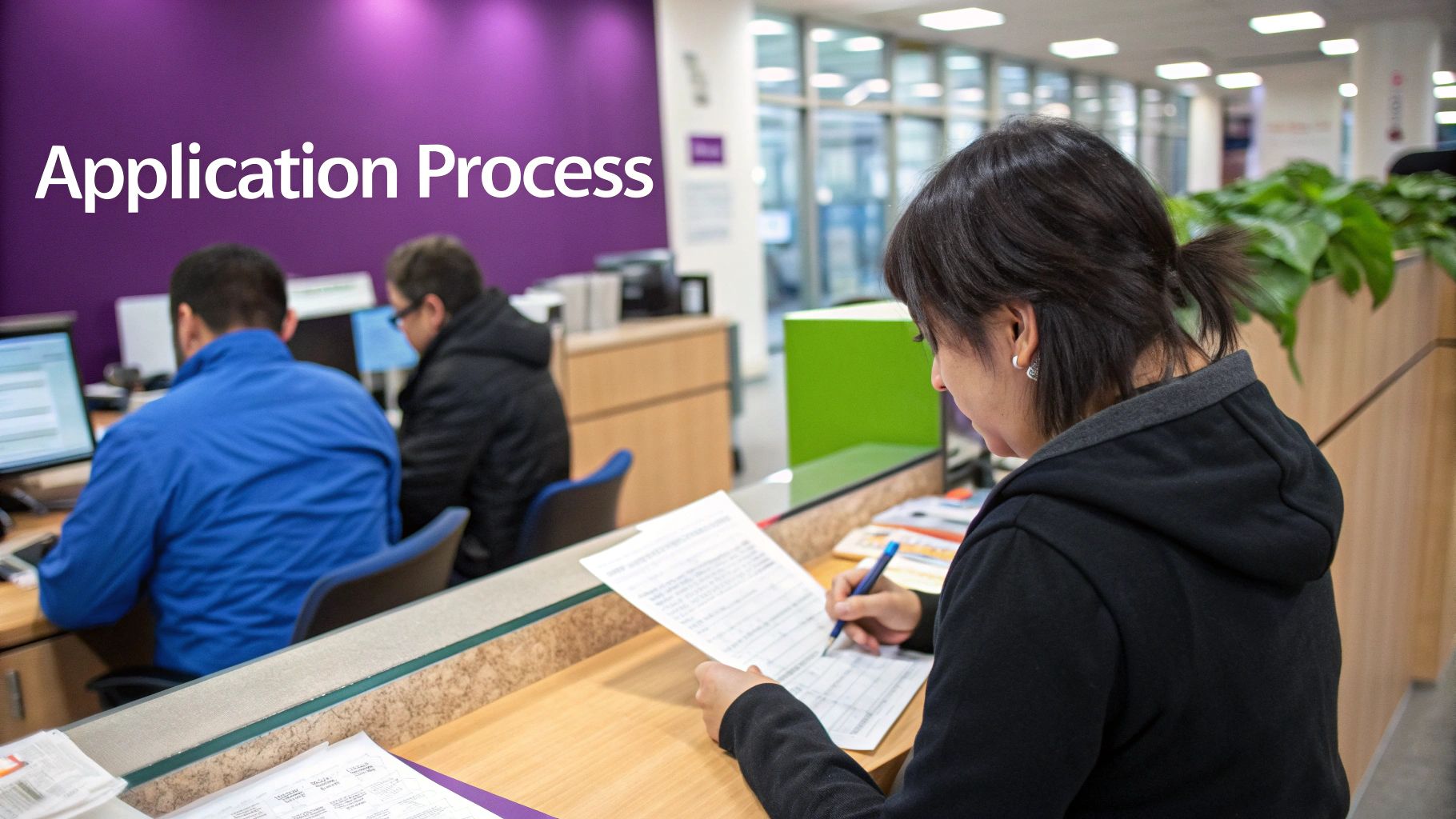
Before you even log into an application portal, let's talk about the single most important step: getting your paperwork in order. From my experience, I can tell you that a blurry scan or a missing document is the number one reason applications get delayed or flat-out rejected. It's a frustrating and completely avoidable setback.
Think of it like cooking a meal—you wouldn't start without having all your ingredients prepped and ready on the counter. The same logic applies here. So, let’s go through exactly what you'll need, which changes depending on your current status.
Your Essential Document Checklist
Your document list will look different based on your connection to the UAE. Find the category that matches your situation below to build your personal checklist.
- For Current UAE Residents: You're in luck; this is the simplest scenario. All you really need is a clear, valid copy of your Emirates ID. That’s it.
- For UAE Nationals: It’s just as straightforward for you. A valid Emirates ID is the key document for your application.
- For Former UAE Residents (Applying from Abroad): This is where it gets a bit more involved. You’ll need to pull together a copy of your passport, a copy of your last UAE residence visa, and a recent passport-sized photograph.
Now, for those of you applying from outside the UAE, there’s one extra, crucial piece of the puzzle: a fingerprint card from the police in your current country of residence. This isn't just any fingerprint card; it must be officially attested by the UAE Embassy in that country. Don't skip this step—it’s non-negotiable.
Decoding the Costs Involved
No one likes surprise fees, so let’s break down what you should expect to pay for your police clearance certificate. The costs are fairly consistent across the emirates, but there can be slight variations.
The main charge is the standard application fee, which covers the processing and issuance of your digital certificate. But there are a couple of other potential costs you should keep in mind.
If you need the certificate for an official purpose in a non-Arabic-speaking country, you’ll definitely need a legal English translation. This is usually offered as an add-on during the application for an extra fee, typically around AED 50.
Another thing to look out for is an express service option. If you're really in a hurry, some platforms offer a rush service that can get the certificate to you much faster, but it will cost you extra. It's a lifesaver if you're on a tight deadline.
To give you a clearer picture, I've put together a table that compares the standard costs and typical timelines across the major emirates.
Document and Fee Breakdown by Emirate
Here’s a quick-glance table to help you anticipate the requirements and costs based on your applicant type and the specific emirate.
| Applicant Type | Essential Documents | Standard Fee (AED) | Typical Processing Time |
|---|---|---|---|
| Current Resident | Valid Emirates ID | 100 – 220 | 24 – 48 Hours |
| Former Resident | Passport, Last Visa, Photo | 200 – 320 | 3 – 5 Business Days |
| UAE National | Valid Emirates ID | 100 – 220 | 24 – 48 Hours |
As you can see, the fees and timelines are quite predictable once you know which category you fall into. Having these figures handy helps you plan your application without any last-minute financial surprises.
How to Apply from Outside the UAE
So, you've moved on from the UAE but now find yourself needing a Police Clearance Certificate for a new job or maybe an immigration application. Don't stress. It's a very common situation, and while it involves a few extra hurdles compared to applying locally, it's entirely manageable.
The main difference when you're abroad is getting your identity and fingerprints verified in a way the UAE authorities will accept. A little bit of prep work here is the key to a smooth process.
The Fingerprinting and Attestation Process
First things first, you need to get your fingerprints taken. This isn't something you can do yourself. You'll have to visit a local police station in the country you're currently in and ask for a formal fingerprint card for an international background check. Make it clear it’s for the UAE.
With the fingerprint card in your possession, you've reached the most critical step: attestation. The card must be taken to the nearest UAE Embassy or Consulate. They will officially stamp and verify it, which is the green light for the authorities back in the UAE.
Key Takeaway: Don't even think about skipping the attestation. A fingerprint card without the official embassy stamp is guaranteed to be rejected. This stamp is their confirmation of its authenticity, making it a non-negotiable part of the process.
Submitting Your Application Online from Abroad
Once you have your attested fingerprint card, you can move everything online. You'll use the same digital channels as residents, like the Ministry of Interior (MOI) website or the Dubai Police app.
Get ready to scan and upload clear copies of a few key documents:
- A copy of your passport.
- A copy of your last UAE residence visa.
- The attested fingerprint card.
- One recent passport-sized photograph.
After uploading, you’ll fill out the application form, state why you need the certificate (for example, "Immigration to Canada"), and pay the fees. The cost for former residents is a bit higher, usually falling between AED 200 and AED 320, to cover the extra verification steps.
Navigating Potential Hurdles
Let's be honest, applying from abroad can feel a bit tangled, especially when you're dealing with different government bodies in two countries. If you’re already in the middle of a complex business setup or a Golden Visa application, adding this to your to-do list can be a real headache.
This is where bringing in a specialist can be a game-changer. As the Best Corporate Service Provider in Dubai, Abu Dhabi & Sharjah, we handle these exact procedures for entrepreneurs and international investors all the time. Our team knows the ins and outs of the attestation process and can take over the application for you, making sure every detail is correct and submitted without delay.
This visual breaks down the timeline you can generally expect once your application is in.
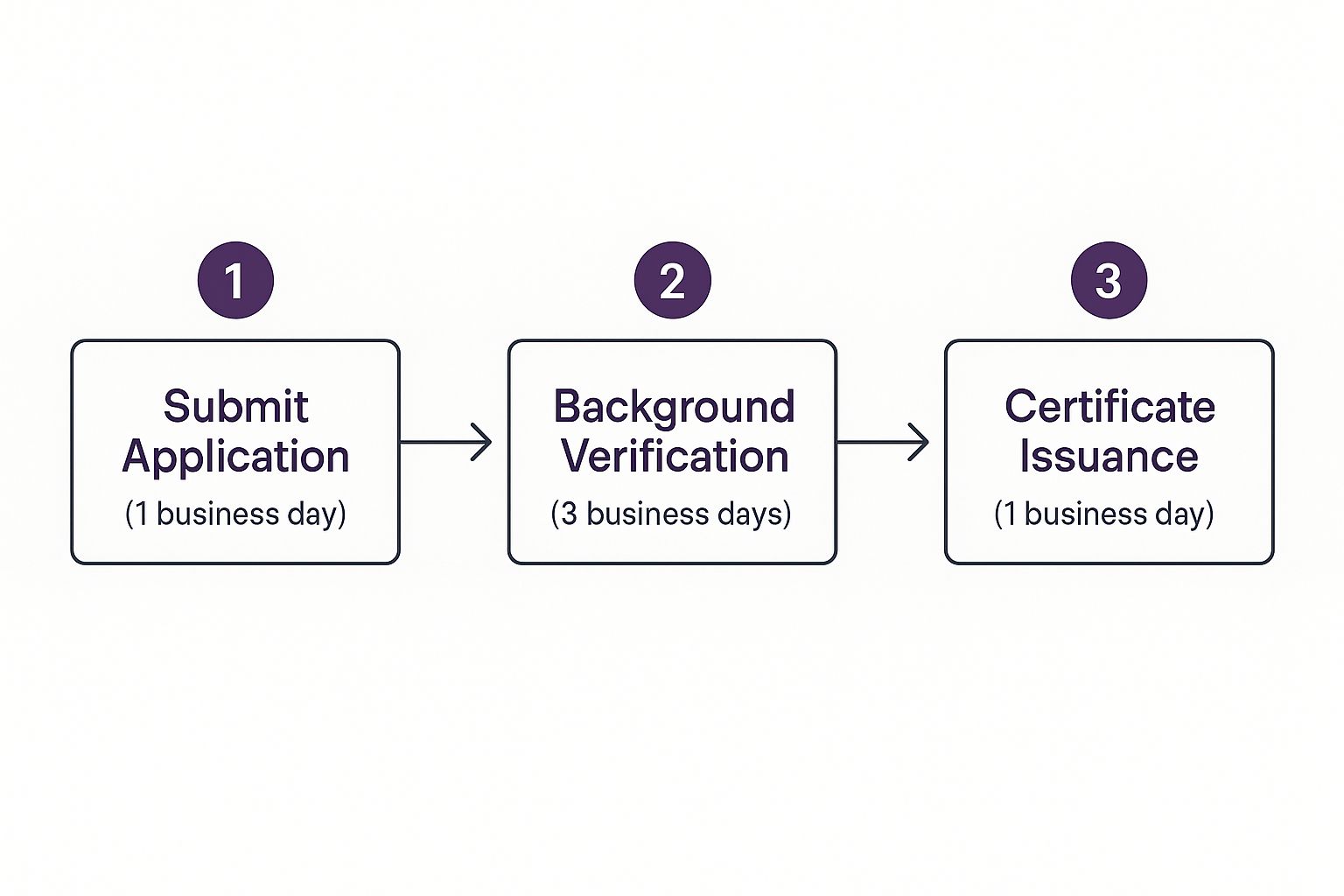
As you can see, the whole thing is surprisingly quick. From the moment you submit, you're typically looking at about five business days, with the actual background check taking up the most time.
When you're looking to work in the UAE, you'll quickly realise the Police Clearance Certificate (PCC) isn't just another piece of paperwork. It's a cornerstone of the hiring process here, serving as a formal testament to your good character in an economy that prizes security and reliability.
For employers and government bodies alike, this document is incredibly important. It's helpful to see it less as a bureaucratic chore and more as a crucial step in building your professional life in the Emirates. After all, it directly reflects the UAE's deep commitment to maintaining a safe and trustworthy environment for business and living.
A Foundation of Trust and Security
Think of the PCC as an employer's primary tool for managing risk. For any company, but especially those in sensitive fields like finance, education, healthcare, or government roles, they need absolute confidence that they're bringing people with a clean slate on board. This simple check helps protect their assets, their data, and perhaps most importantly, their reputation.
When you present a clear certificate, you immediately project trustworthiness, a quality that can't be overstated in this market. For any job that comes with significant responsibility or access to sensitive information, a PCC is almost always a deal-breaker. It’s your official stamp of approval, showing you're a suitable candidate for a position of trust.
Keeping Pace with UAE Regulations
The regulatory environment in the UAE is always moving forward, and hiring practices are right there with it. As the region grows and legal frameworks tighten, background screening has become more critical than ever. For example, with Emiratisation policies now requiring companies with as few as 20 employees to hire at least one Emirati national, we're seeing stricter compliance become the norm everywhere. You can get more insight into the growing importance of background screening in the Middle East on Veremark.com.
This drive for greater compliance means businesses are more meticulous in their hiring than ever before. If you're an international entrepreneur or a company setting up here, making sure every single employee meets these standards from the get-go is non-negotiable.
As Specialists in Mainland Company Formation in Dubai & Abu Dhabi and Freezone Company Formation across the UAE, we see this firsthand. Verifying new hires with a PCC is standard procedure. It’s about aligning the business with national standards and heading off potential legal headaches right from the start.
If you're finding the process a bit overwhelming, don't worry—that's what we're here for. With our 24/7 Support Service, we're always here when you need us. We can take the entire documentation burden off your shoulders, ensuring your team is fully compliant while you take advantage of the UAE Tax Benefits for International Entrepreneurs. For Cost-Effective Business Setup Solutions tailored to your needs, just WhatsApp Us Today.
Got Questions About Your UAE PCC? We've Got Answers
Even with a straightforward process, a few questions always pop up when you're trying to get a police clearance certificate. It's completely normal. Let's tackle some of the most common queries I hear from people, so you can get your application sorted without any last-minute hitches.
Here are the practical, no-nonsense answers to what applicants usually ask about validity, rejections, and other little details.
How Long Is the UAE Police Clearance Certificate Valid For?
This is probably the number one question. Generally speaking, your UAE Police Clearance Certificate is valid for three months from the day it’s issued.
But here’s a crucial tip: don't take that as a hard and fast rule for every situation. The organisation asking for the certificate—whether it's an embassy, a new employer, or another government body—might have its own timeline. Some might only accept a certificate that's less than a month old. Always, always check with them first to avoid any headaches later.
What Happens If My Application Gets Rejected?
Seeing a rejection email can be stressful, but don’t panic. It's almost always due to a simple, fixable mistake. The system is pretty good at telling you exactly what went wrong.
From my experience, rejections usually boil down to one of these common slip-ups:
- Bad Scans: Your Emirates ID or passport copy is too blurry, dark, or has parts cut off.
- Data Mismatch: A tiny typo in your name or passport number that doesn’t match the official records.
- Missing Docs: You forgot to attach something essential, like the attested fingerprint card if you're applying from abroad.
Just read the rejection reason carefully, fix that specific issue, and resubmit your application. If it’s something more complicated, the best thing to do is call the customer service number for the police department you applied through. They’re there to help.
Can I Get a PCC on a Tourist Visa?
This is a grey area, and the short answer is usually no. The whole point of a PCC is to certify the conduct of someone who has actually lived in the UAE as a resident.
However, there can be very specific, rare cases where an official body requires one from you even if you're just visiting. If you find yourself in this unique position, your only option is to go to a police service centre in person, explain your circumstances clearly, and see what they say.
Heads Up: You absolutely cannot apply for a PCC online on a tourist visa. This is not a standard service and is handled strictly on a case-by-case basis at the discretion of the police.
Is the Certificate Issued in English?
By default, the Police Clearance Certificate is an official document issued in Arabic.
The good news is that the authorities know most people need it for international use. When you’re filling out the application online, you'll see an option to request a certified English translation. It costs a little extra, but it’s well worth it to get a document that’s ready to go without you having to find an external legal translator.
Juggling paperwork like this while trying to get a business off the ground can be a major distraction. For entrepreneurs who need to focus on their core business, we offer Cost-Effective Business Setup Solutions tailored to your needs. We're specialists in Mainland and Freezone company formation across the UAE, making sure your journey from licensing to visas is completely seamless. Enjoy the benefits of our 24/7 Support Service and the unique UAE Tax Benefits for International Entrepreneurs.
📞 Call Us Now: +971-52 923 1246 or WhatsApp Us Today for a Free Consultation.