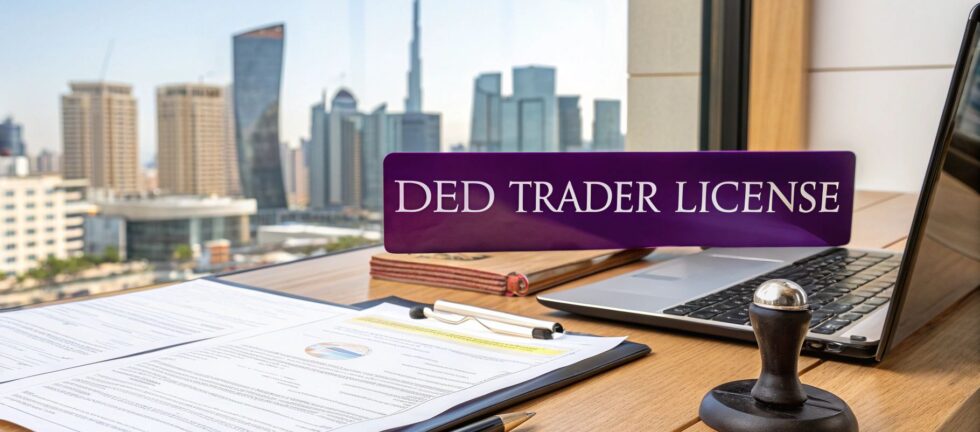
If you're looking to set up a business in Dubai, the first thing you'll hear about is the DED trade license. Think of it as your official green light to operate on the mainland, issued by what's now called Dubai's Department of Economy and Tourism (DET), but which everyone still colloquially knows as the DED. This isn't just a piece of paper; it’s your key to unlocking one of the world's most vibrant and lucrative markets.
What Exactly Is a DED Trade License?
Simply put, a DED trade license is the legal permit you need to run your business in mainland Dubai. This is a crucial distinction. Unlike a free zone license, which ties your operations to a specific geographic area, a mainland license gives you the freedom to trade directly with anyone, anywhere across the entire UAE.
This flexibility makes it the go-to option for businesses that want maximum market access. Whether you're opening a retail shop, launching a service-based company, or getting into general trading, the DED license is what allows you to operate without restriction. For international entrepreneurs, it's also the gateway to taking full advantage of the UAE's attractive tax environment.
The DED’s Role in Your Business Journey
The Department of Economy and Tourism (DET) is the government body that shapes and oversees Dubai's economic landscape. A huge part of its mission is managing the licensing for all mainland businesses.
Their goal is to create a pro-business environment that encourages growth and competition. The numbers speak for themselves. As of September 3, 2025, DED data continues to show a steady rise in new commercial licenses, which is a fantastic indicator of Dubai's thriving business scene. If you're a data person, you can dig into the specifics on the official Dubai Statistics Centre website.
Who Is This License For?
So, who really needs a DED trade license? The short answer is: almost any business that wants to operate directly within the local Dubai market.
This covers a massive range of ventures, including:
- Retail and Hospitality: Think cafes, restaurants, boutiques, and any storefront business.
- Professional Services: This is for consultancies, marketing agencies, law firms, and any company providing expert services.
- Trading and Logistics: Businesses that import, export, or distribute goods across the UAE fall squarely in this category.
- Industrial and Manufacturing: If you're producing goods locally for the UAE market, you'll need this license.
The bottom line is this: if your business plan involves engaging directly with the local UAE market, a DED license isn't just recommended—it's essential. It’s what gives your company legitimacy, credibility, and the legal foundation to thrive here.
As specialists in mainland company formation in Dubai and Abu Dhabi, we've helped countless entrepreneurs navigate this process. Our job is to provide clear, cost-effective guidance to get your DED license without the usual headaches. With our 24/7 support service, we're always here when you need us, making sure your setup is as smooth and successful as possible.
Choosing Your Business Activity and Legal Form
This is where your business idea starts to become real. Picking the right business activity and legal structure is more than just ticking boxes on a form; it's about laying the entire foundation for your company in Dubai. Get this part right, and everything else flows smoothly. Get it wrong, and you could be facing headaches down the road.
The Dubai Department of Economy and Tourism (DED) has a massive list of over 2,000 approved business activities. Your first job is to pinpoint the exact one that matches what you plan to do. Don't be vague here—precision is key.
For instance, if you're planning to sell electronics online, you can't just pick a generic "e-commerce" activity. You'll need to select a specific trading activity that covers electronics. This ensures you can legally import and sell your products without any compliance hiccups.
Matching Your Vision to DED-Approved Activities
Think about your business not just for today, but for a year or two from now. Sometimes a single activity is enough, but I often see entrepreneurs needing to bundle a few related activities under one license to cover their full scope of services.
Here are a few pointers I always share with clients at this stage:
- Get Specific: Vague choices cause problems. Instead of "consulting," you should choose "Management Consultancy" or "Marketing Consultancy." The more specific, the better.
- Bundle Smartly: If you're launching a digital agency, it makes sense to group activities like "Social Media Marketing Services," "Web Design," and "Marketing Management" together. This gives you the flexibility to offer a full suite of services under one professional license.
- Think Ahead: Planning to add a new service in six months? It's usually cheaper and far easier to add that activity to your license from day one rather than amending it later.
Thankfully, recent government moves have made this much simpler. The trade license reforms introduced in 2025 have really helped, especially for startups and SMEs. They've cut costs and processing times, and one of the best changes is allowing multiple business activities under a single license without piling on extra fees. You can get a better sense of how this works by reading up on Dubai's latest business setup reforms.
Selecting the Right Legal Structure
With your activities decided, the next big decision is your company's legal form. This defines your company's identity, impacting liability, ownership rules, and even how you can bring in investors. For mainland businesses in Dubai, the main players are the Limited Liability Company (LLC), Sole Proprietorship, and Civil Company.
A Quick Word of Advice: The choice between an LLC and a Sole Proprietorship really boils down to risk. An LLC shields your personal assets if the business runs into debt. A Sole Proprietorship doesn't. For any serious entrepreneur, that's a critical difference to understand.
I always ask clients to think about their long-term vision. Are you planning to bring on partners? Will you be looking for investment? The answers will almost always point you to the right legal structure.
A Breakdown of Common Legal Forms
- Limited Liability Company (LLC): This is, by far, the most popular option, particularly for expats. An LLC is its own legal entity, so your personal finances are separate and protected. It's flexible, allows for multiple shareholders, and is perfect for nearly any trading or commercial business.
- Sole Proprietorship: This is a one-person show. It's simpler and faster to set up, but there's no legal separation between you and the business. That means you are personally on the hook for any business debts. It's a common choice for individual professionals or freelancers.
- Civil Company: This one is designed for recognised professionals—think doctors, lawyers, engineers, and consultants. It allows for 100% foreign ownership, but you'll need a UAE national to act as your Local Service Agent (LSA). The LSA doesn't have any ownership or say in your business; they're there to handle government paperwork for a fixed annual fee.
Getting the combination of activities and legal form right is crucial. It’s the blueprint for a successful and compliant business, and we can help you make sure you build that foundation correctly from the very start.
Preparing for Your Initial Approval
Once you’ve nailed down your business activity and legal structure, it's time to get your ducks in a row for the first official steps with the DED. Think of this as building your application file. Getting this part right is the secret to a smooth, rejection-free journey towards getting your DED trader license.
This stage is all about hitting three key milestones: reserving your company’s trade name, getting your Initial Approval Certificate (IAC), and drafting the Memorandum of Association (MOA). Each step logically follows the last, laying the legal foundation for your new venture.
Reserving Your Ideal Trade Name
Your company name isn't just for marketing; it's a legal identifier that has to meet some pretty strict DED rules. The name must be completely unique and not already taken by another company in the UAE. This is often the first little stumble for many entrepreneurs.
To stay ahead, I always advise clients to come up with a list of three to five names they like, ranked in order of preference. That way, if your top choice is already gone, you can just move to the next one without slowing down.
Keep these critical rules in mind when you're brainstorming:
- No Religious or Political References: Words like "Allah," "God," or anything tied to political groups are off-limits.
- Avoid Restricted Words: You can't just use terms like "bank," "insurance," or "university" without special, hard-to-get approvals.
- Clarity is Key: The name needs to make sense for what you do and must include the legal structure (e.g., ending with "LLC").
- Respect Trademarks: Using names of famous global brands is a definite no, even if they aren't officially registered here.
A business setup consultant can run a quick check on your proposed names, which can save you the time and money of a rejected application. Once your name is approved, you get a reservation certificate that's valid for a set time, giving you a window to get the next steps done.
Securing the Initial Approval Certificate
The Initial Approval Certificate, or IAC, is a massive step. It’s the Dubai government's way of saying they have no objection to your business idea and you can move forward with the licensing process. It's the DED’s first official nod of approval.
To get the IAC, you'll need to submit an application form along with a few key documents. The exact requirements change slightly depending on your business type, but you'll almost always need:
- Passport copies for every shareholder and manager.
- A copy of that Trade Name Reservation Certificate you just secured.
- A brief business plan, especially for professional or consultancy activities.
It's important to realise the IAC doesn’t give you permission to start trading. What it does do is unlock the next steps, like finalising your legal contracts and finding your office space. It’s the government's official confirmation that your business concept is sound.
A critical piece of advice we offer clients is to treat the IAC application with the same diligence as the final license submission. Any inconsistencies in shareholder information or business activity details at this stage can create significant delays later on.
Drafting Your Memorandum of Association
For most companies, especially an LLC, the Memorandum of Association (MOA) is the single most important legal document you'll create. This is the binding contract between all the shareholders, and it spells out everything about how the company will be run.
The MOA covers the nitty-gritty details, including:
- How much capital each shareholder is putting in and how profits (and losses) will be split.
- The specific roles, responsibilities, and powers of the company’s managers.
- Clear procedures for making big decisions, handling disagreements, and even dissolving the company if it comes to that.
You can find standard templates online, but leaning on them is a big risk. A generic MOA won't protect your specific interests or account for the unique dynamics between partners. It might completely miss crucial clauses about selling shares or what to do if a partner wants to leave.
This is where getting professional help really pays off. As one of the best corporate service providers in Dubai, Abu Dhabi, and Sharjah, we draft custom MOAs that are built to protect your business in the long run. We make sure the document is watertight, compliant with UAE Commercial Companies Law, and ready for notarisation before it's sent to the DED. Getting these foundational elements right from the start is what ensures your application for a DED trader license sails through without any issues.
Once you’ve locked in your trade name and received your initial approvals, it’s time to get practical: you need a physical address for your business.
For a mainland DED trader license, a simple P.O. box or a virtual office just won't do. The Dubai Economy and Tourism (DED) requires a real, tangible commercial or office space. This address will be listed on all your legal documents and serves as your official base of operations.
Your choice of address has a direct impact on both your budget and how you run your business. You could go the traditional route and lease a private office, giving you a permanent and dedicated space. Or, you might opt for a flexible desk in a co-working space—a very popular move for new startups trying to keep initial costs down. Each option has its own financial and operational pros and cons, so think carefully about what works for your business model.
The Importance of the Ejari
No matter what kind of space you choose, there’s one step you absolutely cannot skip: getting an Ejari.
The word "Ejari" literally means "my rent" in Arabic, and it’s the mandatory government system for registering all tenancy contracts in Dubai. Plain and simple, if you don't have a registered Ejari, the DED will not issue your trade license.
Managed by the Real Estate Regulatory Agency (RERA), the Ejari system formalises your lease, making it a legally binding contract. This protects everyone involved—both you and your landlord—and adds a layer of transparency to the rental market. For your business setup, it’s the non-negotiable proof of address that the DED needs to see.
The entire license process is a clear sequence of steps. This image lays out the high-level journey you'll be taking.
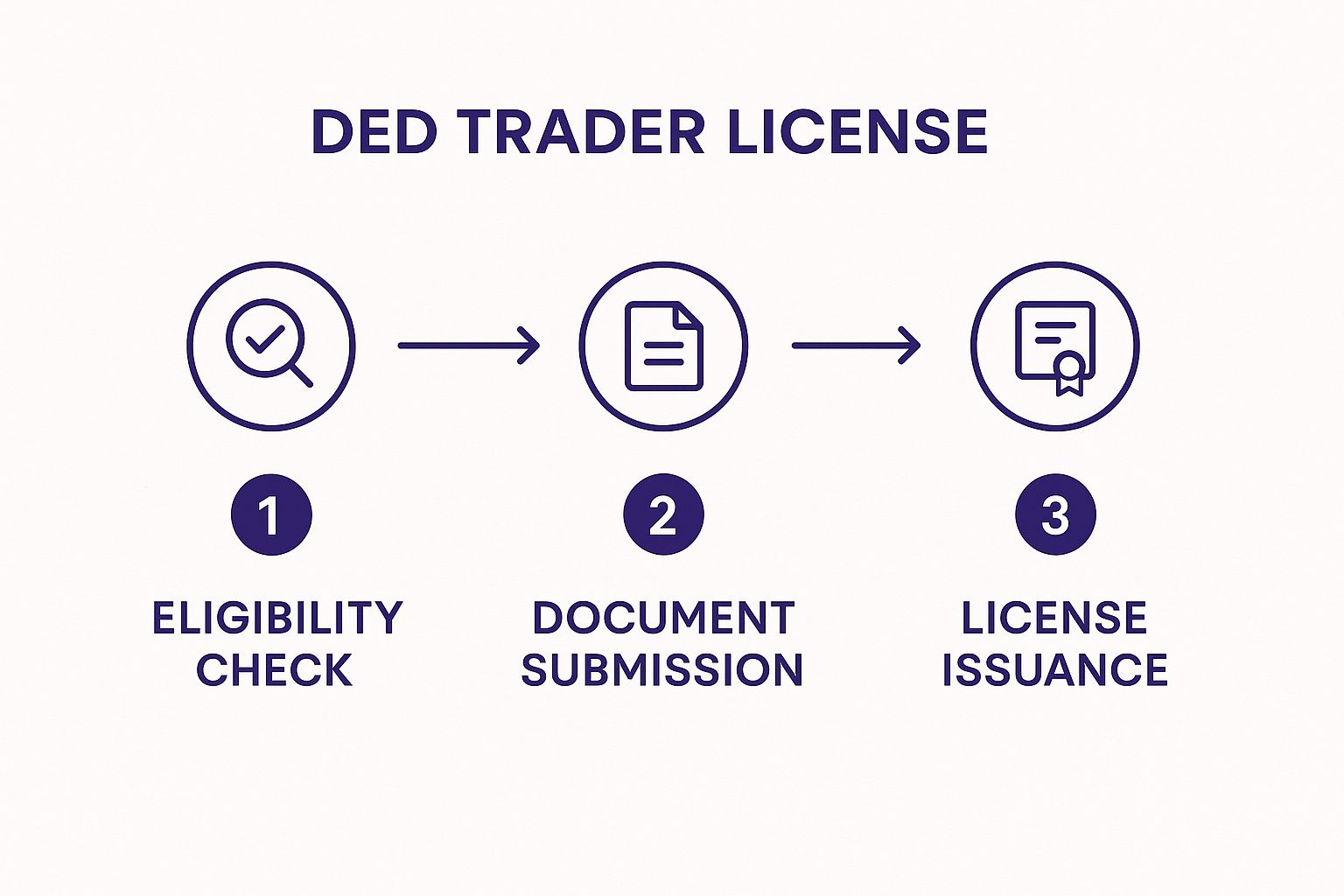
As you can see, getting all your documentation in order is the critical link between your initial approvals and finally getting that license in your hands.
Registering Your Tenancy Contract
Getting your Ejari registered is pretty straightforward, but it requires careful attention to detail. Once you’ve signed the tenancy agreement for your office space, the next immediate task is to submit it for registration.
You’ll need to have a few key documents ready:
- The original, signed tenancy contract
- Your Emirates ID and a copy of your passport
- A copy of the landlord’s passport
- A copy of the property’s title deed
You can get this done at any approved Ejari typing centre or even handle it yourself online through the official app. The fee is quite small, but the certificate you get back is invaluable for your license application.
One of the most common delays I see clients face is a mismatch between their business activity and the approved location. Before you sign any lease, it's absolutely vital to confirm with the DED that the building and the specific unit are permitted for your type of business. A retail shop, for instance, can't operate out of a unit that's only zoned for professional services.
Ensuring Your Location Is DED-Approved
This final check is a crucial piece of due diligence that can save you a world of trouble. Not every commercial property in Dubai is approved for every kind of business activity. The DED has strict zoning regulations, and if you sign a lease without checking first, you could have your license application flat-out rejected.
To avoid such a costly mistake, you can ask the building management for a No Objection Certificate (NOC) or inquire directly with the DED. As specialists in mainland company formation, we make this verification a standard part of our process for every client. We confirm the address is fully compliant before any contracts are signed, giving you peace of mind and keeping your DED trader license application moving forward smoothly.
Finalising Your Licence and Post-Setup Tasks
You’ve done the heavy lifting and now you’re on the home stretch to getting your official DED trade licence. This last phase is where all your hard work comes together. It’s the transition from having a business on paper to running a fully operational company in Dubai.
Think of this as the final package submission. You’ll need to have your Initial Approval Certificate, the notarised Memorandum of Association (MOA), and your registered Ejari tenancy contract ready to go. These documents are the proof the authorities need—they confirm your legal structure, what you’re approved to do, and where you’ll be doing it.
Submitting Documents and Settling Fees
Once your file is submitted to the Dubai Department of Economy and Tourism (DED), they’ll give it one last check. If everything is in order, you’ll be issued a payment voucher. This voucher bundles together all the government fees for your specific licence and business activities.
Paying is usually quite straightforward, with a few options available:
- Online Payment: The easiest way is often through the DED's official portal with a credit card.
- Bank Deposit: You can also do a direct transfer into the DED’s bank account.
- Authorised Service Centres: If you prefer to pay in person, you can visit an approved service centre like Tasheel or Amer.
As soon as your payment is confirmed, the big moment arrives—your official DED trade licence is issued. It's usually sent electronically, so you can download and print it right away. This is your green light to start trading in mainland Dubai.
Activating Your Business Post-Licence Issuance
Getting your licence is a huge milestone, but don't pop the champagne just yet. There are a few crucial post-setup tasks to complete before you’re truly operational. These steps are what really integrate your company into the UAE’s commercial and legal framework, letting you hire staff, open a corporate bank account, and get down to business.
First up, register with the Dubai Chamber of Commerce and Industry. This is a must for most mainland companies, especially if you plan on getting involved in international trade. It’s what allows you to get Certificates of Origin for exports and gives your business a lot more credibility.
A lot of people think the trade licence is all they need to start hiring. That's a common mistake. The Establishment Card is the real key to sponsoring employee visas and dealing with immigration.
The UAE's business community is growing at a staggering rate. By late 2024, the country had more than 1.5 million active commercial licences—a clear sign of the opportunities waiting for new businesses.
Your Company Establishment Card and Visa Processing
Next on the list is applying for your company’s Establishment Card (also called a Firm Card). This is issued by the immigration authorities (GDRFA) and officially logs your business in their system. You absolutely cannot apply for any residence visas—for yourself, partners, or staff—without it.
Once you have the Establishment Card, you can kick off the visa process, usually starting with your own investor or partner visa. After your visa is stamped in your passport, you’re free to sponsor your employees and their families, which is when you can really start building your team.
This is where having an expert on your side makes all the difference. We handle these post-licence steps every day, ensuring everything from the final payment to your visa stamping goes smoothly. With our 24/7 support, we manage the admin so you can focus on what you do best: growing your business. Once your DED Trader License is finalized and your business is operational, a key step in ensuring growth is understanding business leads and how they work.
Your DED Trader Licence Questions Answered
When you’re setting up a business in Dubai, a lot of questions pop up along the way. It’s completely normal. This last section is all about tackling the most common queries we hear from entrepreneurs who are in the exact same position you are right now.
Think of this as a final Q&A session, drawing from our team's years of experience on the ground, helping businesses get off to a flying start. Let's clear up any confusion so you can move forward with confidence.
How Long Does the Entire Process Take?
This is usually the first thing everyone asks. While there's no single magic number, you should realistically budget for a timeline of one to four weeks from start to finish.
Of course, this can shift depending on your specific business and how prepared you are. If all your documents are ready to go and your business activity doesn't need extra approvals, you'll be on the faster end of that scale.
Here are a few things that can affect the speed:
- Document Prep: Having shareholder passport copies, a few trade name ideas, and other essentials ready from day one makes a huge difference.
- External Approvals: If you're in a field like healthcare or education, you'll need a green light from other government ministries, and that naturally adds a bit more time.
- MOA Notarisation: Getting your Memorandum of Association notarised can sometimes take a couple of days just to get an appointment and finalise it.
Working with a good corporate service provider can often shave time off this process. They know how to submit a perfect application the first time, avoiding those frustrating little delays caused by errors or omissions.
Can I Get a DED Trader Licence Without an Office Space?
This is a big point of confusion, especially now that so many businesses are digital. For a standard mainland professional or commercial licence, the answer is a firm no. You absolutely need a physical, DED-approved office address with a registered Ejari.
However, there’s a specific licence called the E-Trader licence that’s designed for home-based online businesses run by individuals. It's really important to know the difference here.
A standard DED trader licence for an LLC or other mainland company is fundamentally tied to a commercial space. The E-Trader licence is a completely separate category for freelancers and social media sellers working from home, and it comes with its own set of rules and activity limits.
If your plan is to build a full-scale company, hire a team, and trade across the UAE, a physical address isn't just a suggestion—it's a requirement.
What Are the Main Differences Between a Mainland and Free Zone Licence?
Choosing between a mainland and a free zone setup is one of the first major decisions you'll make. The biggest difference boils down to where you can do business and what your ownership looks like.
| Feature | DED Mainland Licence | Free Zone Licence |
|---|---|---|
| Market Access | Trade freely anywhere in the UAE and internationally. | Limited to trading within your specific free zone or internationally. |
| Office Requirement | A physical office with an Ejari is mandatory. | Often allows for flexi-desk or virtual office setups. |
| Business Scope | You can take on government contracts and work with any client in the UAE. | To trade directly with the mainland market, you'll need a local distributor. |
| Ownership | Now offers 100% foreign ownership for most commercial and industrial activities. | The original model for 100% foreign ownership. |
For anyone who wants to serve the local Dubai and wider UAE market directly, a DED trader licence is almost always the way to go.
What Happens if I Need to Change My Business Activity Later?
Businesses grow and pivot—it happens. Luckily, the DED system is built to be flexible. You can amend your trade licence to add, remove, or completely change your business activities whenever you need to.
The process is fairly straightforward: you submit an amendment application, get any new approvals required for the new activities, and pay a modification fee. While it’s good to know you have that option, it's always smarter and cheaper to get your activities right from the outset. A bit of foresight here can save you a good amount of time and money later on.
Ready to turn your business vision into a reality in Dubai? As specialists in both Mainland and Freezone company formation across the UAE, we offer cost-effective business setup solutions tailored to your needs. Enjoy the full UAE tax benefits available to international entrepreneurs and let our experts handle the complexities of your DED trader license.
📞 Call Us Now: +971-52 923 1246
💬 WhatsApp Us Today for a Free Consultation